Social Development
 Call Kai
 Learn
Learn Practice Test
 Spaced Repetition
 Match
Match Flashcards
 Knowt Play
1/28

There's no tags or description
Looks like no tags are added yet.
Name | Mastery | Learn | Test | Matching | Spaced | Call with Kai |
|---|
No analytics yet
Send a link to your students to track their progress
29 Terms
Temperament (definition)
Biologically based levels of emotional and behavioural response to the environment that differ in reactivity and self-regulation
Temperament research (Thomas & Chess findings)
40% easy child;
10% difficult child;
15% slow-to-warm-up child;
35% unique blends
Temperament research (Kagan findings)
Temperaments can be detected in the womb;
infants may be
born shy
born bold
Temperament longitudinal findings
Some stability across early childhood;
develops and changes with age;
extreme children may become less extreme but rarely switch sides;
after age 3 more predictive of later personality
Attachment (definition)
An emotional bond that leads a person to want to be with someone else and miss them when separated
Bowlby’s theory (general)
Infants and adults are biologically predisposed to form attachments
Bowlby stage: Preattachment (0–6 weeks)
Recognise mother’s voice and features;
do not mind being left
Bowlby stage: Attachment in the making (6 weeks–8 months)
Differentiate parent and stranger;
learns that actions produce responses;
do not mind being left
Bowlby stage: Clear-cut attachment (8 months–2 years)
Attachment evident;
separation anxiety occurs
Bowlby stage: Reciprocal relationship (2+ years)
Understands parents leave and return;
separation anxiety decreases
Ainsworth Strange Situation (method)
1–2 year old in play area with parent; stranger enters; parent leaves; child’s behaviour is observed
Secure attachment (features)
60–70%;
distressed when parent leaves;
prefers parent over stranger;
seeks parent upon return
Avoidant attachment (features)
15–20%;
unresponsive to parent;
no distress when parent leaves;
reacts similarly to stranger and parent;
slow to seek parent upon return
Ambivalent attachment (features)
10–15%; seeks closeness;
distressed when parent leaves;
mixed reaction when parent returns (wants to be held but resists)
Disorganised attachment (features)
5–10%;
insecure;
confused, contradictory behaviour when parent returns
Attachment predictive validity
Controversial stability;
secure infants often remain secure;
stronger predictive validity in early childhood than adulthood
Socialisation (definition)
The process by which individuals learn the rules, conventions, and accepted norms of society
Socialisation: Reinforcement & punishment
Behaviours that lead to success are more likely to be repeated
Socialisation: Observation & modelling
Learning through imitation and observing others being rewarded or punished
Socialisation: Cognitive development
Understanding thoughts and actions; l
earning what is good/bad;
social development depends on cognitive development
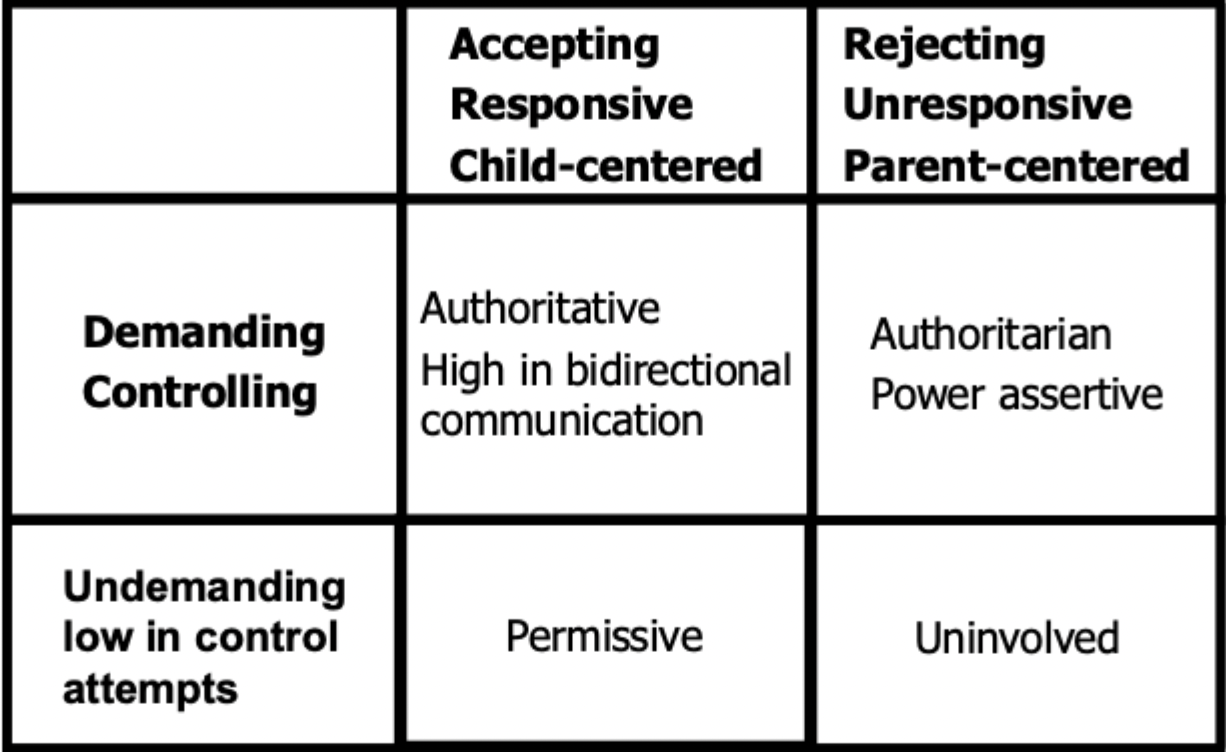
Parenting style: Authoritative
Responsive and accepting;
reasonable demands and consistent discipline;
encourages autonomy and open communication
Parenting style: Authoritarian
Rejecting or degrading;
\strict, power-assertive control;
little autonomy or discussion
Parenting style: Permissive
Warm and overindulgent;
few demands;
child makes many decisions and learns from failure
Parenting style: Uninvolved
Emotionally detached;
neglectful with few demands;
indifferent to child’s decisions and views
Parenting table
What are Bowlby’s theory of attachment
Pre-attachment (birth-6 weeks)
Attachment in the making (6 weeks-8 months)
Clear-cut (8 months-2 years)
Reciprocal relationship (2 years onward)
What are the Different types of attachment styles
Secure 60-70%
Avoidant 15-20%
Ambivalent 10-15%
Disorganised 5-10%
What are the processes involved in socialisation
Reinforcement and punishment
Observation and modelling
Cognitive development
What are the different parenting styles
Authoritative
Authoritarian
Permissive
Uninvolved