ANTH1120 M Midterm Exam Review
 Call Kai
 Learn
Learn Practice Test
 Spaced Repetition
 Match
Match Flashcards
 Knowt Play
1/16

There's no tags or description
Looks like no tags are added yet.
Name | Mastery | Learn | Test | Matching | Spaced | Call with Kai | Chat |
|---|
No analytics yet
Send a link to your students to track their progress
17 Terms
ethnocentric fallacy
the mistake of judging another culture solely by the values, standards, or beliefs of your own culture — and assuming your culture is the “normal,” “correct,” or “superior” one.
considered a fallacy because it leads to biased or flawed reasoning. Instead of trying to understand a practice in its own cultural context, a person evaluates it using their own cultural lens.

ethnographic fieldwork
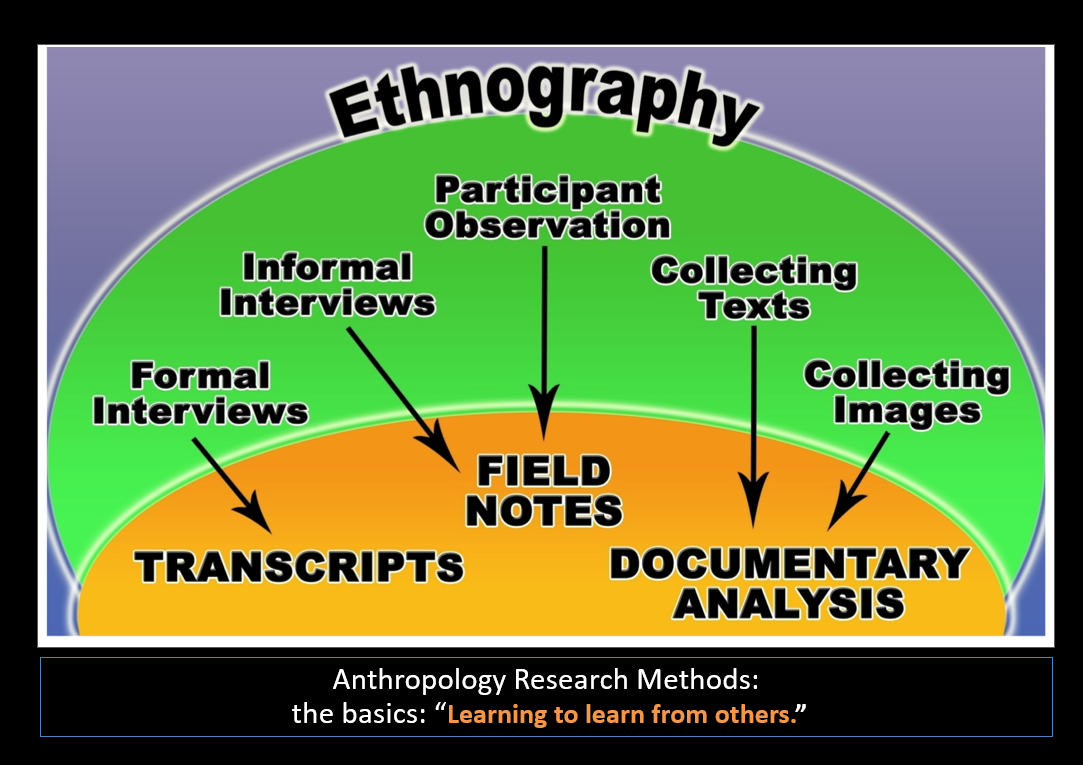
the cornerstone method of anthropology, involving long-term immersion in a community to study culture, behaviors, and social interactions from an insider's perspective
a qualitative research method involving the study of a culture-sharing group, where researchers engage with participants
a research method where a researcher studies people in their natural environment to understand their culture, behaviors, and everyday life.
goes into the community and observes or participates in daily activities.
Key features:
Participant observation
Long-term immersion
Interviews
Field notes
rather than just speculative “verandah” porch fieldwork
tacit cultural codes
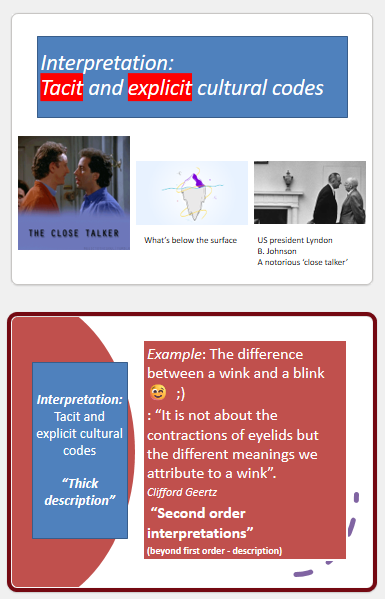
the unwritten, unspoken, and often unconscious rules, norms, and shared understandings that guide behavior, communication, and interaction within a specific group
unconscious
they are understood without being directly expressed.
principles are neither obvious to an observer, nor known explicitly by experts.
the unwritten, unspoken rules and expectations that guide how people behave in a society.
people usually don’t consciously think about them — they just “know” them from growing up in that culture.
rites of passage
culturally patterned rituals or ceremonies marking a significant, transitional change in an individual’s life status, such as birth, puberty, marriage, or death.
ceremonial event, existing in all historically known societies, that marks the passage from one social or religious status to another.
ceremonies or rituals that mark an important transition in a person’s life — usually a change in social status or identity.
metaphor
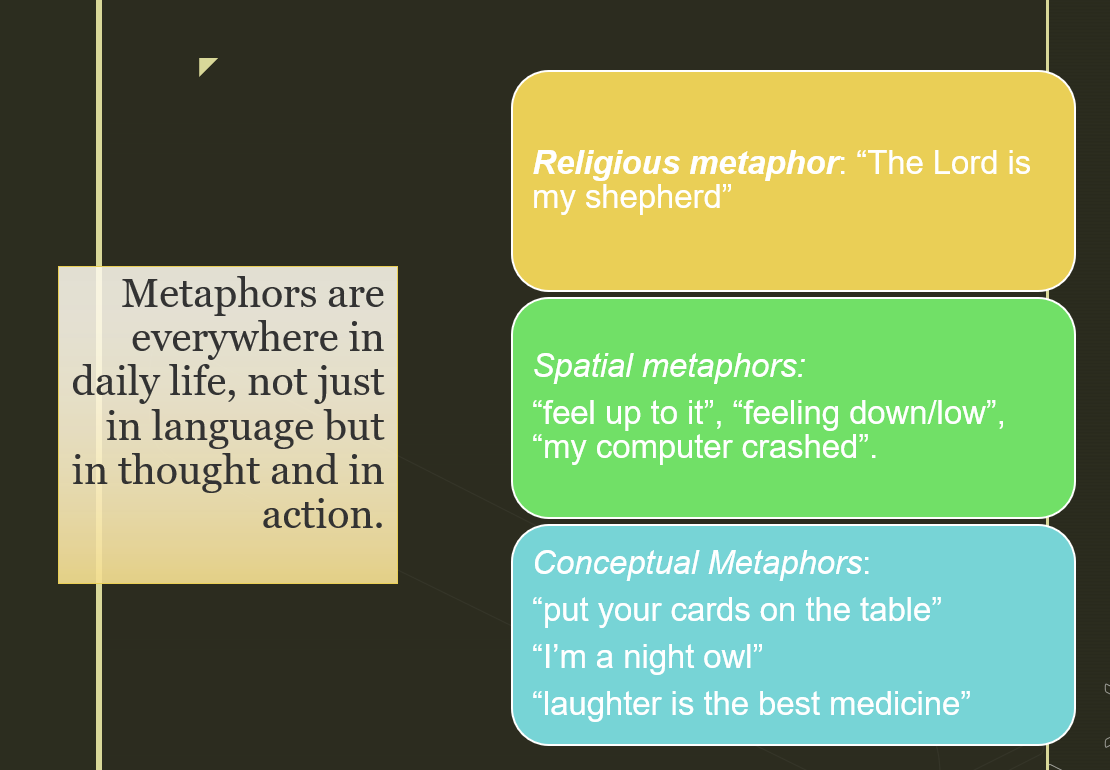
a figure of speech that directly compares two unrelated things by stating one is the other, rather than using "like" or "as".
a figure of speech where you describe one thing as if it is another thing, to show a similarity between them.
sayings used in knowledge systems in every culture across the world
ex. when pigs fly, and differing metaphors with the same meaning in various languages.
Knowledge Systems:
Metaphors and Idioms are sayings:
What can be lost in translation
revitalization movements
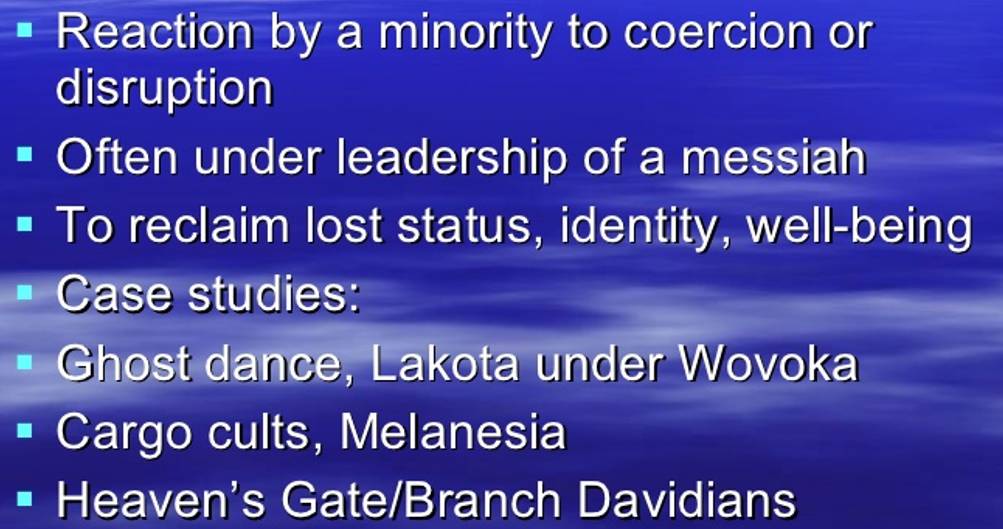
organized efforts by members of a society to reform, renew, or transform their culture — usually in response to crisis, stress, or rapid change.
often occur from; Colonization
Cultural loss
Economic hardship
Political oppression
Rapid modernization
Nativistic, revivalistic, messianic, millenarian, utopian
- Religious revival movementsNationalist movements seeking cultural restoration
Indigenous movements reclaiming language and traditions
Social reform movements
Revitalization movements are ritualized efforts to construct a more satisfying life based on an idealized past.
ex cargo cults
indigenous groups, witnessing Western military technology during WWII, developed rituals to attract the "cargo" (goods) they believed were sent by ancestors
These movements sought prosperity through mimicry of colonial behaviors.
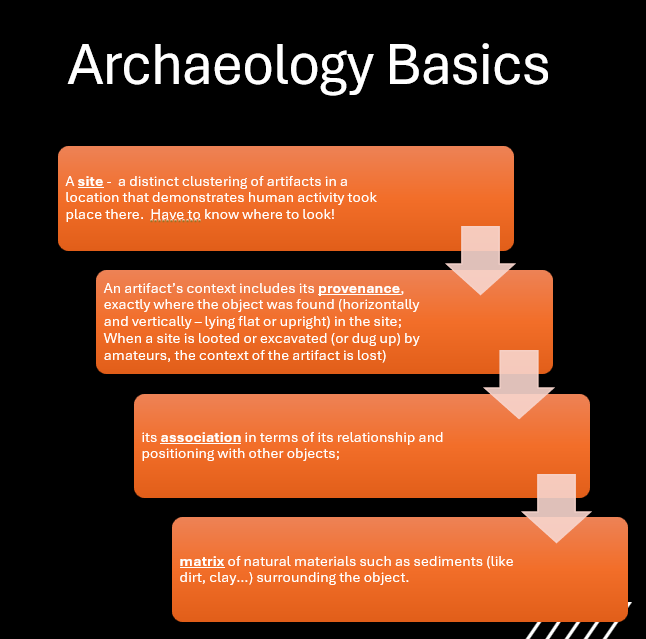
archaeological record
the comprehensive body of physical, material evidence of past human activity, including artifacts, features, ecofacts, and landscapes. It is not just the objects themselves, but their context
the collection of physical remains from the past that archaeologists study to understand ancient human life.
the physical evidence of past human activity.
Directly from lecture slides:
Archaeological Record: The material remains of past human activity, which includes sites, artifacts, food remains, and refuse, which form the database with which to study the human past.
gender stratification
the unequal distribution of wealth, power, and privilege between men and women
the unequal distribution of power, resources, and opportunities based on gender.
a socially constructed system, not biologically determined, that ranks people and limits opportunities for women and gender-non-conforming individuals.
Indigenous refusal
the act of Indigenous peoples rejecting colonial systems, narratives, or demands that try to control, define, or erase their identities and sovereignty.
a critical, proactive, and political stance where Indigenous peoples reject settler-colonial recognition, authority, and narratives. Rather than mere resistance or saying "no," it is a transformative, sovereign act focused on rebuilding, asserting self-determination, and protecting Indigenous ways of life.
not just resistance — it’s asserting sovereignty and self-determination.
but also asserting their own soveriegnty and indigenou systems of governance.
Indigenous Refusal—Refers to the rejection of imposed identities, governance structures, and socio-political norms.
It reflects a decision to create distance from state-driven forms of ‘recognition’ in favour of Indigenous meanings.
Refusal challenges the perception that colonization, elimination, and settlement are situations of the past but are rather ongoing.
Audra Simpson
origin myth
a foundational story in a culture’s tradition that explains the beginnings of the world,
often religious or spiritual, provide meaning and context for how humanity and the universe came to exist.
a traditional story that explains how something began — such as the creation of the world, a people, or cultural traditions.
Identify and briefly explain the difference between family and kinship? Provide examples
from course content to illustrate your answer. (From course content for February 12)
1. Difference Between Family and Kinship
Family refers to a specific domestic group, often the nuclear unit of parents and children, who live together and share everyday responsibilities. Kinship, however, is a broader cultural system that organizes social relationships through descent, marriage, and shared ancestry. As discussed in the February 12 lecture, kinship systems can be patrilineal (tracing descent through the father’s line) or matrilineal (tracing descent through the mother’s line), showing that relatedness is culturally structured, not just biological. Anthropologists study kinship to understand how societies track ancestry, inheritance, marriage rules, and social obligations. While a family is one small unit within this system, kinship extends outward to define belonging and social organization across generations.
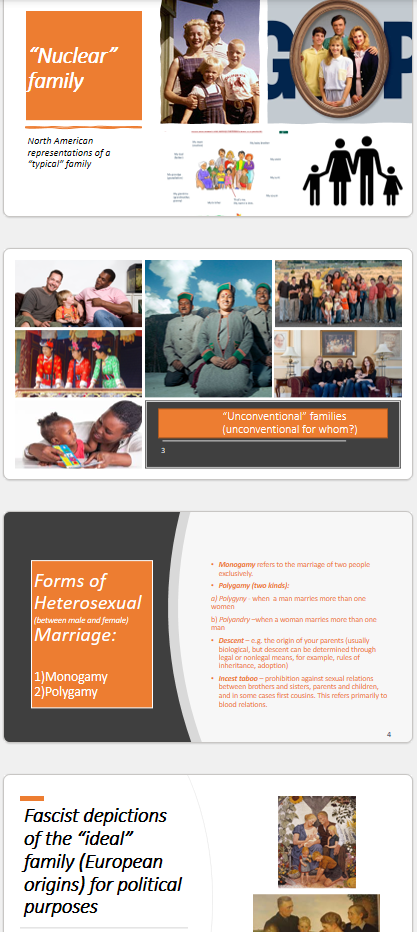
in lecture we talked about different versions of families, and the nuclear family being used as a political tool in european fascism. this unit in society. different from kinship which is organization to track descent/relation.
•Nuclear family – parents and their biological and adopted children
•Bilateral kinship – a system where children trace their descent through both of their parents
•Matrilineal kinship – a system of descent where people are related to their own kin through their mothers only
•Patrilineal kinship – a system of descent where people are related through the male line
•Extended family – a group based on blood relations of three or more generations.
•Fictive kin- family ties based neither on blood nor marriage ties . For example, ”Aunt” or “Uncle” who’s a family friend; a godparent
Identify and briefly explain two key features of Benedict Anderson’s definition of the nation.
(From course content for February 6th lecture)
2. Two Key Features of Benedict Anderson’s Definition of the Nation
Benedict Anderson defines the nation as an “imagined political community” that is imagined, limited, and sovereign (Anderson 2006). It is imagined because members will never meet most of their fellow citizens, yet they still conceive of themselves as part of a shared community. It is limited because nations have finite boundaries; beyond them exist other nations. It is sovereign because the nation emerged in an era when divine monarchies declined, and people began to see political legitimacy as resting in self-rule. Together, these features show that nations are socially constructed communities rooted in shared identity and political autonomy rather than direct personal relationships.
1. Why do you think Horace Miner chose to write about “the Nacirema”?
demonstrate how easily anthropologists — and readers — can fall into ethnocentrism.
critique of ethnocentrism and primitivising discourse
describing ordinary American practices (like brushing teeth and visiting doctors) in exotic and ritualistic language
sort of othering/primitivizing the Nacirema
he’s really showing that what appears abnormal/primitive is just unfamiliar to our culture; and the significance of description/persepective; why cultural relativism is so important in perspective
Highlighting the importance of cultural relativism, so that one does not fall into ethnocentric fallacy.
western society is not the ‘neutral’ or the ‘norm’.
how anthropology has historically portrayed non-Western societies as exotic/primitive, establishing superiority. when really practices just become normalized through attributed meaning (something we talked about in lecture)
all cultures comprise of meaningful practices that may be deemed seem strange when removed from context
critique of Western superiority, which is an ethnocentric fallacy, and a reminder of the importance of cultural relativism.
connects to theme of Othering, Nacirema are misrepresented through anthropological description; Indigenous people and other non-western groups are often misrepresented and described in ways that enforce stereotypes, through media, halloween costumes, mascots, etc.
Othering is where dominant groups define others as inferior to reinforce power hierarchies**
primitivising is displaying societies as less evolved/backwards
Western anthropologists historically described non-Western peoples as strange, backward, or uncivilized.** HISTORY of anthro
encourages readers to question how knowledge of identities, and the ‘norms’, is produced. subjects touched on in textbook
no culture is primitive
3. Is gender a biological fact? Why or why not?
anthropologically, biological sex exists, but gender is socially constructed
anthropology shows that it is largely socially constructed
through enculturation (textbook)
biological sex refers to physical
gender identity and roles are learned through socialization maintained through repeated social reinforcement.
Identity is relational
The textbook explains how from birth, children are categorized (“It’s a girl” or “It’s a boy”), given gendered clothing, toys, and expectations. These practices demonstrate that gender is reinforced through social identity and interaction, not just biology.
this shows that gender is a form of social identity, shaped by cultural norms, rather than just biology
gives the example of 4 percent of births with intersex characteristics, challenges the idea of a strict biological binary
Gender categories are socially maintained, they have cultural meaning.
Binaries are used to privilege one group or term over another creating a hierarchy of value. Gender stratification**
textbook explains that biological arguments about gender are used to justify social inequality, such as claims that women are “naturally” better nurturers
Margaret Mead’s research, which we looked at in class, strongly argues that gender is shaped by nurture rather than nature.
In Samoa, she observed that adolescent girls did not experience the same turmoil as American teenagers, challenging biological explanations of behaviour. In Papua New Guinea, Mead found that different tribes assigned very different roles to men and women. These findings suggest that gender roles vary widely across cultures and cannot be reduced to biology.
gender roles vary across societies
Margaret Mead’s research debunked the theory of nature (Charles Darwin). Identities are NOT biologically based but are learned and cultivated through socialization
Cross cultural perceptions of gender -
chukchi people of siberia
many first nation tribes include a third gender category now called "two-spirit" -
in oman, there is a third gender called the xanith. -
Japanese Wakashu
Katheoy in Southeast Asia
Two Spirit,
third, fourth and fluid gender roles, Anishinaabemowin language niizh manitoag
4. Discuss the ways in which the documentary Your House was my Home, addresses nationalist
policies and practices of forced displacement.
Your House Was My Home explains how nationalism can lead to ethnic cleansing and forced population exchange.
After the breakup of Yugoslavia in 1992, Serbs and Croats, minority groups, were pressured to swap homes under the label of “humane relocation.”
It was actually forced displacement forced by the nationalists, nationalist ideology.
Once nationalist governments came to power, minorities were no longer considered to belong within the imagined nation.
long-term, devastating, disruptful, traumatic effects on the people whose homes were forcibly exchanged.
This reflects a concept we learned in the course, Benedict Anderson’s concept of the “imagined community,” where national identity depends on perceived cultural unity. Those who did not fit the nationalist identity became targets of actually violence.
The film illustrates how nationalist rhetoric can escalate into ethnic cleansing, which we learned about in lecture, where populations are removed to create ethnically homogeneous territories. This homogenouity is referenced in the textbook.
Lecture discussions emphasized that genocide and ethnic cleansing are extreme outcomes of nationalist project
According to lecture relevant to the film
******The formation of the nation-state is fundamentally tied to force, violence and conflict.
State-sponsored violence often includes actions other than killing:
categories of people identified as “terrorists”, “insurgents”, “rebels”, “illegal migrants”, “refugees”, “immigrants”, etc.
Ethnic cleansing is the forced removal or expulsion by all means possible of an ethnically or religiously different group from a territory, with the ultimate aim to expel or eliminate altogether.
The documentary uses personal stories to show the devastating long-term effects of displacement. Goran
Trlaić, who left Kula for Hrtkovci in 1992, and Stjepan Roland, who left Hrtkovci for Kula
A series of threats and violent incidents started a chain reaction of exchanging properties. It was actually a method of forced population exchange.
nationalism is not just symbolic identity formation but can produce material, financial, physical, traumatic suffering.
5. According to Mackey, what is the place of Indigenous peoples in the national narrative of Canada?
According to Eva Mackey, Indigenous peoples occupy a contradictory place within Canada’s national narrative.
included symbolically as part of a romanticized “glorious past,” but excluded from the category of “real Canadians.”
the “real Canadians” are considered the Euro/anglo westernized people, descended from settlers
Indigenous peoples portrayed as part of nature or as helpers to European settlers. European settlers are represented as more innocent and colonial violence is minimized. The lecture example of the peaceful mountee and the Indigenous chief guide.
Mackey argues that nationalism depends on mythological narratives of unity, where Canada is imagined as progressing from past to future.
Indigenous presence becomes symbolic rather than political.**
According to Mackey,, In settler narratives about the creation of the Canadian nation, Indigenous peoples play the role of helpful “children” who join with the “adult” Euro-Canadians in bringing prosperity to the land.
This kind of subdues the history of residential schools and treaty violations.
Mackey critiques Canadian multiculturalism, which celebrates diversity but produces a core group of “Canadian Canadians.” Euro westernized
Indigenous peoples are not treated as founding nations with sovereignty. Instead as one other ethnic group within the mosaic.
Western Canadian Eurocentric National culture is framed as a complete way of life. Meanwhile minority cultures are reduced to fragments, the culture is defined by like food, festivals, or folklore. Indigenous culture included. Those “other” cultures are not considered “real Canadians”
Her stance is Indigenous peoples are foundational to Canada’s history yet marginalized/excluded fully/accurately from in its national identity.**
This connects to lecture themes about Othering and state power,
connects to the textbook about education as a tool used by the state to facilitate the nation state/national identity. This relates to residential schools. This relates to the gentler version of history childen learn in Canadian schools about Inidgenous peoples
According to Mackey, The history that children read in Canadian public schools describes Canada as much kinder to Indigenous peoples than the United States was to the Native American population, but even in this gentle version of history, “real Canadians are, by definition, not ‘Native’ or not from those ‘other cultures’ ”