Respiratory System Disorders Intro
 Call Kai
 Learn
Learn Practice Test
 Spaced Repetition
 Match
Match Flashcards
 Knowt Play
1/20

There's no tags or description
Looks like no tags are added yet.
Name | Mastery | Learn | Test | Matching | Spaced | Call with Kai |
|---|
No analytics yet
Send a link to your students to track their progress
21 Terms
What do the variables V and Q represent in the V/Q ratio?
V represents ventilation (airflow to alveoli) and Q represents perfusion (blood flow past alveoli).
What is the normal V/Q ratio?
Approximately 0.8.
Which gas is more soluble, O2 or CO2?
CO2 is 20 times more soluble than O2.
What conditions impair gas diffusion across the alveolar-capillary membrane?
Thickened membranes (fibrosis) or the presence of fluid (edema).
What does a high V/Q ratio (dead space) indicate?
Ventilation is occurring, but perfusion is absent or reduced.
What are common clinical causes of a high V/Q ratio (dead space)?
Pulmonary embolism and emphysema.
What does a low V/Q ratio (shunt) indicate?
Perfusion is occurring, but ventilation is absent or reduced.
What are common clinical causes of a low V/Q ratio (shunt)?
Pneumonia, atelectasis, and pulmonary edema.
What is the earliest clinical sign of hypoxia?
Mental status changes.
At what PaO2 level does oxygen saturation (SpO2) begin to fall steeply?
Below 60 mmHg.
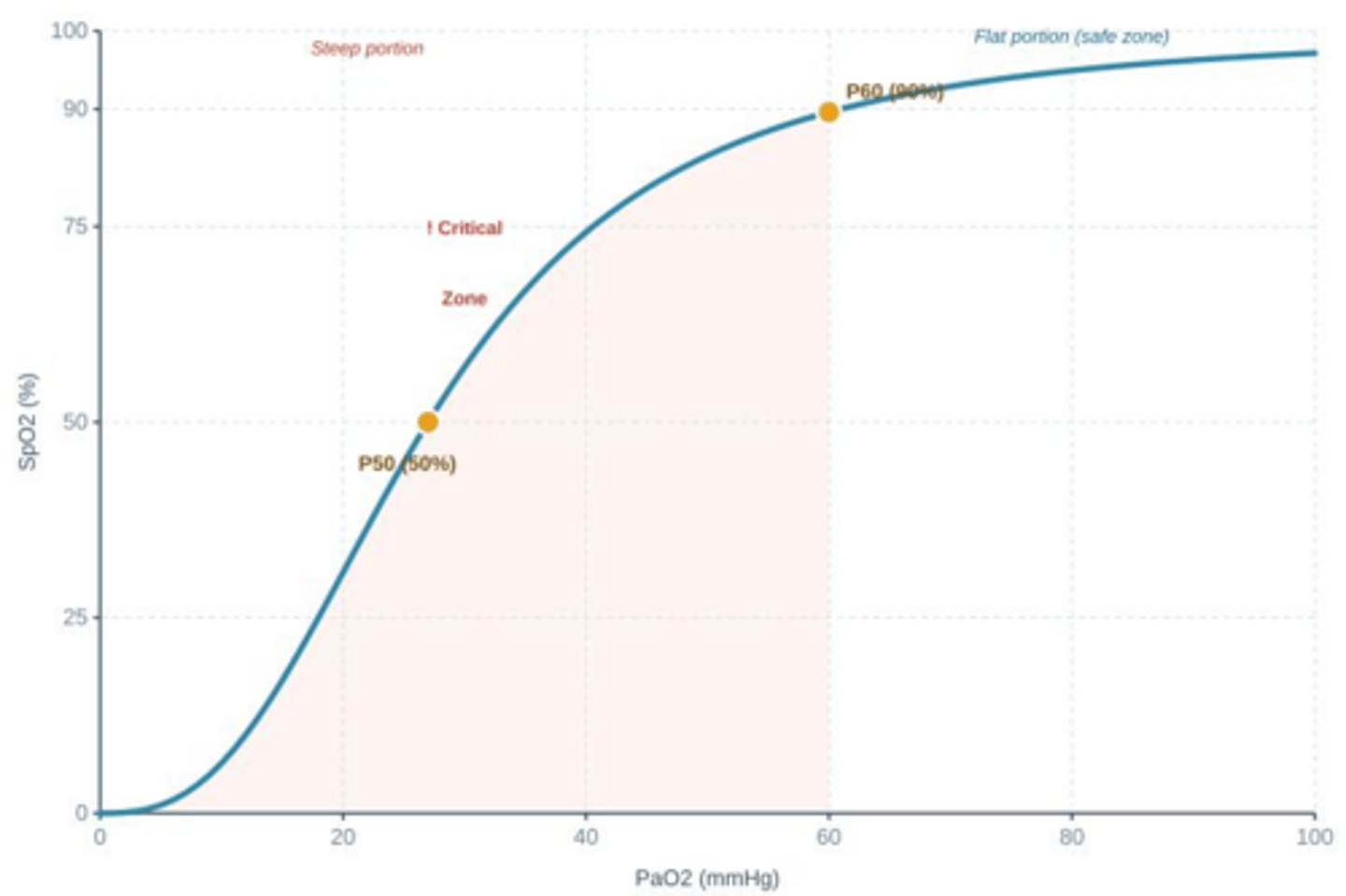
What does a right shift in the oxyhemoglobin dissociation curve indicate?
Increased oxygen release to the tissues.
What factors cause a right shift in the oxyhemoglobin dissociation curve (CADET mnemonic)?
CO2 increase, Acidosis, DPG increase, Exercise, and Temperature increase.
Why is pulse oximetry unreliable in carbon monoxide (CO) poisoning?
Pulse oximetry provides a falsely normal reading; co-oximetry via ABG is required.
What is the normal pH range for arterial blood?
7.35 to 7.45.
In ABG interpretation, what does it mean if pH and PaCO2 move in opposite directions?
The primary acid-base disturbance is respiratory.
In ABG interpretation, what does it mean if pH and HCO3- move in the same direction?
The primary acid-base disturbance is metabolic.
What is the target SpO2 range for patients with COPD?
88% to 92%.
What is the target SpO2 range for most patients (excluding COPD)?
95% or greater.
How is full compensation defined in ABG analysis?
The pH returns to the normal range (7.35-7.45) despite abnormal PaCO2 or HCO3- values.
What is the V/Q ratio in a complete shunt?
0.
What is the V/Q ratio in dead space?
Infinity (∞).