Biology mi
 Call Kai
 Learn
Learn Practice Test
 Spaced Repetition
 Match
Match Flashcards
1/126

Earn XP
Description and Tags
t
Name | Mastery | Learn | Test | Matching | Spaced | Call with Kai |
|---|

127 Terms
p1 2024: Which blood vessels affected by coronary heart disease?
Arteries
Why put pressure on heart?
Pushes blood to get oxygen aruond the body
Why does air in lungs help
provides oxygen for respiration

What drug reduces cholesterol?
statins
Explain how a stent works to treat coronary heart disease.
stent widens blocked blood vessel to allow more blood to flow
Describe lifestyle factor that can increase the risk of cardiovascular disease.
smoking
poor diet
Lack of exercise
Where in a cell are genes found?
NUclues

What are the features of the alveoli that help maximise gas exchange?
large surface area
good blood supply
walls one cell thick
Explain how a reduced amount of oxygen entering the blood will affect the human body.
less aerobic respiration
so less energy released
so less muscle contraction
Explain why the bread tasted sweet.
bread contains starch
starch broken down into sugar
by amlyase in saliva
What strengthes xylem tissue?
lignin, cellulose
Explain how sub-cellular structures help to move dissolved sugars from cell X into the phloem cell.
cell x has mitochondria for aerobic respiration
which releases energy
energy needed to move sugar against the concentration gradient
by active transport
Explain the result for the mass of potato pieces decreasing
lost mass because water left potato
because the solution in potato is less concentrated than outside
Water left cells by osmosis
Why is there a larger decrease in mass the more concentrated the salt solution?
lost more mass because more water left cells
because there is a steeper concentration gradient
Name an antibiotic
penicillin
0 6 . 3 Suggest why doctors are concerned about antibiotic resistance.
current antibiotics do not kill certain bacteria
diseases become more common
new antibiotics need to be developed which takes time/money
0 6 . 4 Suggest why viruses cannot be grown on agar.
viruses only reproduce and live inside living cells
0 6 . 5 Why is it difficult for scientists to develop drugs to destroy viruses?
drugs can damage body cells
hard to get these drugs into living cells
0 7 . 4 Which ion is deficient in a plant with yellow leaves?
magnesium, chlorosis
How could the oxygen produced during photosynthesis be used to measure the rate of photosynthesis?
count the number of bubbles produced in a given time

What is meant by a ‘limiting factor’?
(a factor that) if increased would increase the rate (of a reaction)
Explain increasing temperature and co2 concentration on photosynthesis
increasing temperature while keeping the carbon dioxide (concentration) constant increases the rate (of photosynthesis)
increasing the temperature increases the movement of the molecules i
increasing carbon dioxide concentration increases (the concentration of) substrate
all rates plateau at a certain point due to another factor being limiting
Describe one other change that occurs in a cell before the cell begins to divide. in
Dna replicates to form 2 copies of each chromosome
INcrease in number of ribosomes, mitochondria, sub-cellular structures
box 0 8 . 5 Give the reason why a drug that stops cell division helps to treat cancer.
tumour cannot proliferate, stops metastasis
What is involved in preclinical testing of drugs?
testing the drugs on live tissues in a laboratory

0 1 . 1 What is a tissue?
a group of cells with a (similar / specific) function
Name the type of tissue in plants that contains stem cells.
meristem
Which plant does aspirin originate from?
WILLOW
0 1 . 6 Suggest one reason why the leaves of the deadly nightshade plant have chlorosis.
lack of chlorophyll, lack of magnesium ions
It is important for drugs to be tested in clinical trials before the drugs are approved for use by the public. why?
to check toxicity, dosage and efficiacy
Suggest one reason why a report making claims about the effects of chemical A may be biased.
companies get financial gain
competitor may suffer financial loss
Where in the heart is the pacemaker found?
Right atrium
Describe two ways that the structure of an artery is different from the structure of a vein
• (artery) has a thicker muscle (tissue)
• (artery) has a thicker elastic (tissue)
• (artery) has a narrower lumen
• (artery) does not contain valves
Explain the effect of a partly blocked coronary artery on the human body.
• reduced blood flow to heart (muscle / tissue / cells)
• (so) less oxygen to heart (muscle / tissue / cells)
• (so) less glucose to heart (muscle / tissue / cells)
• (so) less (aerobic) respiration (in heart / body cells
) • (more) anaerobic respiration
• (so) less energy (released)
• (so) less muscle contraction
• (so) less blood / oxygen / glucose around the body (from heart)
• less carbon dioxide removed from body (muscle / tissue / cells)
• (resulting in) breathlessness
• (resulting in) tiredness
• (anaerobic respiration causes) production of lactic acid
• (build-up of lactic acid) causes muscle fatigue or chest pain
Explain how one treatment for a blockage in a coronary artery works.
• (insert) stent(s) (to) open (coronary) artery
• (prescribe) statins to reduce (blood) cholesterol
) • heart (and lung) transplant (to) replace the diseased heart with a healthy heart (1)
• use an artificial heart (to) keep the patient alive while waiting for a transplant (1)
• (artery / heart) bypass (to) divert blood around the blockage (1)
0 3 . 1 How do Salmonella bacteria in food cause the symptoms of vomiting and diarrhoea?
bacteria release / produce toxins
Describe two aseptic techniques the scientists should have used in the investigation
disinfect hands / work surface
• sterilise Petri dish or culture medium (before use)
• pass inoculating loop / forceps through a flame (before use)
• work near a flame or work in a fume cupboard
• tilt lid (of Petri dish) when placing discs on agar (to minimise contact with air / breath)
• secure lid of Petri dish with adhesive tape
Explain why scientists use 37 °C but students must use 25 °C to incubate bacteria.
37 °C is body temperature
Salmonella grows / better at 37 °C
25 °C reduces / prevents the growth of bacteria that are harmful to humans / students
how do you quantitatevely comprare the effectiveness of antibiotics?
measure the diameter / radius of each clear area or calculate / measure the area of each clear area
Explain why the cells burst.
water enters the (bacterial) cell by osmosis (so) damaged cell wall cannot withstand pressure (of water)
Explain two effects of anaerobic respiration on the person’s body.
muscle fatigue or oxygen debt occurs caused by (build-up of) lactic acid
deep / fast breathing to provide the oxygen needed to break down (built-up) lactic acid
increased heart rate to provide the oxygen needed to break down lactic acid
weaker muscle contractions because less energy is released / available
0 4 . 3 Explain how taking anabolic steroids could improve an athlete’s performance, increase muscle mass in humans
athlete is) faster / stronger (because more muscle mass so) more / stronger muscle contractions
Describe how scientists make monoclonal antibodies using the cell created when a mouse lymphocyte and a tumour cell combine.
(cell) is cloned
• many (identical) cells are produced
• all the cells make the same antibody
• the antibody is (collected and) purified
0 4 . 7 Suggest the purpose of the control area in the test strip.
to show that the test is working, prevent false negatives
Describe three ways the structure of the malarial protist is different from the structure of a prokaryotic cell.(eukaryote(
protist / it has mitochondria
• protist / it has (a) nucleus or protist DNA
• protist / it does not have a single loop of DNA /
• protist / it does not have plasmids
• protist / it does not have a cell wall
box 0 5 . 6 Describe the process of cell division by mitosis.
(after DNA replication) one set of chromosomes is pulled to each end of the cell
nucleus divides cytoplasm divides to form two cells
p2 2024: what is a mutation?
a change in: • DNA
0 1 . 2 Describe the process of natural selection.
7 steps

explain how low oxygen and pH lead to decay
lack of oxygen for respiration so less energy (released) (for) microorganisms
low pH denatures enzymes (so) no (chemical) reactions in microorganisms
Explain how the destruction of peat bogs and the use of peat affects the temperature of the Earth’s atmosphere.
increase in temperature because carbon dioxide is released
(because) carbon dioxide is produced by burning off peat (because) methane is released
0 4 . 7 Give two uses of auxin.
weed killers
• rooting (powders)
• (promoting) growth in tissue culture
Suggest two reasons why the farmer sprayed the apple tree with gibberellin.
promote flowering
• more fruit
• bigger fruits
Give two ways that coordination by the endocrine system is different from coordination by the nervous system
(hormones) via blood
• chemical transmission
• slower •
longer-lasting
Describe two effects of adrenaline on the human body.
• increases heart rate
• increases breathing rate
• increases oxygen delivery to cells
• increases glucose delivery to cells
• increases respiration / metabolism
• increases sweat(ing
Explain the use of hormones in: • contraception
use of hormones oestrogen and progesterone or progesterone (only)
o inhibition of FSH
- lack of FSH prevents follicle development / maturation
- therefore there is no egg to fertilise
o inhibition of LH (production / release)
lack of LH prevents ovulation
therefore there is no egg to fertilise
• contraceptive methods include oral contraceptive pill, injection, implant, skin patch, IUD / IUS with hormone
explain how hormones are used in the treatment of infertility
use of FSH
o (FSH) stimulates maturation of follicle(s)
- (FSH) increases number of eggs matured
• use of LH
o (LH) stimulates ovulation -
(LH) allows eggs to be collected (from ovary
) - (so) increased chance of fertilising an egg
- IVF and insertion of embryo(s) into uterus
• use of progesterone
o (to) maintain uterus lining - increased chance of implantation
0 6 . 1 What is a dominant allele?
(an allele) that is always expressed
What happens to the remaining 20% of the biomass in the maize seeds?
lost by egestion(faeces)
0 8 . 1 Explain what is meant by the term ‘homeostasis’.
maintenance of internal conditions for optimum conditions for cell(s) / enzyme(s) (activity)
Describe what happens to glucose, protein and urea in the kidneys.
glucose and urea are filtered (out of the blood) protein is not filtered (out of the blood)
all glucose reabsorbed
urea (mostly) not reabsorbed
box 0 8 . 3 Explain how ADH affects the production and concentration of urine by the kidneys.
high) ADH increases permeability to water (water reabsorption) from kidney tubules (so) ADH increases the concentration (of urine) (so) ADH decreases the volume (of urine)
Suggest two reasons why some people are concerned about the use of GM soya bean plants.
do not know effects on animals / humans (when eaten)
• gene / allele may be transferred to other (wild) plants
• reduce biodiversity
May affect flavor

0 2 . 4 What happens to the shape of the lens when focusing on a near object?
becomes fatter, thicker, wider
Describe how muscles in the iris help the person to see clearly when moving from a dimly-lit area to a brightly-lit area
muscles in the iris) contract • reduce size of pupil • reduces (amount of) light entering
0 3 . 1 Suggest one advantage of growing tomato plants that are genetically different.
• variation of a named / described (desirable) characteristic
• not all susceptible to the same disease / pathogen
• maintain / increase gene pool
0 3 . 2 Suggest one advantage of growing tomato plants that are genetically identical.
they have the same named characteritsics
• they grow at the same rate
• they ready to harvest at same time
What is tissue culture?
a group of cells are grown into a new organism
Describe how selective breeding of chicken varieties A and B can produce the new variety of chicke
breed best of A and B (together)
select offspring with highest egg numbers and heaviest / fastest growing
breed (these) offspring together
repeat over many / several generations
Describe how carbon and nitrogen in compounds in the leaves are recycled and used by living trees.
• microorganisms (cause decay)
• (named) enzyme used in decay
• digestion or large molecules to small molecules
• respiration by microorganisms
• production
• carbon dioxide is released into the air
• carbon dioxide taken in by stomata / leaves
• carbon dioxide used in photosynthesis
• making glucose / sugar / starch / cellulose / other named example • release of nitrate (ions) into the soil
• nitrate (ions) taken in (by roots) • nitrate (ions) taken in by active transport • nitrate (ions) for making amino acids / proteins / DNA / other named example
Explain why the pH changes more quickly when the temperature is higher.
enzymes more active or more bacteria produced
lipids broken down more quickly fatty acids produced more quickly (which changes pH)
Explain how the concentration of substance Q in the blood is controlled by negative feedback
if (concentration of substance) Q becomes high
(hormone) A is released / used
if (concentration of substance) Q becomes low
(hormone) B is released / used
hormone(s) / A / B brings (concentration of) substance Q back to ideal / normal
Explain how the production of thyroxine causes an increase in body temperature.
increases (basal) metabolic rate
respiration releases energy
Explain how the decrease in the concentration of ADH would cause DECREASE IN RATE OF URINE PRODUCTION
(kidney) tubules less permeable to water (so) less water is reabsorbed (so) more water in urine
causing increased rate of production (of urine)
(so) more water in urine causing lower concentration of dissolved substances (in urine)

Give two reasons why an increase in the diversity of trees in the rainforest leads to an increase in animal diversity
different types of food available
more / different types of habitat / shelter available
0 8 . 3 Explain why the change in the number of chromosomes is important in meiosis
(meiosis) forms gametes
(two gametes) fuse / fertilise
(so) keeps chromosome number constant (from generation to generation)
Describe how meiosis produces cells that are genetically different.
random chromosome from each pair (of chromosomes) moves to one end of the cell
p1 2022: What is the function of chloroplasts?
photosynthesis
Describe how mitosis produces two genetically identical cells.
chromosomes is doubled
the (replicated) chromosomes are pulled apart
cytoplasm divides into two (cells)
cell membrane divides to form two cells the set of chromosomes in each new cell are identical (to one another)
0 5 . 2 Describe two differences between the transpiration stream and translocation.
transpiration (stream) involves xylem and translocation involves phloem
• transpiration (stream) transports water (and minerals / ions) and translocation transports (dissolved) sugars
• transpiration (stream) moves substances upwards and translocation moves substances upwards and downwards
The changes in the mean width of the stomata in normal conditions are an advantage to the plant. Explain how
stomata (almost) closed at (mid)night because there is less light for photosynthesis
(closing stomata) reduces water loss
stomata open wide(st) at midday as maximum light intensity for photosynthesis (stomata open wide) to take in more carbon dioxide for photosynthesis

Describe how the alveoli and the villi are adapted to increase absorption.
both have a large surface area
o to maximise diffusion
• both have thin walls or have walls that are one cell thick
o to reduce diffusion distance / time
• both are in close proximity to blood supply
o to reduce diffusion distance / time
• both have a good blood supply or both have a capillary network
o to maintain concentration gradient
• villi have microvilli
o to (further) increase surface area
• cells of villi contain many mitochondria
o for active transport
0 7 . 6 Explain how a vaccine for HIV could work to prevent a person developing
inactive HIV / virus is injected (into bloodstream / muscle / body)
white bloods cells produce antibodies (against inactive virus)
(if infected with HIV)
pecific antibodies are produced quickly antibodies destroy the (active) virus
Suggest how the monoclonal antibody for HIV helps to prevent a person infected with HIV developing AIDS.
monoclonal antibody is complementary / specific to HIV antigen
monoclonal antibodies attach to (all the) HIV antigens
(so) HIV cannot bind to (human) cell
p2 2022: box 0 3 . 2 Explain the effect a high concentration of insulin has on blood glucose concentration.
effect : lowered explanation: glucose taken in by cells
Give two ways that a person can reduce the chance of developing Type 2 diabetes.
(more) exercise eat less carbohydrate / sugar
Name one harmful substance that could cause air pollution.
carbon dioxide or acidic gas
Name three harmful substances that could cause water pollution
fertiliser • sewage • toxic chemicals • herbicide • fungicide
Describe how substances that pollute air and water could be harmful to humans and other living organisms.
air pollution: (carbon dioxide or methane or greenhouse gases)
• global warming traps heat
o floods / fire / drought or ice caps melt or rise in sea level or extreme weather
o loss of habitat / food
o migration
• damage to leaves so less photosynthesis
• damage to roots or alters ions in soil (/ e.g. phosphates / iron)
o (so) less protein manufacture
• damage to lungs o breathing difficulties(carbon monoxide)
• combines with haemoglobin
o less oxygen carried (by haemoglobin / blood)
(particulates / ‘soot’)
• cover leaves or block light
o less photosynthesis so less glucose made
• damage to lungs
o breathing difficulties
water pollution: (sewage)
• bacteria multiply
o use oxygen in respiration
o water animals cannot respire
o pathogens in water (fertiliser)
• algae multiply
o (algae) block light so plants cannot photosynthesise
o lack of oxygen for respiration – fish die
(toxic substances) • damages / harms cells or bioaccumulation
o interferes with metabolism – e.g. respiration
• entrap animals or causing internal damage if swallowed (particles)
• block light
o plants / algae cannot photosynthesise so less glucose made (oil)
• damages birds’ feathers
o cannot fly so cannot find food or escape predators (acid rain / acids)
• lowers pH of water o damages fish gills o bleaches cora
0 6 . 3 Give two uses of water in plants.
photosynthesis • support • (solvent for) transport
Explain how the dilation of blood vessels in the skin can help to decrease body temperature
more blood flow to the skin
(so) more heat / energy is lost (from the blood)
cools blood which cools the body

Explain how the nitrate ions in Figure 4 are transported into the root hair cell.
active transport (because) energy is needed (to move nitrate ions) from a low(er) concentration (in the soil) to a high(er) concentration
0 3 . 6 Describe what happens during each stage of the cell cycle.
(stage 1) DNA / chromosomes replicate
mitochondria / ribosomes increase in number
stage 2:
one set of chromosomes ismoved to each end of the cell
(stage 3) the cytoplasm and cell membrane divides (to form two cells)
0 4 . 2 Explain the ‘lock and key theory’ of enzyme action.
enzyme binds to the substrate because they are complementary (shapes) (so) substrate is broken down (into products) (so) products are released or enzyme is not changed
Why does each different type of lipase act on only one specific type of lipid molecule?
each active site has a specific shape (so only fits one type of lipid molecule)
Explain two other possible reasons for the yellow leaves and stunted growth.
`4213412341234
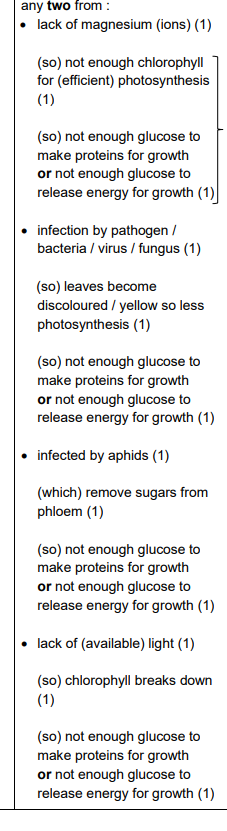
Describe the effects of liver failure on the human body.
• no bile made (in the liver)
o fats / lipids are not emulsified
o surface area of fats / lipids not increased
o pH of small intestine will not be alkaline / neutralised
o enzymes (in small intestine) will not work effectively or (named) food not digested / absorbed
o so may lose weight
• lactic acid not broken down / oxidised
o accumulation of lactic acid in blood / body
o lactic acid is toxic or body will be poisoned o oxygen debt higher / prolonged
o so muscle pain / fatigue
• proteins / amino acids will not be broken down (in liver)
o (amino acids) not deaminated
o amino acids not made into urea or will not form ammonia
o (however) any ammonia formed is toxic o so accumulation of amino acids in blood / body
• liver does not break down / remove other toxins (like alcohol)
o toxins accumulate in blood / body \
o body will be poisoned
o so pain or jaundice or swollen liver or portal hypertension occurs
• glycogen stores will not be formed
o cannot control blood glucose o so hyperglycaemia / hypoglycaemia / diabetes / coma may occu p1 2020
p2 2021 What type of substance does a gene code for?
protein
Explain why the temperature near the brain decreased when ice cold water waes drunk
blood is cooled at stomach / mouth (cooled) blood flows to the brain

Describe:
• how microorganisms in the layers of soil help to recycle chemicals in the dead plants
• how the chemicals are used again by living plants.
in microorganisms
• digestion or large molecules to small molecules
• enzymes or named example
• respiration
• production of carbon dioxide
• release of mineral ions or named example such as nitrate / phosphate / magnesium in plants
• carbon dioxide (from air) taken in by leaves
• by diffusion
• via stomata
• carbon dioxide used in photosynthesis
• making glucose / sugar / starch / cellulose or making other correctly named example
• (named) ions taken in by roots
• by active transport
• nitrate ions for making amino acids / proteins / DNA / chlorophyll
• phosphate for making DNA
0 6 . 1 What is meant by the term ‘reflex action’?
response / reaction automatic or no thinking or not conscious or involuntary