B.2.1 Newton's Laws of Motion
 Call Kai
 Learn
Learn Practice Test
 Spaced Repetition
 Match
Match Flashcards
 Knowt Play
1/15

Earn XP
Description and Tags
Adapted from class notes.
Name | Mastery | Learn | Test | Matching | Spaced | Call with Kai |
|---|
No analytics yet
Send a link to your students to track their progress
16 Terms
Newton’s Laws
Newton’s laws are the primary governing laws of classical physics that determine the general movement of objects through space
Force, Power, Velocity, and energy are specifically defined terms
Kinematics
Kinematics is the study of motion
Motion can be:
Linear - In one-dimensional space (someone running, a ball rolling)
Curvilinear - In two-dimensional space, up/down AND forward/back (a ball thrown)
Angular - Around an axis in a circular motion (a lever, or a gymnast on a bar)
General - Some combination of linear and angular
Measurements and Position
Scalar vs. Vector
Vector - A measurement with a size and direction (10 m/s north)
Direction matters! 10 m/s + 10 m/s doesn’t always equal 20 m/s, it could be 0 because the directions cancel out (10 m/s left + 10 m/s right), or anything in between taking angles into consideration
Scalar - A measurement with a size but not direction (10 kg)
Position - Measured with coordinates, a measure of distance from some origin along two or three axes (horizontal, vertical, lateral)
Linear - Displacement/Distance
Distance - How far an object has traveled. Path matters! Symbol is typically “d”
Displacement - How far from the origin. Path does not matter. Symbol is typically “s”
Ex. I walk to my friend’s house. In a straight line, that is 2 km away. But I wander a bit, and end up walking 5km. My displacement is 2km, but I traveled 5km
Linear - Velocity
Velocity - Change in displacement over time with size and direction (vector)
v = s/t
Speed is the size of the velocity, but without direction (scalar)
Units are m/s or ms-1
Ex. I run a 100m race in 20 seconds. Best time! I had an average velocity of 100m/20s = 5 m/s. This means that I moved about 5 meters every 1 second
Linear - Acceleration
Acceleration - Change in velocity over time with size and direction (vector)
a - v/t = (v-u)/t when v is final velocity and u is initial velocity
Units are m/s/s or ms-2
Ex. The beginning of my 100m race I started from stop, and reached a maximum velocity of 6 m/s in 3 seconds. During this time I accelerated at 2 m/s/s. Meaning that every second, my velocity increased by 2 m/s
Angular Kinematics
Deals with rotation around an axis (like a joint)
Examples of rotation in sports/exercise
A spinning ball pitched in baseball
A flip turn in swimming
A golf club swinging
A gymnast spinning on the uneven bars
A dancer twirling
A cartwheel
Many joint movements (bicep curls for example)
Angular - Displacement and Velocity
Angular displacement is the angular movement around an axis. Symbols is theta. Measured ind egrees or radians
Flexing the elbow would yield a displacement ~150 degrees (depending on ROM)
Angular velocity is the rate at which angular displacement happens. Represented with the letter omega. Measured in degrees/s, degrees s-1, rad/s, rads-1
Omega = theta/t but also, v = omega times r where r is the radius of the circle made by some object moving with the angular velocity of omega (in rad/s) and v is the linear velocity (in m/s) that it would be moving
Also can be represented as v = 2pir/T where r is the radius and T is the time it takes to complete the circle
Example - A bicep curl is performed. The angular displacement in 150 degrees. The length of the forearm from elbow to weight in hand is 30cm. If the bicep curl takes 0.5 seconds to complete, the angular velocity is 300 degree/s or 5pi/3 rad/s, and the weight held in the hand moves at 157 cm/s
Angular - Acceleration
Angular acceleration represented with the Greke letter a, alpha
Units are degrees/s/s, degrees s-2, rad/s/s, or rad s-2
/s/s can also be represented as /s2
Has direction (vector)
Instantaneous vs Average
Instantaneous refers to the measurement at any one point in time
Average regers to the overall measurement
Ex. If I run a 100m dash, I start from stop. This means that I will accelerate for a few seconds to my maximum velocity. If it takes me 20 seconds to run this, I had an average velocity of 5m/s, but because I accelerated at the start, there were periods in the beginning of my race that had instantaneous velocities lower than 5m/s, and toward the middle and end of my race that were greater than 5 m/s
Additionally, during the first 3 seconds, I had instantaneous acceleration of 2ms-2, but when averaged with the end of the race (where I slowed down) the average acceleration is only 0.5m s-2
Kinetics
Kinetics involve the forces acting on objects
Force: A mechanical interaction between two objects involving contact or no contect (as in gravity)
Resultant motion: The motion becayse of all the forces acting on an object
Gravity: An attractive force between all objects with mass
Mass: The amount of material
Weight: The effect of gravity on mass
Newton’s Laws: First
Alternate Name
Description
Law of Inertia
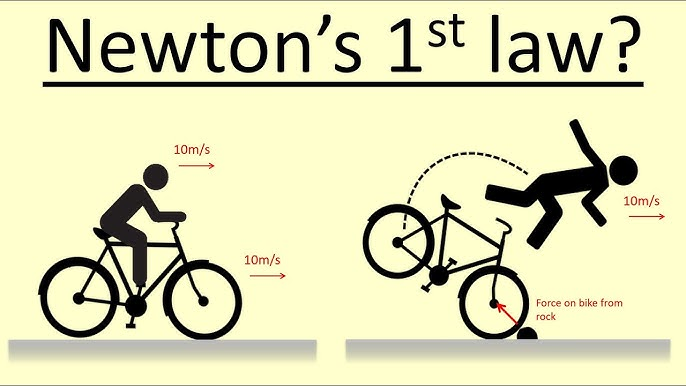
An object at rest stays at rest, or an object in motion stays in motion UNLESS acted on by a force. Inertia is resistance to change in movement
Newton’s Laws: Second
Alternate Name
Description
Law of Acceleration
The acceleration of an object is proportional to the force acting on it, and inversely related to its mass. F = m times a, Fg = m times g, F = m(Vf - Vi)/t

Newton’s Laws: Third
Alternate Name
Description
Law of Reaction
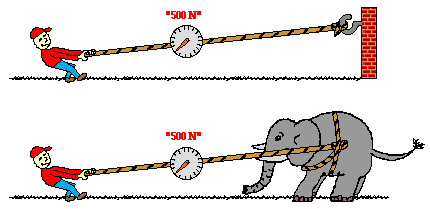
For every action there is an equal and opposite reaction. Forces are the same, but results might not be the same
Application of Newton’s Laws
Principle of Stability - Stability is affected by:
The height of the center of mass (lower is more stable)
Large base of support is more stable
Line of gravity (horizontal center of mass) above base of support is more stable
Greater mass is more stable
Principle of summing joint forces - Multiple forces may act on any joints, the overall movement is the sum of the forces. If forces at in same direction, they add
Principle of linear momentum and linear impulse:
Linear momentum is the amount of movement, p = m times v (momentum is mass times velocity)
Linear impulse is time that a force acts, J = F times N, linear impulse is the change in momentum
Large forces acting for a long time results in a large change in momentum (velocity)
Principle of impulse direction - The direction of the applied force translates to change in momentum toward that direction. A stopped object will move in that direction. A moving object will shift toward that direction (but might not entirely move that way)
Application of Newton’s Laws: Principles of Angular Movement
Torque - A force causing rotation. Torque depends on the size of the force, the distance the force is from rotational axis, and the angle which it is applied. T = F times d times sintheta. Big force, large distance, or a perpendicular angle of force creates the largest torque
Moment of inertia - A measure of difficulty of an object to rotate. A large moment of inertia is hard to rotate. When the center of mass of the rotating object is far from the axis, it will have a difficult time rotating. Also affected by shape of an object. Measured in kg m-2
Angular momentum - the amount of rotation. Measured in kg m s-1. Represented by “L”. L = I times omega (moment of inertia times angular velocity). Generated in the body through muscle contraction
Conservation of angular momentum - An angular version of the first law. Rotation will continue unless acted on by a force, or won’t begin until acted on. When a person is rotating (as in diving, or in gymnastics), they can change their shape, which would change their moment of inertia. To maintain angular momentum, their angular velocity would change. This is how divers/gymnasts can perform various flips easier in some positions than others
Trading angular momentum - As an object is spinning, if a body changes its shape to have greater angular velocity on one side, then the rotation can be transferred to a different axis. Meaning a flip can turn into a spin through changing body position