Chap 8: Problems of Kinship
 Call Kai
 Learn
Learn Practice Test
 Spaced Repetition
 Match
Match Flashcards
 Knowt Play
1/68

There's no tags or description
Looks like no tags are added yet.
Name | Mastery | Learn | Test | Matching | Spaced | Call with Kai |
|---|
No analytics yet
Send a link to your students to track their progress
69 Terms
What is the difference between reproductive fitness (Darwin) and Inclusive fitness (Hamilton)?
RF: measures an individual's success in passing down genes to their own offspring
IF: expands this to include the reproductive success of relatives sharing the same genes
According to Hamilton’s rule, what is the condition for an altruism gene to spread/evolve??
rb > c
r: genetic relatedness
b: benefit to recipient
c: cost to the actor
What is genetic explanation as to why altruism at the individual level (sacrificing oneself to help others) occurs?
Genes are ‘selfish’ (to ensure and promote the survival of its own replicas in other individuals, not just in the individual organism)
What 2 aspects does kin selection include? (PA)
Parental care
Altruism towards non-descendant kin
What is another way to identify positive relatedness (i.e., r>0) other than kinship?
The green beard effect
How does the green beard effect act as an alternative to kinship?
If you have the genes of a green beard, and you see another person with a green beard, you are more likely to be altruistic towards them, even if they are non-relatives
What is the green beard an example of?
An arbitrary trait that provides no survival or reproductive benefits that can propagate if there are specific genes
What are the 3 requirements for such genes to make this happen?
Produces a visually perceptible trait (or feature)
Induce the host organism to identify this trait in others
Induce the host organism to help those with that feature
What is one assumption for the arbitrary traits?
They do not have any intrinsic survival or reproductive costs
Eg. (of a possible cost) potential mates finding green beard to be unattractive and reducing mating chances
What are the 4 different types of kinship r/s?
Parenting
Sibship
Half sibship
Grandparenthood
What is parenting considered as?
A “special” case of evolved kinship mechanisms (i.e., Hamilton's Rule in action)
What does sibship focus on?
Cooperation (support system) and competition (for attention, affection, inheritance etc)
Recap: what is the genetic relatedness of siblings?
0.5
According to Sulloway’s theory of birth order, what are the different “niches”/characteristics of 1st born and later born children?
1st borns: conservative
Later borns (esp middle borns): rebellious
What are 2 characteristic of middle born children?
They regard their family the least positively
Less likely to help family member in need
What is the difference between the dynamic between half-sibs vs full-sibs?
Greater conflict between half-sibs (r = 0.25) than full subs (r = 0.5)
What is an example of inclusive fitness implications in animals?
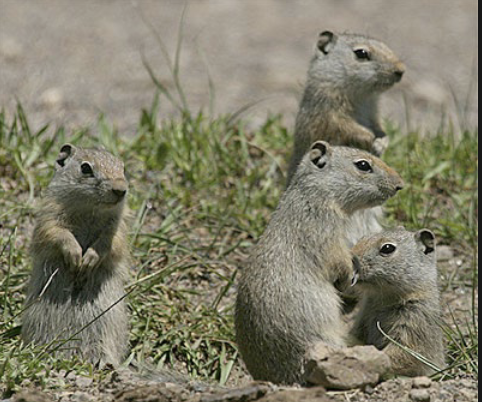
Alarm calling in ground squirrels
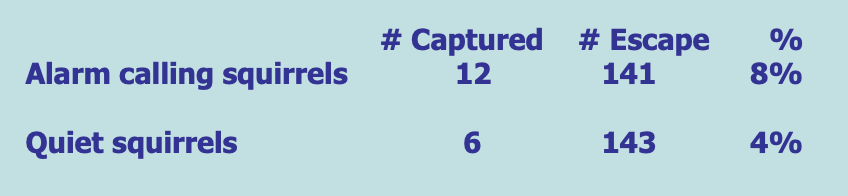
What are the consequences of alarm calling?
Squirrels that call alarms are twice as likely to be killed by predators than those who stay quiet
What are 3 reasons that motivate an individual to warn others even though doing so makes it MORE vulnerable to predation? (PPI)
Predator confusion - gets squirrels to scatter everywhere, which helps all squirrels, including the alarm caller
Parental investment - saving children
Inclusive fitness - benefits of saving relatives outweighs cost to oneself
What is the gender difference in the frequency of alarm calling?
Higher among females than males at every age group (from juveniles to adults)
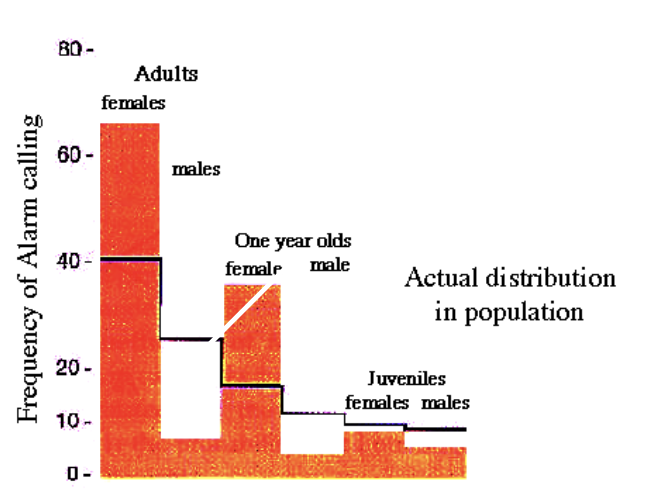
Why is that so?
Males disperse (leave home) when they become sexually mature (~2 y/o), but females remain in where they were born in → become more close to e/o (eg. mothers, sisters) → alarm call more as she would be saving her surrounding relatives
What is the trend of alarm calling like among JUST females?
It is not uniform
What is the 3 sources of evidence for that?
Females with daughters in a group = 80% rate
Females with mother & sisters in group, but no daughters = 80% rate
Females with no kin or offspring in group = 20% rate
Based on this, what is the required condition for high frequency of alarm calling among females?
The presence of individuals who simply share your genes; kins, AND it doesn’t matter who (same effect for daughters/mothers/sisters)
How do primates go through kin recognition?
Use cues of early association (during infancy)
How do parents, grandparents, and aunts identify a newborn kin?
By their odour
Who is better at this?
Women is better than men
What do breastfed newborns prefer in their own mothers compared to other women?
The odour of their own mothers
Who can pre-adolescent children identify based on odour?
Their full siblings (but NOT half- or step-sibs)
What is a characteristic of kin classification systems?
They are universal
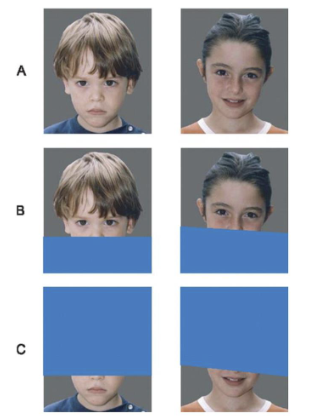
Between B & C, which condition led to the lesser and greater decline in accuracy in predicting siblings r/s?
B (covering lower half of face): lesser decline (5%)
C (covering upper half of face): greater decline (65%)
What does this imply?
Upper face (eyes, eyebrows, forehead) provides the vast majority of kinship information
Lower face contributes very little to kin recognition
In Los Angeles, who are the people more inclined to help?
Close and younger kin
How would human’s tendency to help change based on closeness & age, and how would that change for life or death (burning building) vs everyday conditions?
Closeness: Close kin > distant kin or strangers
Age: Young > older (*exception: >45y/o for everyday conditions)
Both tendencies increase as the gravity of the situation increases (increases for life or death)
What is the general trend of helping toward friends vs siblings?
People gave as much as or more help to friends than to siblings
But as costs escalate, how would that change?
People would give more help to siblings than to friends, even when they report being emotionally closer to friends
What is the difference in investment received from full vs half siblings?
People received more investment from full siblings, even when half-sib were raised together and treated as full-sib by parents
What is the r/s between genetic relatedness and emotional closeness?
Positive: the more genetically related, the more emotionally close people feel
What are the 2 factors that are accounted for in the r/s above? (“regardless of…”)
Residential proximity
Frequency of contact
How did the cortisol levels of children living in a Caribbean village vary when they lived with:
Both biological parents
Single mother
Stepfather and half-sibs or distant relative
Both biological parents: lowest
Single mother: higher
Stepfather and half-sibs or distant relative: highest
Patterns of inheritance: What are the 3 categories of people we are more likely to leave wealth to?
We leave wealth to
Kin > non-kin
Close kin > distant kin
Children > siblings
Why do we leave our wealth to our children instead of our siblings?
Children have higher reproductive value
What is the gender difference in distribution of inheritance/wealth?
Women distribute more widely than men
What is the gender difference in trusting the other party with their wealth?
Men trust their wives, but women don’t trust their husband
What is one possible reason for women not trusting their husband?
In the case where the woman dies, the husband is more likely to remarry and thus, divert resources away from her family
What conditions make men more likely to trust/leave money with their wives?
If she was relatively old and post-reproductive
What is grandparental uncertainty?
Grandparents differ in their certainty whether a grandchild is actually their genetic relative
How does certainty differ through the maternal vs paternal line?
Maternal: perfect certainty
Paternal: uncertainty compounds
Why is there perfect certainty through the maternal line?
The maternal grandmother is 100% certain her daughter is her child (she gave birth to her), and her daughter is 100% certain the baby is hers, so maternal grandmothers have 100% certainty
Why is there compounded uncertainty through the paternity line?
Paternal grandfathers cannot be 100% certain whether his son is really his, and his son also has uncertainties about his child, hence producing double uncertainty
What is the correlated investment grandkids receive from and closeness with their respective grandparents?
Grandkids receive more resources, time, knowledge (and grief) from, and feel closest to maternal grandmother, compared to paternal grandfather
What is the ranking of grandparental investment (& certainty) from most to least?
Maternal grandmother (MoMo)
Maternal grandfather (MoFa)
Paternal grandmother (FaMo)
Paternal grandfather (FaFa)
What does the results stay true regardless of?
Distance
What does maternal grandmother’s investment contribute to?
Improved survival of both the mother and grandchildren
Why do paternal grandmothers invest less than maternal grandfather?
There are higher rates of infidelity in the younger generation, which leads to paternity uncertainty on the dad side (the paternal grandmother will be more uncertain of the grandchild)
What is the investment difference by aunts & uncles?
Matrilateral aunt > Patrilateral aunt
Matrilateral uncle > Patrilateral uncle
What is the altruism ranking toward cousins from most to least?
Mother’s sister’s children
Mother’s brother’s children = Father’s sister’s children
Father’s brother’s children
What is the concrete definition of ‘family’?
Where offspring continue to live with parents into adulthood
How common is the formation of families across all bird and mammal species?
Only 3% form families
What are the 2 costs of having a family?
Delayed and sometimes suppressed reproduction
Concentrated competition for resources (eg. food, shelter, territory, mates)
According to Emlen’s theory of evolution of families, what are the 3 conditions for families to form?
More offspring are birthed than available (ST) reproductive vacancies
Offspring do not initially compete with parents for reproductive vacancies
Benefits of staying at home outweigh the costs (eg. resource access, skills acquisition > resource competition)
5 predictions based on this theory (no definition)
Under what condition will families form and break up?
Form: when there is a shortage of reproductive vacancies
Break up: when vacancies become available
What do families that control many resources end up becoming?
More stable and enduring
What will families help out more on with e/o as compared to groups without kin?
Rearing the young (due to kin selection)
What happens when a breeder (parent) is lost due to death or departure?
Family members will get into a conflict over who will fill the breeding vacancy
What happens if it is replaced by a breeder who is NOT genetically related to family members?
It will increase sexual aggression
What are the 3 critiques of this theory? (that are not just based on kin selection)
Human families stay together to win group competition (larger groups outcompete rival groups for territory, resources, and power)
Humans also engage in social exchange with non-kin based on reciprocal altruism
Postmenopausal women gain higher inclusive fitness by staying and helping grandchildren than seeking reproductive opportunities elsewhere
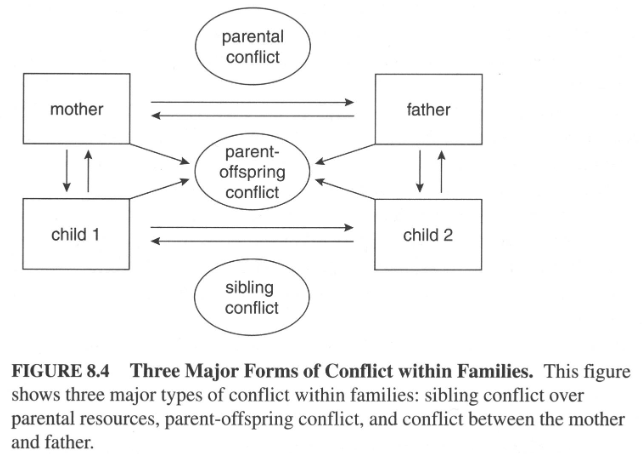
What are the 3 major forms of conflict within families?
Parental conflict (between mum & dad)
Parental-offspring conflict (between parents & offspring)
Sibling conflict (between siblings)