Memory
 Call Kai
 Learn
Learn Practice Test
 Spaced Repetition
 Match
Match Flashcards
 Knowt Play
1/44

There's no tags or description
Looks like no tags are added yet.
Name | Mastery | Learn | Test | Matching | Spaced | Call with Kai |
|---|
No analytics yet
Send a link to your students to track their progress
45 Terms
Research into Duration of STM AO1
Peterson & Peterson (1959)
Procedure:
Participants tasked with remembering a consonant trigram (3 letters e.g. CPW or NGV), which had no meaning
They were asked to count backwards from a 3-digit number (e.g. 413) until they were told to stop (to prevent rehearsal)
After intervals of 3, 6, 9, 12, 15 or 18 seconds, participants were asked to recall the original trigram
Findings:
Participants were able to recall 80% of trigrams after a 3 second interval
Progressively fewer trigrams were recalled as the time intervals lengthened
After 18 seconds, fewer than 10% of the trigrams were recalled correctly
Conclusions:
STM duration may be about 18-30 seconds
Research into Duration of LTM AO1
Bahrick et al. (1975)
Procedure:
Used high school yearbooks
Condition 1 was a photo-recognition test where pps were asked to recall the names of the people shown from 50 photos from the yearbook
Condition 2 was a free recall test where pps were asked to list the names of their ex classmates
Findings:
Condition 1 (photo-recognition test):
Those within 15 years of graduation were 90% accurate on face recall
Those after 48 years of graduation were 70% accurate on face recall
Condition 2 (free-recall test):
After 15 years were 60% accurate
After 30 years were 30% accurate
Conclusions:
Long-term memory duration lasts a lifetime
Evaluations of Research into Duration of Memory
Artificial task
E: Peterson & Peterson (1959) used artificial stimuli of consonant syllable trigrams. Most everyday memory activities has meaning behind why we remember it.
E: This suggests that the study is not reflective of everyday situations as the study tested memory of meaningless items, so the findings of the duration of STM may not be accurate compared to real life.
L: Therefore, decreases ecological validity
Lab setting
E: Lab setting may have caused demand characteristics. Behaviour is unnatural
L: Lacks mundane realism
Measuring interference rather than duration
E: Participants were counting backwards in their STM which may have displaced (overwritten) the trigrams, thus wiping out the memory of the trigram.
E: This suggests that Peterson & Peterson’s experiment does no actually test the duration of the STM but may be a result of interference
L: Therefore, we can be less confident on conclusions & findings. Less internal validity
Confounding variables
E: Participants may have differed in how often they looked at their yearbooks or kept in touch with their ex classmates.
E: This suggests that there may be other variables affecting how well their recall accuracy was and the findings of duration of LTM is not accurate.
L: Therefore, lacks internal validity
Bahrick more realism
E: The researchers investigated meaningful memories of the names and faces of participants’ ex classmates. When studies on LTM were conducted with meaningless pictures to be remembered, recall rates were found to be lower (Shepard 1967).
E: This suggests that Bahrick’s findings reflect a more real estimate of the duration of LTM
L: Therefore, this increases the external validity, so the findings can be more easily generalised to real life.
Research into Capacity of STM AO1
Jacobs (1887):
Procedure:
Used digit span technique
Participants are read a sequence of letters/numbers and asked to repeat the same sequence back immediately.
An additional digit is added on each subsequent trial to measure the capacity of STM
Findings:
Digits recall: average was 9.3 items
Letters recall: average was 7.3 items
Miller (1956):
Findings:
Capacity of STM is around 7
People can recall 5 words as well as they can recall 5 letters - CHUNKING makes it easier to remember
Conclusions:
STM Capacity is 7 ± 2 items
If we ‘chunk’ information together, we can recall more information from our STM - suggesting that chunking increases the capacity of the STM to a limit (of 7 +/- 2)
Evaluations of Research into Capacity of Memory
Artificial task
E: Digit span technique of memoring meaningless numbers or letters.
E: This suggests that the study is not reflective of everyday situations as the study tested memory of meaningless items, so the findings of the capacity of STM may not be accurate compared to real life.
L: Therefore, decreases ecological validity
Lab setting
E: Lab setting may have caused demand characteristics. Behaviour is unnatural
L: Lacks mundane realism
Individual differences
E: Recall capacity increases with age.
E: This suggests that recall capacity increases with age, so individual variables like age can affect the capacity of STM meaning capacity is not the same for everyone.
L: Therefore, Miller’s magic number fails to account for individual differences affecting the capacity of STM, making it oversimplified and decreasing its internal validity.
Research into Coding in Memory AO1
Baddeley (1966)
Procedure:
Pps presented with one of four word lists repeated four times
4 categories of word lists were: acoustically similar, acoustically dissimilar, semantically similar, semantically dissimilar.
STM Condition: 12 sets of 5 words were read out and after each set, the participants had to immediately write them down
LTM Condition: 12 sets of 10 words were read out. Participants were prevented from rehearsing as they were interrupted after each presentation. Recall was tested after 20 minutes
Findings/Conclusions:
The acoustically similar list was the worst recalled list for the STM
There is acoustic confusion, therefore STM is acoustically coded
The semantically similar list was the worst recalled list for the LTM
There is semantic confusion, therefore LTM is semantically coded
Evaluations of Research into Coding in Memory
Artificial task
E: Involved recalling word lists
E: This suggests that the study is not reflective of everyday situations as the study tested memory of meaningless items, so the findings of the capacity of STM may not be accurate compared to real life.
L: Therefore, decreases ecological validity, lacks mundane realism
Lab setting
E: Lab setting may have caused demand characteristics. Behaviour is unnatural
L: Lacks mundane realism
STM may not be exclusively acoustic
E: Brandimore et al. (1992) found that pps used visual coding in STM if they were given a visual recall task and were prevented from doing any verbal rehearsal in the retention interval (they had to say ‘la la la..’) before performing a visual recall task.
E: This suggests that people may use visual codes too instead of verbal, so there is more than one type of coding in STM.
L: Therefore, the original conclusion is oversimplified.
LTM may not be exclusively semantic
E: Frost (1972) showed that long-term recall was related to visual as well as semantic categories.
E: This suggests that LTM is not simply semantically coded and more than one types of coding like visual may be used in LTM
L: Therefore, the original conclusion is oversimplified and coding may vary depending on the circumstances.
Diagram of Multi-Store Model of Memory
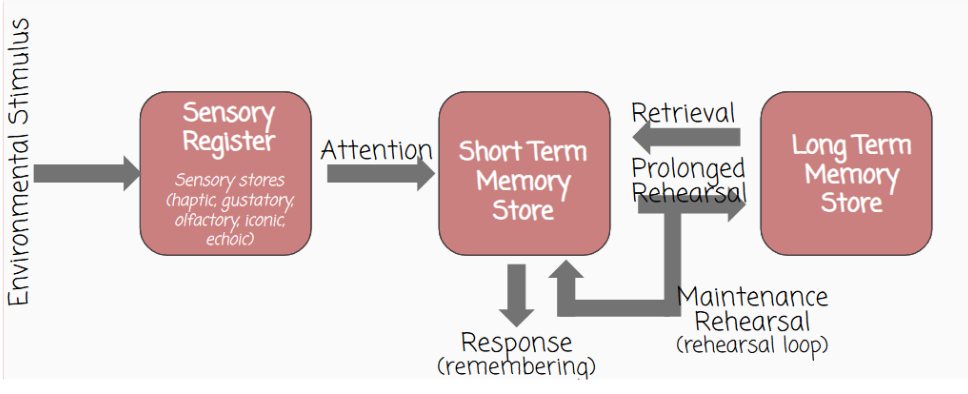
Multi-Store Model of Memory AO1
Atkinson & Shiffrin (1968)
It is a structural model where information flows through three separate, unitary memory stores of the sensory register, STM & LTM
Sensory Register:
Receives information from environmental stimuli / from any sense
Capacity: Very high
Duration: Very brief (less than half a second)
Encoding: Modality specific (touch, taste, smell, visual, sound)
Forgetting: Lack of attention
Directing attention to incoming info passes it from SR onto STM
STM:
Capacity: 7 ± 2
Duration: 18-30 seconds
Can be extended by maintenance rehearsal
Encoding: Acoustic
Forgetting: Decay
Prolonged rehearsal to pass info from STM to LTM
LTM:
Capacity: Unlimited
Duration: Unlimited
Encoding: Semantic
Forgetting: Interference
Sensory Register characteristics =
Receives information from environmental stimuli / from any sense
Capacity: Very high
Duration: Very brief (less than half a second)
Encoding: Modality specific (touch, taste, smell, visual, sound)
Forgetting: Lack of attention
Directing attention to incoming info passes it from SR onto STM
STM characteristics =
Capacity: 7 ± 2
Duration: 18-30 seconds
Can be extended by maintenance rehearsal
Encoding: Acoustic
Forgetting: Decay
Prolonged rehearsal to pass info from STM to LTM
LTM characteristics =
Capacity: Unlimited
Duration: Unlimited
Encoding: Semantic
Forgetting: Interference
Evaluations of Multi-Store Model of Memory
Research support for STM/LTM distinction
E: Case study - HM had part of his brain, the hippocampus, removed. After this, he could not remember speaking with someone an hour earlier and his LTM never improved despite practice. However, he performed well on tests of his immediate STM.
E: This suggests that the STM and LTM are separate distinct stores, supporting the MSM of memory.
L: Therefore, adds validity to the model, making it more useful in understanding memory.
Contradictory evidence for LTM - LTM not unitary
E: Clive Wearing kept his procedural memory but not his episodic memory. For example, he could still play the piano but couldn’t recall what his children were doing.
E: This suggests that there is not just one store for LTM, but there are different types of LTM stores. This challenges the MSM’s idea that there is only one store.
L: Therefore, MSM is oversimplified in explaining LTM, decreasing validity.
Contradictory evidence for STM - STM not unitary
E: KF was in a motorcycle accident resulting in brain damage. KF’s STM was damaged as his memory for digits was very poor when they were read aloud to him. However, his recall was much better when he was able to read the digits to himself.
E: This suggests that KF had difficulty with verbal information in STM but had a normal ability to process visual information. This means that STM must not be a single store.
L: Therefore, MSM is oversimplified in explaining STM, reducing validity.
Artificial tasks
E: Most studies that MSM is based on use artificial materials. For example, MSM uses Peterson & Peterson and Baddeley’s research which use digits, letters and word lists to investigate memory.
E: This suggests that the tasks conducted in these studies are meaningless and irrelevant compared to daily life situations.
L: Therefore, these studies lack mundane realism and the findings cannot be generalised to everyday life, so MSM may not be a valid model for how memory works in real life.
Oversimplistic - Alternative model
E: MSM sees STM as a passive, unitary store. However, WMM saw STM as non-unitary and an active processor that holds several pieces of info while they are being worked on. WMM splits up STM into multiple components.
E: This suggests that only considering STM as unitary is oversimplified, as it is a multi-component system
L: Therefore, these studies lack mundane realism and the findings cannot be generalised to everyday life, so MSM may not be a valid model for how memory works in real life.
Process of moving info from STM to LTM is inadequate
E: MSM suggests that prolonged rehearsal is the main way information transfers to LTM. However, researchers later suggested that elaborative rehearsal, which is connecting new info to existing knowledge, is more effective for moving info to LTM.
E: This suggests that the type of rehearsal is more important than the amount of rehearsal which MSM does not account for.
L: Therefore, MSM is a limited explanation of how information moves from STM to LTM.
Diagram of Working Memory Model
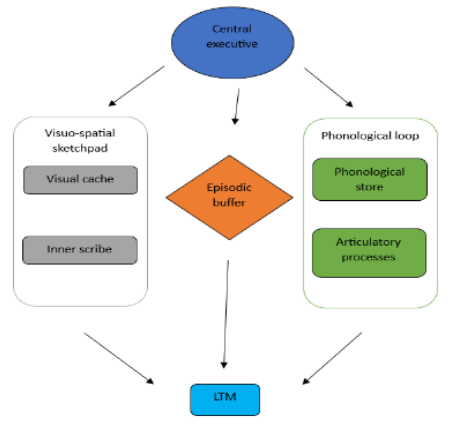
Working Memory Model AO1
Baddeley and Hitch (1974)
Updated model of STM
Sees STM as non-unitary and an active processor that holds several pieces of info while they were being worked on.
Central Executive:
Monitors incoming data and directs our limited attention to slave systems.
Controls the 3 slave systems
Coding: Modality-free - meaning it can process information in any form
Capacity: Very limited
Phonological Loop:
Controls auditory information
Subdivided into:
Phonological store - inner ear that holds the words you hear in speech-based form for 1-2 seconds.
Articulatory processes - inner voice that rehearses sounds in a loop.
Coding: Acoustically/Auditory
Capacity: 1-2 seconds in phonological store, but can be maintained by articulatory processes (maintenance rehearsal)
Visuo-Spatial Sketchpad:
Processes visual and spatial information
Subdivided into:
Visual Cache - stores visual data
Inner Scribe - records the arrangement of objects in the visual field
Coding: Visual
Capacity: Limited capacity of about 3-4 objects
Episodic Buffer:
Temporary general store for information which integrates visual, spatial and verbal information processed by other stores
Maintains a sense of time sequencing (records information as episodes)
Links working memory to long term memory
Coding: Modality-free
Capacity: Limited of about 4 chunks
Central Executive characteristics
Monitors incoming data and directs our limited attention to slave systems.
Controls the 3 slave systems
Coding: Modality-free - meaning it can process information in any form
Capacity: Very limited
Phonological Loop characteristics
Controls auditory information
Subdivided into:
Phonological store - inner ear that holds the words you hear in speech-based form for 1-2 seconds.
Articulatory processes - inner voice that rehearses sounds in a loop.
Coding: Acoustically/Auditory
Capacity: 1-2 seconds in phonological store, but can be maintained by articulatory processes (maintenance rehearsal)
Visuo-Spatial Sketchpad characteristics
Processes visual and spatial information
Subdivided into:
Visual Cache - stores visual data
Inner Scribe - records the arrangement of objects in the visual field
Coding: Visual
Capacity: Limited capacity of about 3-4 objects
Episodic Buffer characteristics
Temporary general store for information which integrates visual, spatial and verbal information processed by other stores
Maintains a sense of time sequencing (records information as episodes)
Links working memory to long term memory
Coding: Modality-free
Capacity: Limited of about 4 chunks
Evaluations of Working Memory Model
Research support for separate slave systems
E: Baddeley et al. (1975) showed that participants had more difficulty doing two visual tasks than doing both a visual and verbal task at the same time.
E: This suggests that if one store is utilised for both tasks, the store’s limited capacity causes poorer performance compared to tasks requiring different stores. This means that there must be separate slave systems for processing visual information and auditory information which have limited capacities.
L: Therefore, increases validity of the model and can explain working memory well.
Research support for STM being non-unitary
E: KF was in a motorcycle accident resulting in brain damage. KF’s STM was damaged as his memory for digits was very poor when they were read aloud to him. However, his recall was much better when he was able to read the digits to himself.
E: This suggests that KF had difficulty with verbal information in STM but had a normal ability to process visual information. This means that STM must not be a single store.
L: Therefore, adds validity to WMM
Research support for phonological loop
E: Baddeley et al. (1975) demonstrated that people find it more difficult to remember a list of long words rather than short words.
E: This is because there is limited capacity for rehearsal in the articulatory process. This supports the phonological loop that it has limited capacity as it is accounted for by the WMM.
L: Therefore, increases validity of WMM that phonological loop has limited capacity.
Artificial tasks
E: Most studies that WMM is based on use artificial materials in highly controlled lab settings. For example, Baddeley’s research which use digits, letters and word lists to investigate memory.
E: This suggests that the tasks conducted in these studies are meaningless and irrelevant compared to daily life situations.
L: Therefore, these studies lack mundane realism and the findings cannot be generalised to everyday life, so WMM may not be a valid model for how memory works in real life.
Better than MSM
E: MSM sees STM as a passive, unitary store. However, WMM saw STM as non-unitary and an active processor that holds several pieces of info while they are being worked on. WMM splits up STM into multiple components.
E: This suggests that only considering STM as unitary is oversimplified, as it is a multi-component system
L: Therefore, these studies lack mundane realism and the findings cannot be generalised to everyday life, so MSM may not be a valid model for how memory works in real life.
Lack of clarity over Central Executive
E: The WMM’s explanation of the central executive is vague and doesn’t really explain anything. This also makes the CE be untestable.
E: This suggests that the central executive is oversimplified. Does not attempt to explain CE in detail by splitting it into separate components.
L: Therefore, WMM explanation of STM is limited and lacks detail.
Types of LTM
Semantic
Episodic
Procedural
Semantic Memory =
= Memories of facts & knowledge
Declarative - memories are easy to put into words
Recall requires conscious effort
Episodic Memory =
= Memories of events in your life
Declarative - memories are easy to put into words
Recall requires conscious effort
‘Timed-stamped’ - memory involves contextual knowledge of when & where the info was learnt
Involves storage of emotional content, such as how you felt at the time
Procedural Memory =
= Memory of how to do something
Non-declarative - memories are not easy to express in words
Recall is less conscious - automatic response, so doesn’t require conscious effort
Evaluations of Types of LTM
Research support from case studies
E: Episodic memory in HM and Clive Wearing were severely impaired due to brain damage, however their semantic and procedural memories were still intact, but episodic memory was damaged. For example, they understood the meaning of words and knew how to walk and speak, but could not remember a conversation half an hour earlier.
E: This suggests that there are in fact different memory stores in LTM as the episodic memory store can be damaged, whilst the others remain unaffected.
L: Therefore, increases validity
Research support for different types of LTM
E: Tulving et al. (1994) performed brain scans and found that when the pps used their semantic memories, part of the LEFT prefrontal cortex was active. When pps used their episodic memories, part of the RIGHT prefrontal cortex was active.
E: This suggests that there are different stores for episodic and semantic memories, supporting the idea of different types of LTM.
L: Therefore, this increases the validity
Episodic & semantic may be the same
E: Cohen and Squire (1980) argued that episodic and semantic memories are in fact stored together in one store they call declarative memory. Episodic and semantic memories involve a lot of overlap between the two systems, with semantic memories often clearly originating in episodic memory. But it is unclear whether when episodic memories transform into semantic, that this also involves a change in memory systems.
E: This suggests that we may have overestimated the number of stores in LTM, questioning the distinction between episodic and semantic memory.
L: Therefore, the types of LTM may be over complex
COUNTER: Evidence that episodic & semantic are separate
E: Patterson found that some people with Alzheimer’s disease could form new episodic memories but not semantic memories.
E: This suggests that episodic and semantic memories are separate systems.
L: Therefore, the distinction in LTM having 3 different types may be in fact correct.
Real life application
E: For example, as people age, they experience memory loss, but research has shown that this is specific to episodic memory. Sylvie Belleville et al. (2006) targetted to attempt to improve episodic memory in older people and the trained pps performed better on an episodic memory test after training.
E: This suggests that distinguishing between types of LTM enables specific treatments to be developed
L: Therefore, has real life application making it more useful.
Explanations for Forgetting
Interference Theory
Retrieval Failure
Interference Theory explanation for forgetting AO1
Interference = When two lots of information become confused in memory
This confusion occurs during coding because it is disrupted by other information, leading to inaccurate recall.
More likely to occur when two pieces of information are similar
Proactive Interference = When old memories interfere and affect the recall of new information you are trying to store.
Retroactive Interference = When new memories interfere and affect the recall of older memories.
Proactive Interference =
When old memories interfere and affect the recall of new information you are trying to store.
Retroactive Interference =
When new memories interfere and affect the recall of older memories.
Evaluations of Interference Theory explanation for forgetting
Research support for similarity
E: McGeoch & McDonald (1931) made pps learn a list of 10 words until they could remember them with 100% accuracy. They then learned a new list. Those whose second list were synonyms (similar) to the first list produced worst recall of original list.
E: This supports idea that similarity increases interference, hence forgetting.
L: Therefore, increases validity
Artificial tasks
E: Most studies supporting interference theory are lab-based where researchers have control over variables. These studies utilise artificial tasks such as learning word lists.
E: This suggests that the studies are unrealistic as tasks such as learning word lists are not comparable to everyday life, where we often learn things with meaning and recall it much later.
L: Therefore, decreases ecological validity
COUNTER: Real life support
E: Baddeley and Hitch (1977) found that rugby players who played the most games over the same time interval had the poorest recall of the team names they had played against in the season.
E: This suggests that playing more games means there is more chance of these memories overlapping and therefore those who played more had more interference.
L: Therefore, shows that interference can operate in real-world situations, increasing ecological validity
COUNTER: Evidence that episodic & semantic are separate
E: Patterson found that some people with Alzheimer’s disease could form new episodic memories but not semantic memories.
E: This suggests that episodic and semantic memories are separate systems.
L: Therefore, the distinction in LTM having 3 different types may be in fact correct.
Only temporary & can be overcome by using cues
E: Tulving and Psotka (1971) found that pps recall averaged about 70% for a first list of words, but became progressively worse as they learned each additional list. However, when given a cued recall test, recall rose again to 70%.
E: This suggests that interference only causes a temporary loss of accessibility to material that is still in LTM, which interference theory fails to explain.
L: Therefore, there may be better explanations for forgetting which account for cues such as retrieval failure, decreasing the usefulness of interference.
Practical application - revision strategies
E: Interference theory has been applied in real life for revision strategies. For example, avoiding revising similar subjects together/right after each other. Like not revising Spanish immediately after French.
E: This suggests that knowledge on how similar info affects forgetting has been applied to improve studies in real life.
L: Therefore, useful
Retrieval Failure explanation for forgetting AO1
Retrieval Failure = When Information is available in LTM but cannot be recalled because retrieval cues are absent.
i.e. forgetting is due to absence of cues
Retrieval Cues = Things/information from the situation of a memory that serve as a reminder to help trigger retrieval of the memory
Encoding Specificity Principle = Recall is most effective if the same cues that were present during learning are present during recall.
Types of Cues:
Context Cues = External cues in the environment (e.g. smell, room)
- Lack leads to context-dependent forgetting
State Cues = Internal cues/factors inside of us (e.g. emotional state, mood, drunk)
- Lack leads to state-dependent forgetting
Evaluations of Retrieval Failure explanation for forgetting
Research support for context-dependent forgetting
E: Godden & Baddeley (1975) had pps learn lists of words in conditions either: learn on beach & recall on beach, learn on beach & recall underwater, learn underwater & recall underwater, learn underwater & recall on beach. Number of words recalled was best on the conditions where learning & recall occured in same location.
E: This supports idea that context cues are important in recall
L: Therefore, increases validity
Research support for state-dependent forgetting
E: Carter & Cassaday (1998) had pps learn lists of words in conditions either: learn on drug & recall on drug, learn on drug & recall not on drug, learn not on drug, recall not on drug, learn not on drug, recall on drug. Number of words recalled was best on the conditions where learning & recall occured in same state of drug/notdrug.
E: This supports idea that state cues are important for recall
L: Therefore, increases validity
High face validity
E: Retrieval failure seems to occur in everyday situations. For example, thinking about needing to get an item from another room. You go to the other room but forget what it is you first wanted, but when you go back to the first room, you remember again.
E: This suggests that context cues can remind us of strategies to help improve recall and overcome forgetting in daily life scenarios.
L: Therefore, retrieval failure as an explanation of forgetting has real life applications, improving ecological validity & more useful
Context effects may depend on type of memory
E: Godden and Baddeley (1980) replicated their underwater experiment but used a recognition test instead of recall. When word recognition was tested, there was no context-dependent effect.
E: This suggests that retrieval failure’s explanation of state-dependent forgetting only applies when a person has to recall information rather than recognise it.
L: Therefore, retrieval failure is a limited explanation as it does not account for how context affects different types of memory
Difficult to test cues
E: It is very difficult to establish whether a cue has been encoded or not. It is often based on assumptions like if a cue did not produce recall, we assume it cannot have been encoded.
E: This suggests that we cannot be sure of what extent to which cues during encoding that are present in the time of retrieval actually improves recall.
L: Therefore, decreases validity
Factors affecting Accuracy of Eyewitness Testimony
Misleading Information
Leading Questions
Post-Event Discussion
Anxiety
Misleading Information =
Incorrect information given to an eyewitness usually after the event.
Types of Misleading Information
Leading Questions
Post-Event Discussion
Leading Questions affecting EWT AO1
Leading Questions = A question which because of the way it is phrased, suggests a certain answer.
(e.g. “Was the knife in his left hand?” leads a person to think there’s where it was)
Response-bias Explanation - Leading questions do not affect memory, just choice of answer
Substitution-bias Explanation - Question wording actually distorts/changes memory
Loftus & Palmer (1974):
Procedures:
Pps shown clips of car accidents then asked a leading question to describe/estimate the speed of the cars
5 different conditions varying the verb used in the critical question:
“How fast was the car travelling when it ___ the other car?” (smashed, collided, bumped, hit, or contacted)
Findings:
The pps in the condition with the verb “contacted” had a mean estimated speed of 31.8mph
The pps in the condition with the verb “smashed” had a mean estimated speed of 40.8mph
Supports response-bias explanation
Loftus & Palmer (1974):
pps returned 1 week later and were asked whether they saw any broken glass (there was no broken class in the clip)
More participants in “smashed” condition reported there was broken glass
Supports substitution-bias explanation
Post-Event Discussion affecting EWT AO1
Post-Event Discussion = When witnesses to a crime discuss what they saw in the event with co-witnesses or to other people.
Information, which may be misleading, is added to a memory after the event has occured
Therefore, the accuracy of the witness’ recall may be reduced
Memory Contamination explanation - Co-witnesses mix/combine misinformation from other witnesses with their own memories.
Memory Conformity explanation - Witnesses go along with each other to win social approval
Gabbert et al. (2003):
Procedure:
Pps were paired
Each pp watched a video of same crime, but filmed from different points of view
Pps discussed what they had seen with their pair
Then they individually completed a test of recall
Findings:
71% of pps mistakenly recalled aspects of the event that they did not see but had picked up in the discussion with their partner
This was 0% in the control group where there was no discussion
Evaluations of Leading Questions affecting accuracy of EWT
Research support - (CAN BE AO1 OR AO3)
E: Loftus and Palmer (1974) had pps watch film clips in a lab. Changed the verb used in critical question. Found that estimates of speed of car changed depending on verb used.
E: This supports idea that wording of question changes witness responses - supports response-bias explanation
L: Therefore, adds validity
Artificial tasks
E: Loftus and Palmer (1974) had pps watch film clips in a lab, which is a very different experience from witnessing a real event.
E: This suggests that the task used in research is artificial as it is not similar to real-life situations needing eyewitness testimonies, so pps may not have been motivated to be accurate as they are not experiencing the stress and emotions of a real-life event.
L: Therefore, research lacks mundane realism and EWT in real-world situations may be more dependable than many studies suggest.
Demand characteristics
E: Loftus and Palmer (1974) study took place in a lab setting. Pps may have changed their behaviour due to wanting to be helpful to the researcher
E: This suggests that behaviour of pps is unnatural.
L: Therefore, lacks internal validity
Lack of consequences in lab studies vs real life
E: Lab studies testing witness recall do not accurately mimic real crime situations as there is a lack of consequences for what the responses are used for. No real implications on whether response is correct or not, so may be less accurate than in real situations.
E: This suggests that findings may not be truly reflective of real-life scenarios.
L: Therefore, research lacks ecological validity making it less useful to apply to real life.
Real life application
E: Knowledge of leading questions affecting accuracy of EWT has led to development of the Cognitive Interview. There is now a focus on ensuring that leading questions are not asked. Psychologists are also often used to act as expert witnesses in court trials and explain the limits of EWT to juries, helping to prevent wrongful convictions
E: This suggests that research on misleading information have enabled psychologists to improve the way the legal system works, especially by protecting people from fault convictions based on unreliable EWT.
L: Therefore, misleading information has strong real life applications
Substitution effect oversimplified
E: Later studies have found that when pps are asked leading questions, their recall was more accurate for central details of the event than for peripheral ones.
E: This suggests that original memories for central details were relatively resistant to misleading information and were not distorted which the substitution explanation fails to account for.
L: Therefore, substitution explanation is oversimplified as it does not explain how different types of details have different accuracy in EWT.
Evaluations of Post-Event Discussion affecting accuracy of EWT
Research support - (CAN BE AO1 OR AO3)
E: Gabbert et al. (2003) had pps watched a video of same crime, but filmed from different points of view. Pps discussed in pairs what they had seen, then individually completed test of recall. 71% of pps mistakenly recalled aspects of the event that they did not see but had picked up in discussion.
E: This supports idea that discussion with co-witnesses affects EWT.
L: Therefore, adds validity
Artificial tasks
E: Gabbert et al. (2003) had pps watch film clips in a lab, which is a very different experience from witnessing a real event.
E: This suggests that the task used in research is artificial as it is not similar to real-life situations needing eyewitness testimonies, so pps may not have been motivated to be accurate as they are not experiencing the stress and emotions of a real-life event.
L: Therefore, research lacks mundane realism and EWT in real-world situations may be more dependable than many studies suggest.
Demand characteristics
E: Gabbert et al. (2003) study took place in a lab setting. Pps may have changed their behaviour due to wanting to be helpful to the researcher
E: This suggests that behaviour of pps is unnatural.
L: Therefore, lacks internal validity
Lack of consequences in lab studies vs real life
E: Lab studies testing witness recall do not accurately mimic real crime situations as there is a lack of consequences for what the responses are used for. No real implications on whether response is correct or not, so may be less accurate than in real situations.
E: This suggests that findings may not be truly reflective of real-life scenarios.
L: Therefore, research lacks ecological validity making it less useful to apply to real life.
Real life application
E: Knowledge of post-event discussion affecting accuracy of EWT has led to development of the Cognitive Interview. Psychologists are also often used to act as expert witnesses in court trials and explain the limits of EWT to juries, helping to prevent wrongful convictions
E: This suggests that research on misleading information have enabled psychologists to improve the way the legal system works, especially by protecting people from fault convictions based on unreliable EWT.
L: Therefore, misleading information has strong real life applications
Difficult to distinguish between explanations of contamination vs conformity
E: It is hard to test whether the cause of post-event discussion reducing accuracy of EWT is due to memory contamination or conformity.
E: This suggests that we are less confident on which is right.
L: Therefore, limits validity
Anxiety affecting EWT AO1
Anxiety has a Negative Effect on Recall:
Tunnel Theory of memory - High-stress & anxiety situations cause a witness’ attention to narrow, causing enhanced memory for central events (the weapon), but reduces recall for other details of the event.
Weapon Focus effect - Presence of a weapon causes high anxiety, which leads to attention being focused to the weapon, so reducing recall of other details in the scene (like perpetrator’s face, surrounding scene)
Anxiety can have a Positive or Negative Effect on Recall:
Yerkes-Dodson Law - Uses the Inverted-U Hypothesis
Suggests that accuracy of recall increases with anxiety, but only up to an optimal point which is the point of maximum accuracy. After this optimum, any more increases of anxiety causes a decline in accuracy of recall due to anxiety levels being too strong.
Evaluations of Anxiety affecting accuracy of EWT
Research support for decreasing accuracy
E: Johnson & Scott (1979) weapon focus experiment found that more pps correctly identified a person when they were holding a pen (49%) than when they were holding a knife covered in blood (33%).
E: This supports weapon focus effect & tunnel theory that people focus their attention on the weapon, so reducing recall of other details in the scene like the perpetrator’s face.
L: Therefore, adds validity
COUNTER: Research support for increasing accuracy
E: Yuille & Cutshall (1986) real life study found witnesses who had been most distressed at the time of a shooting gave the most accurate recall/account five months later.
E: This suggests that increased anxiety can actually increase accuracy of EWT. This can be explained by anxiety activating our fight or flight response, which increases our alertness so improves memory for the event.
L: Therefore, anxiety may actually reduce accuracy
Weapon focus not caused by anxiety but by surprise
E: Pickel (1998) proposed that reduced accuracy of recall is due to surprise and not anxiety. She arranged for pps to watch a thief enter a hairdressing salon carrying either scissors (high threat, low surprise), a handgun (high threat, high surprise), a wallet (low threat low surprise) or a whole raw chicken (low threat high surprise). Recall accuracy was poorest in both high surprise conditions.
E: This suggests that the weapon focus effect is due to surprise rather than anxiety.
L: Therefore, research on the weapon focus effect may not tell us anything about the role of anxiety on accuracy of EWT.
Lab studies have low validity
E: Studies such as Johnson and Scott (1976) are done in labs so may not create real levels of anxiety experienced by real eyewitnesses during an actual crime.
E: This suggests that findings may not be truly reflective of real-life scenarios.
L: Therefore, research lacks ecological validity making it less useful to apply to real life.
Alternative explanations - situational not biological
E: Misleading information may affect EWT. For example, leading questions and post-event discussion can affect accuracy of EWT.
E: This suggests that it may be situational factors not biological factors.
Individual differences
E: Bothwell et al. (1987) found that participants labelled as ‘stable’ (less emotionally sensitive) showed higher levels of accuracy as stress increased. The opposite was true for neurotics.
E: This suggests that individual differences like emotional sensitivity affect levels of recall accuracy which studies fail to control so we can be less sure on the causal relationship between anxiety and recall accuracy.
L: Therefore, this decreases internal validity of research into anxiety as extraneous variables like individual differences may be the cause.
Yerkes-Dodson Law too simplistic
E: Fazey and Hardy (1988) created the catastrophe theory which accepted the Yerkes-Dodson Law explanation that physiological arousal gradually decreases performance once it hits the optimum. However, they suggested that a catastrophic decline sometimes occurs due to increased mental anxiety.
E: This suggests that accuracy of recall does not always gradually decline after the optimum level, but sometimes can steeply decline too which the Yerkes-Dodson Law fails to account for.
L: Therefore, the Yerkes-Dodson Law is oversimplified as it fails to account for mental anxiety affecting EWT
Way of Improving Accuracy of EWT
Cognitive Interview
Cognitive Interview AO1
Series of 4 techniques to improve recall accuracy of EWT in police interviews
Report Everything - Witnesses are encouraged to include every single detail of the event, even if they seem irrelevant or trivial.
Reinstate Context - Witnesses try to mentally recreate an image of the situation, including details of the environment and their emotions
Reverse the Order - Witness is asked to recall the scene in a different chronological order (e.g. from the end to the beginning)
Change Perspective - Witness tries to recall the incident from other people's perspectives (e.g. what another witness would have seen)
Enhanced Cognitive Interview Features:
Relax
Get witness to speak slowly
Evaluations of Cognitive Interview in improving accuracy of EWT
Context reinstatement works on cues
E: The technique of mentally recreate an image of the situation works on reinstating state & context cues. According to retrieval failure, this should help recall.
E: This suggests that it based on theory of retrieval failure, and that by reinstating state & context cues, this should help increase accuracy of recall.
Prevents dishonesty & the effect of expectations/schema
E: By reversing the order and changing perspective, this prevents people from reporting their expectations of how they think the event must have happened rather than the actual events they saw. Also prevents dishonesty as it is harder to lie.
E: This suggests that CI shuold improve accuracy of EWT
Time-consuming & expensive
E: The CI takes more time and training than the standard police interview. For example, more time is needed to establish a rapport with a witness and allow them to relax, and it requires special training.
E: This suggests that the CI is not a feasible, realistic technique for all police forces to use due to limitations of time and resources.
L: Therefore, limits its practical application and usefulness.
Research support
E: Kohnken et al. (1999) conducted a meta-analysis of 55 studies comparing CI to a standard police interview. Found that the CI gave a 81% increase in correct information compared with the standard interview.
E: This suggests that the CI is an effective technique in helping witnesses recall information more accurately.
L: Therefore, increases validity of the CI so can provide a more useful EWT. Also, increases reliability as it is a consistent finding across many studies.
COUNTER: Quality may suffer
E: Kohnken et al. (1999) also found that there was a 61% increase in incorrect information recalled in the CI compared to the standard police interview.
E: This suggests that although the CI may produce more correct information, it also suffers from more inaccurate information as well. This is because the CI may sacrifice quality of EWT in favour of quantity.
L: Therefore, eyewitness evidence from CIs need to be treated with caution, making it less useful.
Some features more important than others
E: Milen and Bull (2002) found that a combination of the ‘report everything’ and ‘context reinstatement’ components of CI produced better recall than any other components.
E: This suggests that not all aspects of the CI are equally effective and useful.
L: Therefore, this casts doubt over the credibility of the CI as a whole. Modified version may need to focus on these more important aspects.
Not useful for children
E: CI is not generally effective for children under six, who may find the complex instructions confusing
E: This suggests that CI not effective for everyone.
L: Therefore, not universally applicable.
Memory Hook for Proactive vs Retroactive Interference
PORN
Proactive: Old memories interfere with new ones
Retroactive: New memories interfere with old ones