IB HL Physics (2023) - Wave Behaviour
 Call Kai
 Learn
Learn Practice Test
 Spaced Repetition
 Match
Match Flashcards
 Knowt Play
1/53

Earn XP
Description and Tags
Name | Mastery | Learn | Test | Matching | Spaced | Call with Kai | Chat |
|---|
No analytics yet
Send a link to your students to track their progress
54 Terms
Angular Frequency
Radians turned per second (Rad s-1)
displacement
how far away in m a pendulum or particle of a wave is from the equilibrium
Simple Harmonic Motion
Motion of a Simple pendulum or Mass spring where the restoring force / acceleration is directly proportional to the extension in the opposite direction
One Cycle of SHM
One full cycle of SHM is:
one time period
one oscillation
2π rad
Time Period of a Pendulum
does not depend on mass or displacement
when L is greater the period is longer
Natural (Resonant) Frequency
The frequency an oscillator vibrates at freely after an initial disturbance
Forced Vibrations
it’s possible to force an object to vibrate using a periodic driving force. The frequency of this force is called the driving frequency
Resonance
Occours when the driving frequency matches the natural frequency which leads to maximum the amplitude being achieved
Damping
The way a system performing SHM loses energy to its surroundings. The heavier the damping the faster the amplitude decrease
Types of Damping
Over Damping - the displaced object returns very slowly to the equilibrium position
Critical Damping - The displaced object returns to equilibrium as fast as possible
Standing Wave
A wave that does not transfer energy or matter, and has nodes which dont move and antinodes which do move
Travelling Wave
A wave which transfers energy but not matter
Transverse Wave
A Travelling Wave in which the particles oscillate perpendicular to the direction of energy transfer
Longitudinal Waves
A Travelling Wave in which the particles oscillate parallel to the direction of energy transfer
Mechanical Waves
A wave that involves the movement of particles
a transverse mechanical wave would be water ripples
a longitudinal mechanical wave would be sound waves
EM Waves
Transverse waves that can travel through a vaccum or through a medium
made of a pair of oscillating magnetic and electric fields
travel at 3 ×10⁸ ms-1 in a vaccum
Key Wave Features
Amplitude - maximum displacement of the wave from the equilibrium (m)
Wavelength - shortest distance between two points in phase (m)
Time Period - Time it takes for one complete Oscillations (s)
Frequency - The number of Oscillations per second (Hz = s-1)
Wavespeed - The distance a wave travels in a second (ms-1)
Displacement - Distance Graph
can be used to determine amplitude and wavelength
Displacement - Time Graph
can be used to determine ampiltude and period
Phase Difference
The amount in metres degrees or radians that one wave lags behind another
waves in phase have an even Phase Difference (2π, 4π, 6π). Waves out of phase have an odd Phase Difference (π, 3π, 5π)
Law of Reflection
when a wave is reflected off a boundary the angle of incidence is equal to the angle of reflection
Wavefronts
parts of a wave that are in phase with eachother
Rays
Lines perpendicular to the wavefronts that show direction of energy transfer
Waves at Boundaries
waves can undergo:
Reflection
Refraction
Transmission
Diffraction
Absorption
Scattering
Waves in different materials
in a more dense medium waves slow down and bend towards the normal
in a less dense medium wave speed up and bend away from the normal
Refraction
The change of a wave’s wavelength speed or direction as it enters a new medium
Refractive index
The ratio of the speed of light in a medium to the speed of light in a vaccum
Total Internal reflection
Reflection of a wave within an object.
Occurs when the angleof incidence is in the more dense subject and the angle of incidence is greater than the critical angle
Critical angle
Sinθc= n1/n2 OR v1/v2
Principle of Superposition
When two or more waves cross, the resultant displacement equals the vector sum of the individual displacements
Interference
The result of superposition of two waves
can be:
constructive (Phase difference = n*λ)
or destructive (Phase difference = [n+1/2]*λ)
Diffraction
the spreading of waves through an aperture/slit or around an obstacle
diffraction is greatest when the wavelength is similar to the slit size
Young’s Double slit
Two slits act as coherent sources
curved wavefronts overlap and interfere
an interference pattern of light and dark fringes is produced on the screen
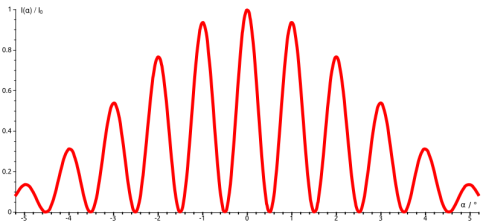
Double slit intensity graph
all fringes are equal width
central fringe (order of maximum = 0) has maximum intensity, decreasing for subsequent fringes
Huygens’ Principle
The wavefront of a travelling wave consists of circular wavelets created by every point on the previous wavefront.
Single Slit Diffraction
a wave will diffract through a single slit
the greatest diffraction happens when λ≈b
each part of the wave can act as its own source
each point of the wave can interfere and superpose with another part of the wave
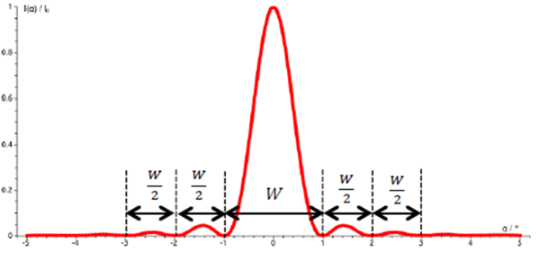
Single Slit intensity graph
Central maximum is double the width of the secondary maxima on either side
secondary maxima greatly reduce in intensit
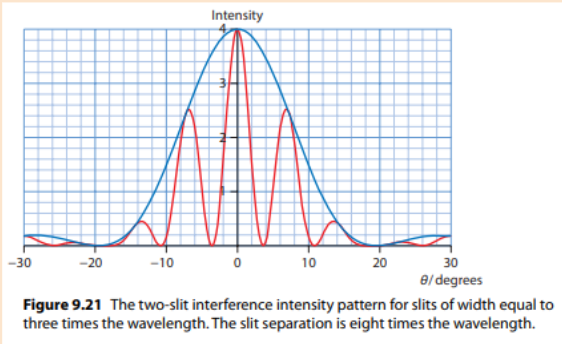
Double slit modulation
when light passes through the slits both single slit and double slit intereference occour, leading to a double slit pattern modulated by the single slit envelope
Multi-Slit interference
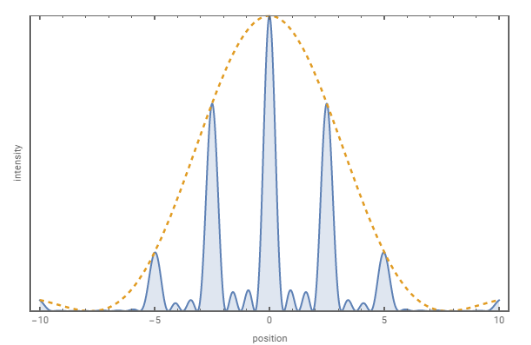
As the number of slits increases:
the intensity of primary maxima increases
the primary maxima become shaper
the secondary maxima become less bright
Multi-Slit intensity pattern
the number ofsecondary maxima between each primary maxima is equal to the number of slits -2
Diffraction grating
an optical element with many parallel slits which produces bright maxima at discrete points along the sceen
Reflection off an end
When a rave reflects off a closed end the reflected wave inverts and is pi radians out of phase withthe incidence wave
When a wave reflects off an open end the wave doesnt invert and stays in phase
Coherent waves
Waves with a constant phase difference between them
Standing wave formation
When two coherent waves with the same amplitude, travelling in opposite directions, interfere with each other, superposition occurs and a standing wave is formed.
Nodes and Antinodes
Nodes are point of no displacement
antinodes are points of displacement
all particles in an antinode are in phase with eachother
adjacent antinodes are out of phase by pi radians
harmonics
the harmonic number refers to the number of antinodes that form in a standing wave
the wavelength and frequency of a wave are different in each harmonic
There will always be a node at a fixed end and an antinode at an open end
Two open ends
For two open ends the frequency that forms the ‘n’th harmonic is always
fn = nc/2L (when n = the harmonic number)
Two closed ends
For two closed ends the frequency that forms the ‘n’th harmonic is always
fn = nc/2L (when n = the harmonic number)
One closed and One open end
The harmonic number refers to the number of quarter waves visible. Therfore there can only be odd harmonic numbers because one end must always be an antinode
fn =nc/4L (when n = the harmonic number)
Doppler effect
the apparent change in frequency of a wave due to relative motion between the source and the observer.
Moving source
When the source is moving the wavefronts are compressed or expanded and so the percieved wavelength changes
Moving Observer
The wavelength is constant but the observers experience of the frequency changes
Double Doppler
The double doppler effect occours when the observer and source are moving in opposite directions either towards or away from eachother
Uses of Dopper Effect
Determining the distance to a galaxy
Determining the speed of things like blood or cars