14. human communication
 Call Kai
 Learn
Learn Practice Test
 Spaced Repetition
 Match
Match Flashcards
 Knowt Play
1/58

There's no tags or description
Looks like no tags are added yet.
Name | Mastery | Learn | Test | Matching | Spaced | Call with Kai |
|---|
No analytics yet
Send a link to your students to track their progress
59 Terms
4 kinds of verbal behaviors
talking
understanding speech
writing
reading
are verbal behaviors lateralized?
yes
verbal behavior left hemisphere is dominant for
language
Wada test
determines hemispheric dominance for VERBAL communication (injection of intracarotid sodium amobarbital)
what does the right hemisphere do?
plays a role in the expression and recognition of emotion and in processing tone of voice
aphasia
disturbance in speech
2 kinds of aphasia
production - “expressive aphasia”
comprehension - “receptive aphasia”
what is aphasia NOT the result of?
lack of motivation
sensory/motor deficit (e.g., paralysis)
in most ppl, what can aphasia result from?
dmg to the left hemisphere
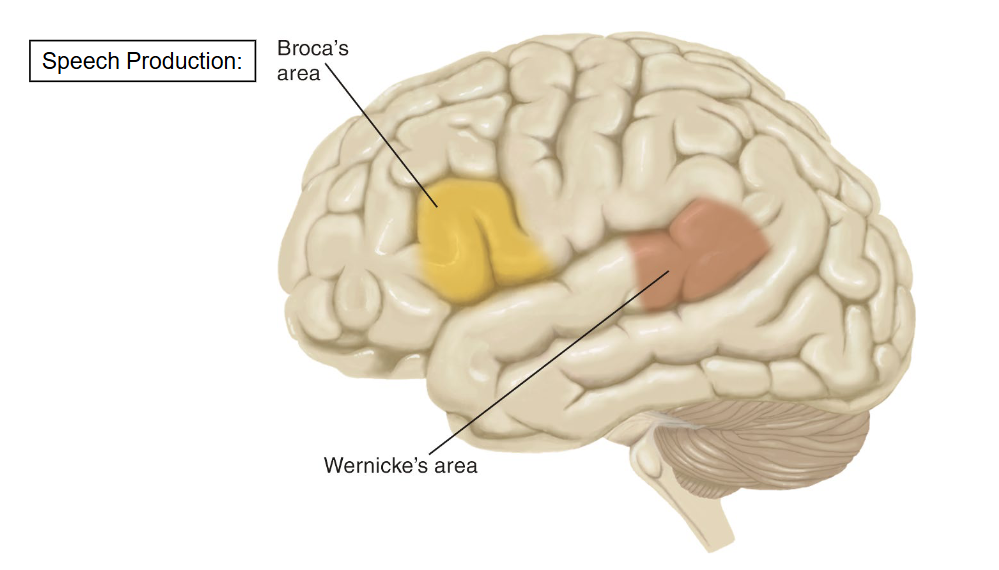
Broca’s area
controls speech
Broca’s aphasia (cause, characteristics)
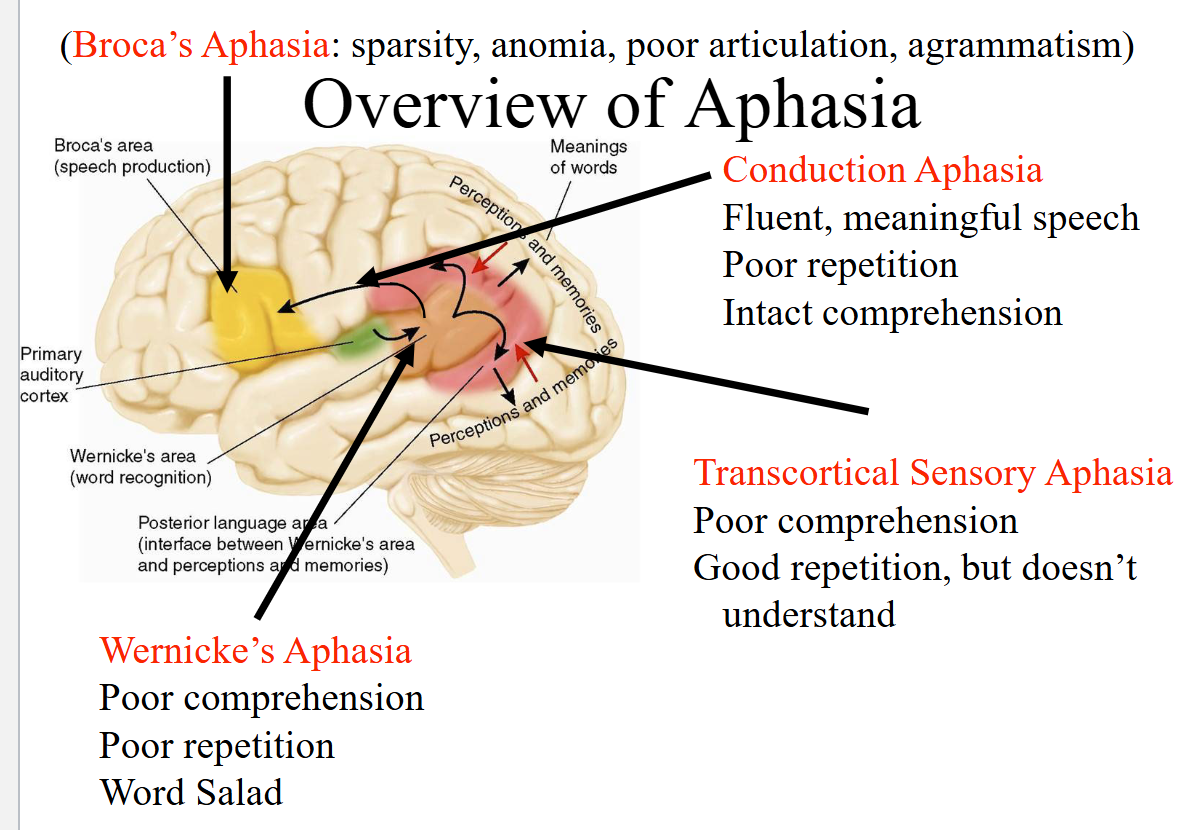
results from dmg to the inferior left frontal lobe
slow, laborious speech
spoken words have meaning (are intelligible)
person can comprehend the speech of others, as long as it isn’t too long or sequential
what kind of words do those w Broca’s aphasia have trouble with? what kinds of words are they better w?
difficulty w FUNCTION WORDS - relational words like a, the, in, about
better w CONTENT WORDS - nouns, verbs, adjectives, adverbs
3 primary speech difficulties in Broca’s aphasia
agrammatism
anomia
difficulty w word articulation
agrammatism
difficulty in using grammar rules (e.g., -ed)
anomia
difficulty in finding appropriate words
periaqueductal area
species-typical behavior, associated w vocal output
lesion in periaqueductal gray area
produces no “ribbits” (mutism), also causes mutism in humans too
Wernicke’s area + location
responsible for language comprehension
superior left temporal gyrus
word salad
produce string of words that don’t make any sense together, symptom of Wernicke’s aphasia
Wernicke’s aphasia + 2 primary symptoms
word recognition is disrupted
poor speech comprehension
fluent, but meaningless speech - word salad
what kind of deficits are involved in Wernicke’s aphasia?
receptive deficits
pure word deafness
disruption of inputs to Wernicke’s area results in an inability to understand speech
left superior temporal
processes the sequence of sounds (i.e., word recognition)
are those w Wernicke’s aphasia aware of their deficits?
no, so they experience no frustration
what can those w Wernicke’s area identify?
sounds and animals, prosody (emotional content)
transcortical sensory aphasia + location, symptoms
damage to posterior language area
surrounds Wernicke’s area
person CAN repeat statements, but does not comprehend the statements - echolalia
cannot follow simple directions
in order to speak, signals go from…
association areas → posterior language area → Wernicke’s area → Broca’s area
difference btwn Wernicke’s area and PLA
Wernicke’s area is for RECOGNITION of words, PLA is for COMPREHENSION of words
note that Wernicke’s aphasia is caused by damage to both regions
arcuate fasciculus
connects Wernicke’s area w Broca’s area, carries info abt word sounds
damage to fasciculus produces…
conduction aphasia
conduction aphasia symptoms
fluent, meaningful speech
good word comprehension
DIFFICULTY IN REPEATING WORDS (can never repeat non-words), especially complex sentences
example of someone w conduction aphasia having trouble w complex sentence repetition
experimenter: "the auto’s leaking gas tank soiled the roadway”
patient: “the car’s tank leaked and made a mess on the street”
the arcuate fasciculus conducts …, not …
sounds, meanings
prosody
refers to variations in rhythm, pitch, and cadence that communicate info
2 things prosody is severely disrupted by
damage to right hemisphere
damage to Broca’s area
receptive aphasia
can’t understand the prosody/emotion of words
prosody reception occurs purely in what brain area?
right cerebral
pure alexia (alexia without agraphia)
the inability to read — can’t see from RVF, can’t read from LVF
what produces pure alexia? what conditions cause thsi damage?what symptom does this produce?
damage to the left visual cortex AND the posterior end of the corpus callosum (splenium)
left posterior cerebral artery stroke or hemorrhage
person can write, but cannot read what they wrote
flow of info during reading
retina → striate cortex → extrastriate → corpus callosum → ipsilateral extrastriate → Wernicke’s area → Broca’s area
damage to only left visual cortex
anopsia in right visual field
damage to only splenium
alexia in left visual field but not right visual field
reading involves 2 processes
recognition of the entire word (whole-word approach)
sounding out the word, letter by letter (phonetic approach)
dyslexia
faulty reading
acquired dyslexia
brain dmg causes ppl who previously could read to not read
2 kinds of acquired dyslexias
phonological dyslexia
surface dyslexia
phonological dyslexia + cause
person can read using the whole-word method, but cannot sound out words (CAN understand words)
usually left frontal lobe dmg, but may extend back to Wernicke’s
what words can those w phonological dyslexia read?
can read only words that they are familiar with or one letter at a time
surface dyslexia + cause
deficit in whole-word reading (can sound words out and understand them)
left lateral/inferior temporal lesion
what brain area processes words?
fusiform face area (expertise area), SPECIFICALLY the visual word form area (VWFA)
what kind of words can those w surface dyslexia read?
words that have the same sound as spelling, but not good with other words (ex: will pronounce sew as sue)
agraphia
any type of disability involving writing (not due to perceptual or motor deficits)
2 major types of agraphia
phonological dysgraphia
orthographic dysgraphia
phonological dysgraphia + cause
unable to sound out words to write them
damage to Broca’s area
orthographic dysgraphia + cause
can only write words by sounding them out
damage to left visual word-form area
what specifically can those w phonological dysgraphia write and can’t write?
CAN write familiar words (easy - dog, hard - busy)
CANNOT write pronounceable nonwords (e.g., glab, chint)
what specifically can those w orthographic dysgraphia write and can’t write?
CAN write ‘easy’ words like “dog” or “tree”
CANNOT write words in which phonology does not equal spelling
busy = bizzy, half = haff