NFS302 Lecture 5: Testosterone and Sports
 Call Kai
 Learn
Learn Practice Test
 Spaced Repetition
 Match
Match Flashcards
 Knowt Play
1/50

There's no tags or description
Looks like no tags are added yet.
Name | Mastery | Learn | Test | Matching | Spaced | Call with Kai | Chat |
|---|
No analytics yet
Send a link to your students to track their progress
51 Terms
Is there a “Sports gene”?
Almost certainly not
BUT, there is a sports hormone → testosterone (C19H28O2)
What is Testosterone?
A steroid=based androgenic hormone produced primarily in the gonads
Androgenic = derived from Greek (“man” + “produce”)
Men produce ~2.5-10 mg/day
Men produce at least 10x more than women (generally, but up to 20x)
Testosterone Reference Ranges
“Ideal” range depends on who you ask, and we use different units in Canada vs. US
Testosterone reference:
8.4-28.8 nmol/L (Canada)
242.2-830.6 ng/dL (US)
As long as you are in this range, it doesn’t really matter how high/low you are
Free testosterone reference: 196-636 pmol/L
34.7 nmol/L (1000 ng/dL) or higher → disqualification from a natural bodybuilding competition
Would assume you are using exogenous test
What is Estrogen?
All estrogen comes from testosterone (or other androgens)
Female sex hormone
Enzyme aromatase: converts testosterone and other less active androgens → estrogen
Male bodybuilders may take things to downregulate this enzyme and prevent this reaction
Humans with more testosterone are…
Bigger, taller, faster, stronger
More aggressive
Higher proportion of lean muscle mass
Regardless of sex, if you give someone testosterone, these things will generally happen
Sex as a Biological Predictor
Biological sex has one of the strongest correlations to performance and athletics
There are relevant differences between men/women and overall health
Women are the underrepresented sex → much harder to get information that is applicable to them
Variables Predictive for Health and/or Behaviour
These variables are not that important on their own, but are predictive of something WAY more important
Factors: sex, cholesterol, BP, eating nuts, bone mineral density, BMI, vegetable intake, pushups number, IQ, HbA1c, age, VO2 max
Some more impactful than others
5 words to live by
Be nice
Don’t tell lies
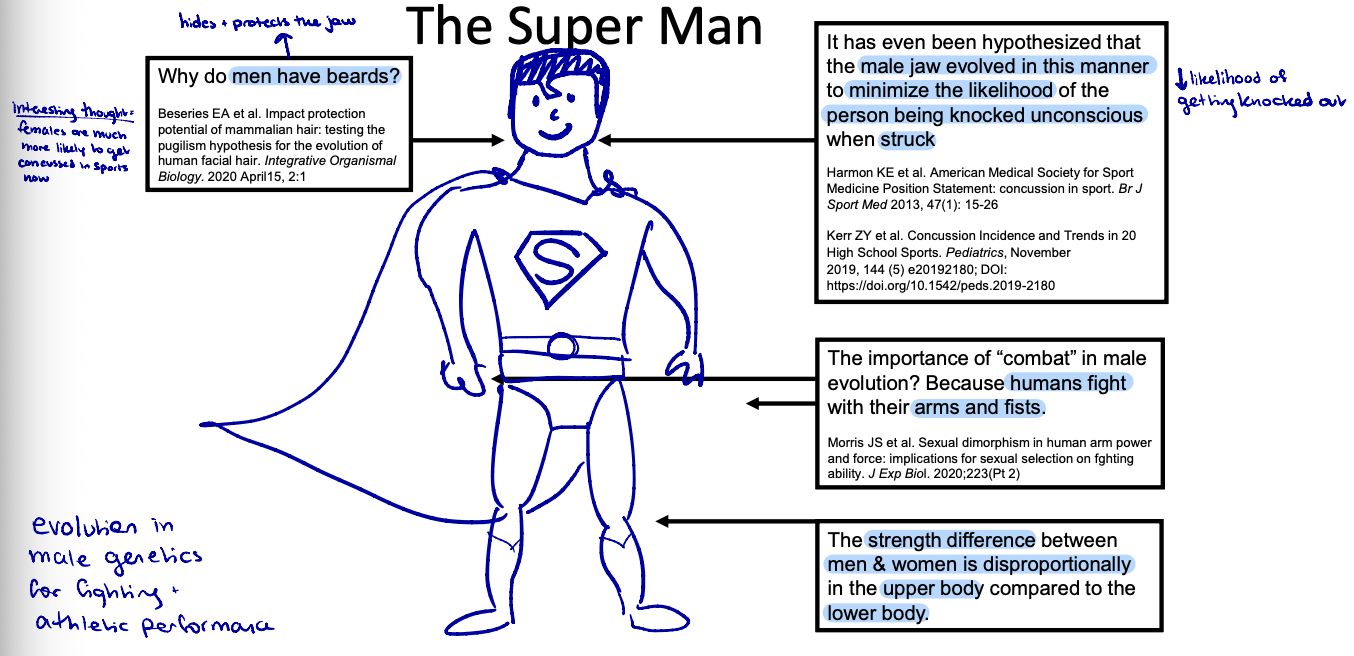
The Super Man
Evolution in male genetics for fighting and athletic performance
Beard: hides and protects the jaw → keeps you from getting knocked out
Females are more likely to get concussed in sports
Jaw: evolved to ↓ likelihood of getting knocked out
Humans use hands and fists for fighting
Strength difference between men/women is disproportionate in upper vs. lower body
History of “War” in Male Genetics
Winners get to procreate, losers die
Minor changes in number of reproducing females and a more stable female population
Dramatic reduction in number of reproducing males (ratio of 1:17)
Violent intergroup competition preferentially taking place between members of male descent groups
Group extinction → extinction of lineages
T&F world records
males are significantly faster (~10-12%)
Roger Bannister
Makes history in 1954 by becoming first human to run a mile in <4 min
Since then, ~1400 male runners have gone on to do this
No female has done this yet
Peres Jepchirchir
WR holder in women’s only marathon
2 hr 16 min 16 sec
Her WR time is beaten by 250-300 different men every year
Christian Coleman
Won gold medal in 100m at 2019 world championships
That season, ~2500 men ran times to beat the female gold medalist
Male vs. Female: Voice types
Female singers:
Pitch ~160-300 Hertz
Soprano, mezzo-soprano, contralto
Male singers:
Pitch ~60-180 Hertz
Tenor, baritone, bass
Behaviour and Testosterone
Classic behavioural change with anabolic steroids → ↑ increased aggression
However, anywhere from ~20% of normal levels to 2x normal is largely unpredictive of anything
↓ testosterone to 0 → ↓ aggression (seen with animal castration)
“Roid rage” → test levels 4x+ higher
Obviously many factors contributing to predisposition for aggressive behaviour:
Nature: brain structures (amygdala, etc)
Nurture: traumatic incidents in childhood, etc.
Behaviour and Biological Sex
150 studies of over 100,000 subjects
Different categories of risk taking behaviour were evaluated and men finished ahead of women in 14/16 categories
One of the ties → smoking
“Men are by far the more reckless sex” - ↑ recklessness and risk-taking behaviour
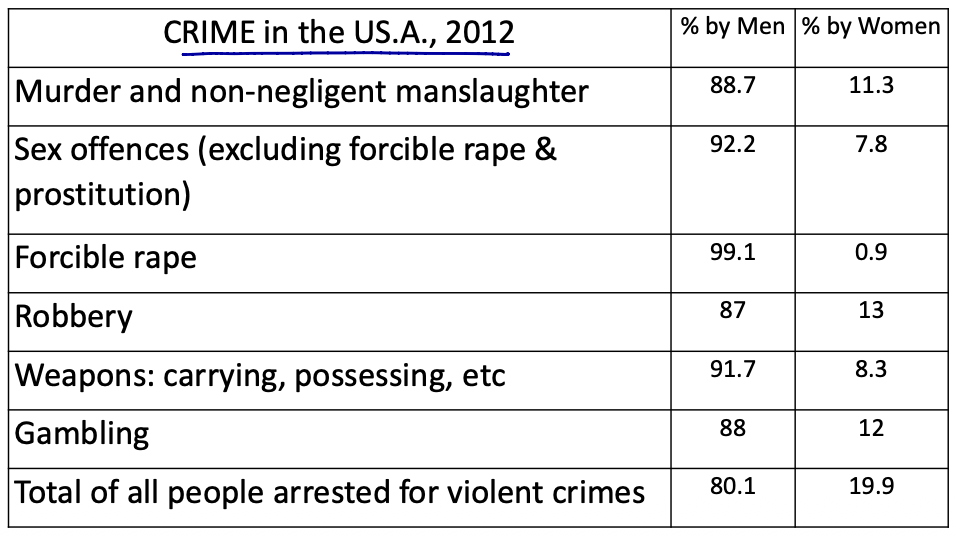
Behaviour & Biological Sex: Crime
Men commit the overwhelming majority of violent crimes
Firearms: men and boys are 2/3 victims and 9/10 people accused of firearm related violence
Executions: 883 total, 13 women (1.5%)
Held up across multiple countries (nurture may not play as much of a role)
Behaviour & Biological Sex: Jobs
Men die in occupational jobs far more than women
Dominate top 20 most dangerous jobs in %
Behaviour & Biological Sex: Darwin awards
Award given for dying the stupidest death
Men are way more likely to receive this award (90%)
Women: 10%
Shark Attacks
More than 80% of recorded shark bites in history happened to men
According to recent data, more females are being bitten
Attributable to more women gaining equality and engaging in water sports
Cross of Valour/Star of Courage
Two highest honours for bravery available for Canadian citizens
Since 1972:
484 recipients: 437 men, 47 women
Risk-taking can sometimes be beneficial (saving someone who fell in ice, running into burning building)
Behaviour: control for environment?
Sampled ~80,000 people from 76 countries
6 fundamental preferences
Men were more likely to be risk-taking and more willing to punish negative actions
Differences become more pronounced in countries with increased levels of economic development/gender equality
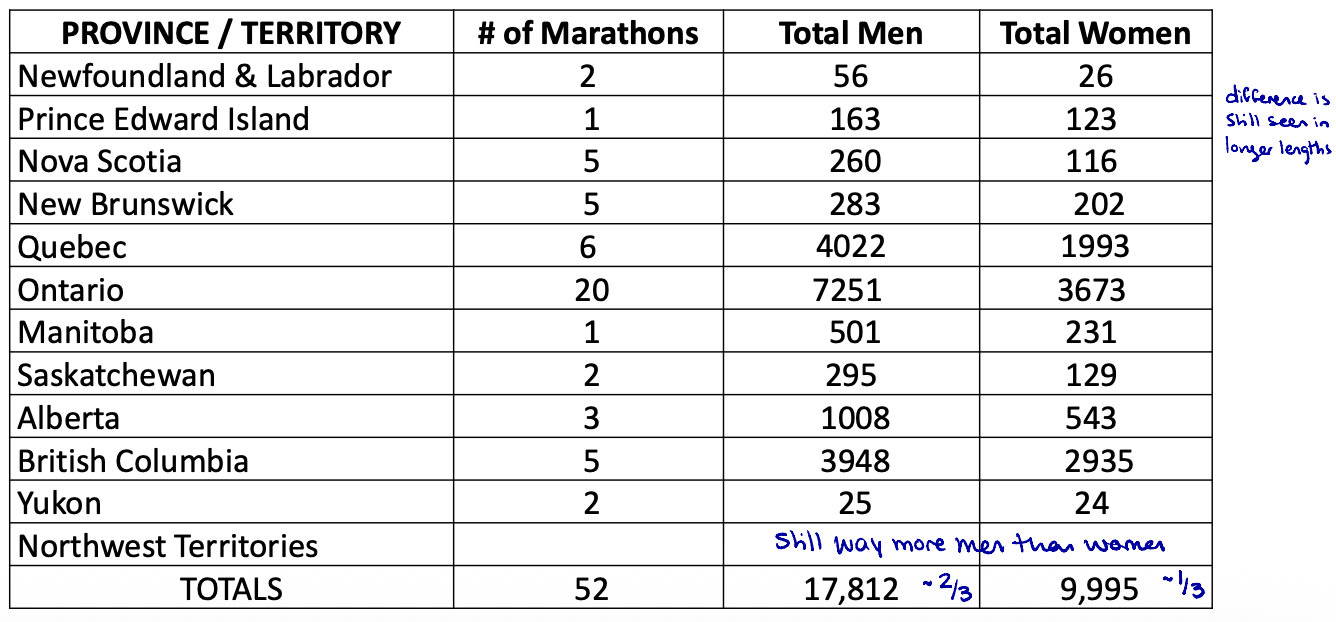
Marathon Participation in 2019
Large difference between male and female participation
2/3 male, 1/3 female across Canada
Participation in Shorter Races?
Way more women competed in Toronto 10k than men
Shorter distance → ↑ women
3 pillars of evolutionary biology
Variability
Heritability
Differential reproductive success
Variability
Not all members of a species are exactly the same
They differ across many traits
Height, intelligence, etc.
Heritability
Some portion of some traits are attributable to genes passed down from parents to offsprint
Differential reproductive success
Not everyone has the same number of kids
↑ # of kids → ↑ success (genes passed down)
How much can an individual procreate?
Genghis Khan
DNA is still seen today (he lived 1000s of years ago)
Was a conqueror - lots of free time
Some lady from 1400s
69 kids (27 births) → 16 pairs of twins, 7 sets of triplets, 4 sets of quadruplets
Could not do anything else in life
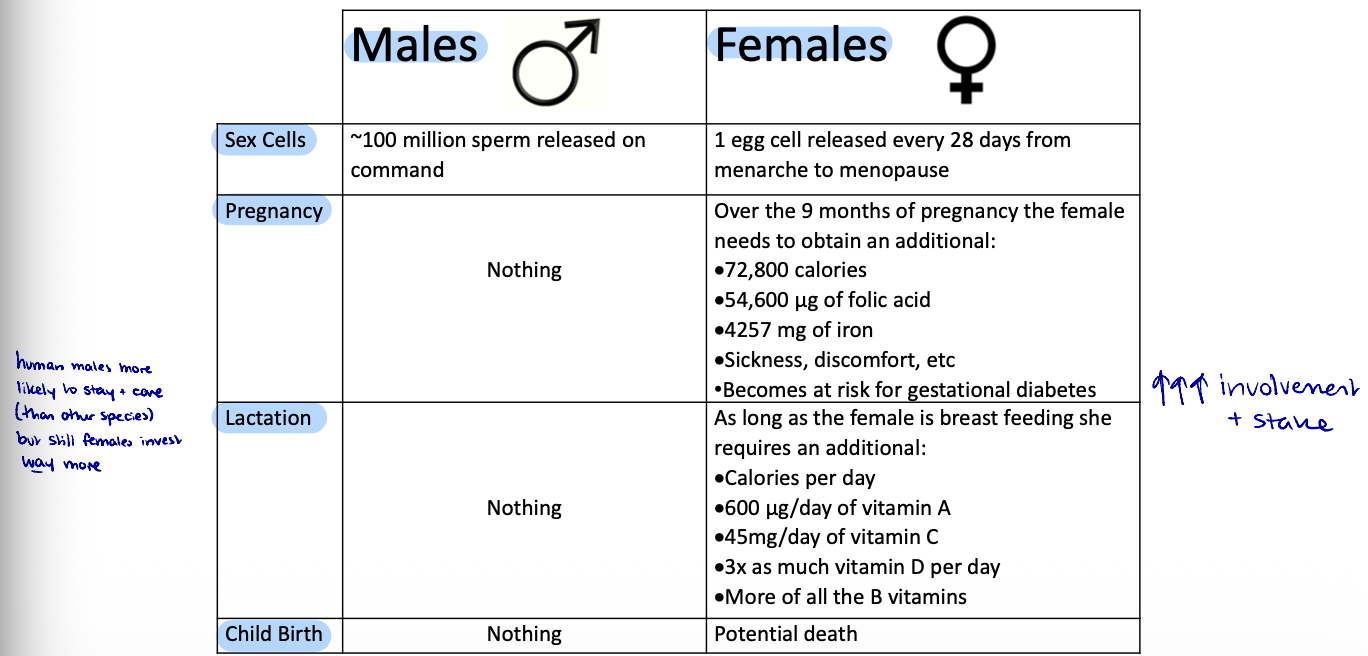
Cost of Getting Genes into Next Generation
Males:
Voluntary release sperm
No cost for pregnancy, lactation or childbirth
Females:
1 egg cell/28 days from menarche-menopause
Need 72800 calories, extra folic acid, iron, physical illness during pregancy
Need extra calories and vitamins during lactation
Potential death during childbirth
Modern Pregnancy-Related Deaths (USA)
CDC data with PMSS for 2011-15 analyzed
~700 women die from pregnancy-related complications in US every year
Translates to 17.2 deaths per 100k live births
Significant racial/ethnic disparities
↑ for African American, Native American and Alaska native women
How many mammals are there?
>6000 species of mammals
Not all live in “social groups”
Authors analyzed 76 social species to determine which sex occupied “leadership role”
Females: leaders in 8 species (10.5%)
Challenge Hypothesis
Developed in 1990
Explained 3 seasonal fluctuations in testosterone observed in birds:
Levels lowest in non-breeding season
Testosterone increases at start of breeding season
Physiological max testosterone level reached when male-male competitive interactions happened
Subsequent meta-analysis in human males → simulated competitions influence testosterone
Winning → ↑ testosterone
Differences in Toy Preference
Meta-analysis in 16 studies from multiple locations
Children overwhelmingly chose to play with toys typed to their gender
Meta-regression showed no significant effect of presence of an adult, study context, geographical location of study, publication date, child’s age, inclusion of gender neutral toys
Compared interactions of 34 rhesus monkeys with human wheeled toys and plush toys
Male monkeys showed consistent, stronger preference for wheeled toys
Female monkeys showed greater variability in preferences
Nature seems to have a greater effect
Sexual Dimorphism
Condition where 2 sexes of the same species exhibit different characteristics
Ie. size, colour, markings, other features
Usually resulting from sexual selection
Dimorphism often allows males to fight for females
Ex. elephant seals: giant nose
Hyenas: Exception
Hyena procreation is bizarre and dictated by the female
Fallacy of logic → exception proving the rule
Law of parsimony
Principle that the simplest explanation of an extent or observation is the preferred explanation
“if you hear hoofbeats, think horses, not zebras”
Comparing Male vs. Female athletes
Christine Sinclair: greatest Canadian football player of all time
But… overlooked due to being a woman
People think Alphonso Davies is greater simply because he is a man
It is not productive to compare male vs. female athletes
Representation in Healthcare
Important to discuss biological sex differences for purpose of representation
Women are not just smaller men → research is not translatable
Studying women is crucial for diagnosis and treatment → pathologies differ (ex. heart attack)
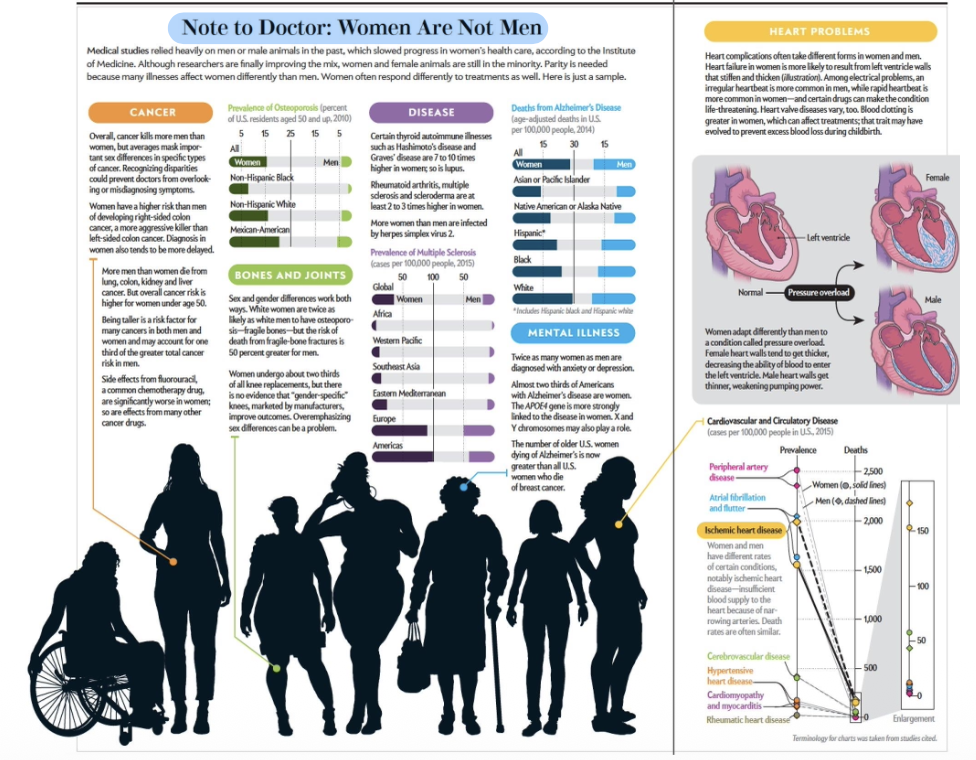
Diseasing with Differing Prevalence in Men vs. Women
Some are obvious:
Organ specific cancers (breast, ovarian, prostate)
Disorders associated with menstrual cycle
Others are less obvious:
ADHD prevalence greated in males
1/5 and 1/3 women break bone due to osteoporosis in their lifetime
Nearly 60% of all people with arthritis are women
75-90% of people with fibromyalgia are women
Global incidence of depression (2010) was 5.5% for women and 3.2% for men
1.7x more common in women
Other types of “pain” disorders are more common in women
Ex. migraines, IBS, anxiety, UTIs
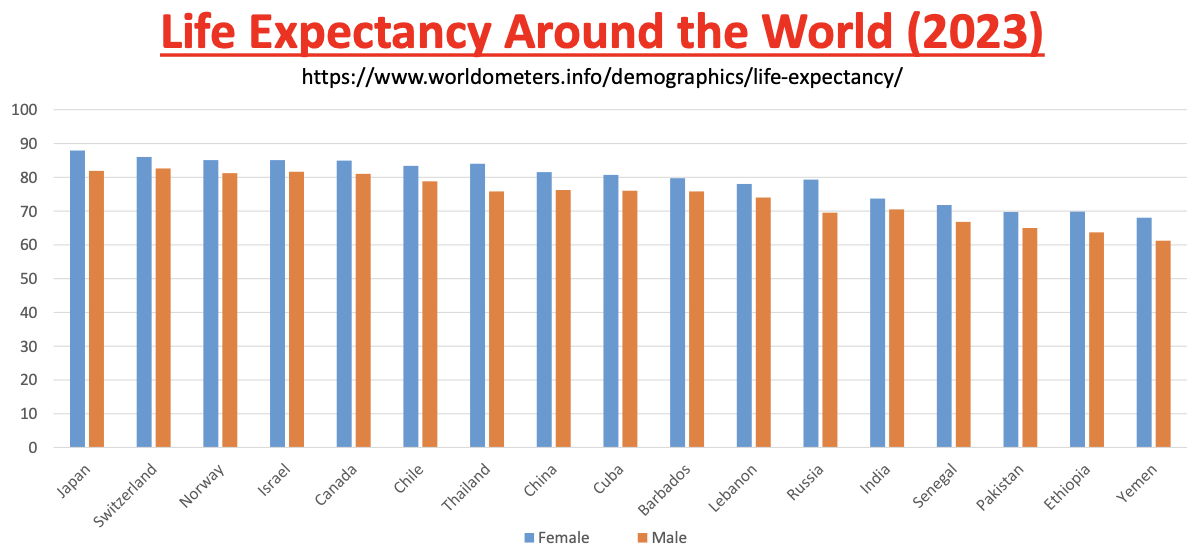
Life Expectancy Trends
Women live longer than men
“Straw Man” Fallacy of Logic
Misrepresenting, exaggerating, or just completely fabricating your opponent’s arguments, usually as something extreme or easy to argue about
Change subject and make a statement that is hard to argue
Transgender
Describes a psychological identification with the gender that is different from the person’s gender as assigned at birth
Intersex
Refers to persons born with congenital conditions in which development of chromosomal gonadal or anatomic sex is atypical
Timeline of gender testing in sports
1928: women are allowed to compete in track and field at Olympics
Occasional spot checks for external genitalia → obviously discouraged women from signing up
1968: advent of chromosome testing
Males = XY, females = XX
Problem is that human chromosomes don’t always divide into binary groups (ie. intersex)
2011: IAAF implements regulations based on hyperandrogenism with the key metric being functional testosterone
Measure test levels to distinguish M vs. F
Consensus meeting on sex reassignment and hyperandrogenism (2015)
Those who transition from female to male are eligible to compete in the male category without restriction
Those who transition from male to female are eligible to compete in the female category under the following conditions
Athlete has declared that her gender identity is female (min. 4 years)
Total serum test level has been <10 nmol/L for at least 12 months prior to first competition
Total serum test level stays below <10 nmol/L throughout competition
Compliance with these conditions may be monitored by testing
Eligibility regulations for female classification (2018)
Any athlete with difference in sexual development (DSD) must meet the following criteria to be eligible to compete in restricted events (400m-mile) in an international competition:
Must be recognized by law as female or intersex
Must reduce her blood test level to <5 nmol/L for a continuous period of 6+ months
Must maintain blood testosterone <5 nmol/L continuously (whether in/out of competition)
REDUCED cutoffs
Why pick on testosterone?
“To the best of our knowledge, there is no other genetic or biological trait encountered in female athletics that confers such a huge performance advantage”
Which is why FTM athletes compete with no restrictions, while MTF face pitfalls
Do Serum Androgens Influence Athletic Performance?
2127 observations of competition best performances and serum androgen concentrations
Obtained in 2011-2013 IAAF World Championships
Argument against allowing high T women:
Women in lowest free test group performed significantly worse than women in highest group in 400m, 400m hurdles, 800m, hammer throw, pole vault
Argument in favour of allowing high T women:
Many other events showed no difference
This pattern was not found in any of the male athletic events
8 trans female distance runners
7/8 runners experienced significant slowing of race times from 5k-marathon distance
The 1 runner improving also lost 20 pounds and significantly increased training
Serum Androgens and Performance: USAF
29 trans men and 46 trans women who started gender affirming hormones while in the US Air Force
Compare pre- and post-hormone fitness results of athletes with average performance of all men and women under age of 30 in USAF between 2004-24
Conclusions:
Prior to hormones, trans women performed 31% more pushups, 15% more situps and ran 21% faster (↑ performance)
After two years of taking hormones, pushup and situp differences disappeared but trans women were still 12% faster (still slight ↑ performance despite ↓ test levels)