Bonding and structure
 Call Kai
 Learn
Learn Practice Test
 Spaced Repetition
 Match
Match Flashcards
 Knowt Play
1/23

Earn XP
Description and Tags
Chapter 6
Name | Mastery | Learn | Test | Matching | Spaced | Call with Kai |
|---|
No analytics yet
Send a link to your students to track their progress
24 Terms
Ionic bonding
Ionic bonding is the strong electrostatic attraction between positive cation and negative anion. This can be represented by dot and cross diagrams.
Solid structures result from giant ionic lattices resulting from oppositely charged ions strongly attracted in all directions (for example NaCl)
Effect of structure and bonding on physical properties of ionic compounds
Melting and boiling points:
Strong electrostatic forces of attraction in the giant ionic lattice in all directions requiring high energy to break and overcome
Solubility:
Ionic compounds are soluble becuase the H2O is polar and surrounds the ions and can form hydrogen bonds with it thus dissolving it
Electrical conductivity:
Solid are fixed ions so cannot conduct but aqueous and liquid have freely moving charged particles therefore can conduct electricity
Covalent bond
Strong electrostatic attraction between a shared pair of electrons and the nuclei of the bonded atoms
Dative bond
Coordinate/ dative bonding is a covalent bond between two atoms where both electrons are supplied by one of the two shown by an arrow from giver to reciver
Average bond enthalpy
Average bond enthalpy = the mean energy required to break 1 mole of a covalent bond in the gaseous state, averaged over different compounds
It is a measure of covalent bond strength (higher value = stronger bond)
Always refers to bond breaking (endothermic process)
VSEPR theory:
Electron pairs around a central atom repel each other and arrange to be as far apart as possible to reduce electron repulsion
Repulsion strength:
lone pair–lone pair > lone pair–bond pair > bond pair–bond pair
lone pairs repel more strongly, reducing bond angles (by 2.5 degrees)
Bond shapes and angles
Linear → 2 electron pairs → 180°
Non-linear (bent) → 2 bonding pairs + lone pairs → angle < 120° or < 109.5°
Trigonal planar → 3 electron pairs → 120°
Pyramidal (trigonal pyramidal) → 3 bonding pairs + 1 lone pair → ~107°
Tetrahedral → 4 electron pairs → 109.5°
Octahedral → 6 electron pairs → 90°
NH3 and H2O bond angles
Ammonia, NH₃:
Shape: trigonal pyramidal
Bonding pairs: 3
Lone pairs: 1
Lone pair reduces bond angle by 2.5 from 109.5 to 107
Water, H₂O:
Shape: bent (V-shaped)
Bonding pairs: 2
Lone pairs: 2
Two lone pairs reduce bond angle by 2.5 × 2 from 109.5 to 104.
Electronegativity and Pauling scale
The ability of an atom to attract the bonding electrons in a covalent bond (increases towards F)
The Pauling scale compares electronegativity values of two atoms by finding the difference, which is used to judge bond type (small difference = covalent, large difference = ionic).
A small difference (~0–0.4) means non-polar covalent, moderate (~0.4–1.7) means polar covalent, and a large difference (>1.7) suggests ionic bonding.
Polarity and permanent dipoles
Permenant dipoles are within atoms in molecules containing covalently bonded atoms with different electronegativity values which causes a polar bond
A polar moelcule and overall dipole is when there is a permenant dipole and the molecular shape is not symetrical which means the dipoles do not cancel out (for example bent H2O compared to linear CO2)
Permanent dipole–dipole forces (van der Waals)
Occur between polar molecules with a permanent uneven charge distribution
Molecules have partial charges (δ⁺ and δ⁻)
Attraction occurs between δ⁺ end of one molecule and δ⁻ end of another
Requires polar bonds + asymmetrical shape
Stronger than London forces but weaker than hydrogen bonding
Strength increases with greater molecular polarity
Induced dipole–dipole forces (London/dispersion vandervall forces)
Occur in all molecules and atoms, including non-polar ones
Caused by temporary fluctuations in electron distribution
Creates an instantaneous dipole which induces a dipole in nearby particles (electron repulsion)
Always present but weak individually
Strength increases with:
more electrons (larger molecules)
greater surface area (longer/less branched molecules)Often the only intermolecular force in non-polar substances
Hydrogen bonding
Strong intermolecular force between molecules containing N–H, O–H or F–H bonds
Occurs when H is bonded to N, O, or F (very electronegative atoms)
Causes a strong attraction between δ⁺ hydrogen of one molecule and a lone pair on N, O, or F in another molecule
Much stronger than other van der Waals’ forces but weaker than covalent bonds (more energy to overcome)
Density of ice vs water
Density of ice vs water:
In ice, hydrogen bonds form a rigid open lattice structure
Molecules are held further apart than in liquid water due to hydrogen bonds
Therefore ice is less dense than water and floats
Higher melting and boiling points (relative) H2O
Extra energy is needed to overcome strong hydrogen bonding between water molecules which is stronger than vandervall forces
This requires more heat to separate molecules
Therefore water has unusually high melting and boiling points compared to similar small molecules
Made of discrete covalently bonded molecules arranged in a regular lattice
Molecules are held together by intermolecular forces (permenant dipole, london or hydrogen)
Forces between molecules are weak compared to covalent bonds, so solids often have low melting points and are soft
Simple molecular physical properties
Melting & boiling points:
Lower melting and boiling points as weak intermolecular forces require little energy to overcome
Solubility:
Often insoluble in water if non-polar
May dissolve in non-polar solvents (“like dissolves like”)
Polar molecules may dissolve if they can form intermolecular interactions with water
Electrical conductivity:
Do not conduct electricity
No mobile ions or delocalised electrons
All electrons are held in covalent bonds or within molecules
BF3
Boron has 3 electrons so forms 3 bond pairs
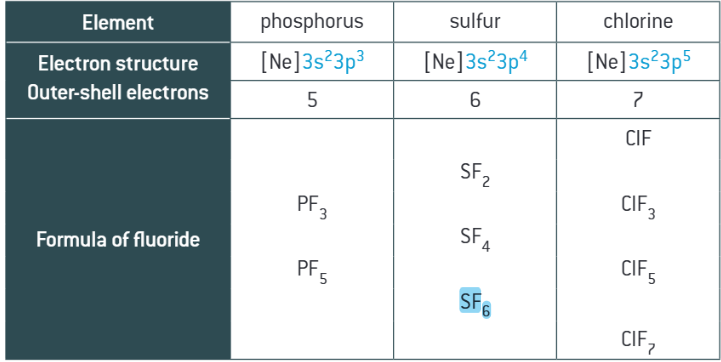
Flouride compounds, sulphur phosphous and chlorine