Strabismus and Ventral Stream - Visual Neurophysiology and Perception Spring 2026
 Call Kai
 Learn
Learn Practice Test
 Spaced Repetition
 Match
Match Flashcards
 Knowt Play
1/126

There's no tags or description
Looks like no tags are added yet.
Name | Mastery | Learn | Test | Matching | Spaced | Call with Kai |
|---|
No analytics yet
Send a link to your students to track their progress
127 Terms
eye turn in early infancy/childhood
What is the etiology of strabismic amblyopia?
esotropia
Strabismic amblyopia is more common for (esotropia/exotropia)
anisometropia
An infant/child with strabismic amblyopia may have concomitant _______
-eye turn of the affected eye
-reduced optotype acuity in the affected eye
-suppression of the affected eye during binocular viewing
-other perceptual signs
-little or no stereopsis
What are the signs and symptoms of strabismic amblyopia?
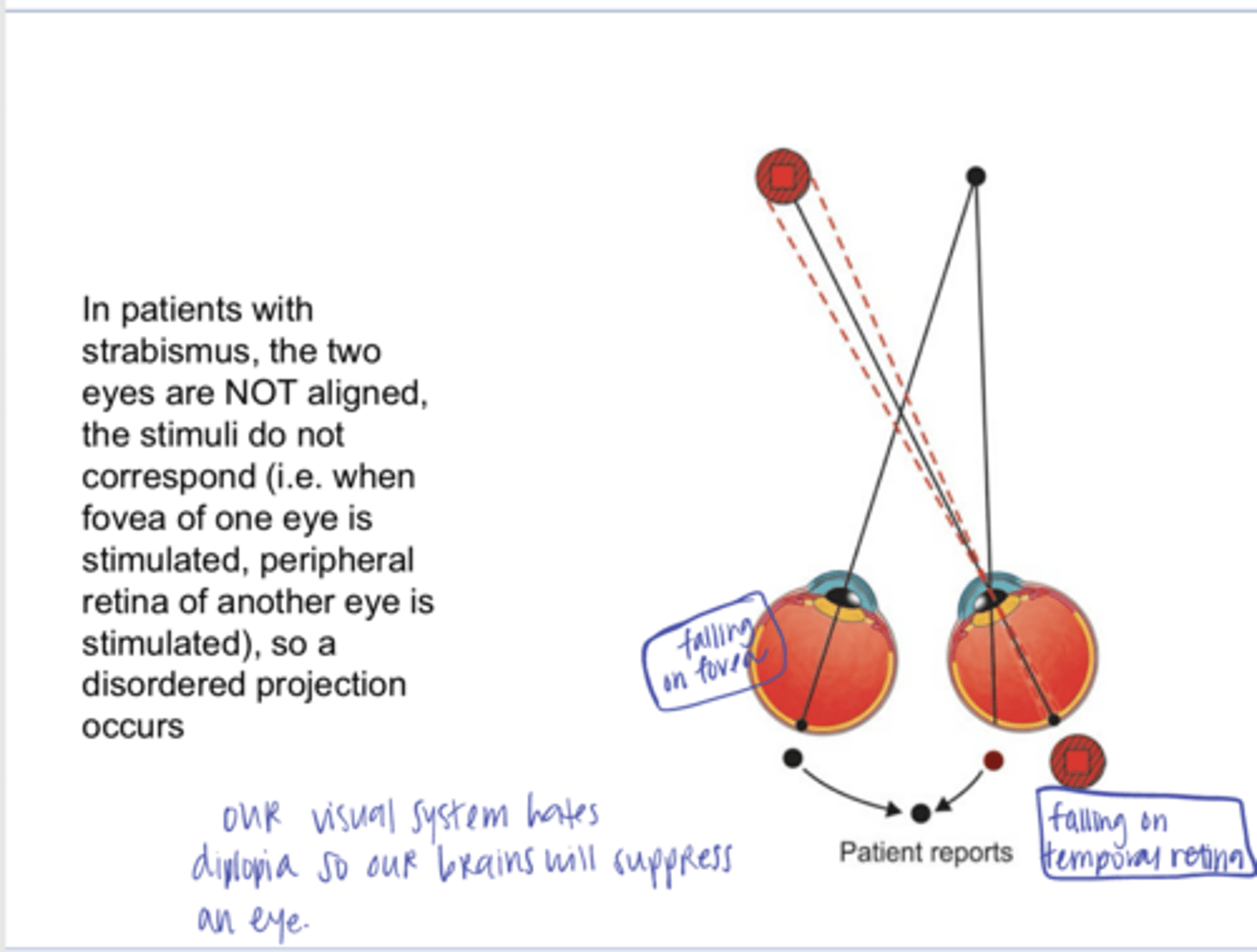
Because of coordinated activity produced by stimulation of similar retinal locations by a given stimulus in the visual field (both foveas responding to a central stimuli)
Why do cells "fire together" after birth?
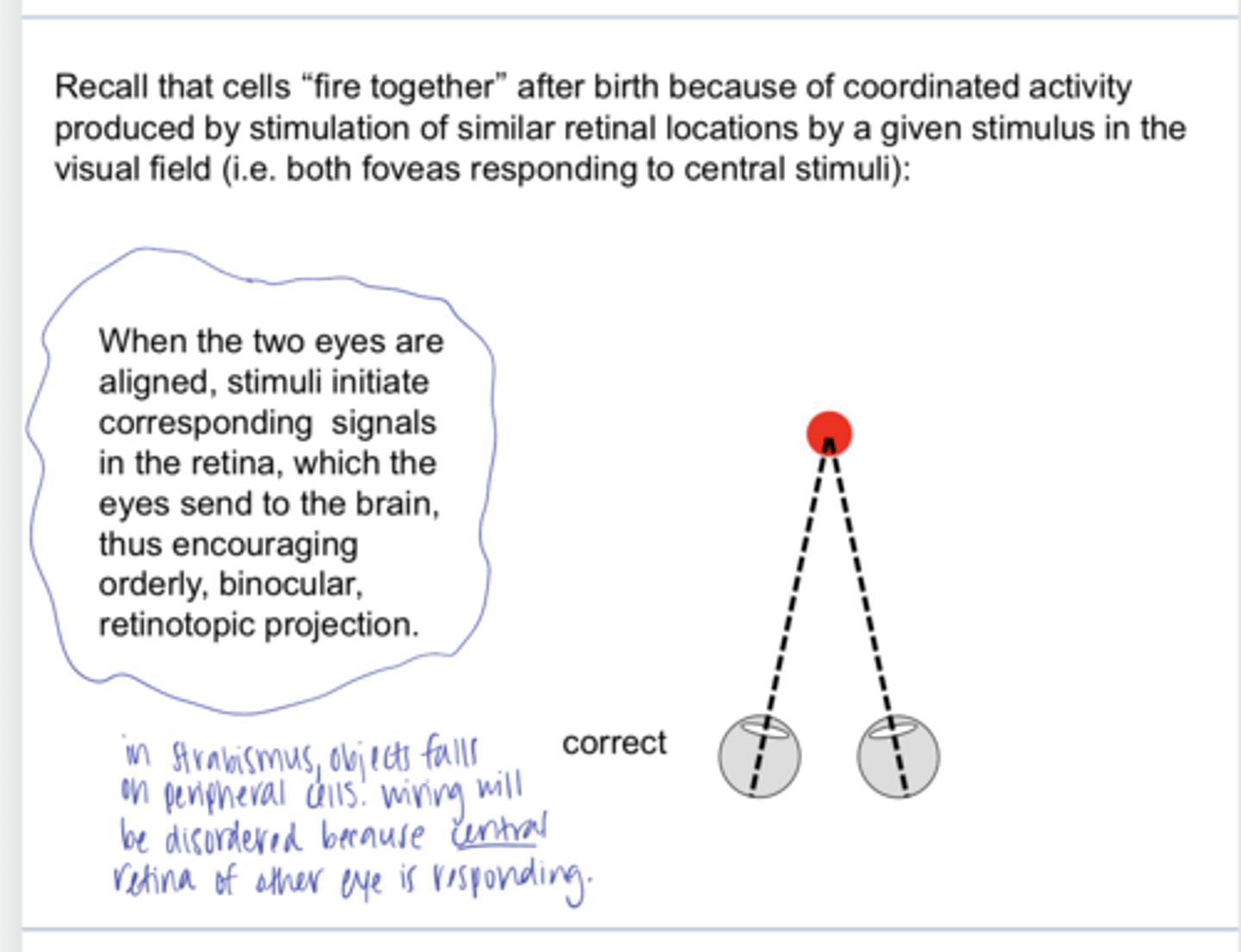
Signals initiate corresponding signals in the retina, which the eyes send to the brain, thus encouraging orderly, binocular, retinotopic projection
When 2 eyes are ALIGNED, what do the signals they receive initiate?
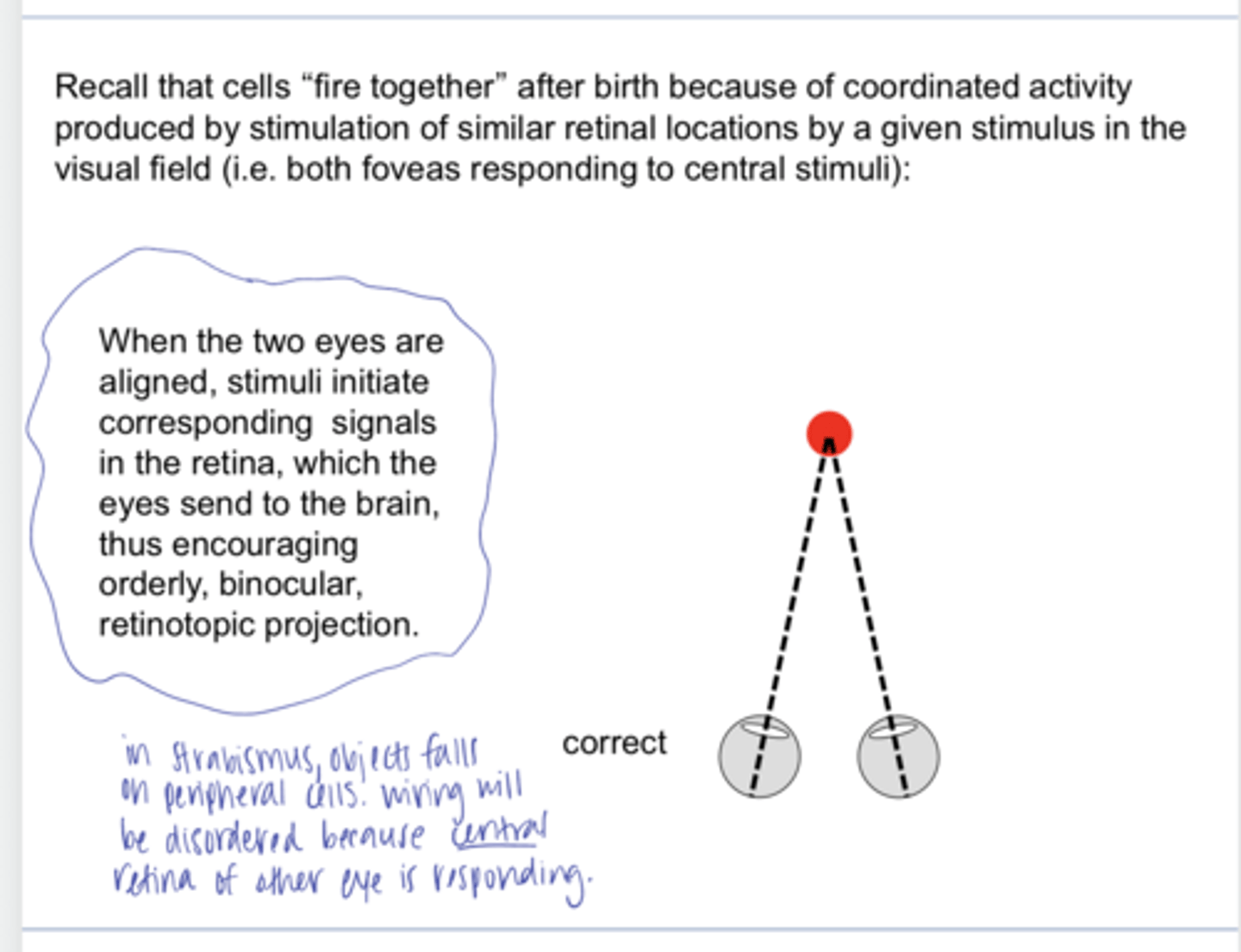
The stimuli DO NOT CORRESPOND. When the fovea of one eye is stimulated, the peripheral retina of the other eye is stimulated at the same time. A disordered projection will occur d/t this.
In patients with strabismus the two eyes are NOT ALIGNED, what are the consequences of this?
prenatal
_________ retinal waves refine the projection to the LGN correctly
Postnatally
_________, an eye turn will make different stimuli fall on the foveas (stimuli are not similar)
the same
Postnatally, an eye turn will make (the same/different) stimuli fall on non-corresponding positions of the 2 retinas
No
Can postnatal stimulation encourage orderly, in-register projection from the 2 eyes?
-Disordered retinotopic map
-Suppression of the turned eye to prevent diplopia
-Perceptual abnormalities
What does post-natal stimulation cause?
suppressed
When a disordered retinotopic map is present d/t the presence of strabismic amblyopia, the turned eye will be ______ to prevent diplopia
dual -- one from each eye
Strabismus produces _____ retinotopic maps and disordered retinotopic projection
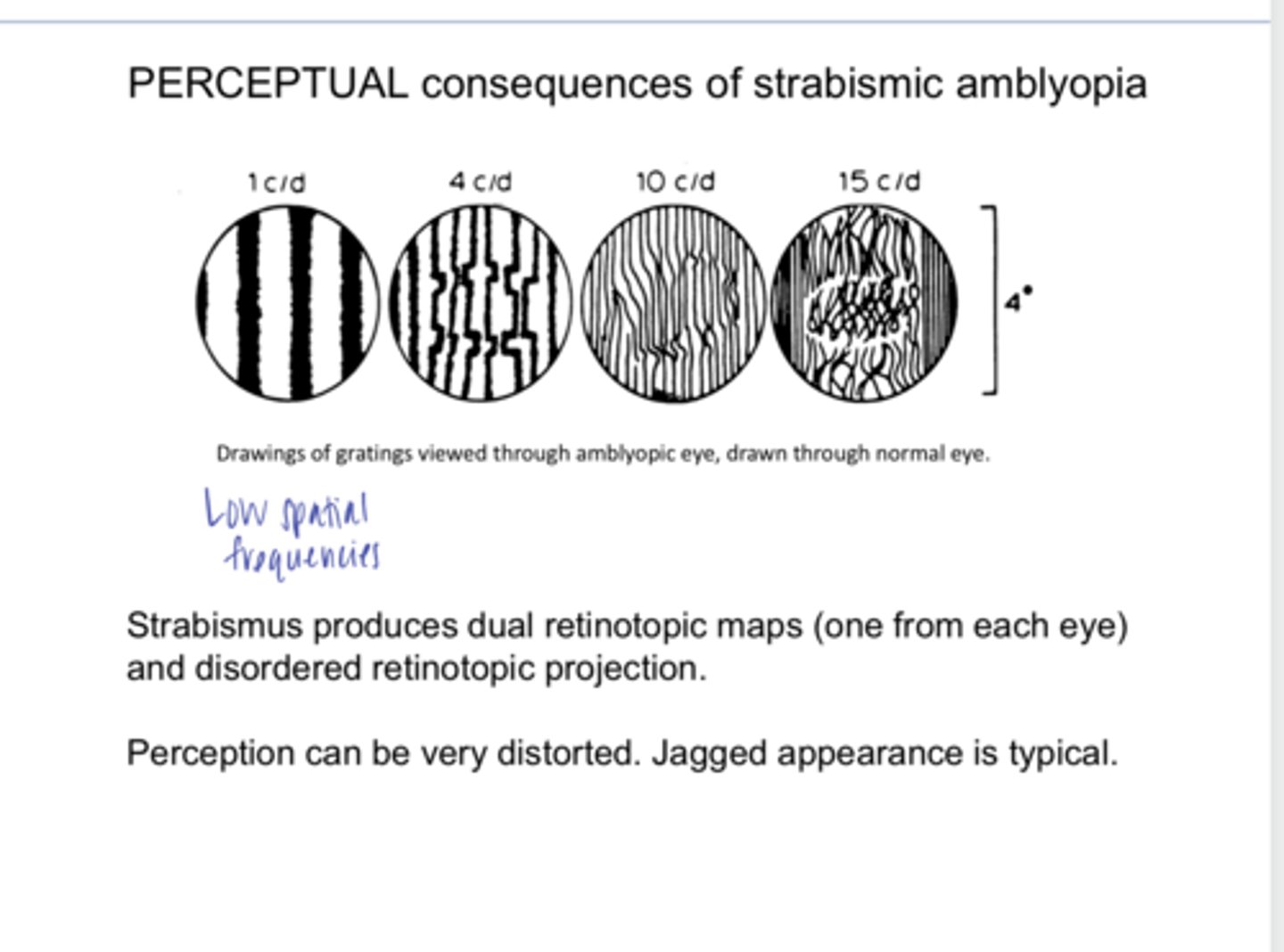
Yes -- jagged appearance of lines is typical
Can perception of images be very distorted in an individual with strabismic amblyopia?
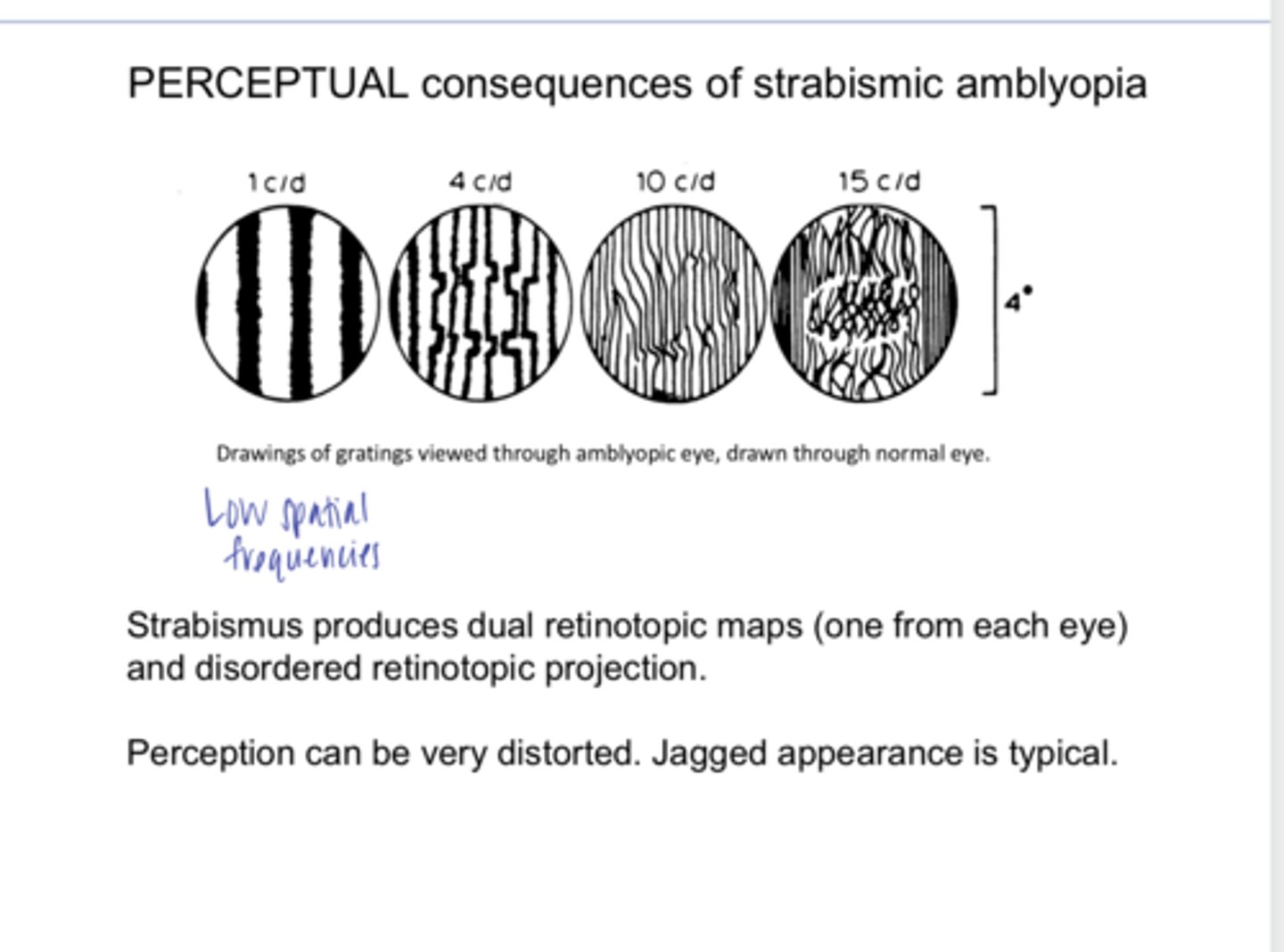
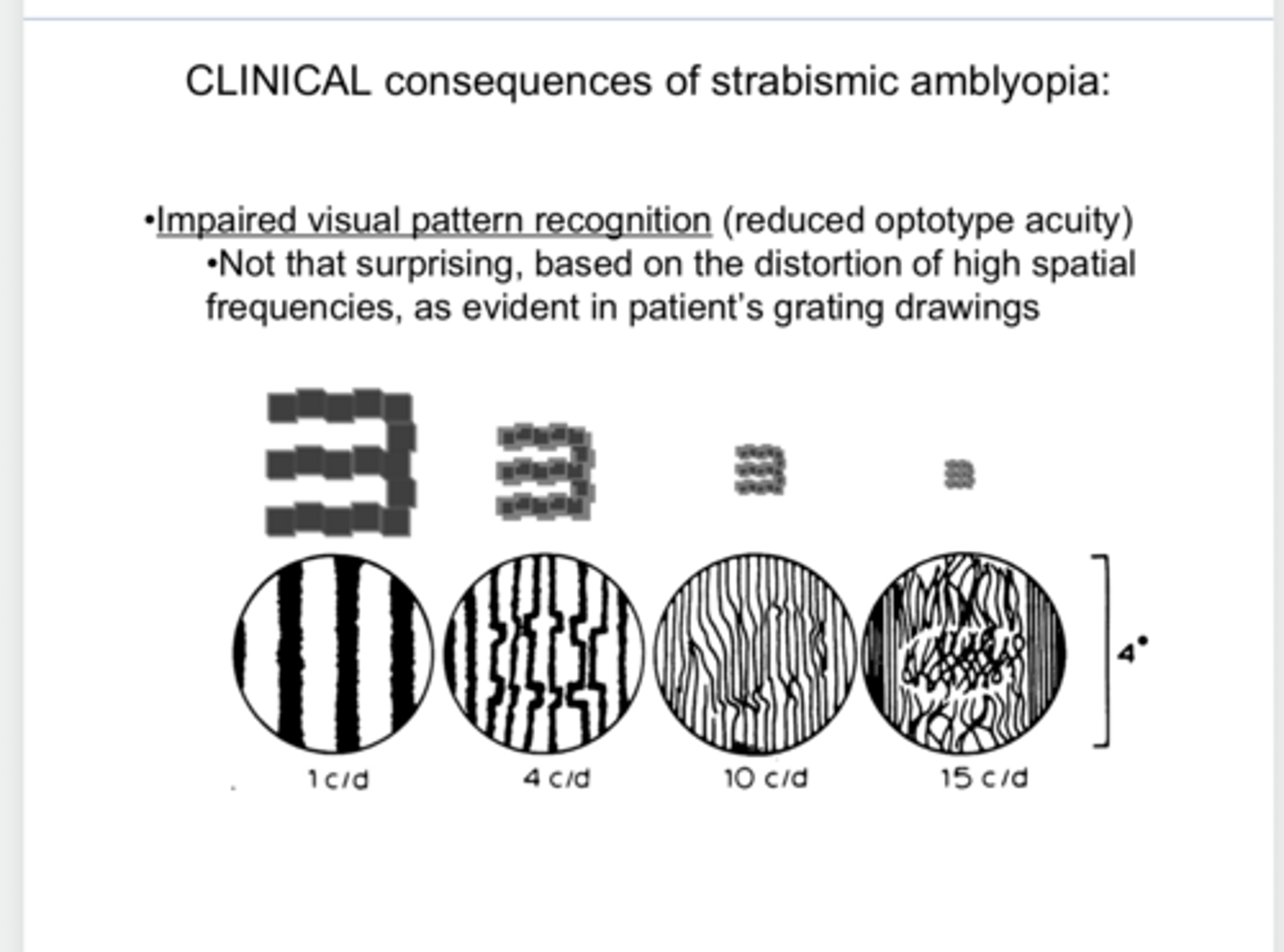
-waves in lines
-jumps in lines
-multiple angles
-interruptions
-scotomas
What are the perceptual consequences of strabismic amblyopia?
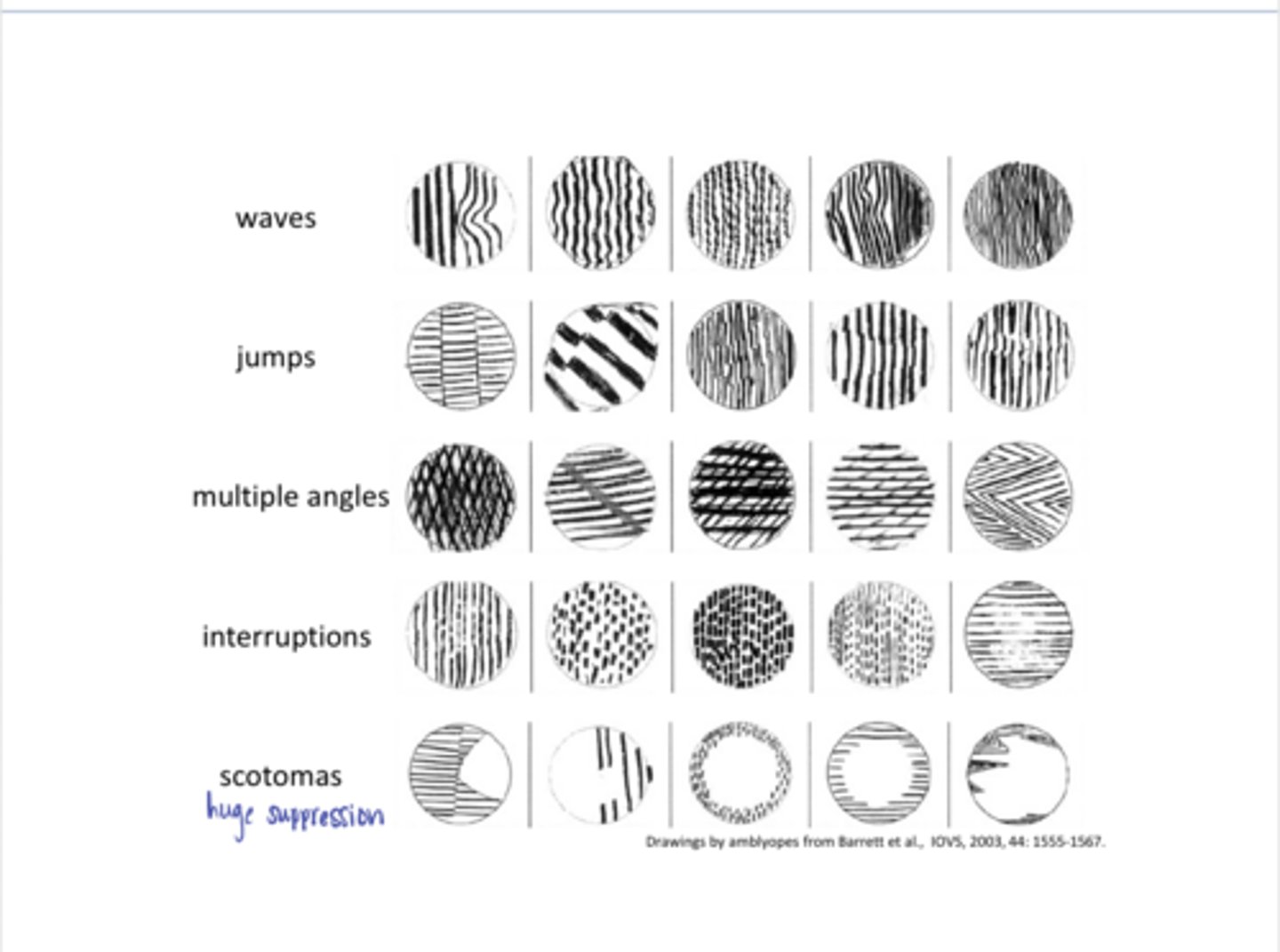
Reduced pattern recognition (reduced optotype acuity)
What is the clinical consequence of strabismic amblyopia on pattern recognition?
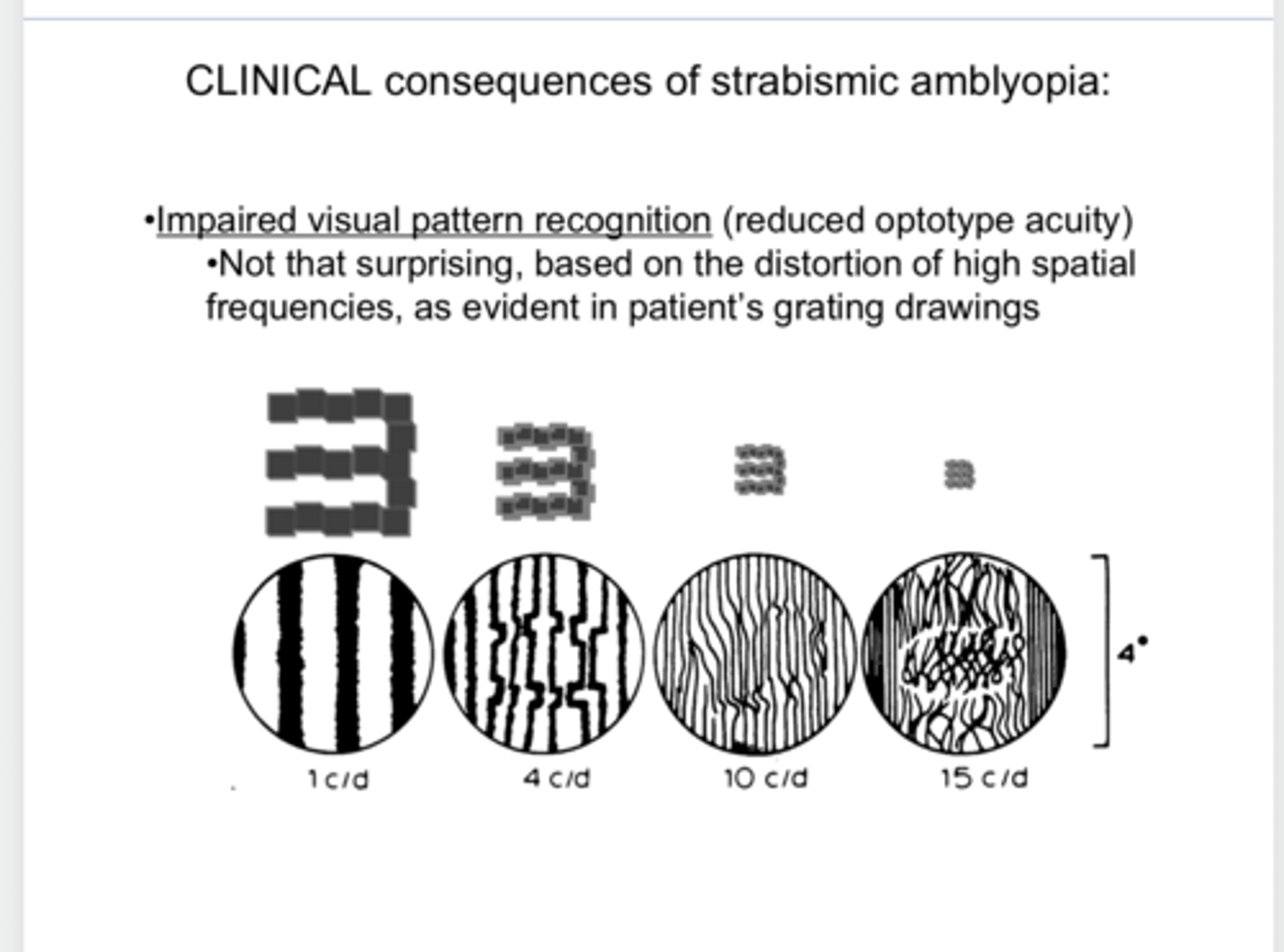
high
Distortion of (high/med/low) spatial frequencies is seen with strabismic amblyopia leading to reduced visual pattern recognition and optotype acuity
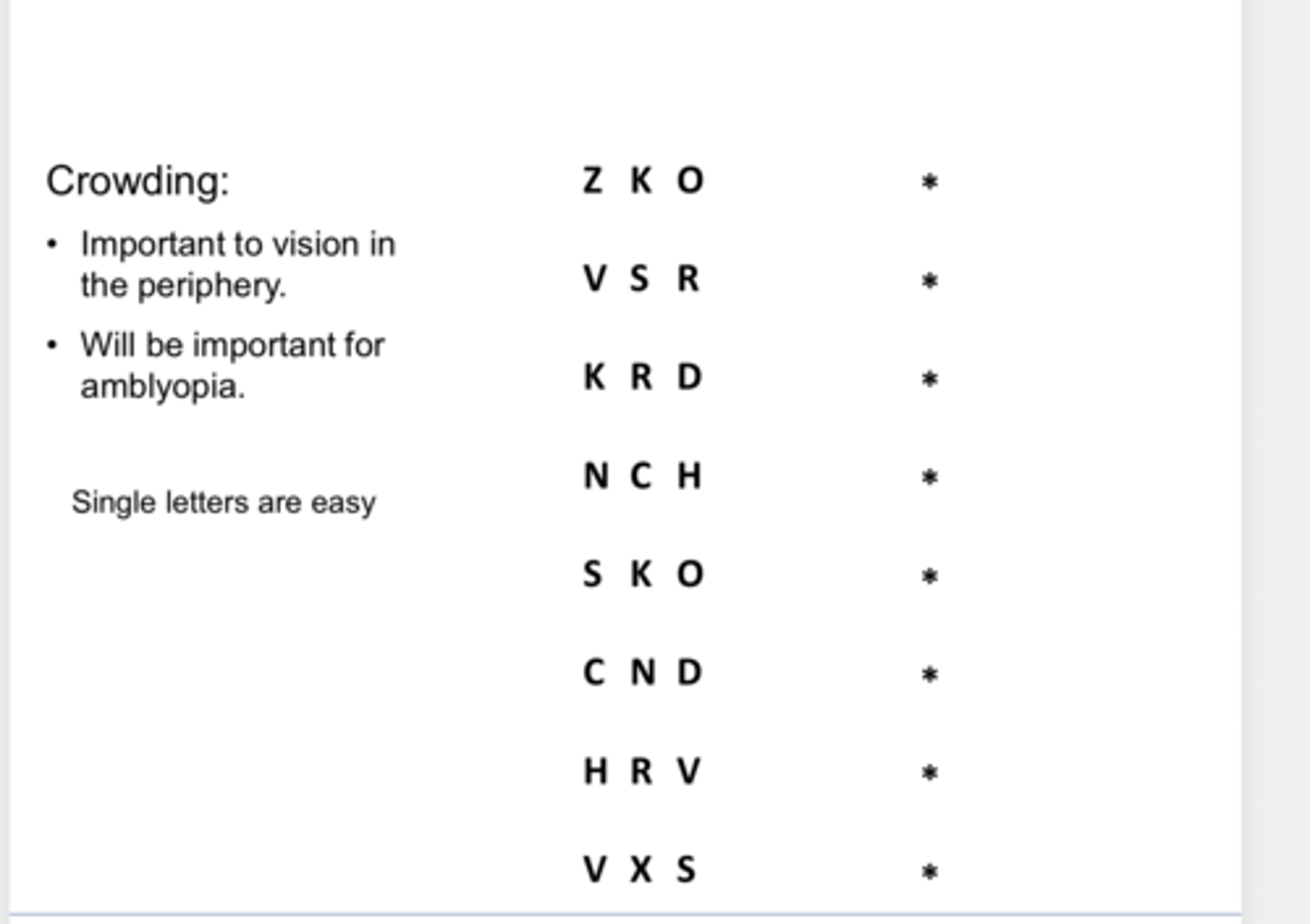
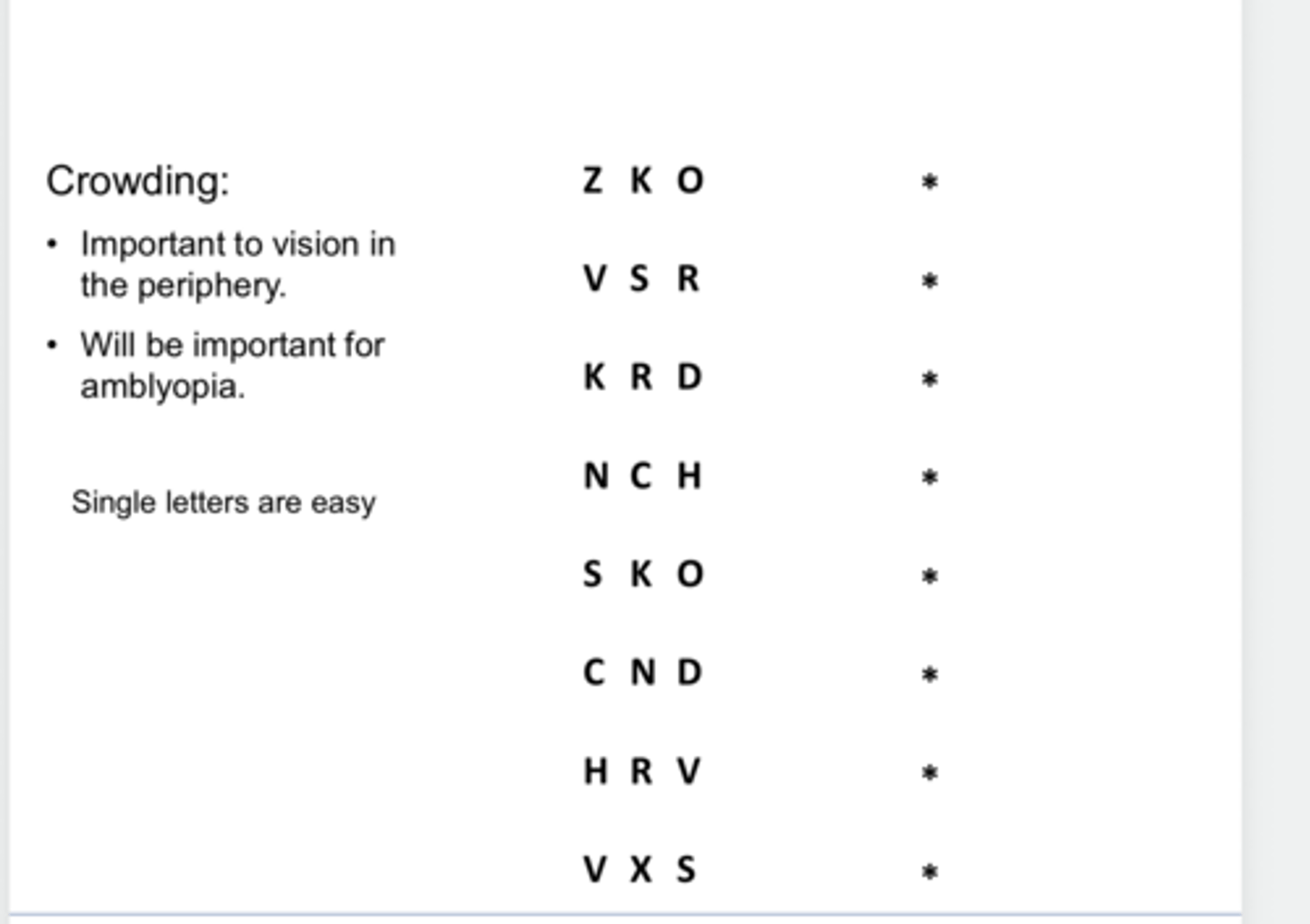
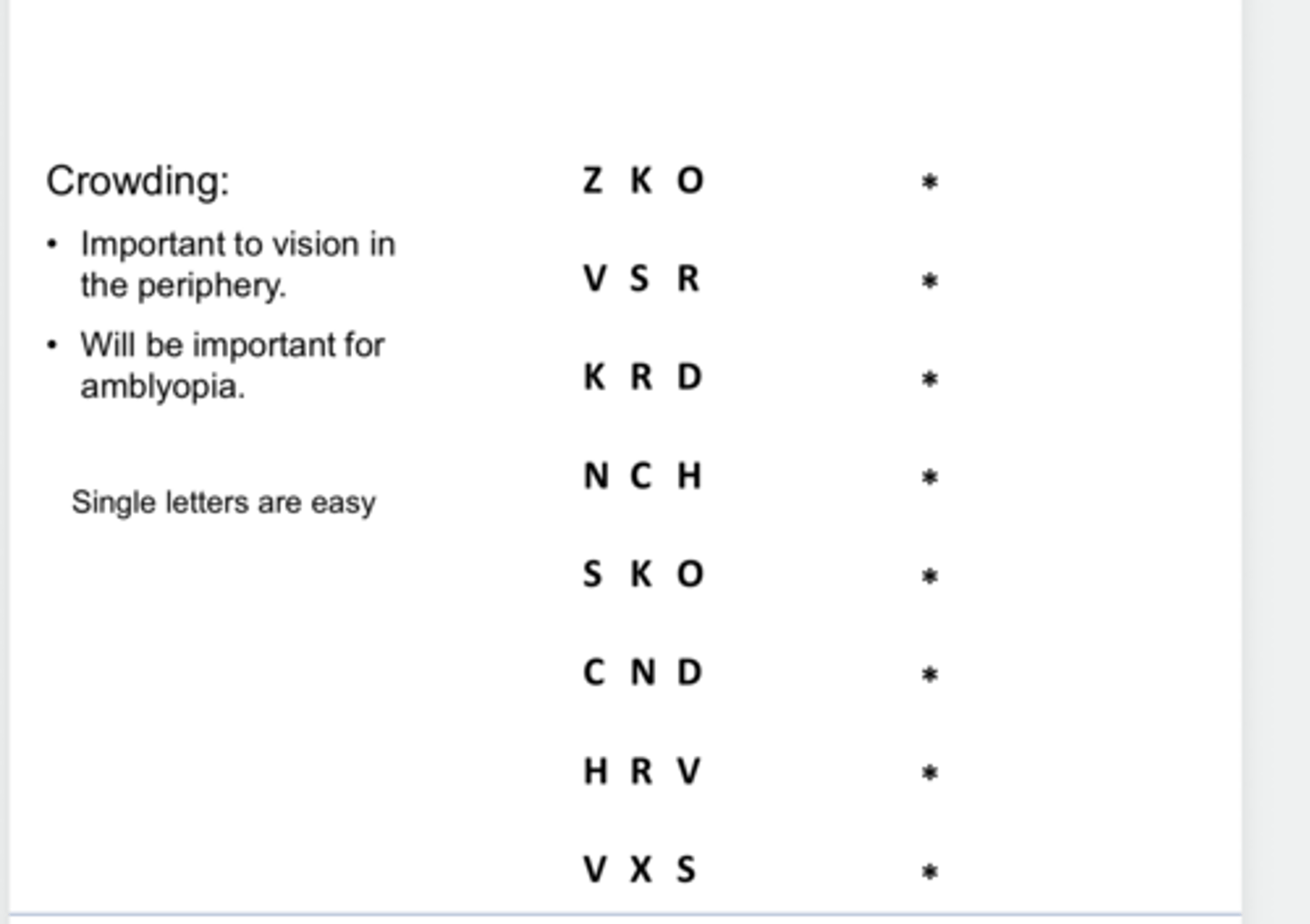
nearby stimulus information obscures attended item (with reduced optotype acuity)
What is the crowding effect as experienced by strabismic amblyopes?
periphery
Crowding is important to vision in the _____
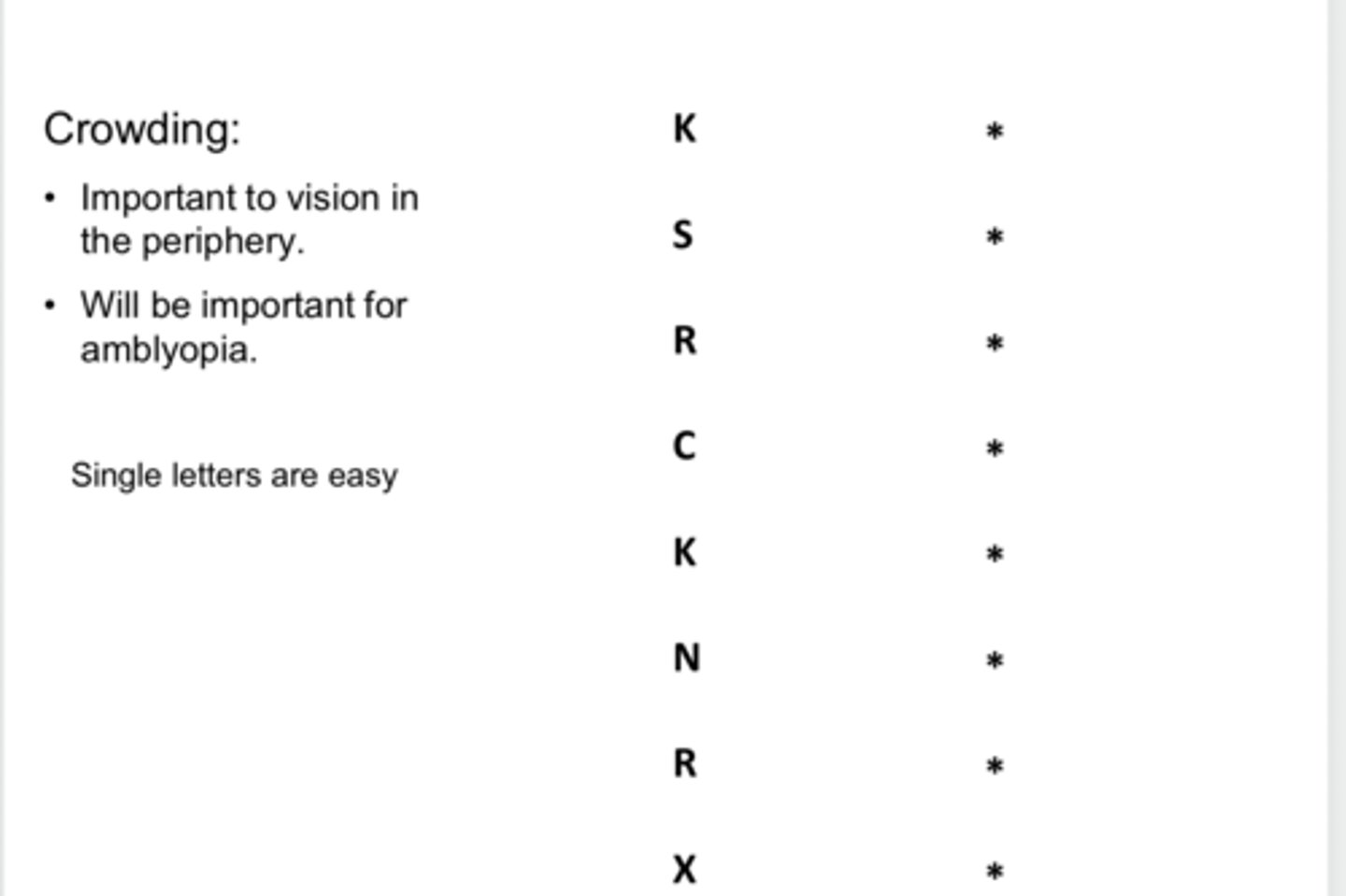
No
Is crowding usually present with foveal vision?
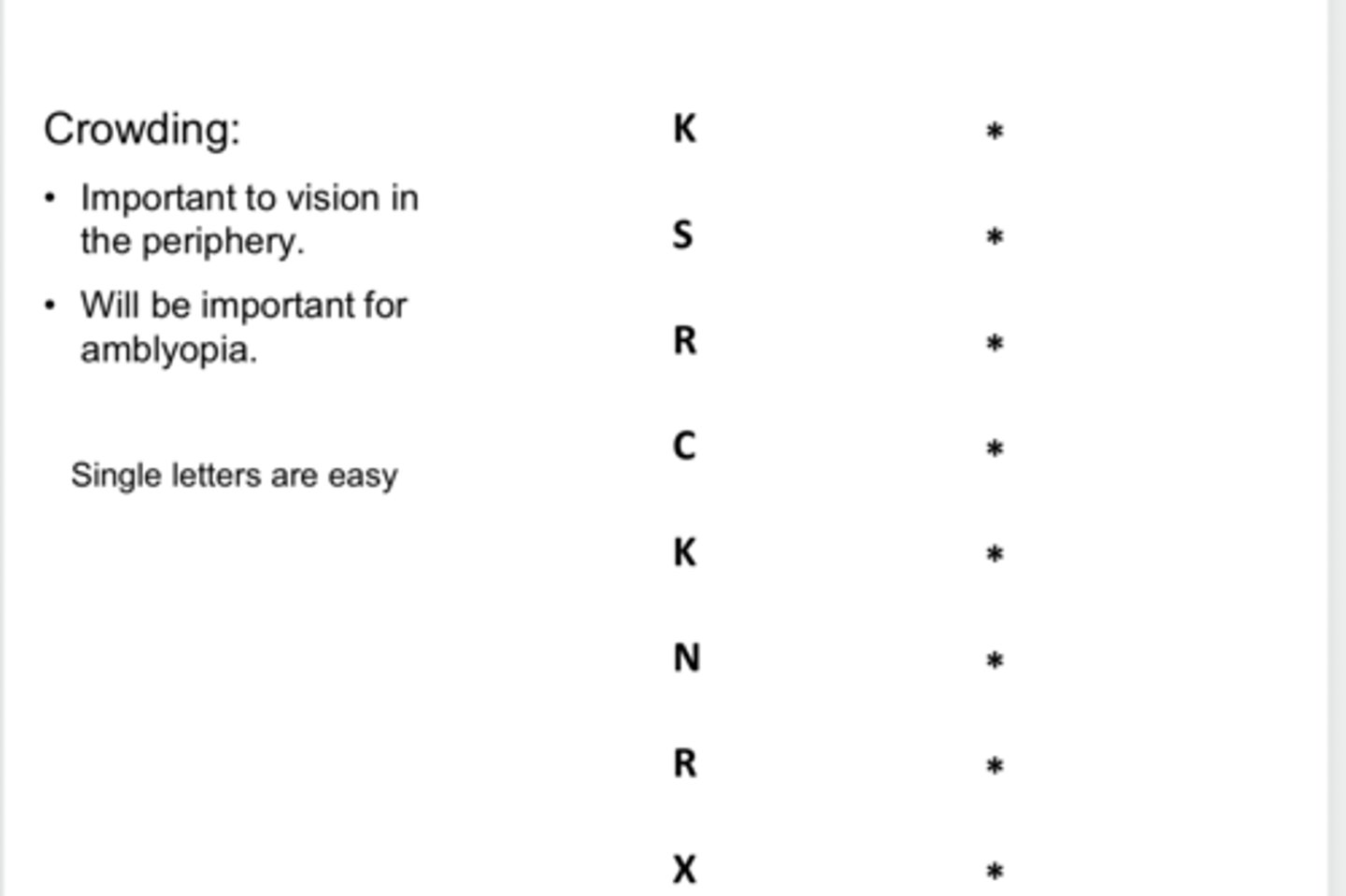
Crowding -- Single Letters Easy to Distinguish (Pic)
Crowding -- Single Letters Easy to Distinguish (Pic)
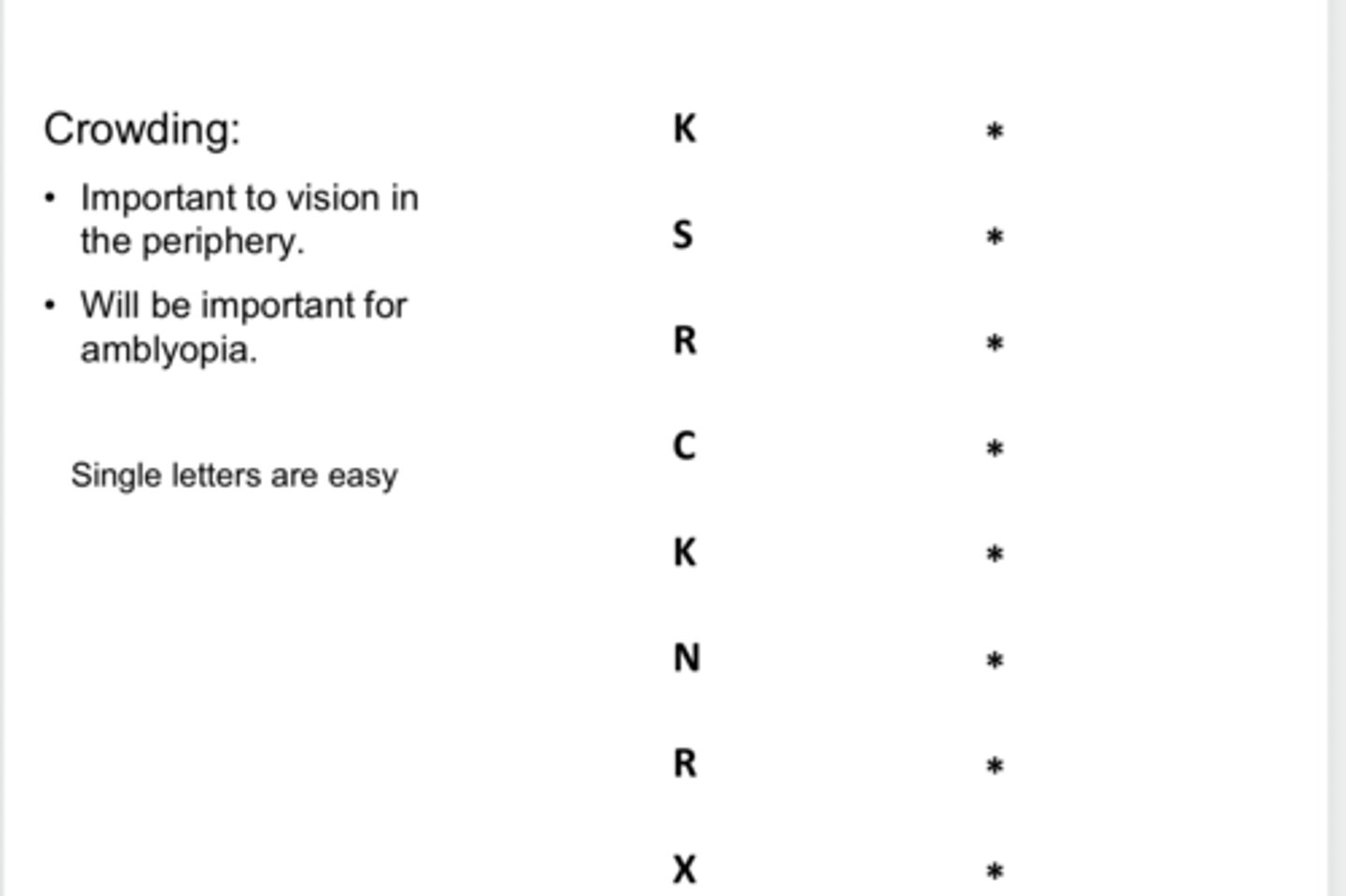
Crowding -- Multiple Letters Make It Harder to Distinguish Middle Letter (Pic)
Crowding -- Multiple Letters Make It Harder to Distinguish Middle Letter (Pic)
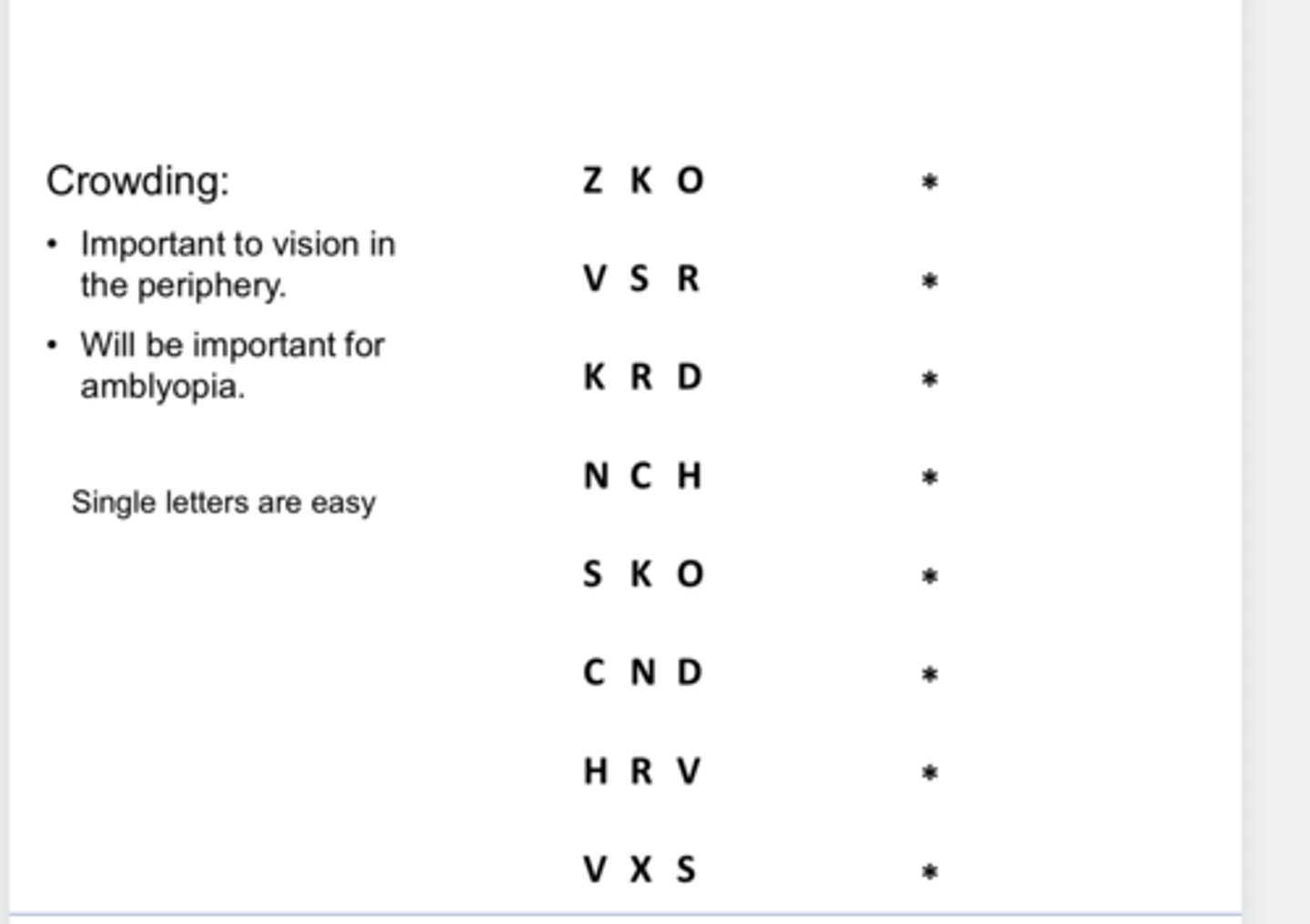
true
True or False:
With the crowding effect, single letters are easy to identify, even when viewed in our midperipheral visual field
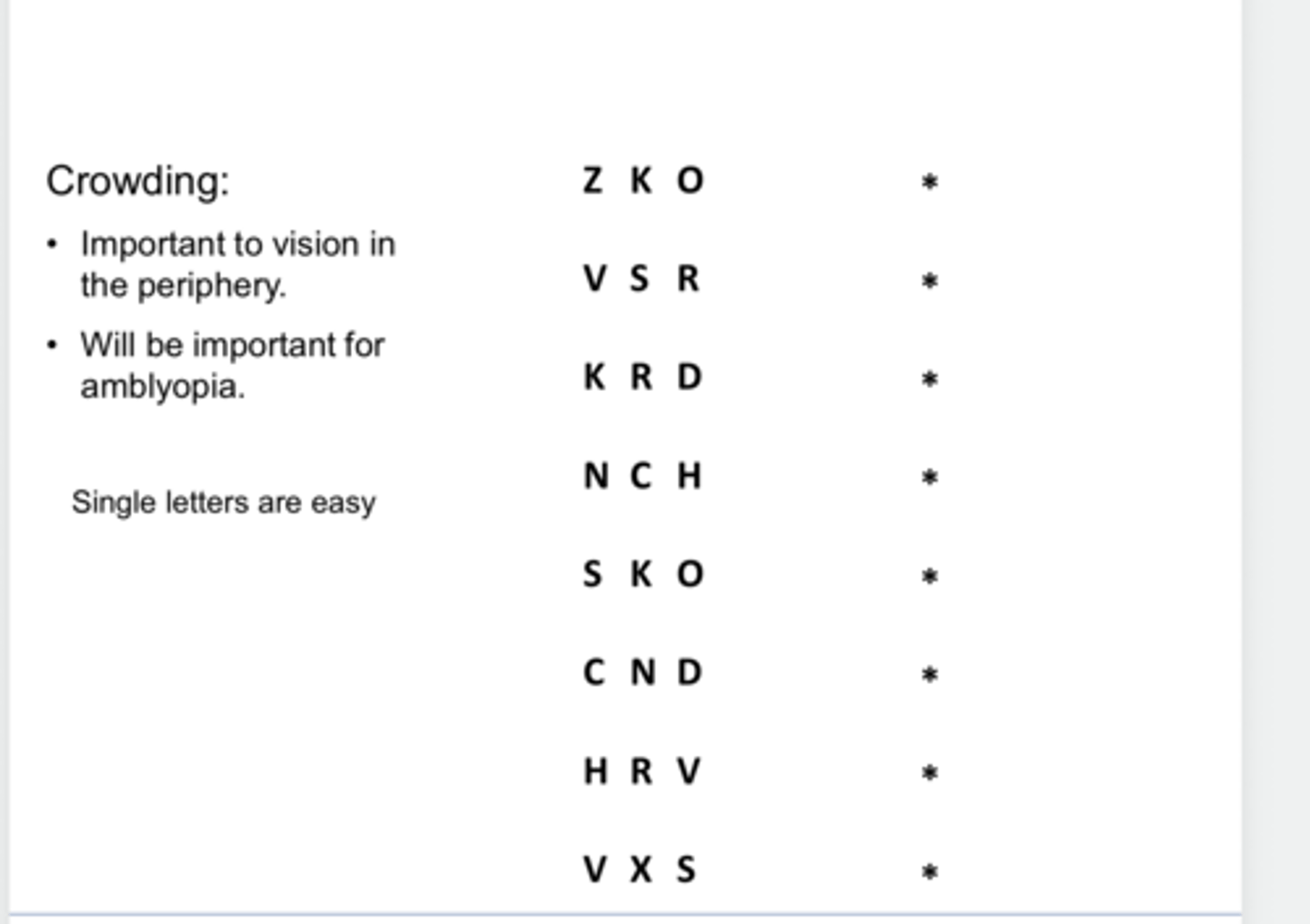
Yes
Are crowded letters much harder to identify than single letters for amblyopes?
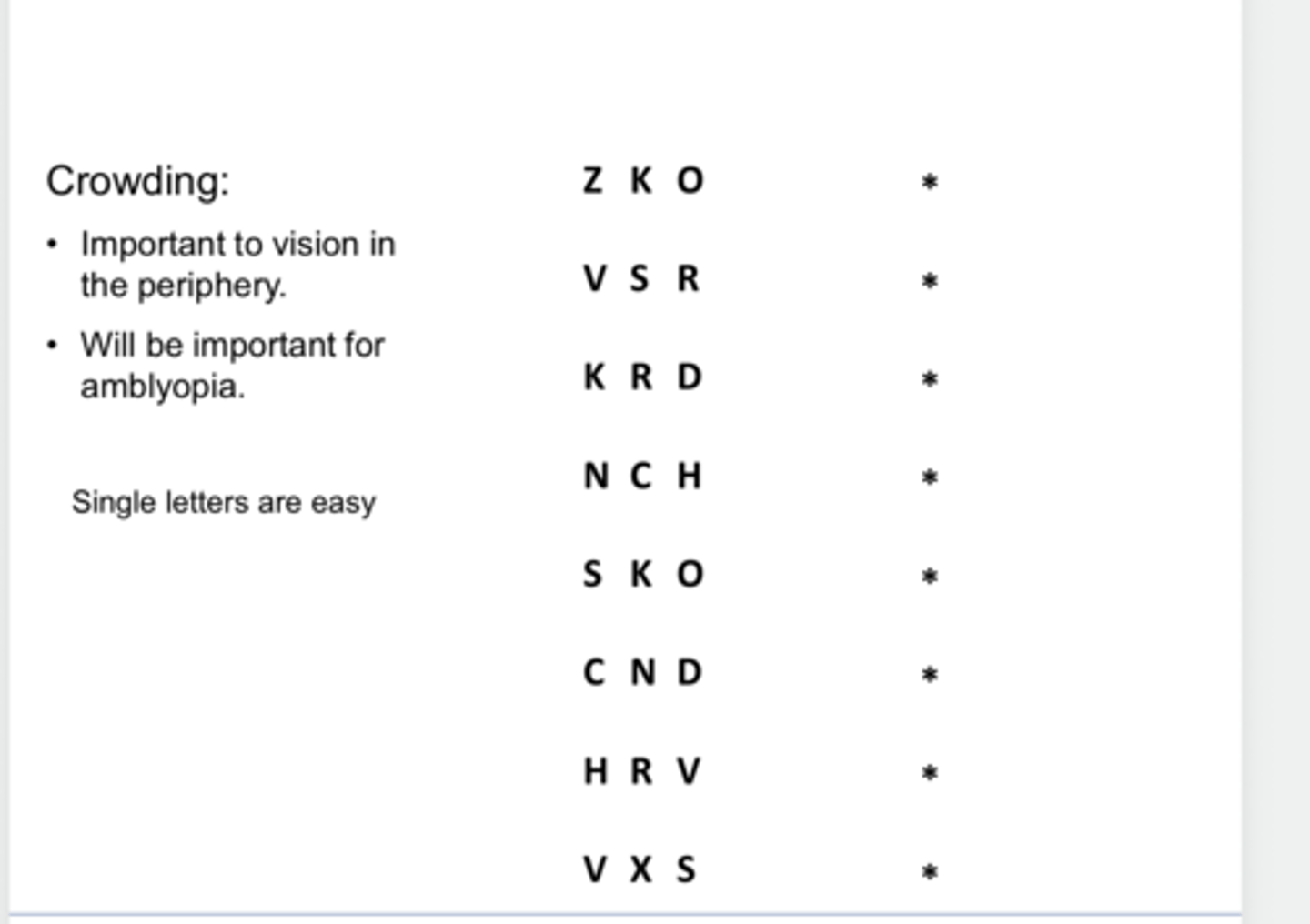
Yes -- there is not much improvement when letter size is increased
Are bigger letters still affected by crowding?
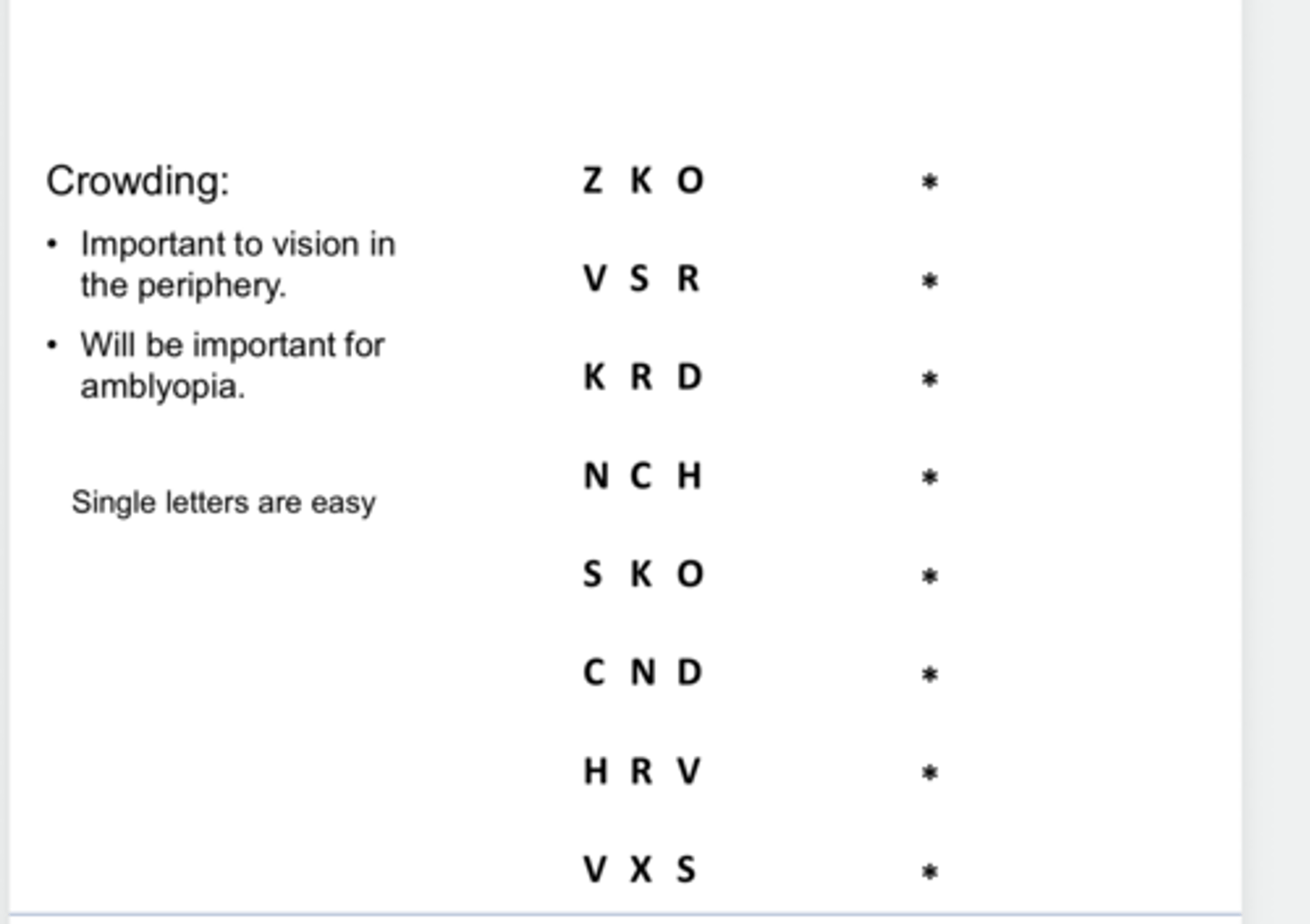
more
The farther from fixation the letters are, the (more/less) the crowding effect will be present
more
The closer the crowding letters are to the target, the (more/less) the crowding effect will be present
Yes -- applies to lots of visual stimuli
Does crowding apply to more visual stimuli than just letters?
when neighboring items impair the perception of the target item
REVIEW: When does crowding occur?
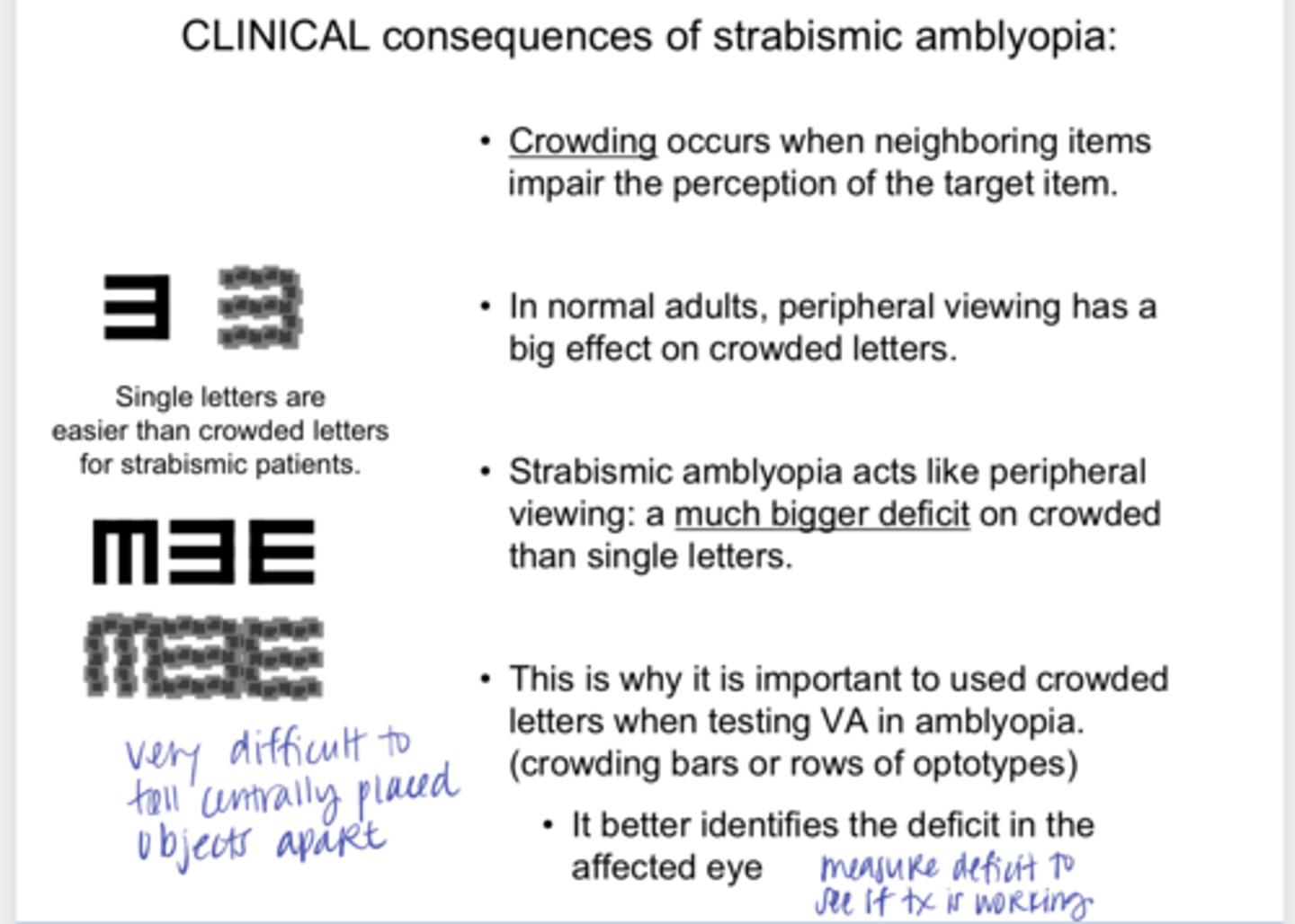
Yes
In normal adults, does peripheral viewing have a big effect on crowded letters?
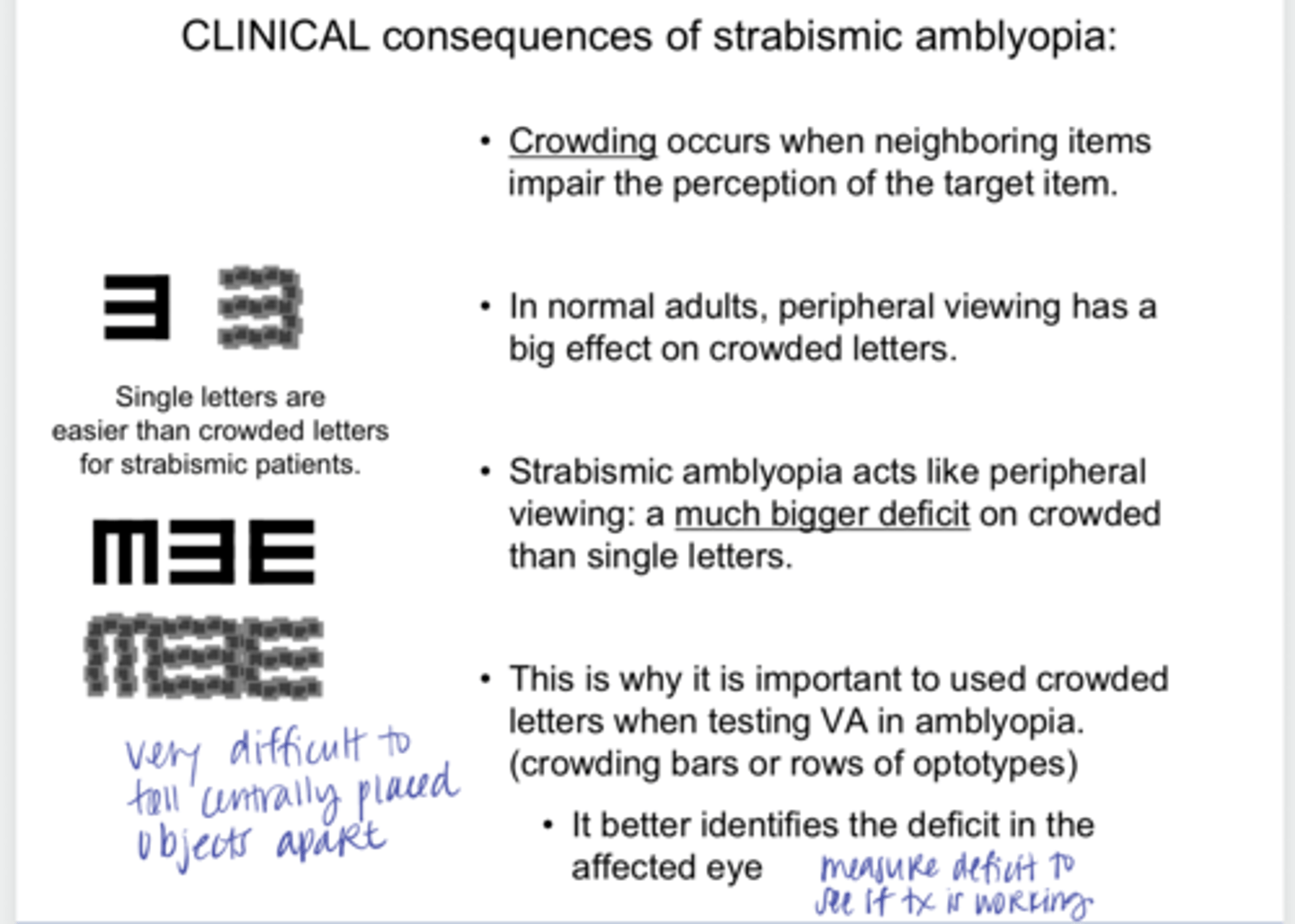
peripheral
Strabismic patients act as (foveal/peripheral) viewers
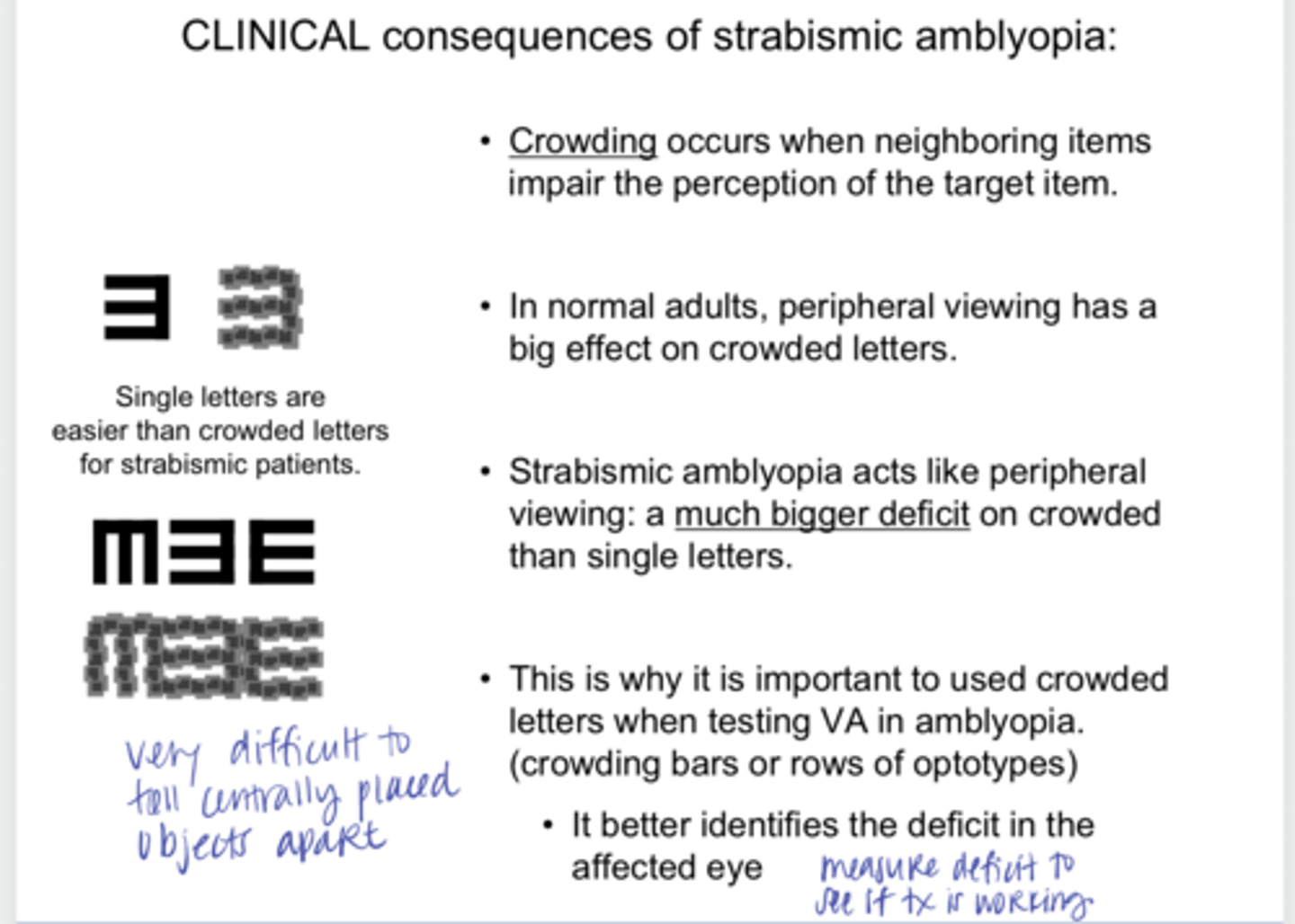
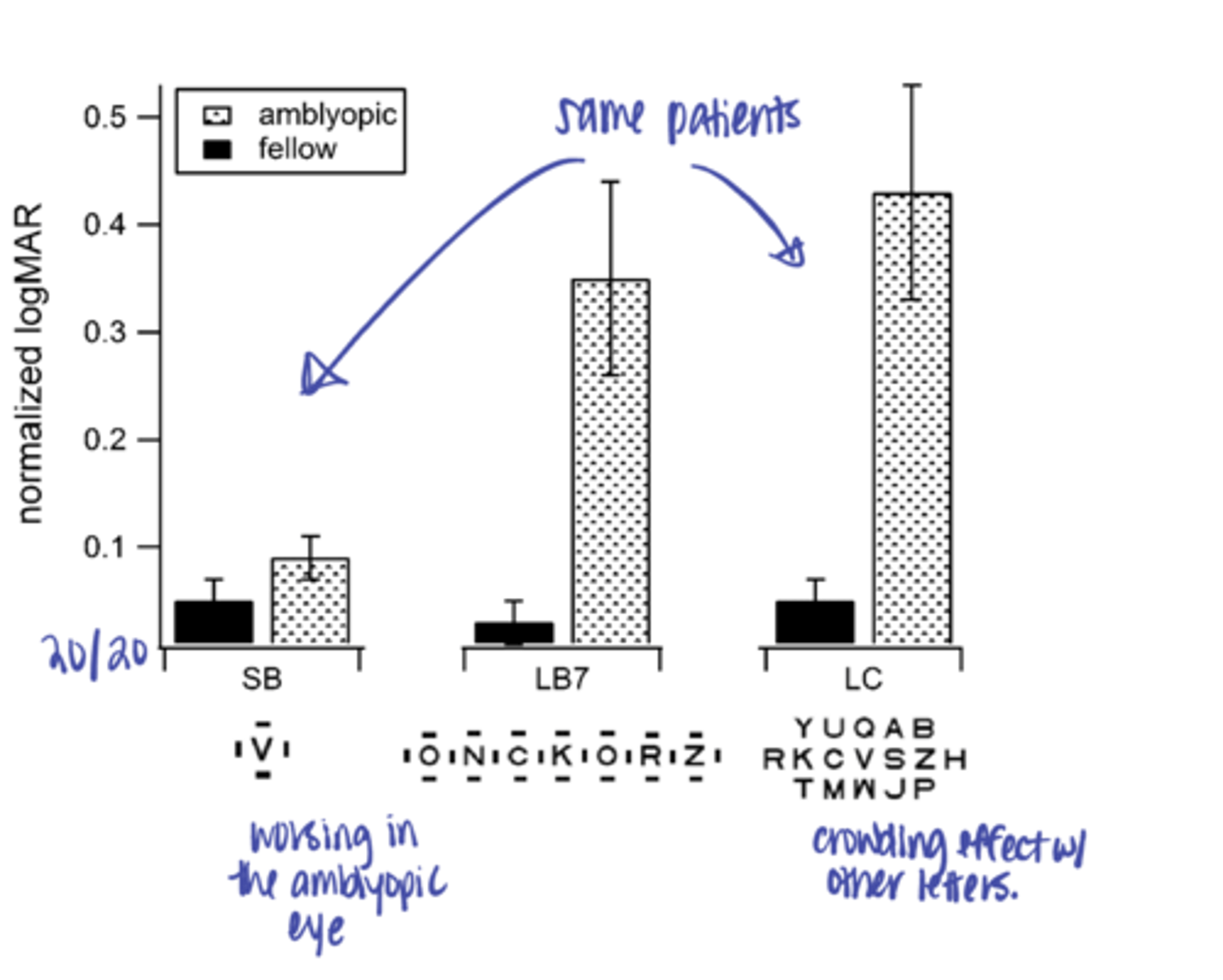
a much bigger deficit on crowding than single letters
What is the effect of peripheral viewing in strabismic patients?
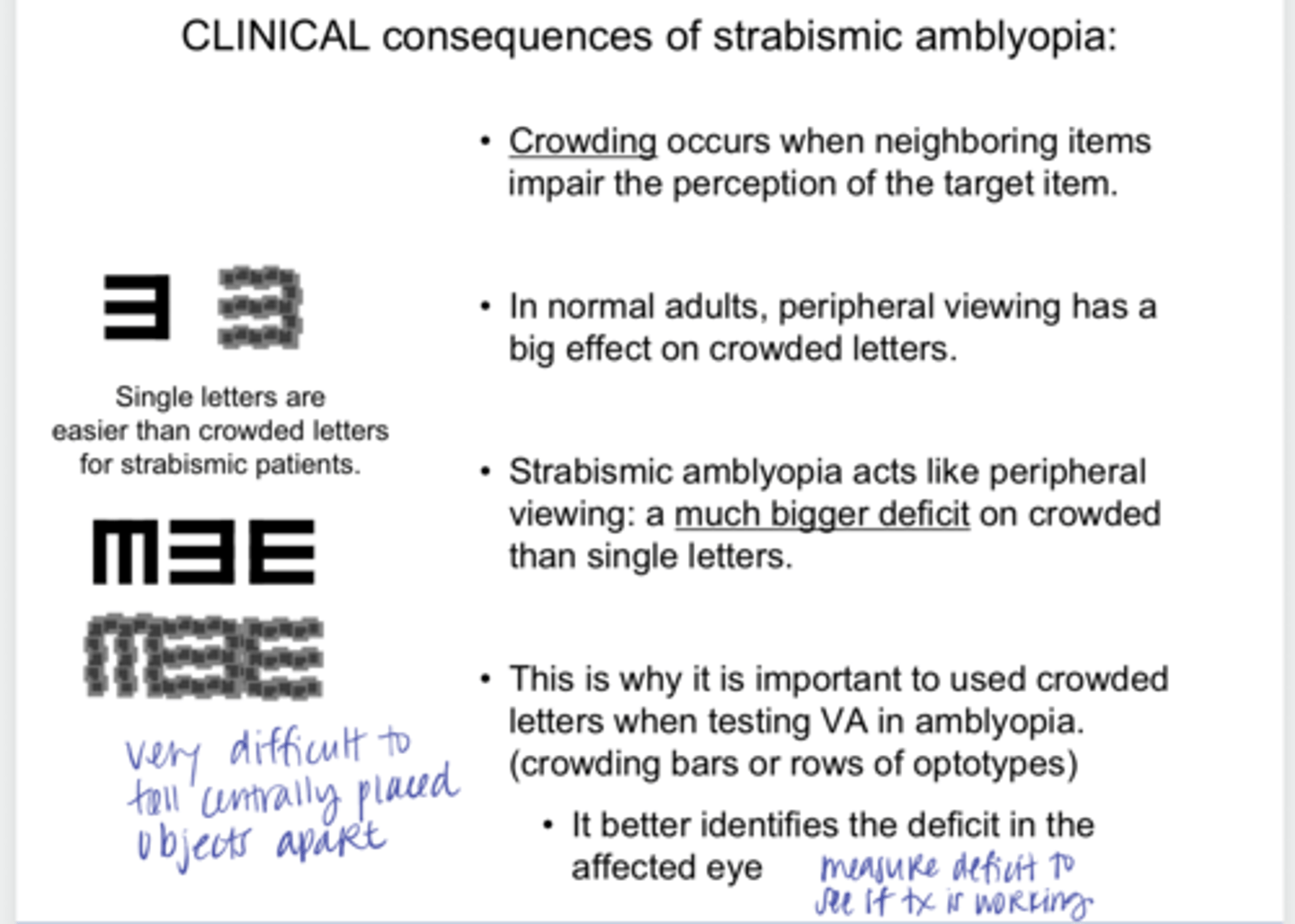
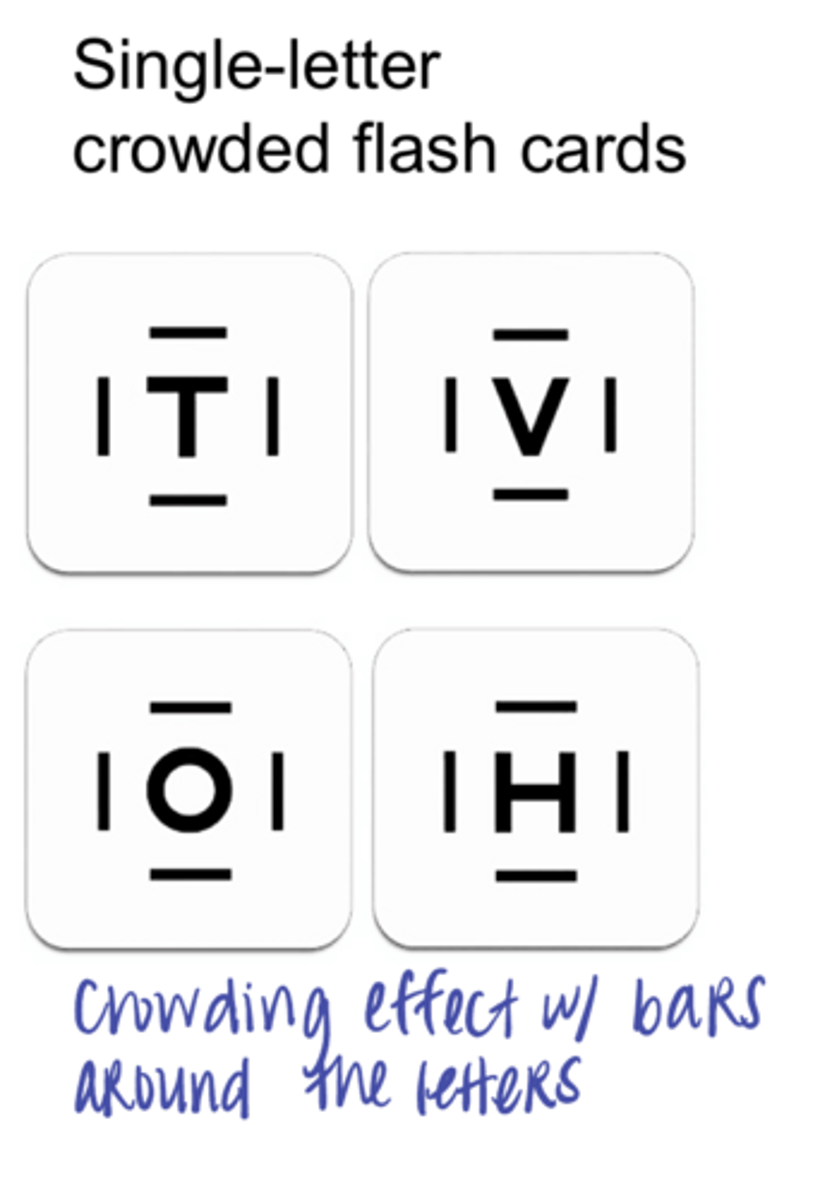
Yes -- by using crowding bars or rows of optotypes
Is it important to use crowded letters in patients with amblyopia when testing their VA?
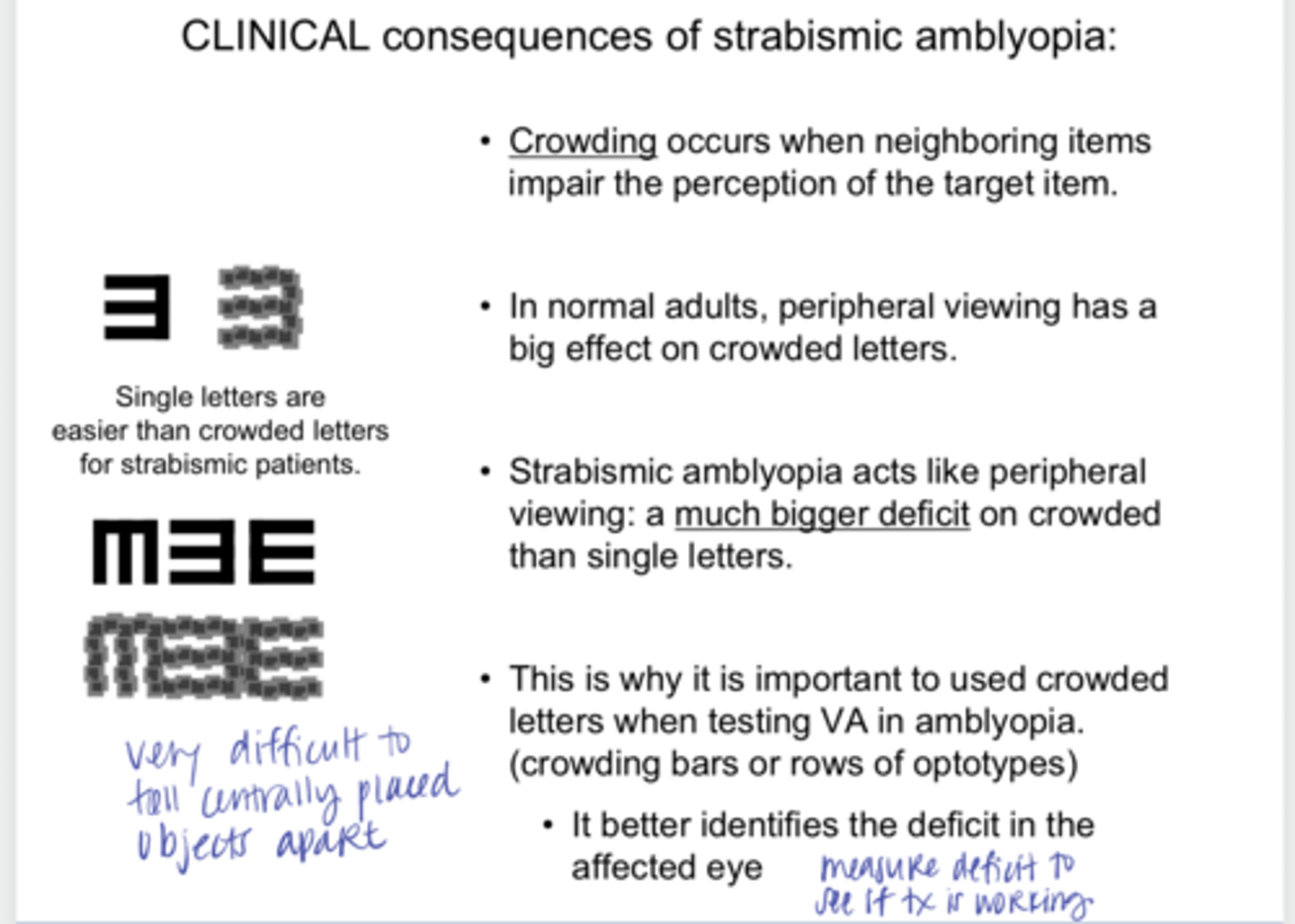
to better identify the deficit in the affected eye
WHY is it important to use crowded letters in patients with amblyopia when testing their VA?
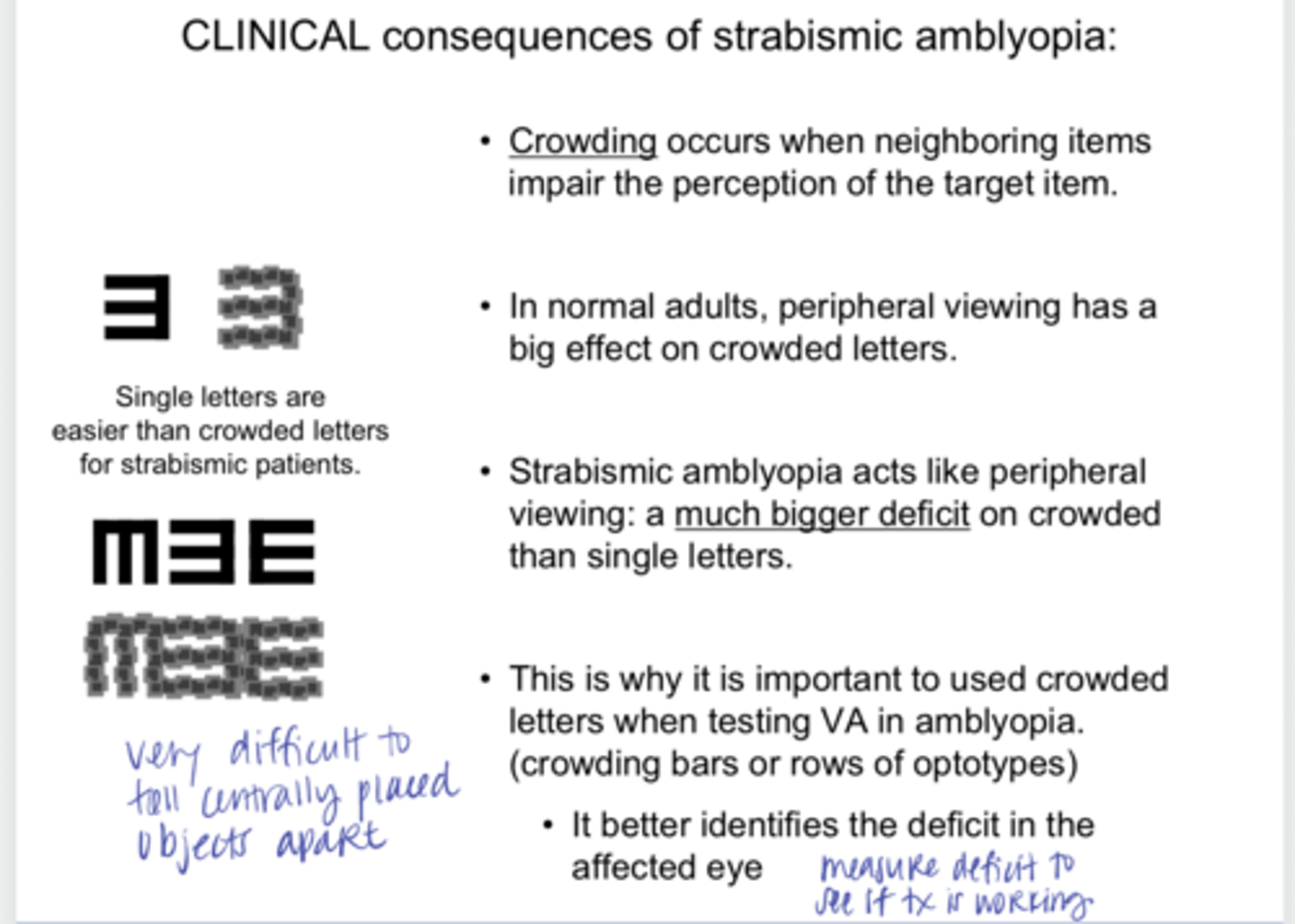
single
(single/crowded) letters are easier to recognize for strabismic patients
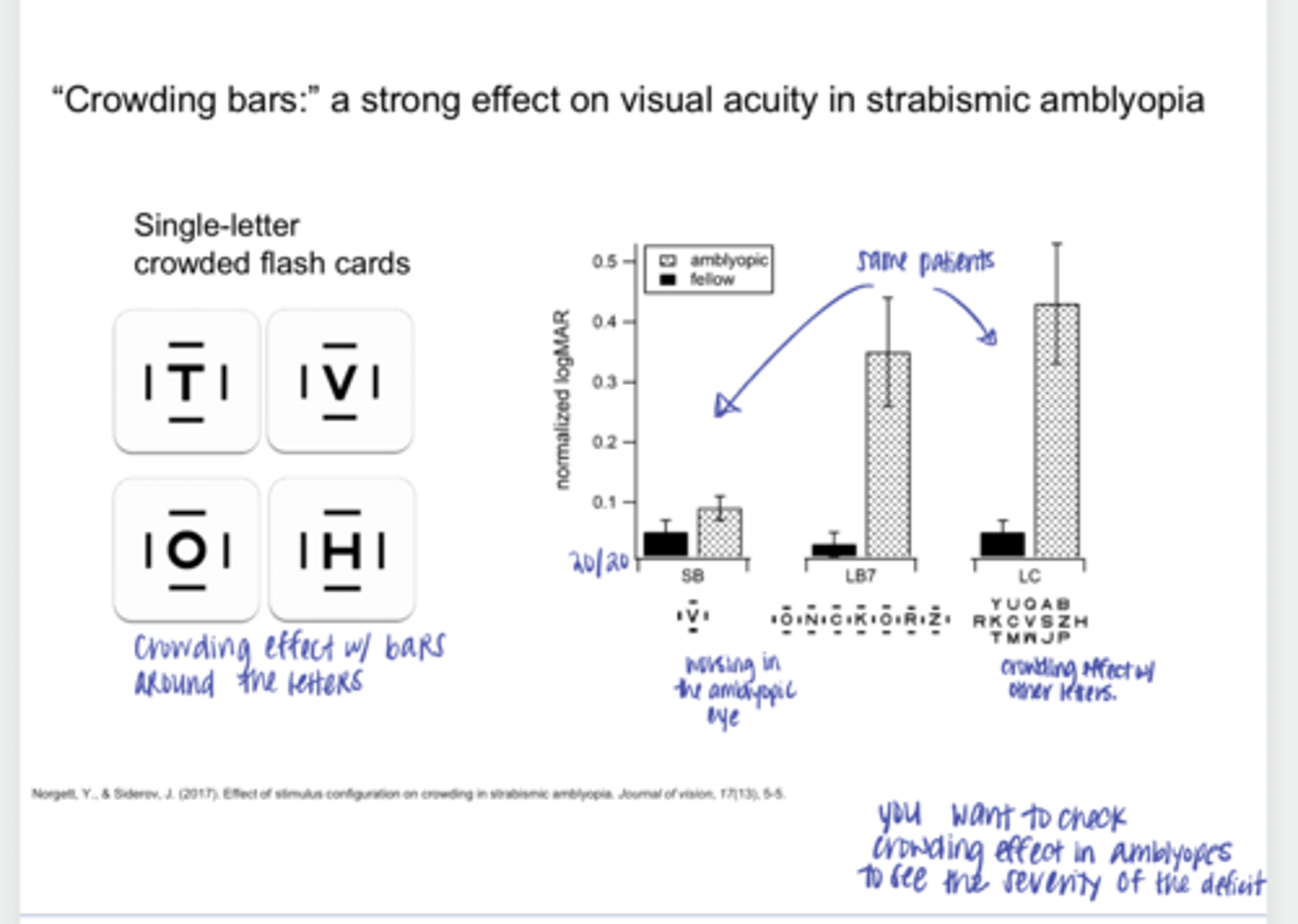
Yes
Do crowding bars show a strong effect on VA in strabismic patients?
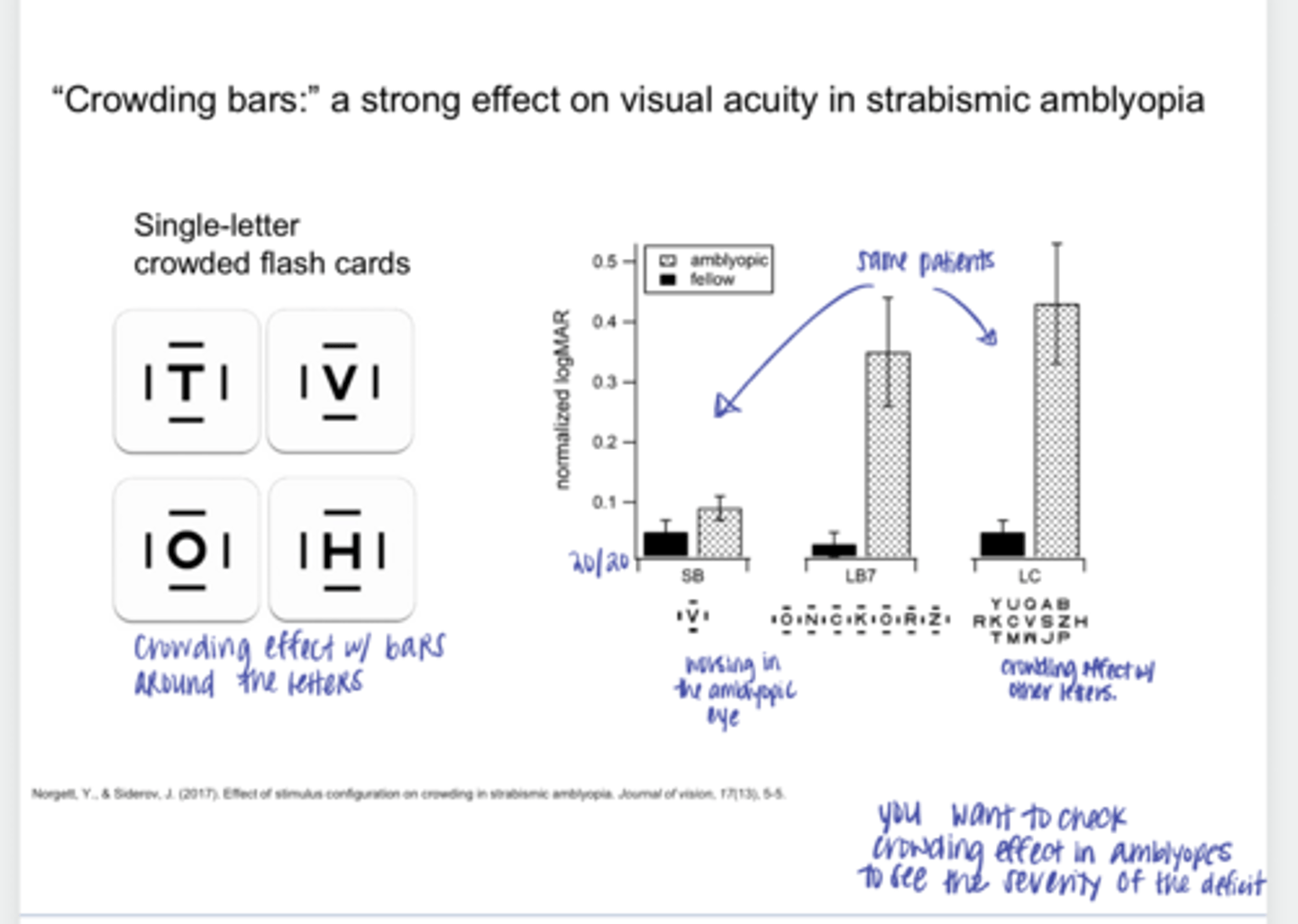
Single Letter Crowded Flash Cards (Pic)
Single Letter Crowded Flash Cards (Pic)
Effect of Crowding and Crowding Bars on VA in an Amblyopic Patient (Pic)
Effect of Crowding and Crowding Bars on VA in an Amblyopic Patient (Pic)
poor
Individuals with strabismus will have (good/poor) Vernier acuity
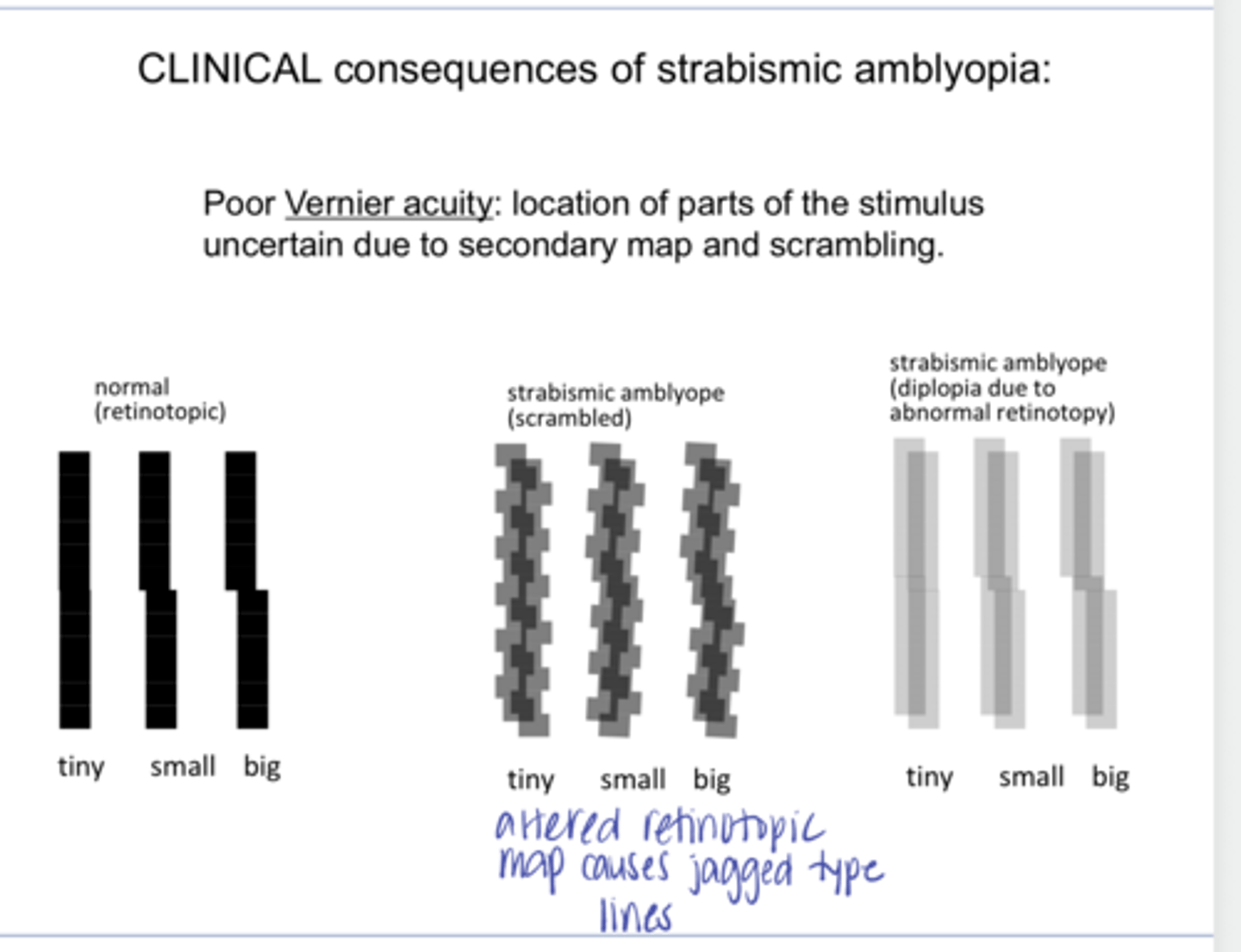
location of parts of the stimulus uncertain d/t the secondary map and scrambling
What is the effect of poor Vernier acuity in a strabismic amblyope?
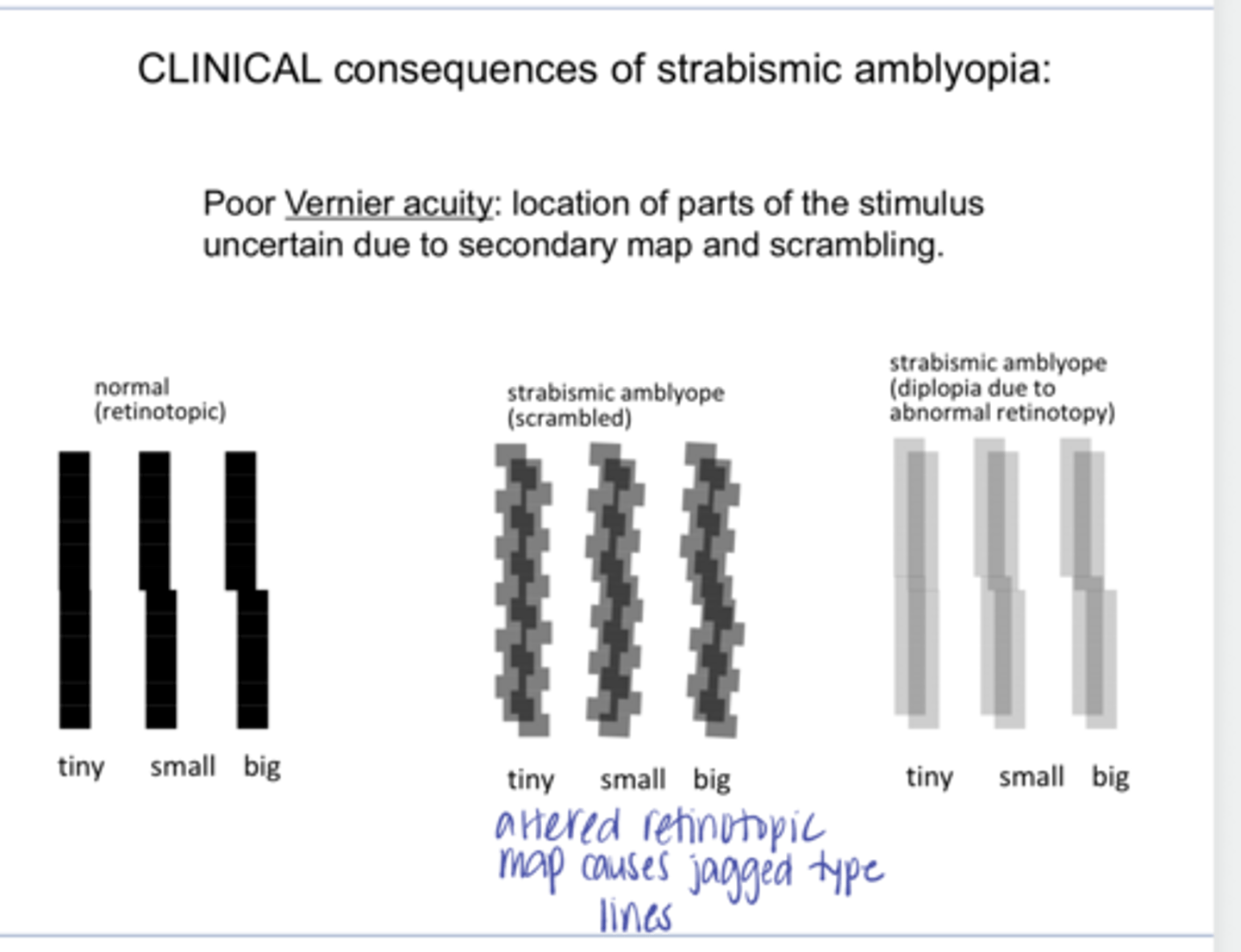
poor
Individuals with strabismic amblyopia are likely to have (poor/good) stereoacuity
binocular cells must have binocular input to form and survive
WHY do individuals with strabismic amblyopia have poor stereoacuity?
poor
Individuals with strabismic amblyopia will have (good/poor) grating orientation identification acuity
Often this is near normal in these patients
Will the grating resolution acuity be reduced in individuals with strabismic amblyopia?
high
In a strabismic amblyope, ____ spatial frequency gratings DO NOT look like a uniform grey and thus can be detected OK
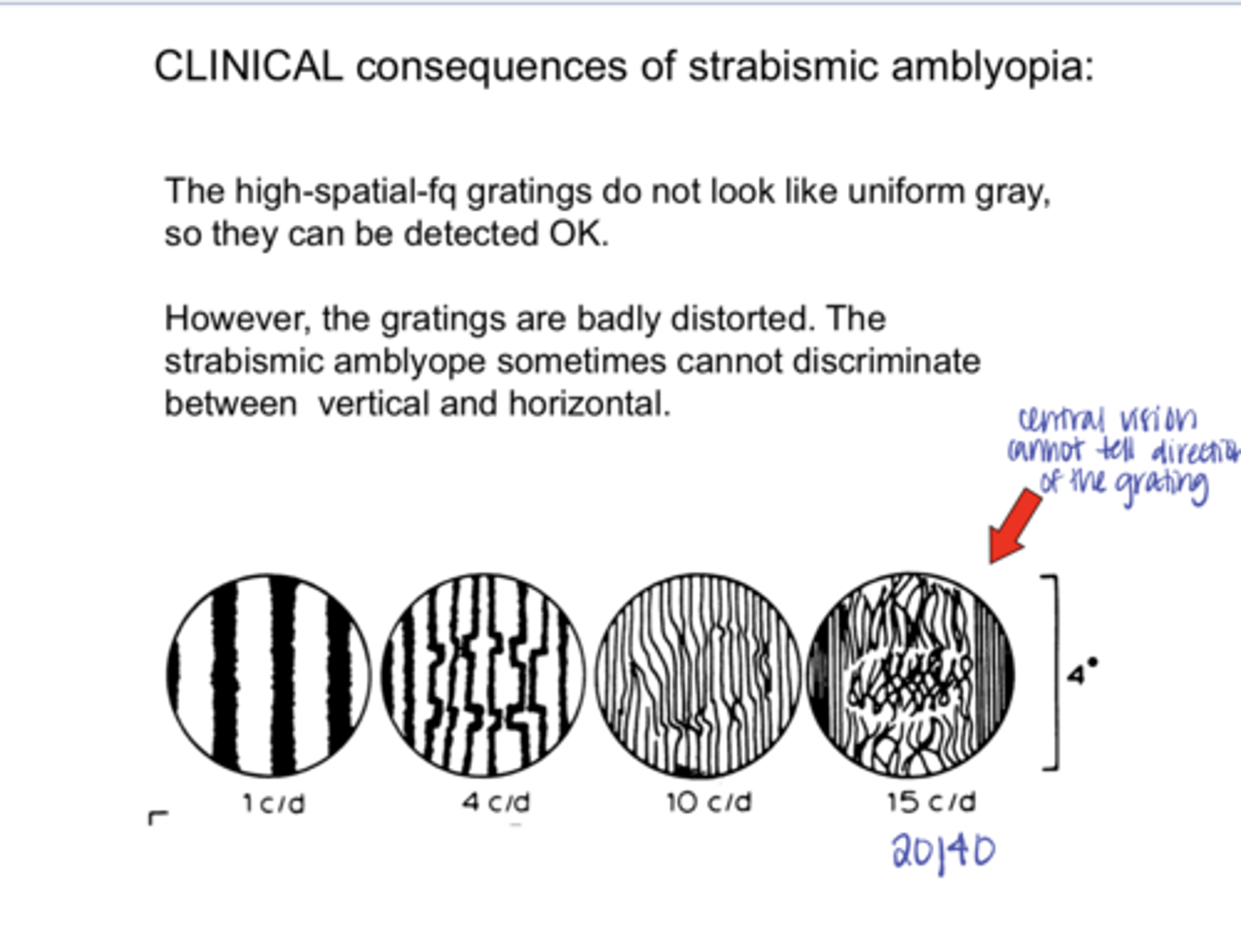
they are badly distorted -- sometimes the patient will NOT be able to tell the difference between vertical and horizontal oriented lines
Even though strabismic amblyopes can detect gratings, what do the gratings look like?
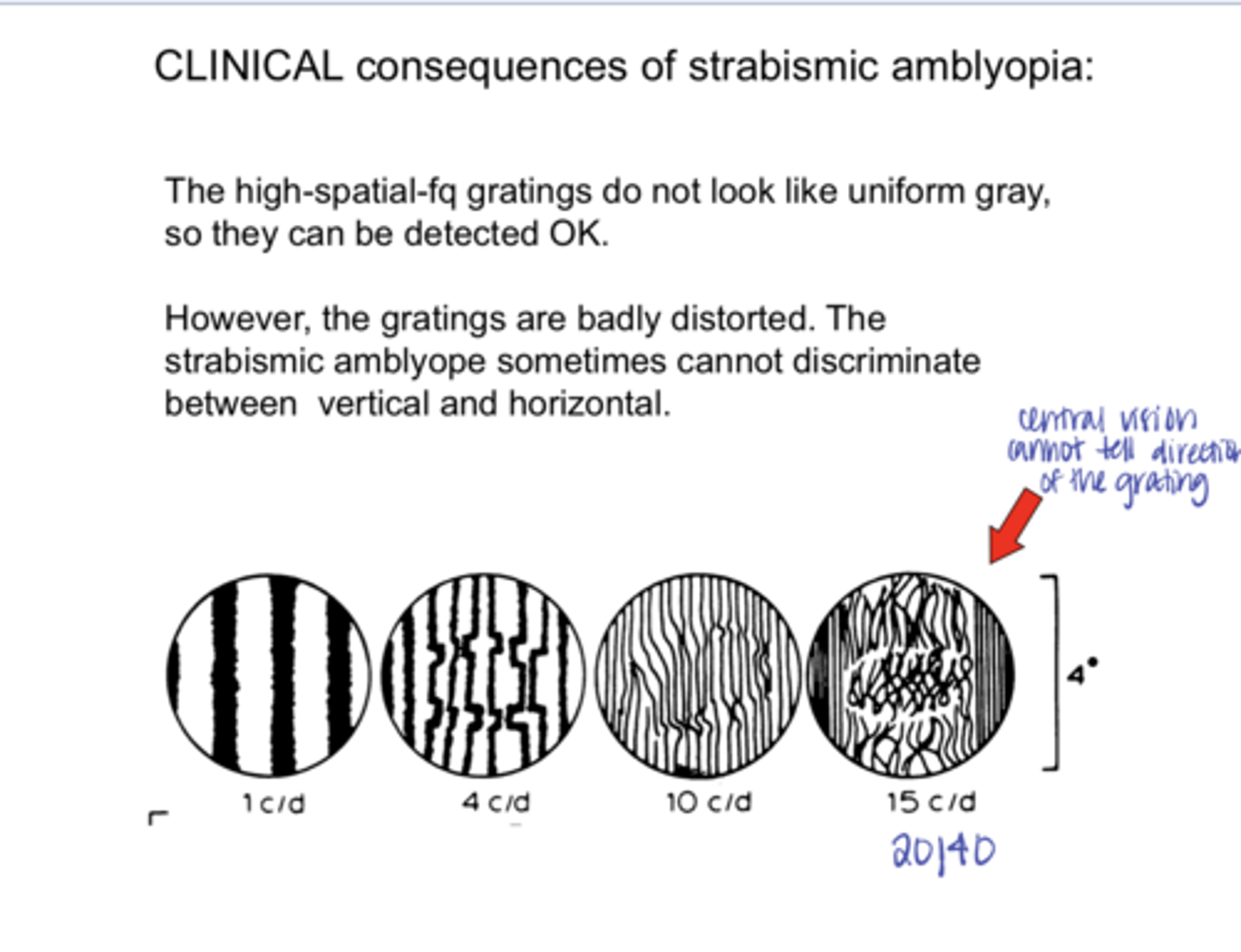
Vernier acuity; optotype acuity
______ and _____ acuity are generally very highly correlated in patients with strabismic amblyopia
affects them the same proportion
REFRACTIVE amblyopia affects Vernier or Grating acuity more?
-Good grating acuity
-Vernier much worse
STRABISMIC amblyopia affects Vernier or Grating acuity more?
No
Can babies do optotype VA tasks?
Vernier acuity is a promising approach to diagnosing amblyopia in infants and toddlers.
If babies cannot do optotype VA tasks, how are we able to monitor for amblyopia in infants?
No -- NOT ideal. This is a grating acuity
Is Teller acuity (grating) ideal for identifying amblyopia in children?
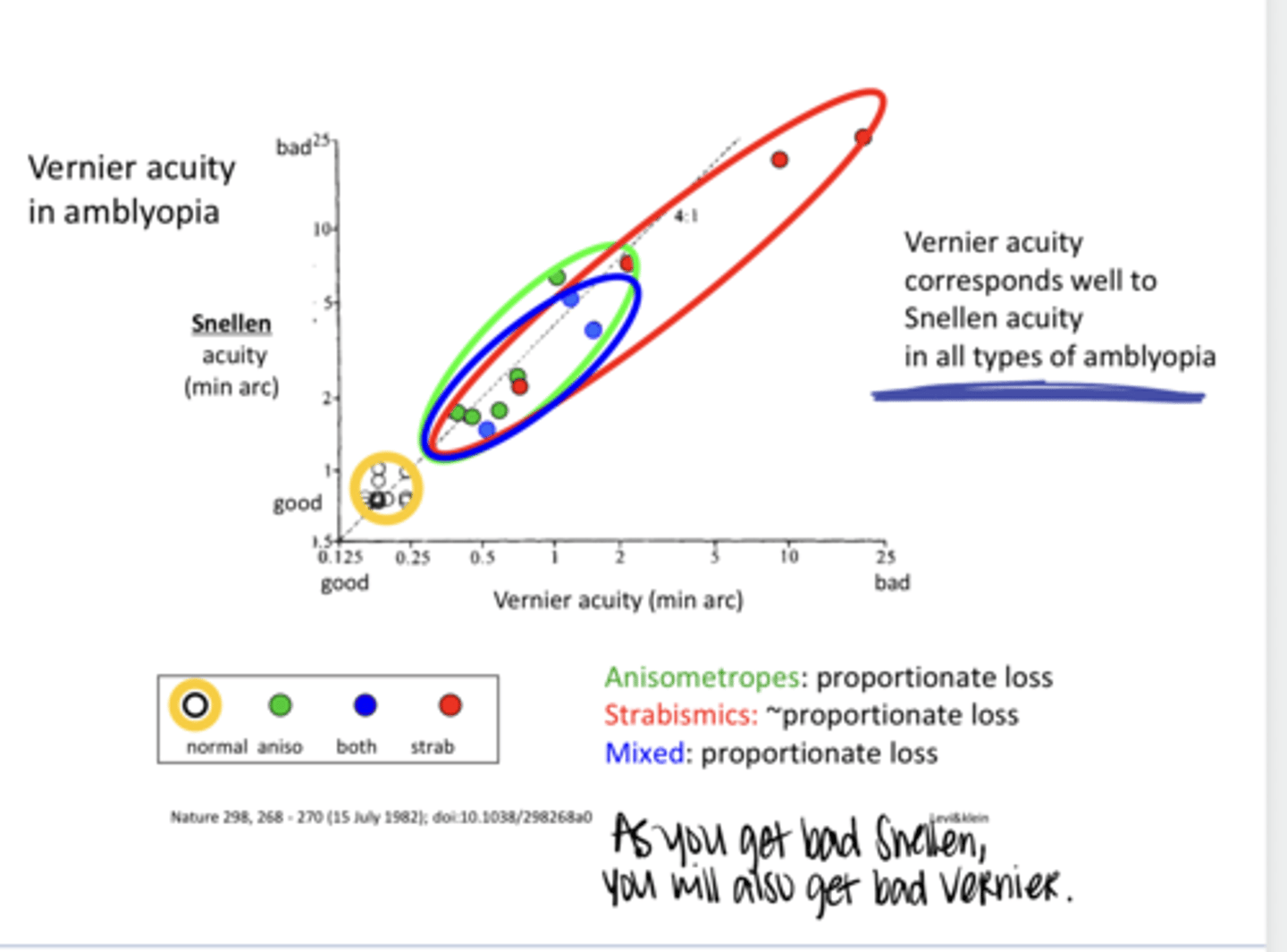
Vernier
_____ corresponds well to Snellen acuity in all types of amblyopia
Vernier Acuity in Amblyopia v Snellen Acuity (Pic)
Vernier Acuity in Amblyopia v Snellen Acuity (Pic)
**Proportional loss of both in Anisometropes, Strabs, and Mixed Amblyopes
Vernier Acuity in Amblyopia v Grating Acuity (Pic)
Vernier Acuity in Amblyopia v Grating Acuity (Pic)
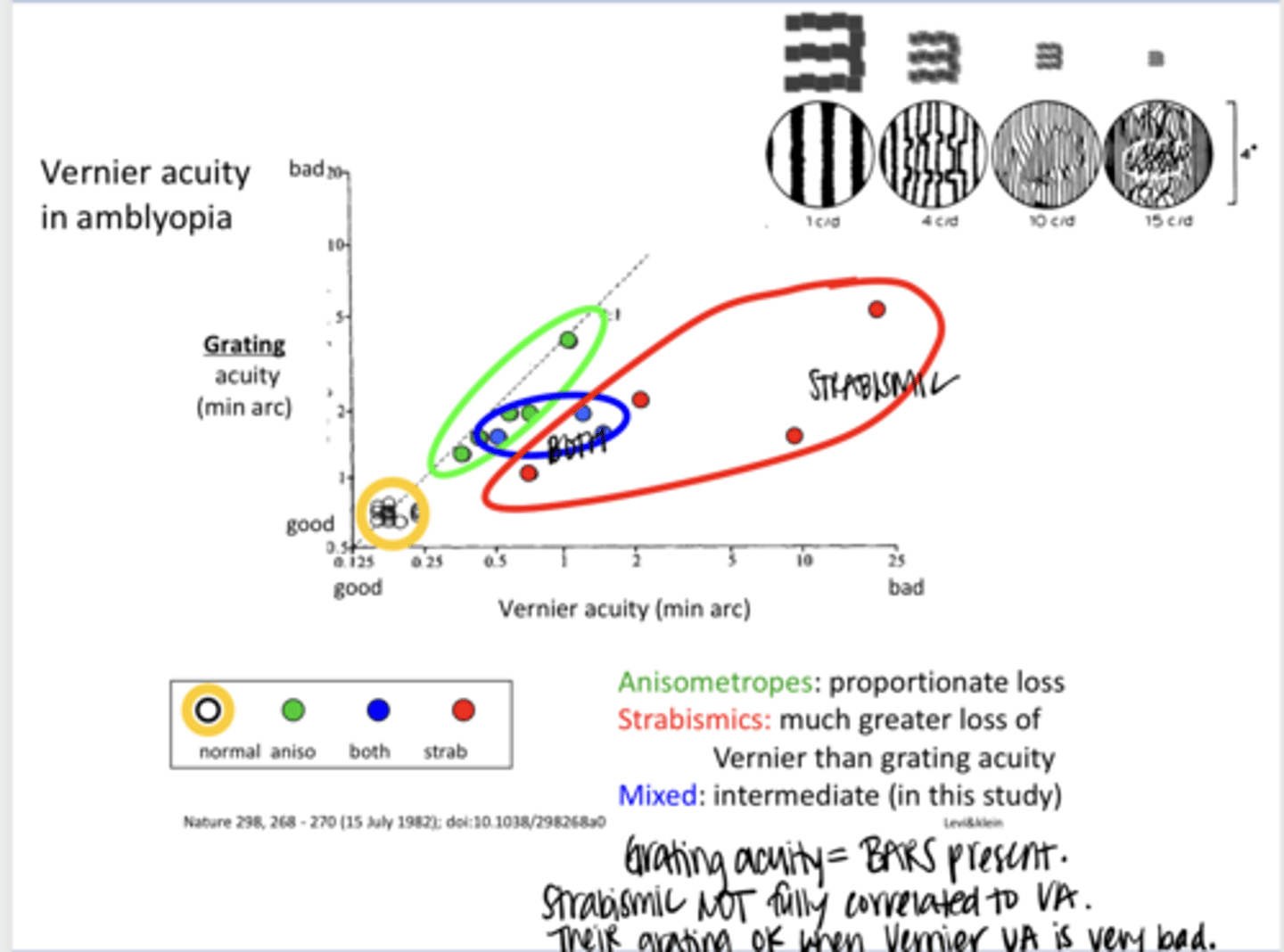
Proportional loss of both
Vernier Acuity v Grating Acuity in an Anisometrope
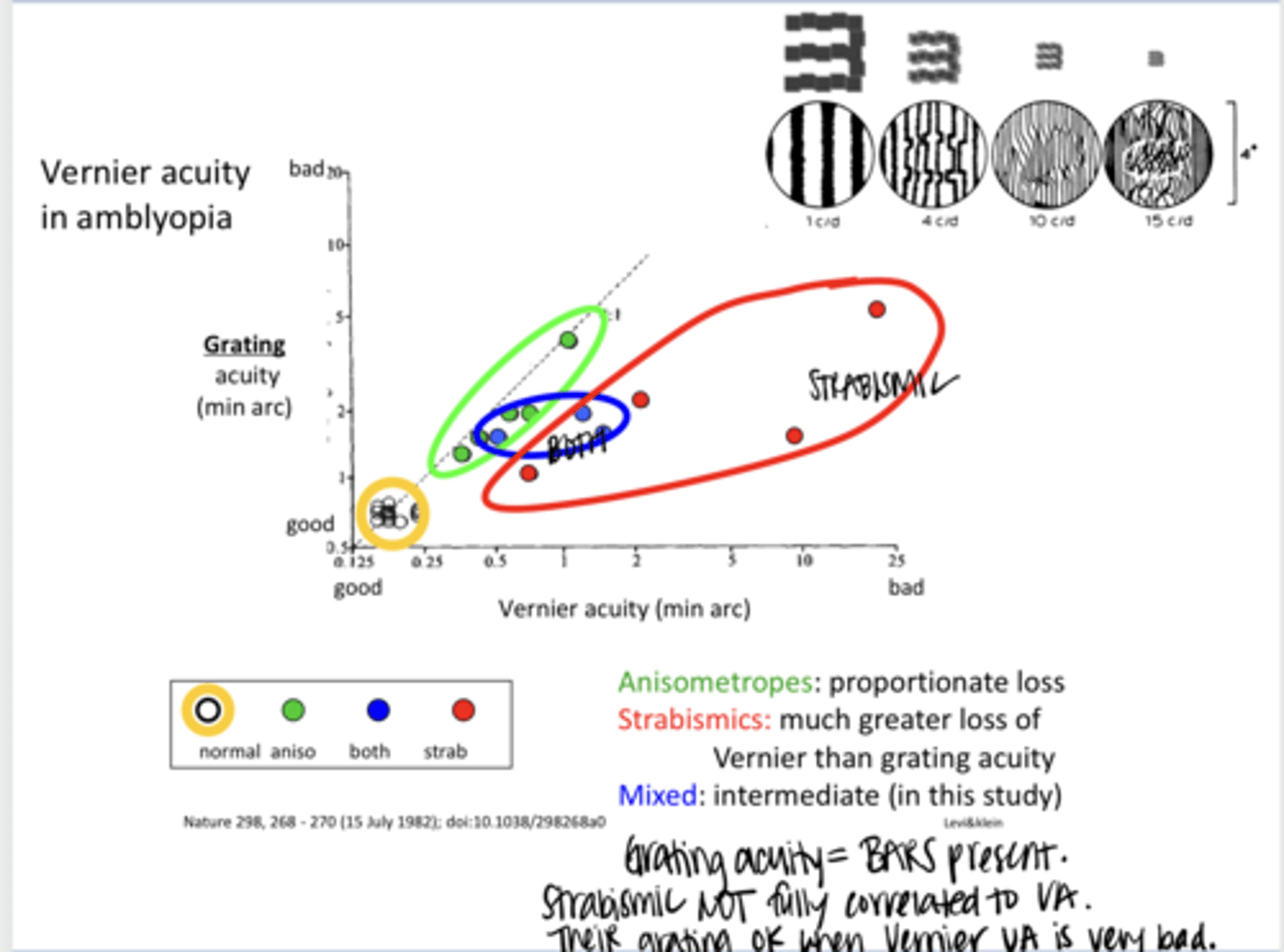
Much greater loss of Vernier than Grating
Vernier Acuity v Grating Acuity in a Strabismic Patient
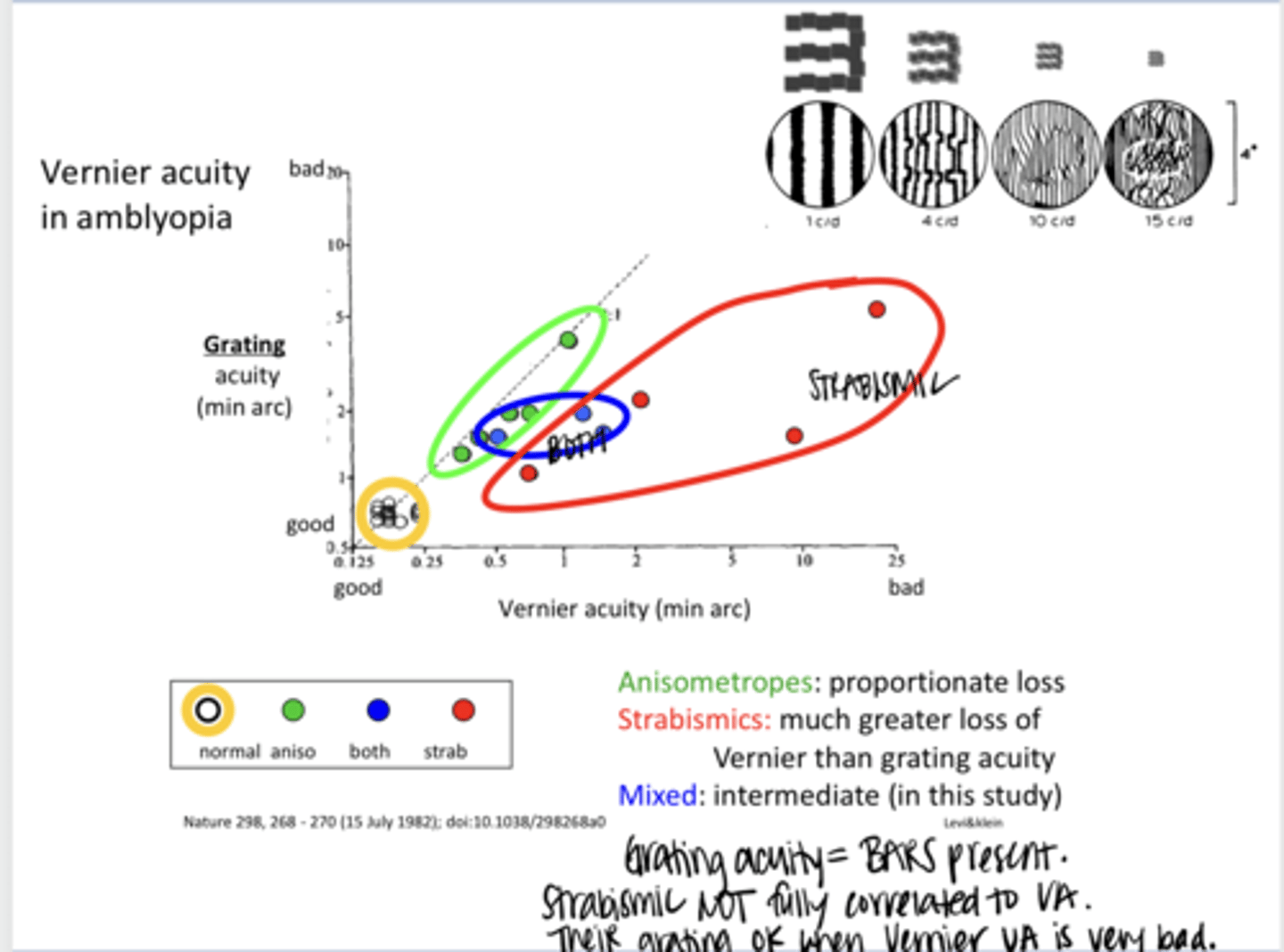
Intermediate loss of both
Vernier Acuity v Grating Acuity in a Mixed Aniso/Strab Patient
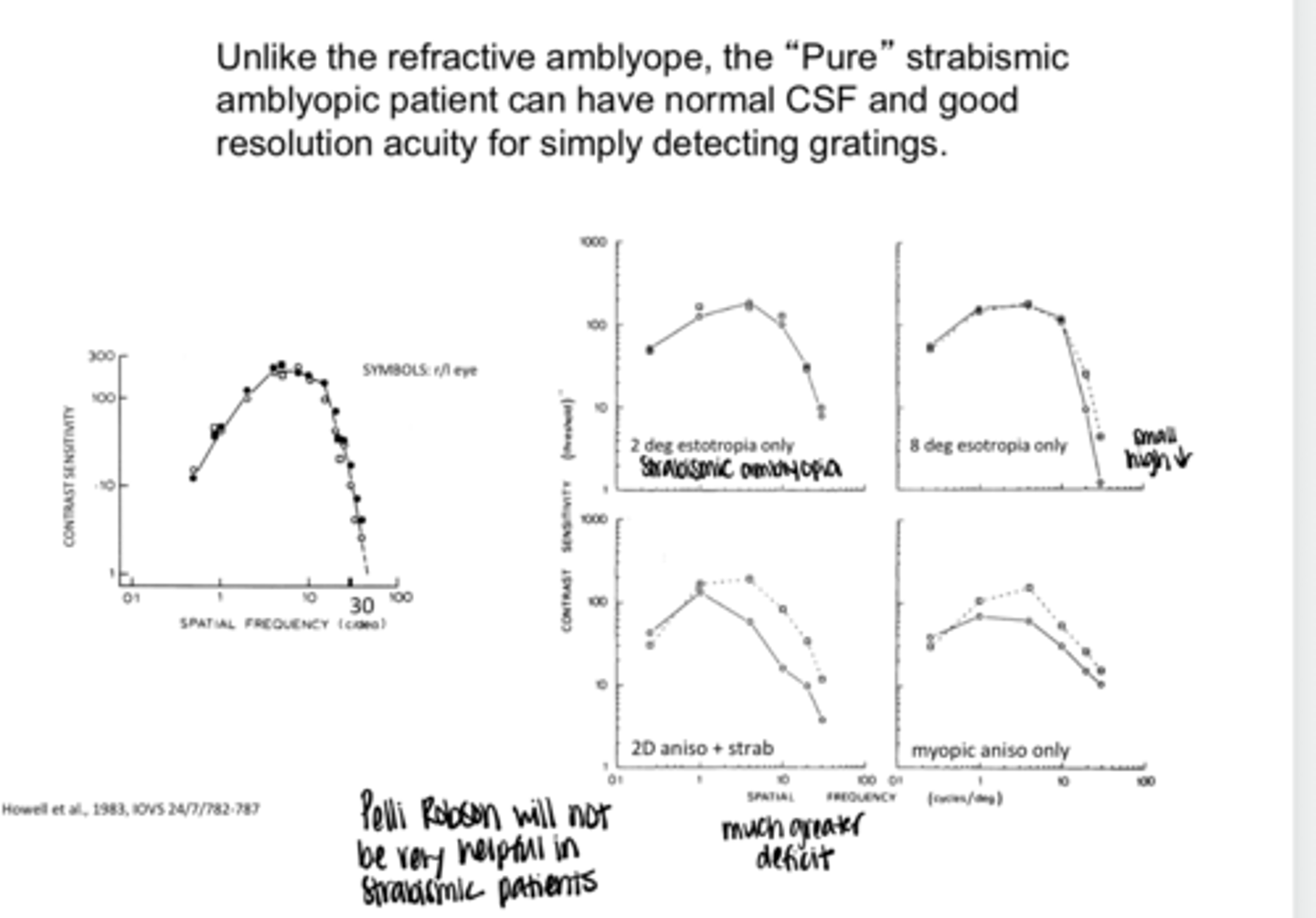
Yes
Can a "pure" strabismic amblyopic patient can normal CSF and good resolution acuity for simply detecting the presence of gratings?
No
Will a refractive amblyope have a normal CSF/good resolution acuity for detecting gratings?
Both are defects in the vision of ONE eye in the absence of any obvious pathology in the eye
SUMMARY: What are refractive and strabismic amblyopia?
abnormal visual experience during the critical period
SUMMARY: Both refractive and strabismic amblyopia are the result of what?
Yes -- "mixed" amblyopia.
They can have independent and severe effects on vision
SUMMARY: Are refractive and strabismic amblyopia often mixed and found in the same patient?
deprivation of the high-spatial frequency tuned channels d/t anisometropia during the critical period
Refractive v Strabismic Amblyopia
What is the cause and result of refractive amblyopia?
Results from different stimulation of corresponding points, which disrupts the "postnatal" wave during the critical period
Refractive v Strabismic Amblyopia
What is the cause and result of strabismic amblyopia?
loss in grating acuity
Refractive Amblyopia
Grating Resolution Result
loss of optotype acuity
Refractive Amblyopia
Optotype Acuity Result
Proportional
Refractive Amblyopia
______ loss in Vernier and resolution acuity
little loss at low spatial frequencies
Refractive Amblyopia
Contrast Sensitivity Result at LOW SPATIAL FREQUENCIES
No -- crowded optotype acuity is similar to single-letter optotype acuity
Refractive Amblyopia
Crowding effect?
Reduced optotype acuity
Strabismic Amblyopia
Optotype Acuity Result
No loss in grating acuity
Strabismic Amblyopia
Grating acuity result
Much higher loss in Vernier acuity than grating acuity
Strabismic Amblyopia
Vernier vs grating acuity loss
Little loss in contrast sensitivity AT ALL SPATIAL FREQUENCIES
Strabismic Amblyopia
Contrast sensitivity result
Crowded optotype acuity is WORSE than single letter acuity
Strabismic Amblyopia
Crowding present?
Ocular dominance columns asymmetrical (deprivation or refractive) or the cells in V1 may receive input from non-corresponding retinal neurons (strabismic) resulting in image distortion
SUMMARY: What are the major issues in amblyopia?
more
SUMMARY: In general, the earlier you treat amblyopia, the (more/less) effective patching will be
7
SUMMARY: Amblyopia is more responsive to treatment among children younger than ____ years old
Yes -- Stereo Sue example
SUMMARY: Are there reports of individuals developing improvements in vision (acuity, stereopsis) with vision therapy that is prescribed in adulthood?
Yes
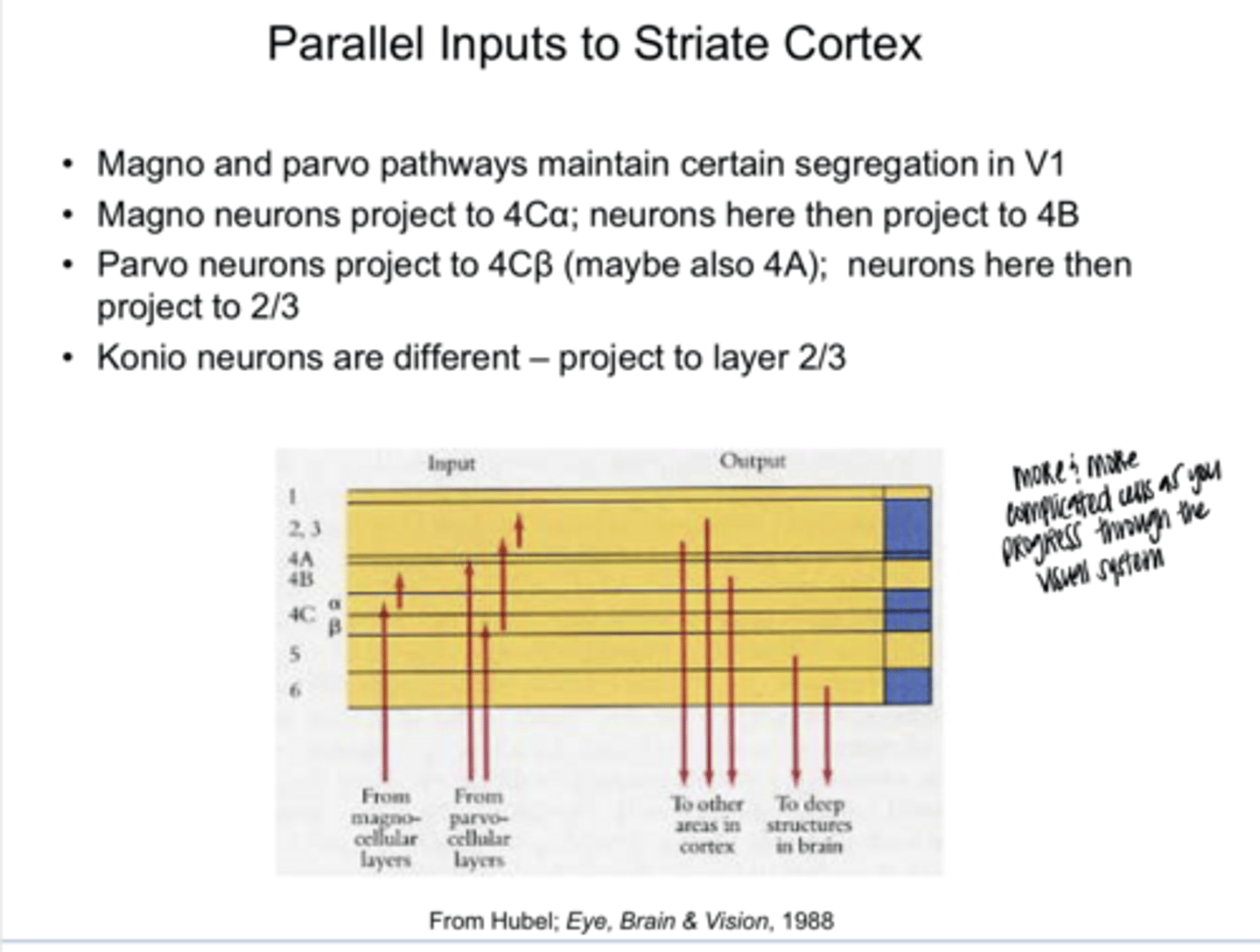
Parallel Inputs to the Striate Cortex
REVIEW: Do magno and parvo pathways maintain segregation in V1?
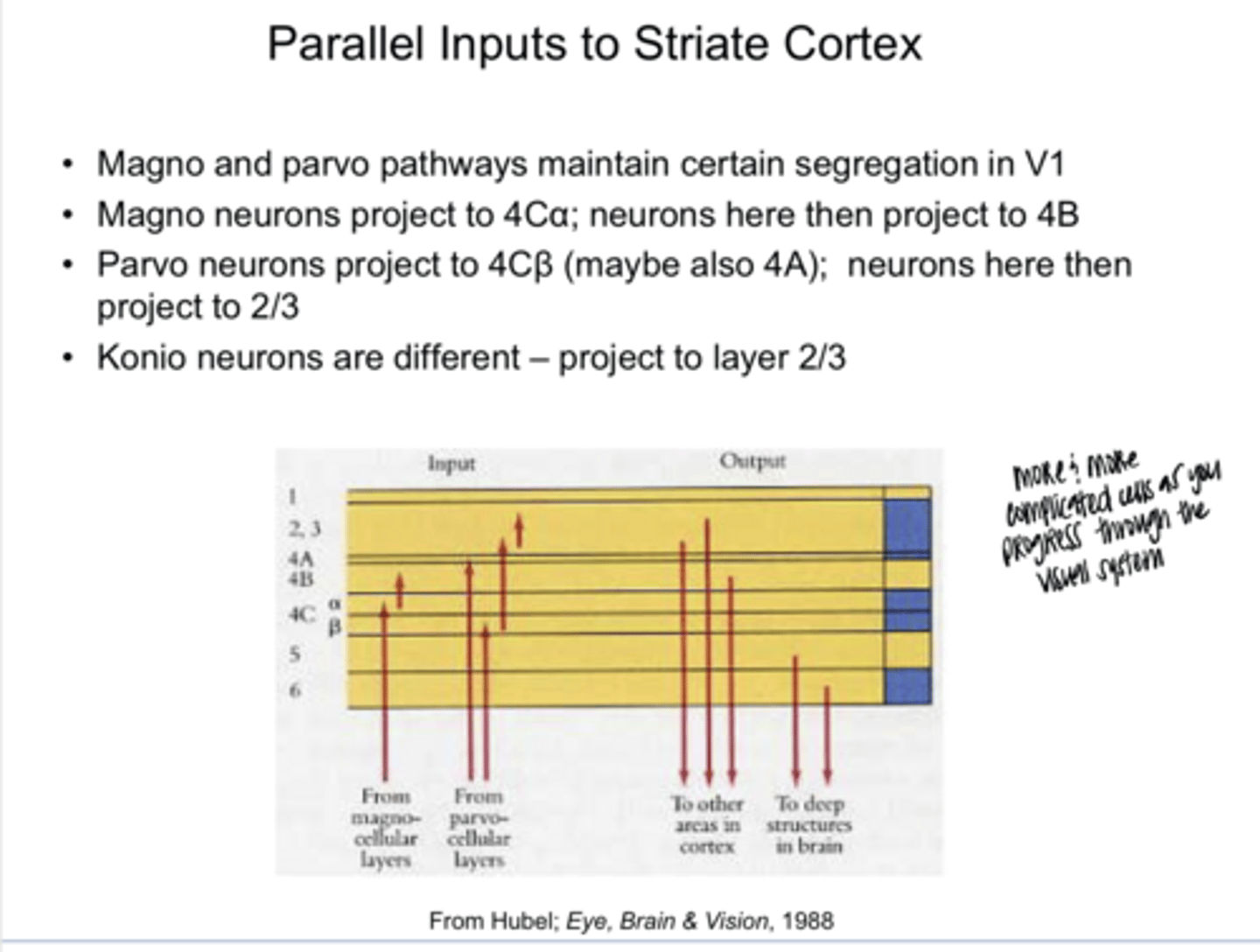
4Cα
Parallel Inputs to the Striate Cortex
REVIEW: Magno neurons project to _____
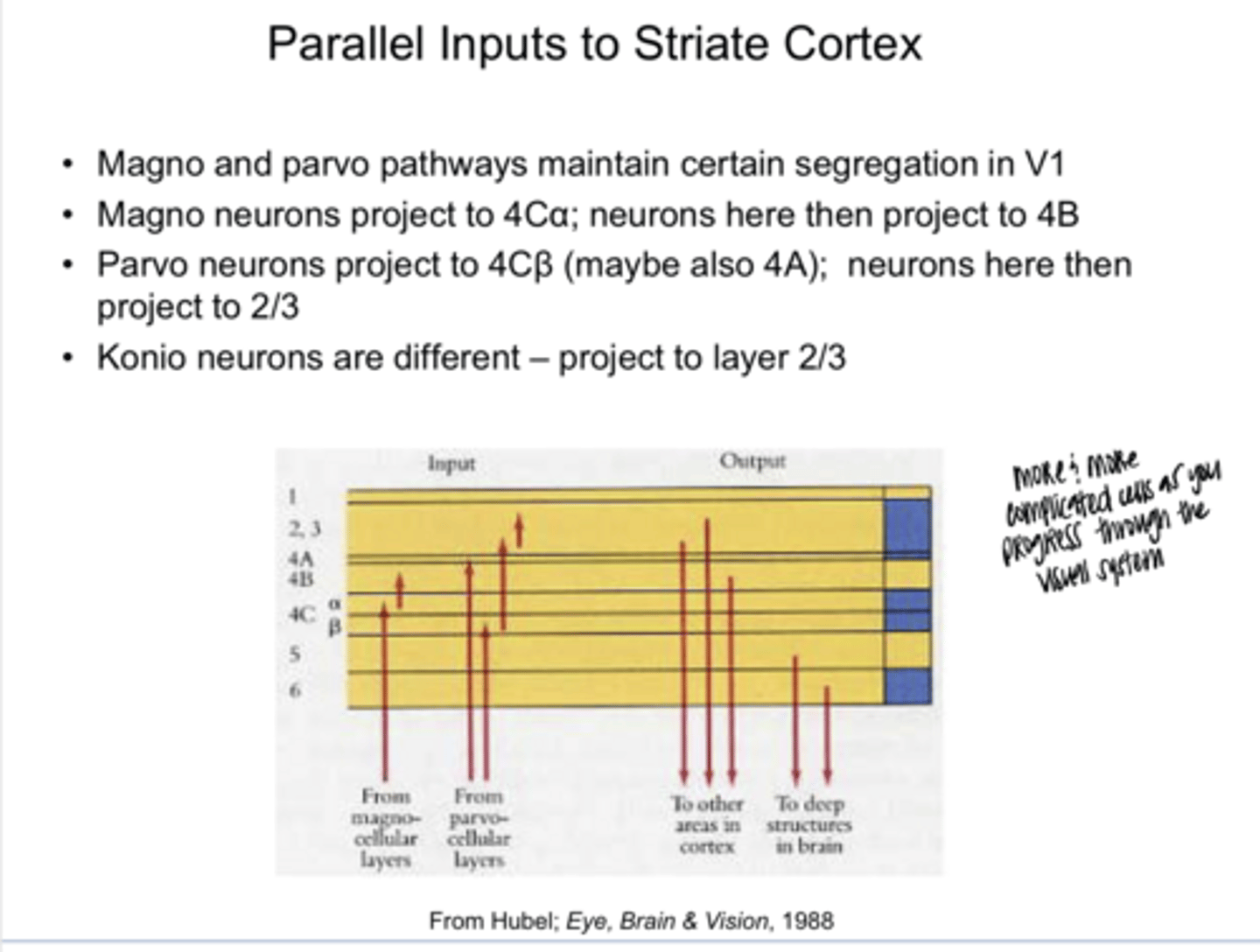
4B
Parallel Inputs to the Striate Cortex
REVIEW: Margo neurons project to 4Cα, neurons from here then project to ______
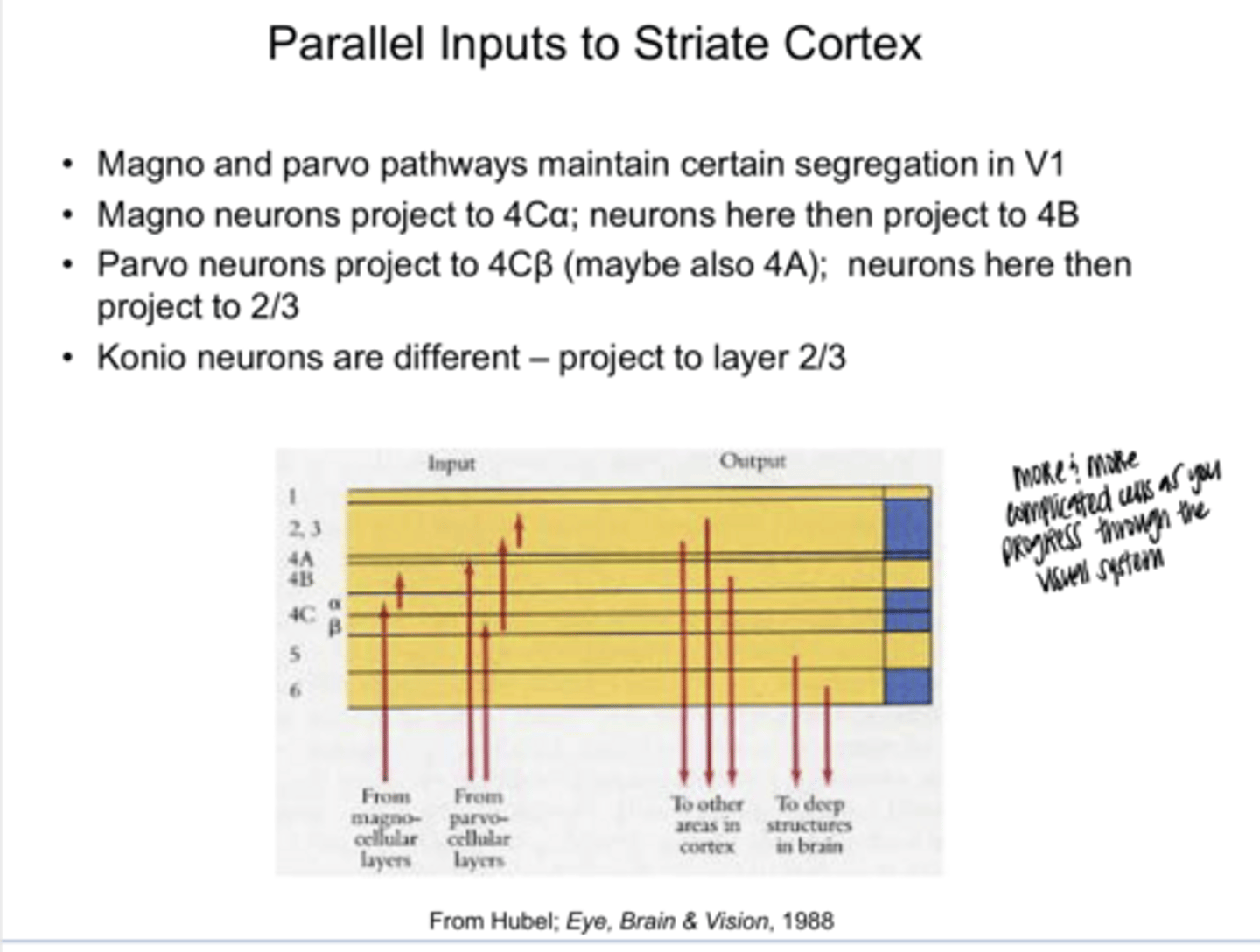
4Cβ
Parallel Inputs to the Striate Cortex
REVIEW: Parvo neurons project to _____
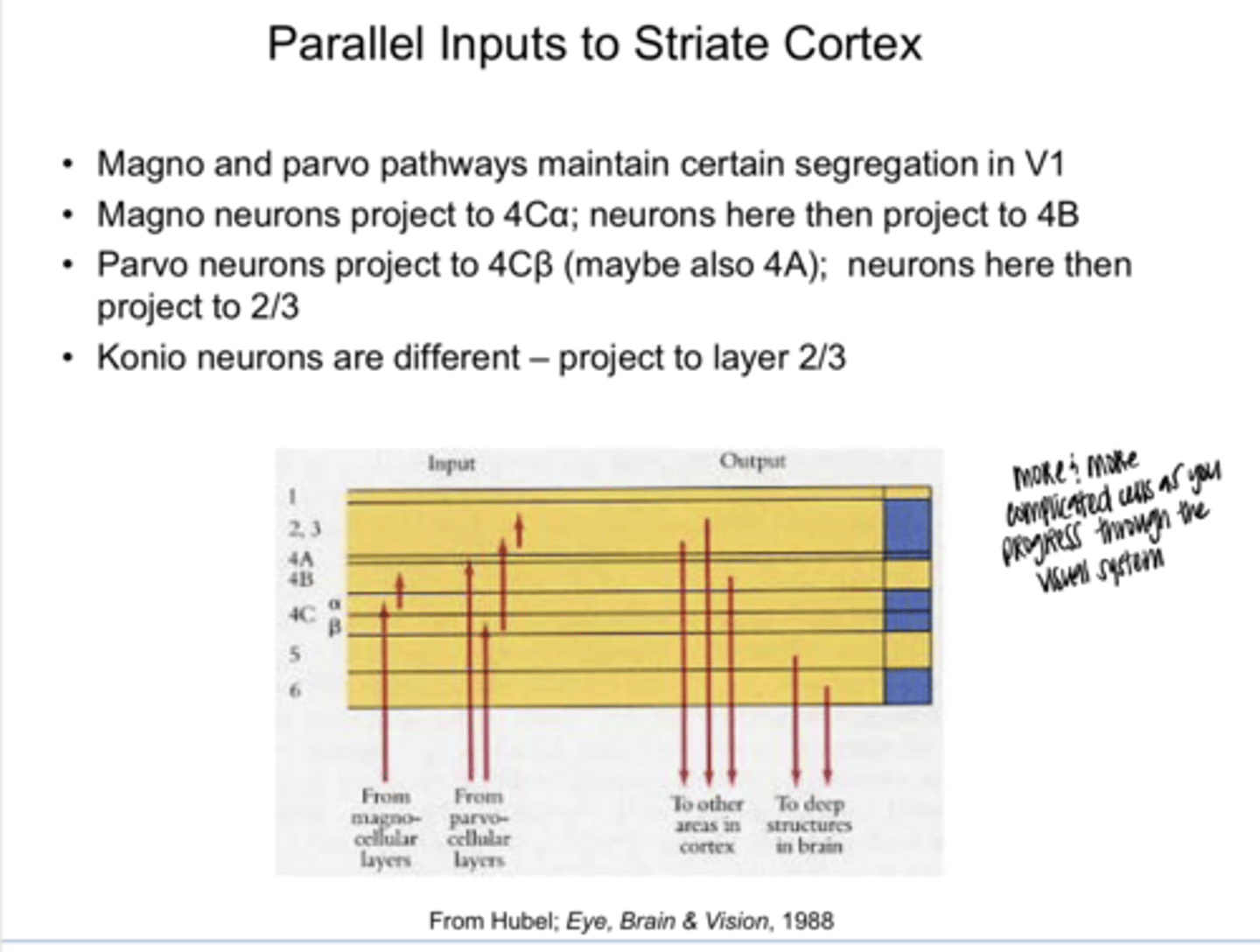
2/3
Parallel Inputs to the Striate Cortex
REVIEW: Parvo neurons project to 4Cβ, neurons from here then project to ______
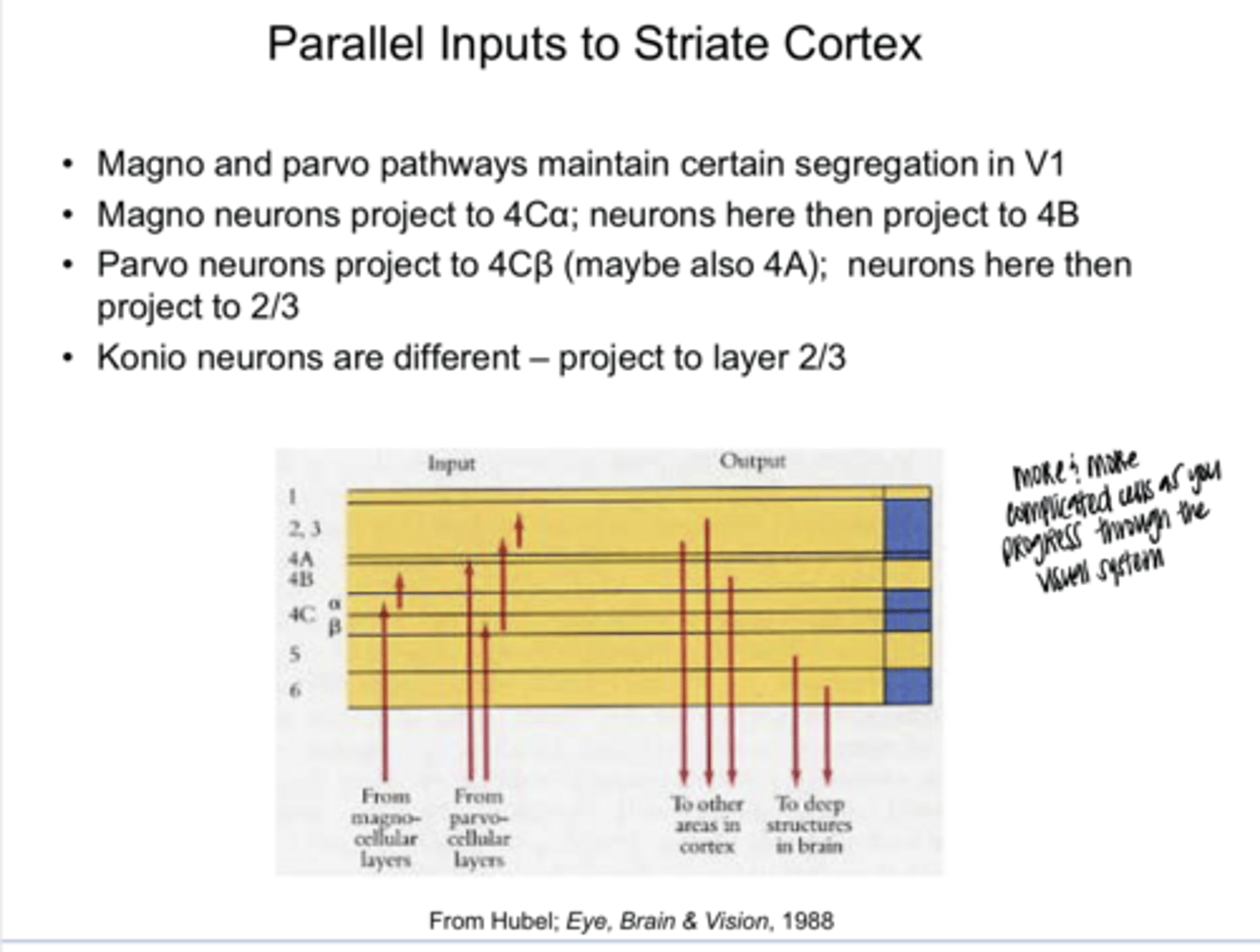
2/3
Parallel Inputs to the Striate Cortex
REVIEW: Konio neurons project to ____
low
Magno Channel LGN to VI -- Parasol cells
(high/low) spatial frequency
high
Magno Channel LGN to VI -- Parasol cells
(high/low) temporal frequency
achromatic
Magno Channel LGN to VI -- Parasol cells
(Chromatic/achromatic) processing
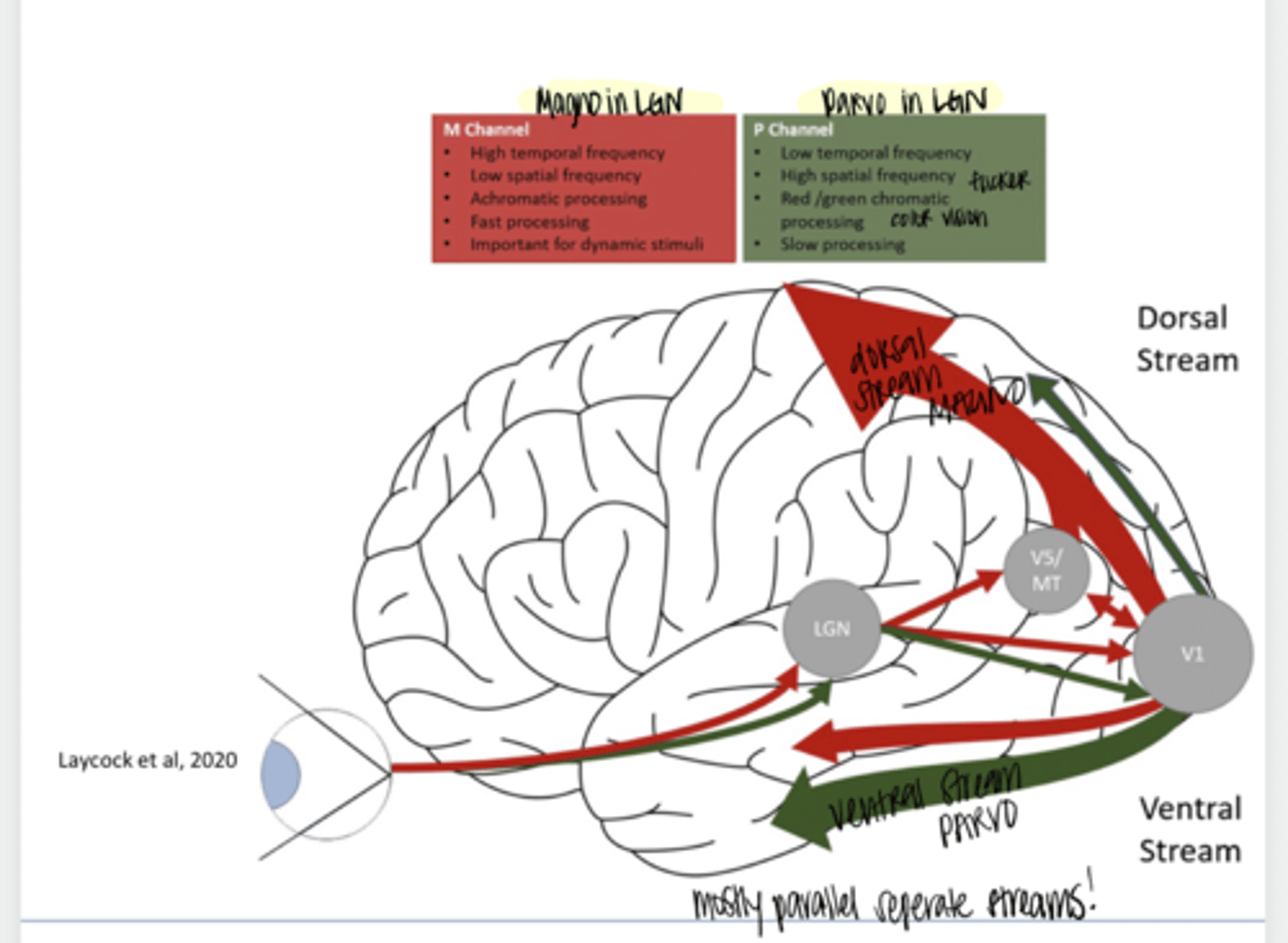
fast
Magno Channel LGN to VI -- Parasol cells
(Fast/slow) processing
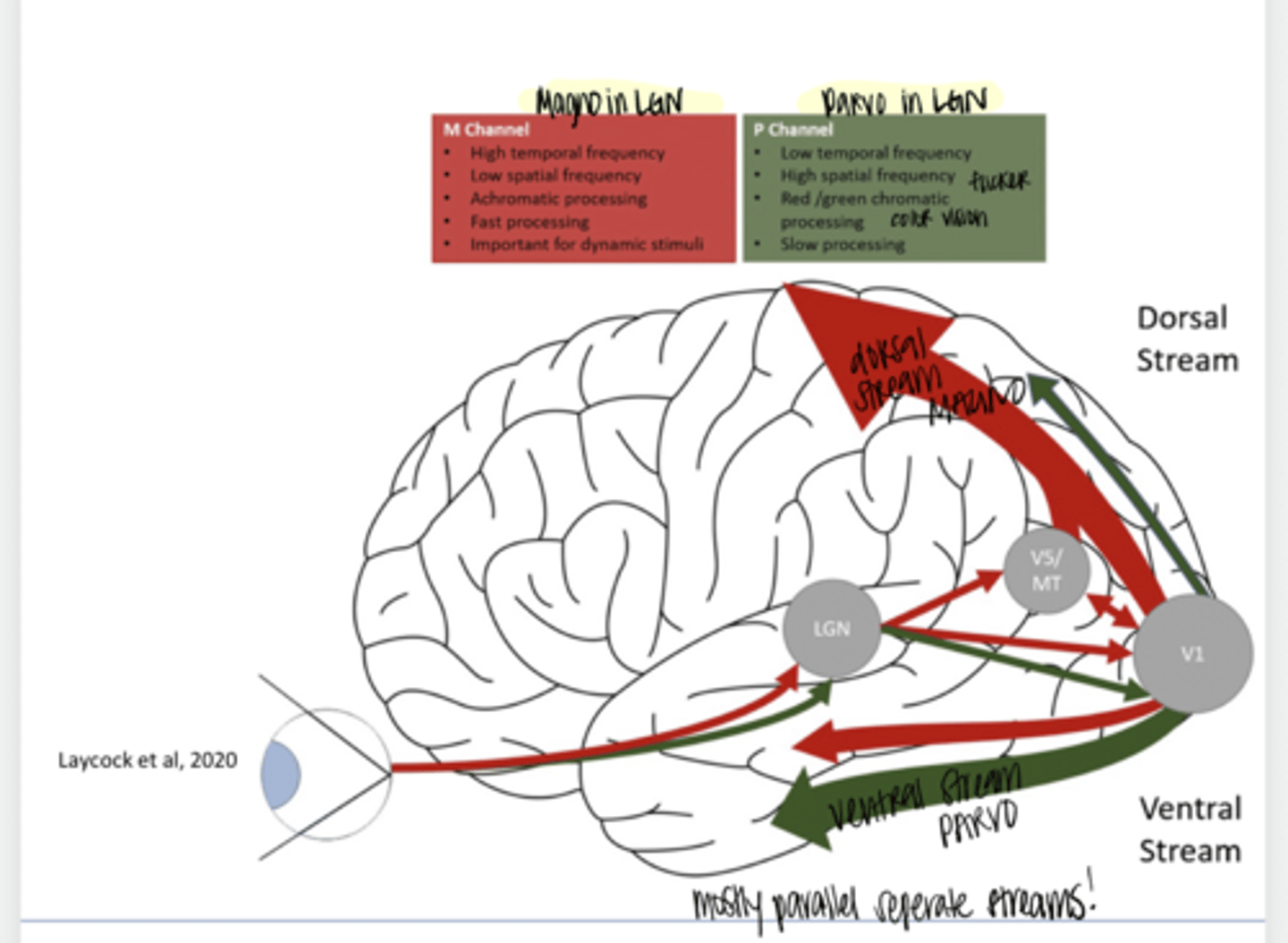
dynamic
Magno Channel LGN to VI -- Parasol cells
Input for _____ stimuli
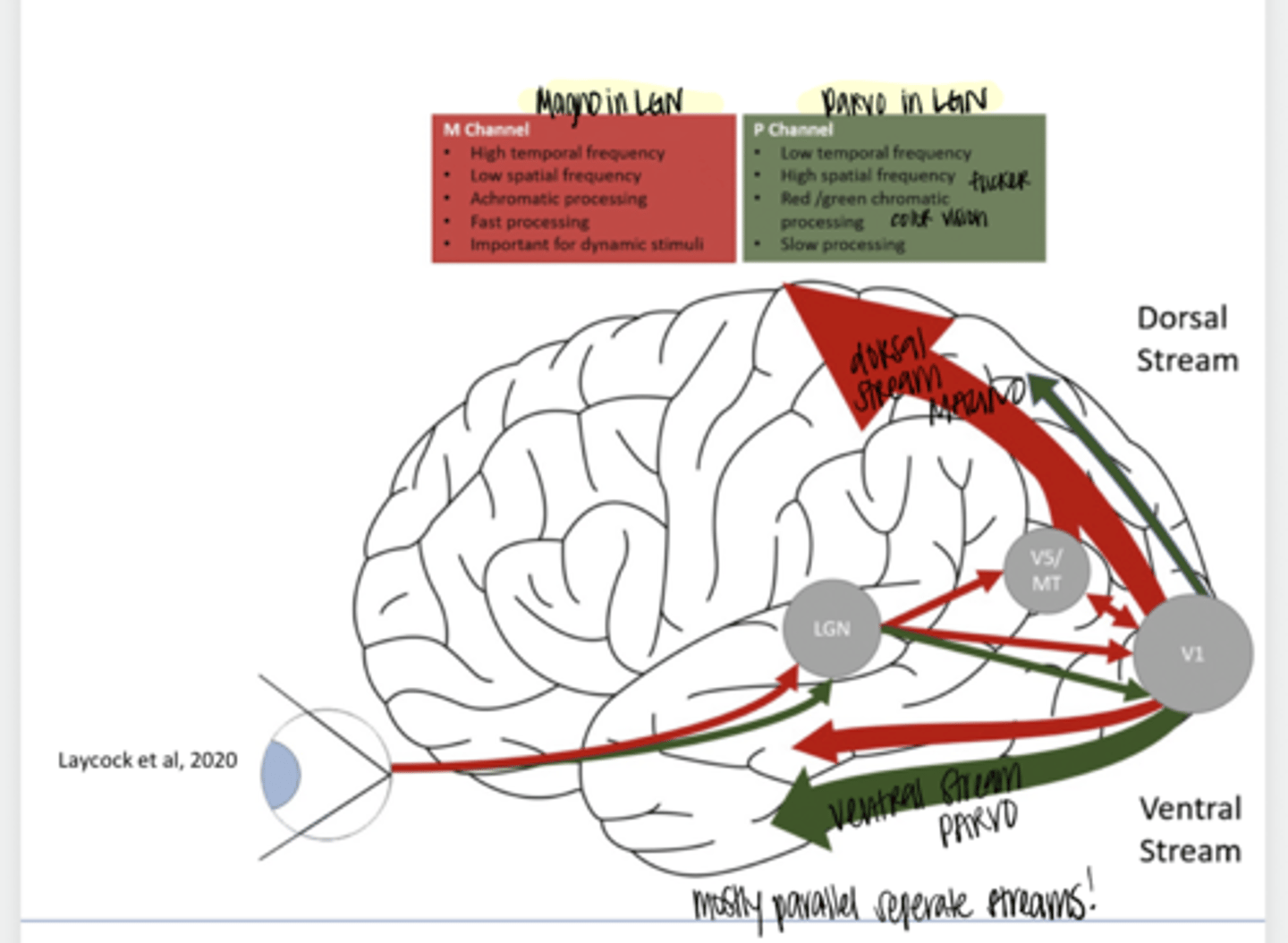
low
Parvo Channel LGN to V1 -- Midget Cells
(high/low) temporal frequency
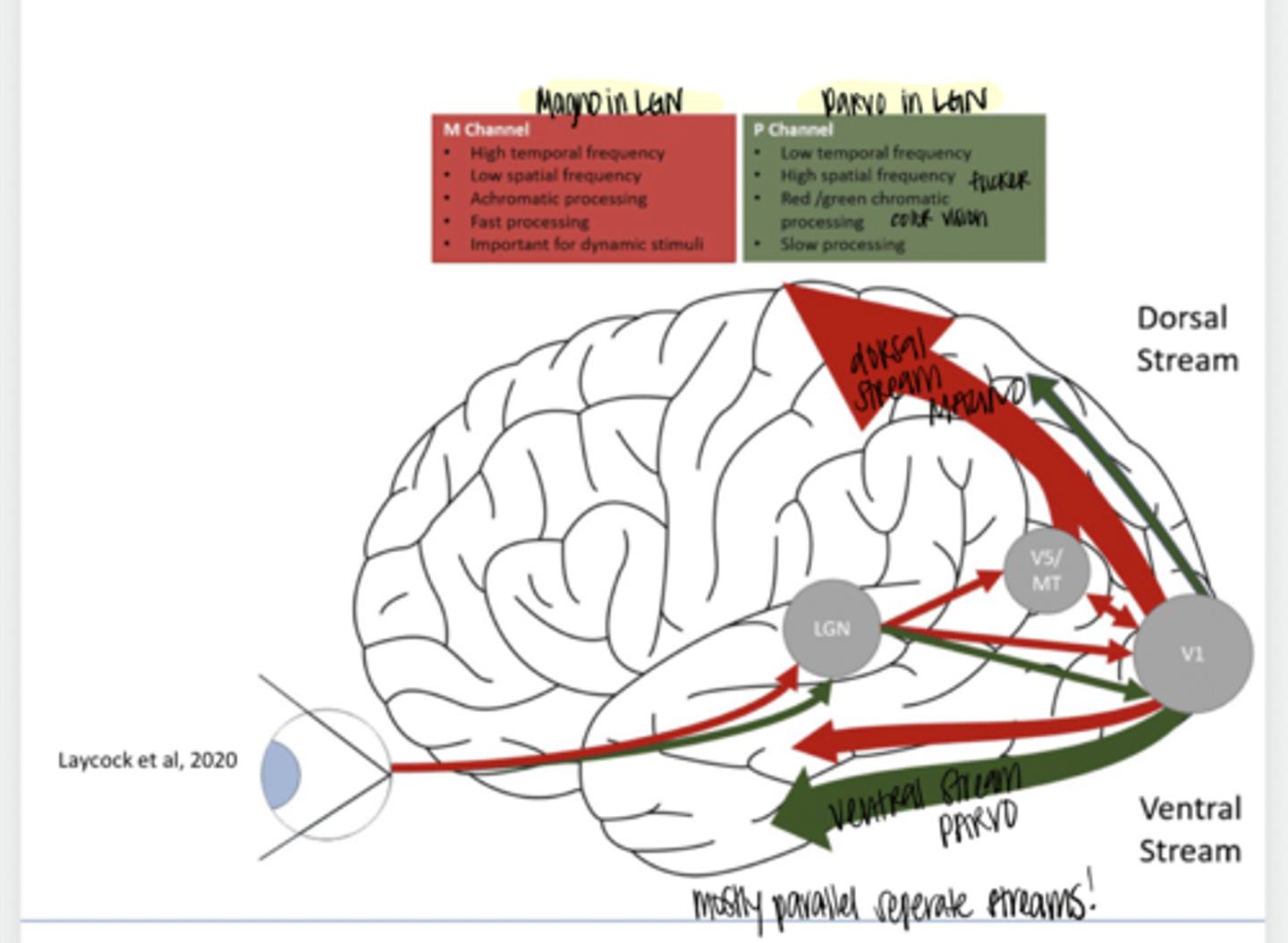
high
Parvo Channel LGN to V1 -- Midget Cells
(high/low) spatial frequency
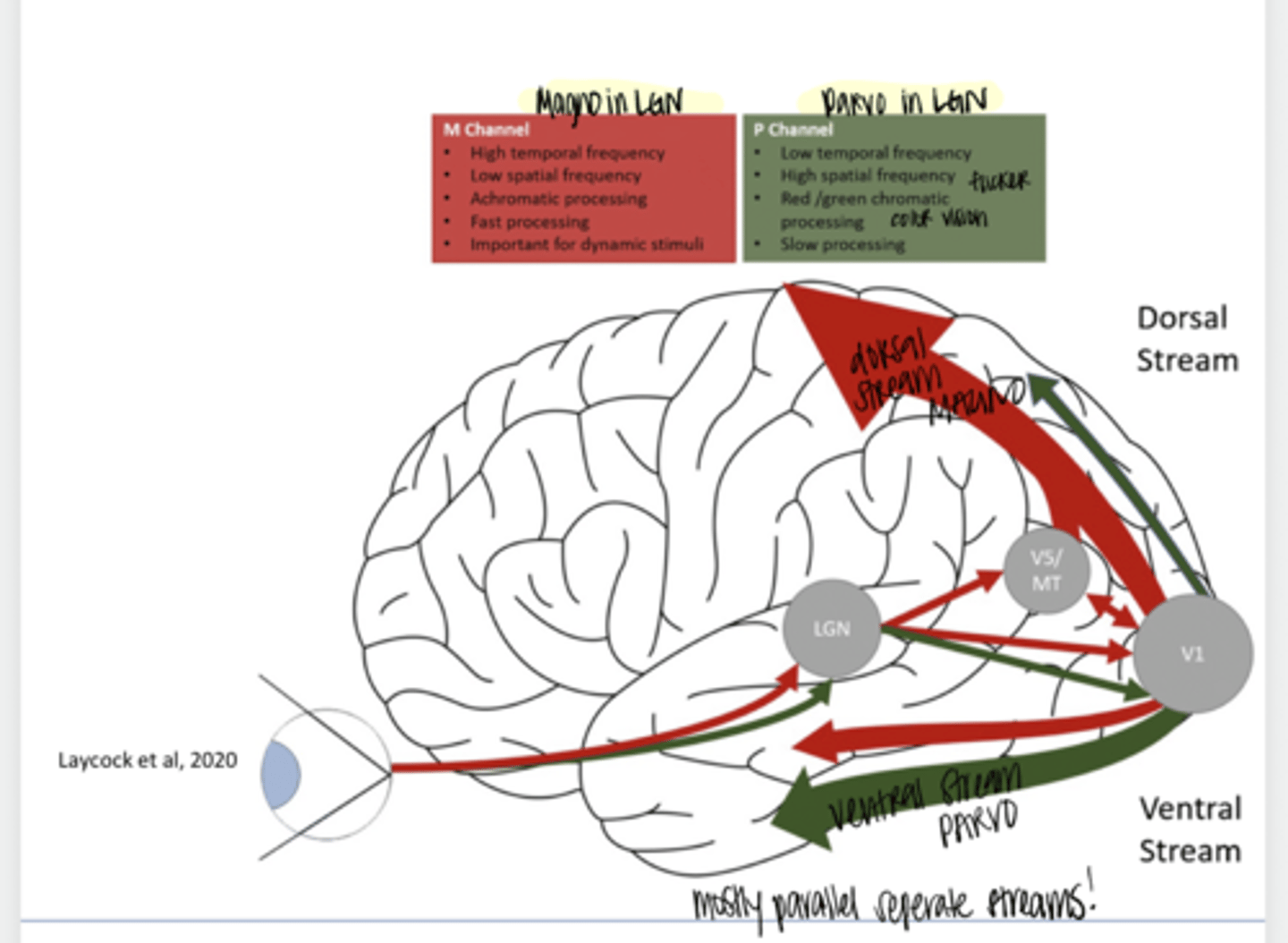
red/green
Parvo Channel LGN to V1 -- Midget Cells
_______ chromatic
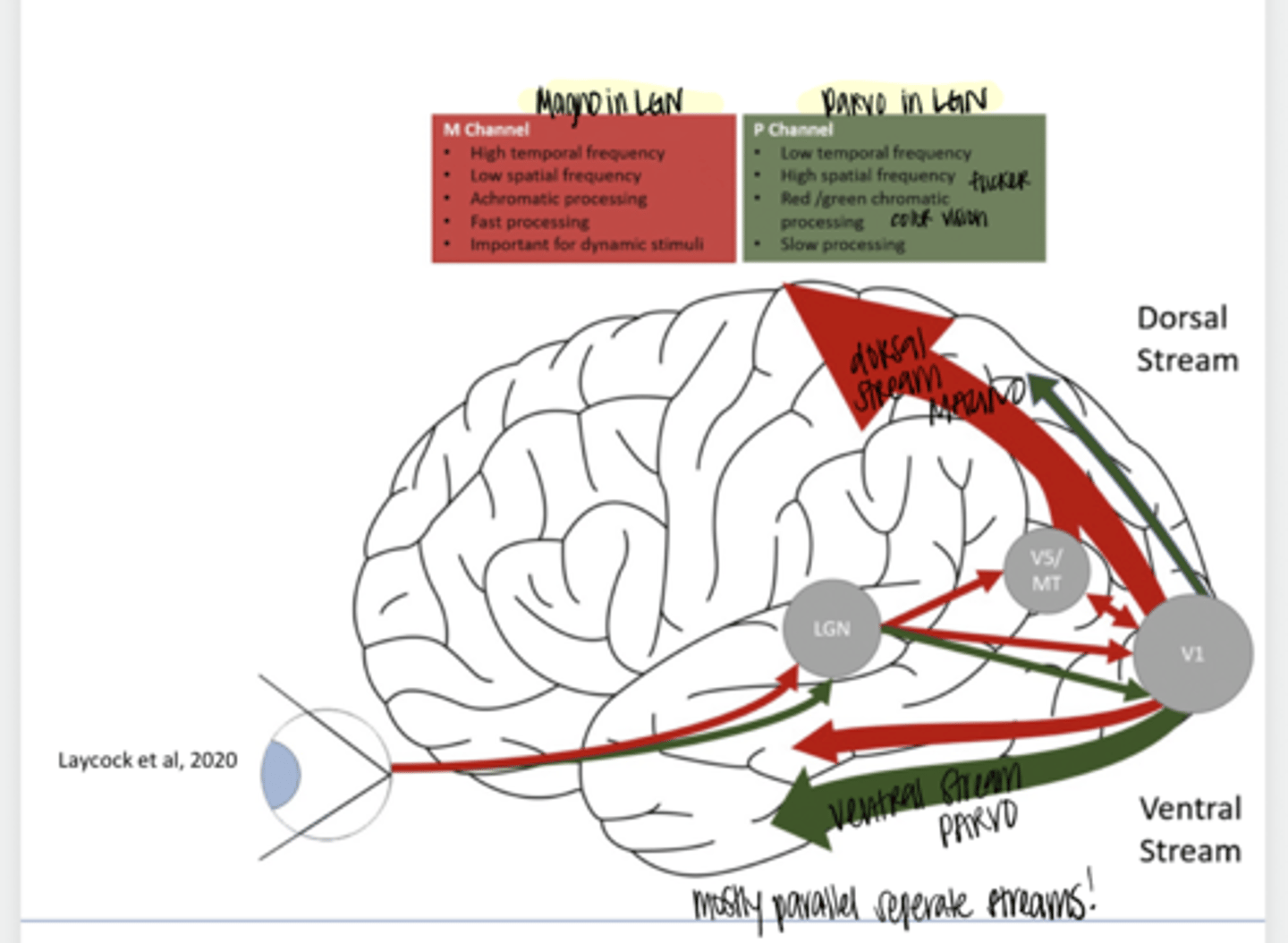
slow
Parvo Channel LGN to V1 -- Midget Cells
(Slow/fast) processing
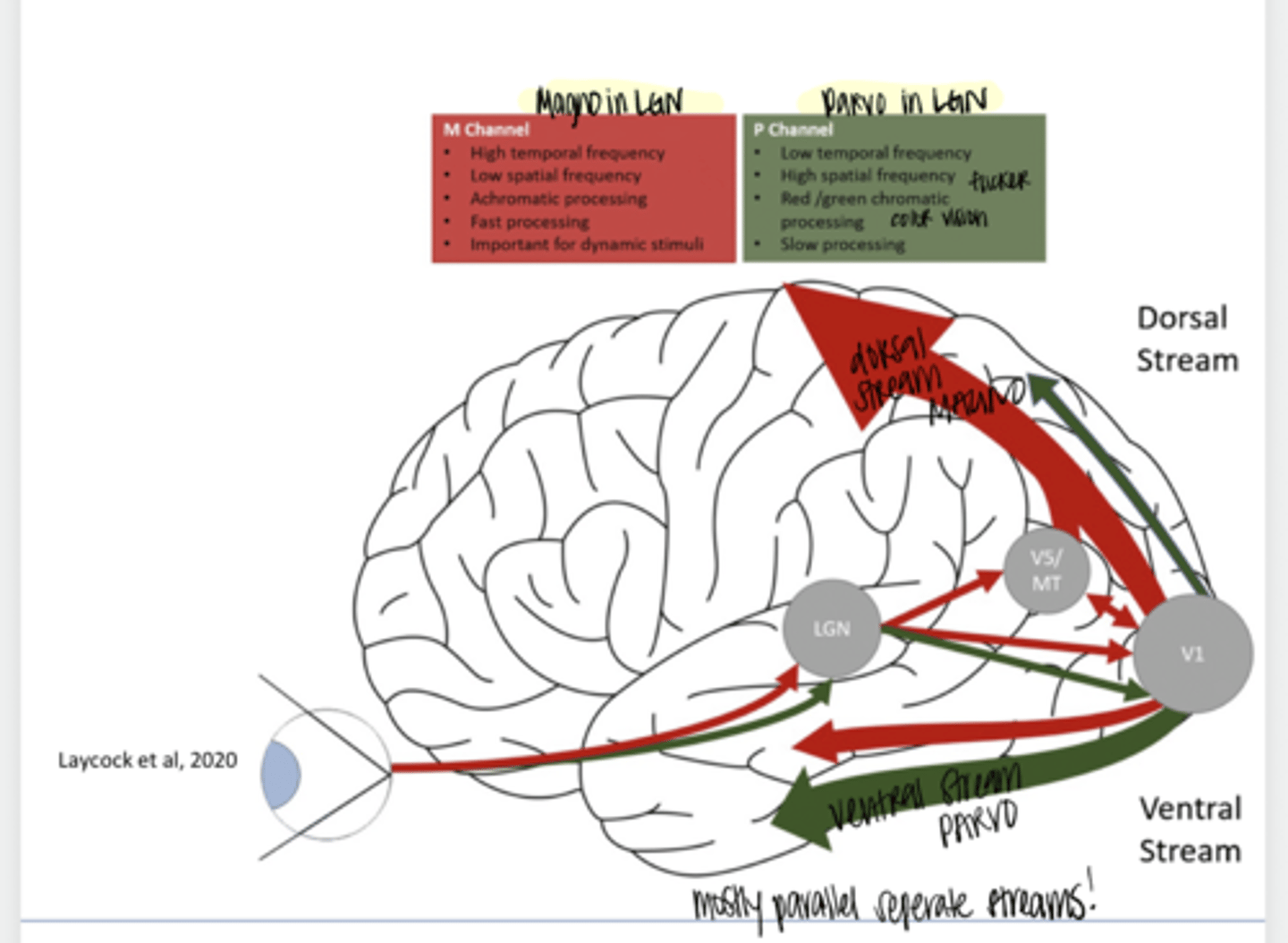
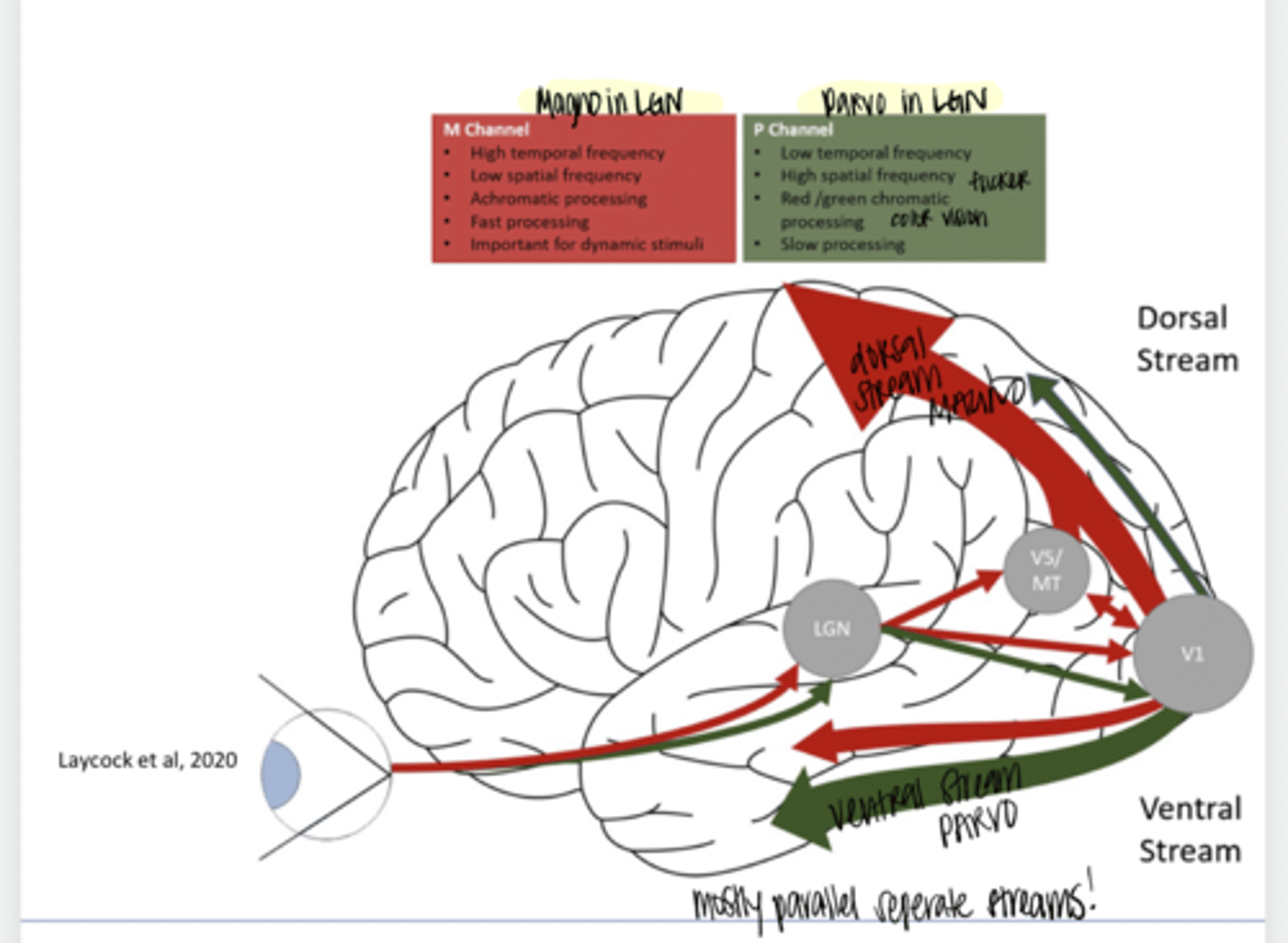
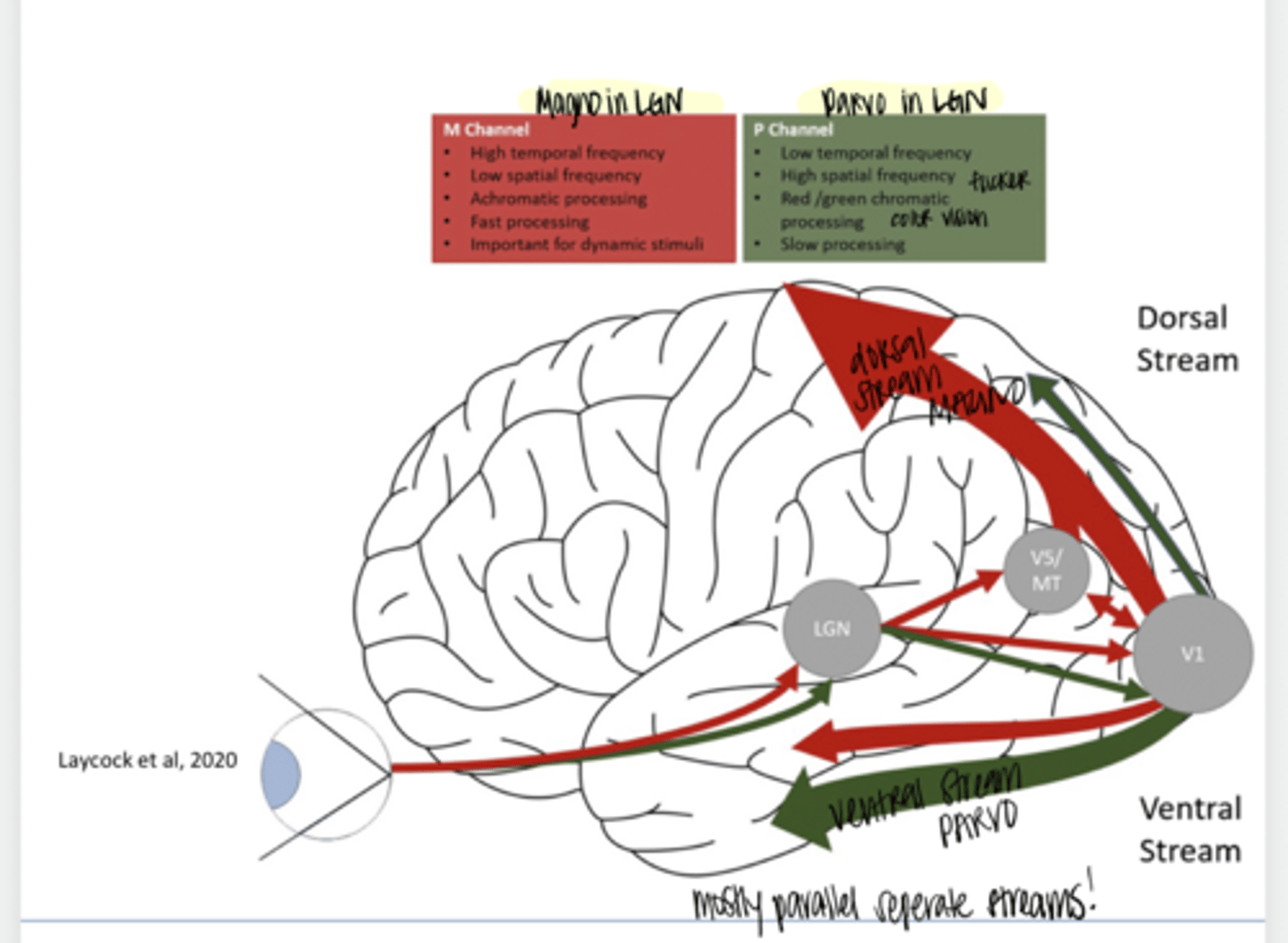
Dorsal v Ventral Stream (Pic)
Dorsal v Ventral Stream (Pic)
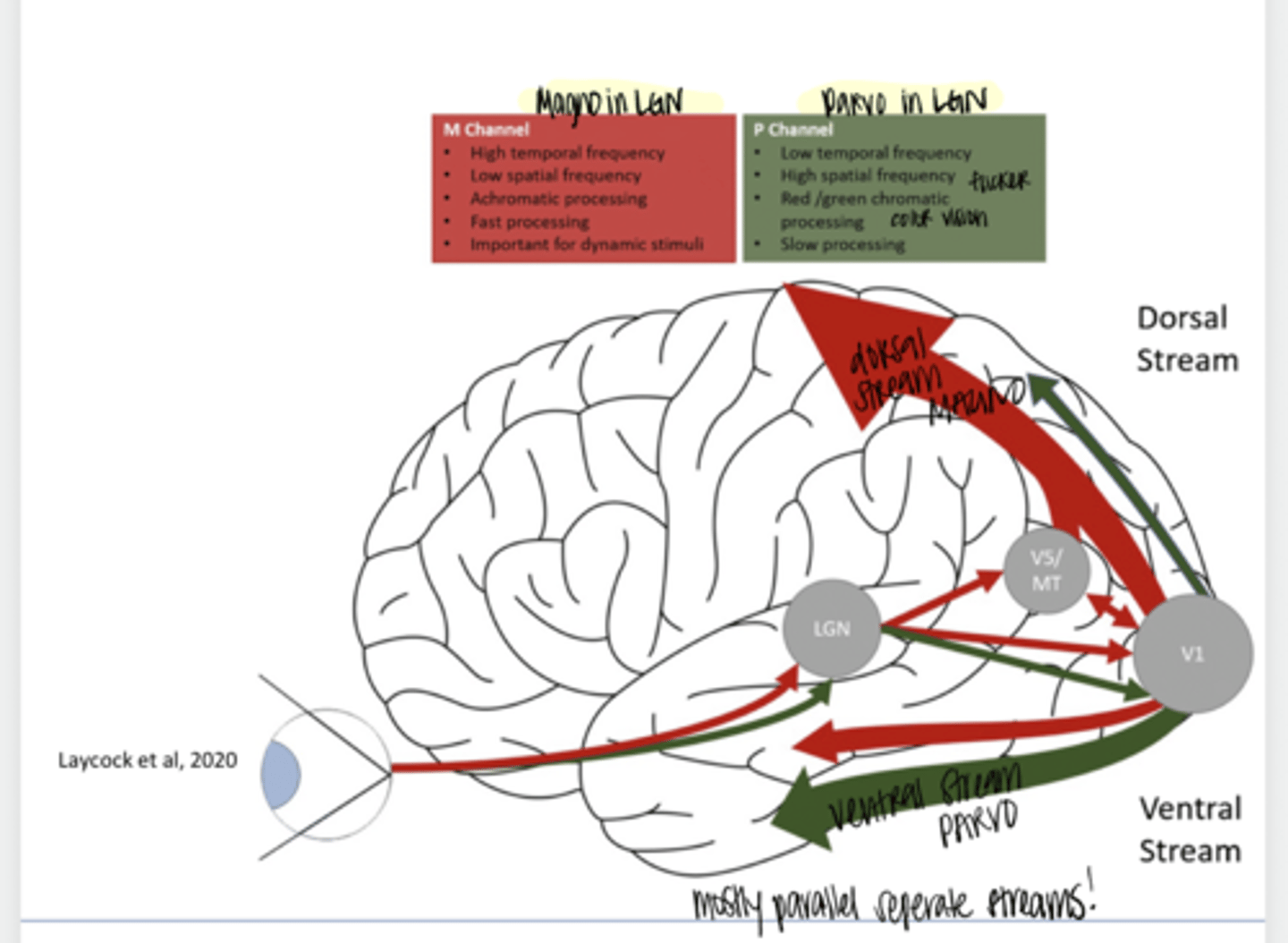
magno
Dorsal stream mainly contains the (magno/parvo) pathway information
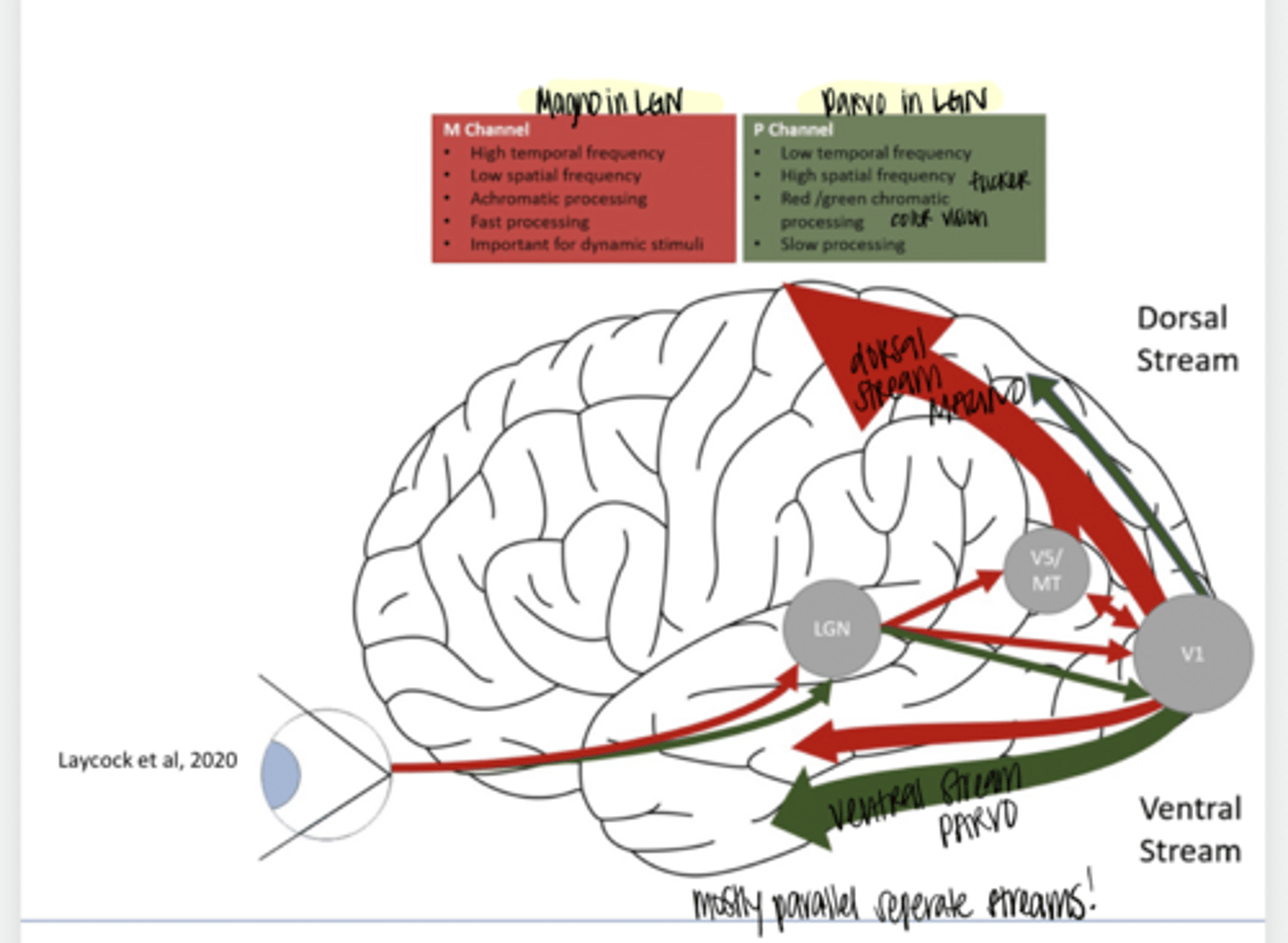
Parvo
Ventral stream mainly contains the (magno/parvo) pathway information
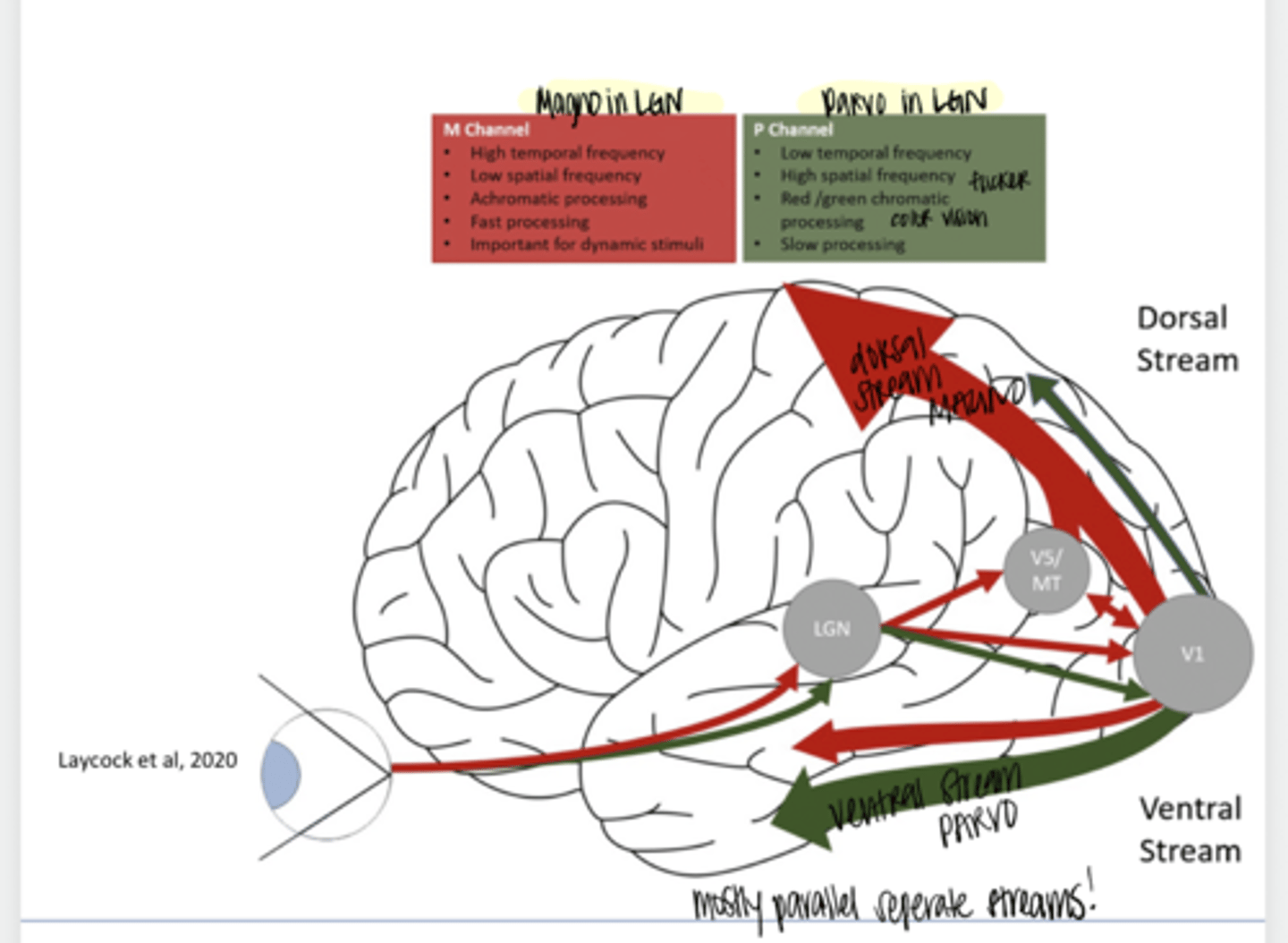
Parvo
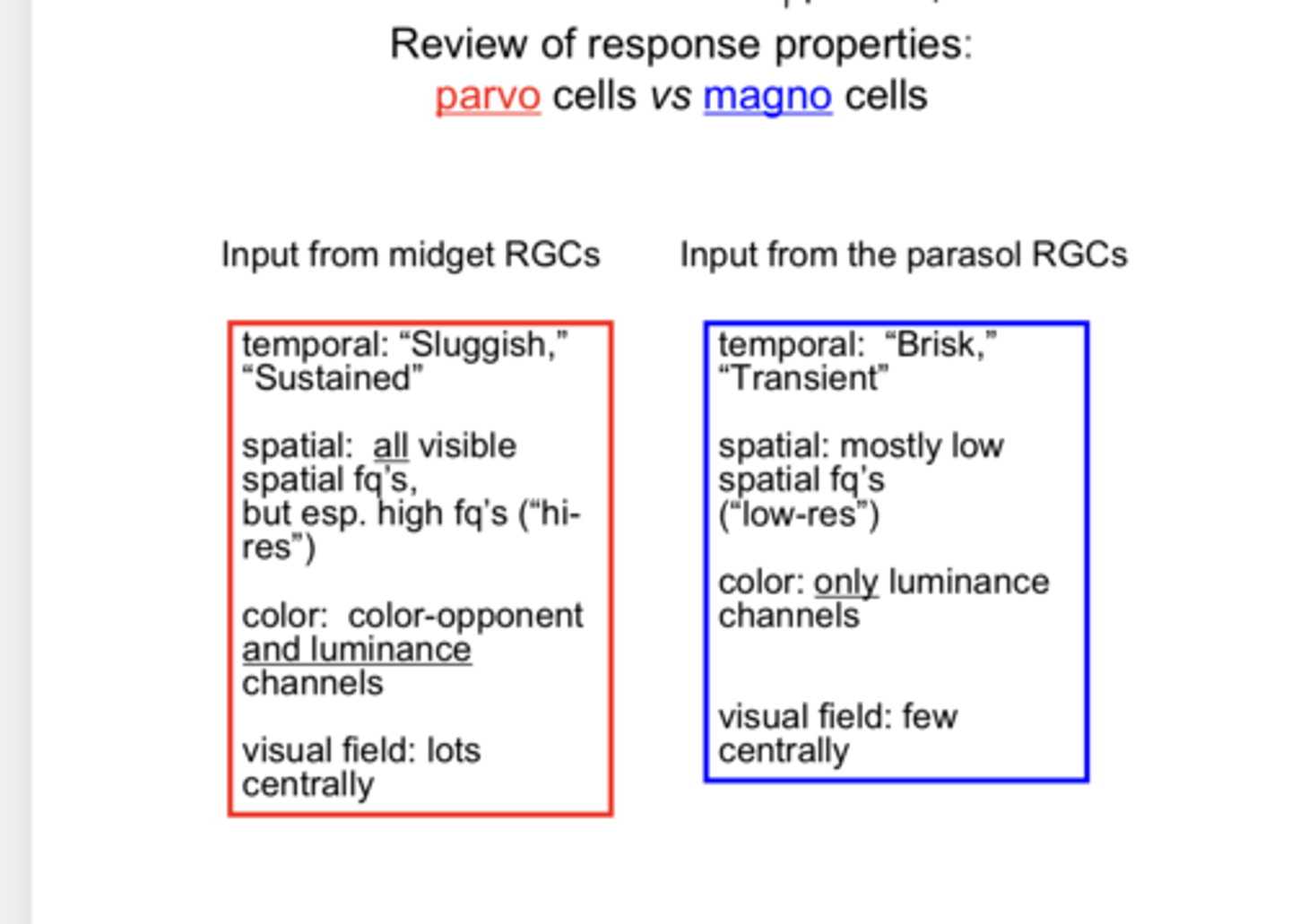
Review of Response Properties -- Magno v Parvo
Temporal spatial frequency is sluggish and sustained
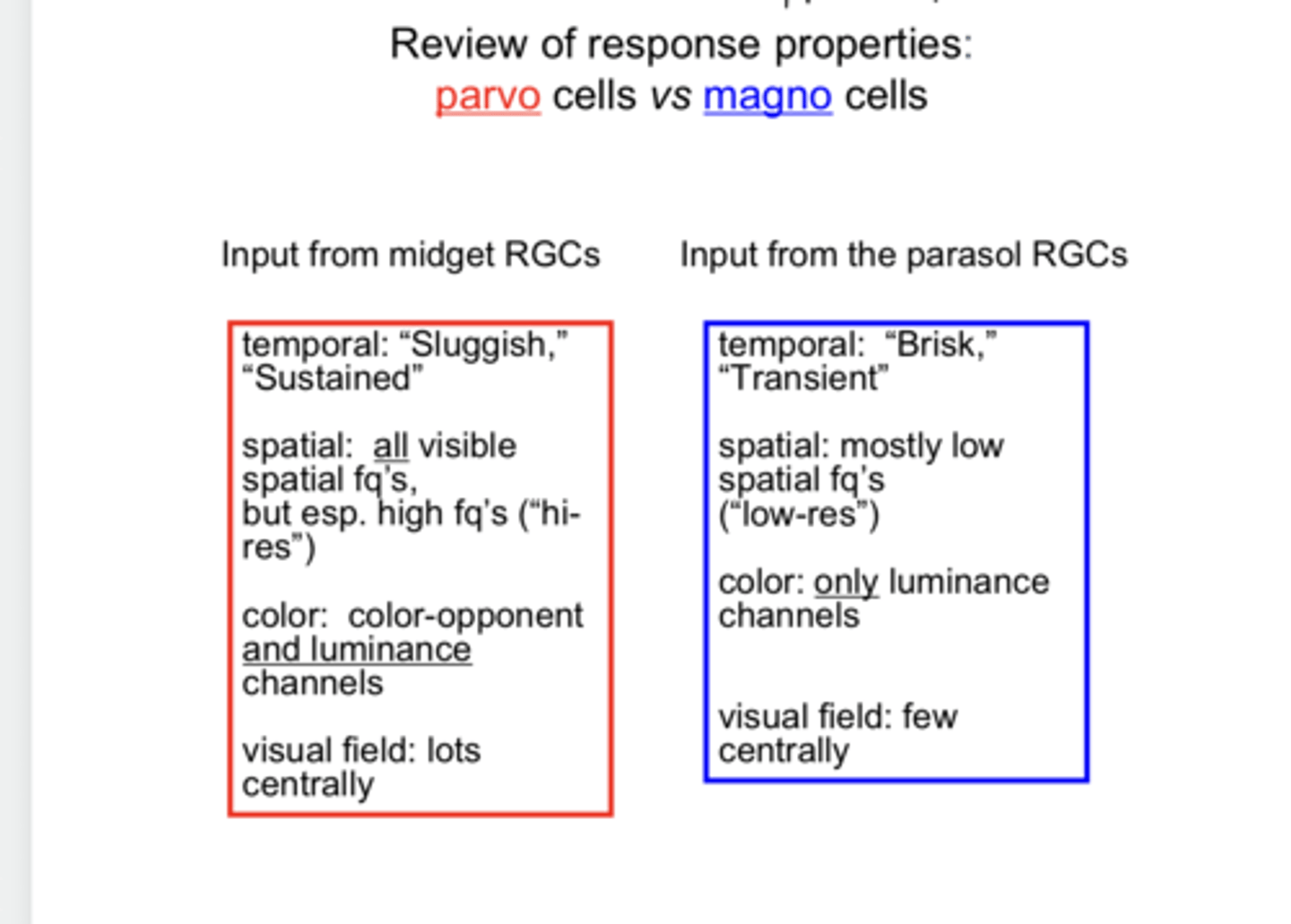
Magno
Review of Response Properties -- Magno v Parvo
Temporal spatial frequency is brisk and transient