Chapter 16 - Mating Strategies Based on Animal Performance: Random and Assortative Mating
 Call Kai
 Learn
Learn Practice Test
 Spaced Repetition
 Match
Match Flashcards
 Knowt Play
1/59

There's no tags or description
Looks like no tags are added yet.
Name | Mastery | Learn | Test | Matching | Spaced | Call with Kai |
|---|
No analytics yet
Send a link to your students to track their progress
60 Terms
Mating system =
a set of rules for making mating decisions
General mating strategies based on animal performance include:
simple random mating
positive assortative mating
negative assortative mating
Individual context =
strategies for mating particular animals
Population context =
strategies for crossing breeds or lines
What is one stragety for making individual matings?
random mating
Random mating =
a mating system in which males are chosen at random
With truly random mating:
all conceivable matings are equally likely
To make random matings, a breeder with a statistical bent might:
assign each female with a number from a random number table, then allocate those females with the lowest random numbers to one male, those females with random numbers in the next higher category to another male, and so on.
More typical procedures of random mating include:
gatecutting and randomly choosing doses of semen for artificial insemination
Gatecutting =
sorting females according to the order they choose to approach a gate
Random mating has nothing to do with:
random selection — a highly select group of individuals can be randomly mated
Random mating is easy because it requires:
no performance records or genetic predictions & little time is involved in making mating decisions
Random mating is popular in:
commercial breeding programs where performance information is unavailable or where there are so many animals that other approaches are impractical
With random mating, it is unlikely that a sire’s evaluation will:
benefit from having a particualy good set of mates or suffer from having a particularly poor set
Assortative mating =
the mating of either similar individuals or dissimilar individuals
Similar =
similar performance in a trait or set of traits or it can also mean having similar expectation of performance (similar genetic predictions)
Any mating strategy that is not random with respect to performance or the expectation of performance is:
a form of assortative mating
The lowest and worst are:
simply the animals with the lowest or worst data of those individuals selected — they may actually be very select, not particularly low or bad at all
Assortative mating requires:
performance records, genetic predictions, or some other mating criterion — animals must be ranked
Assortative mating favors some individuals with respect to progeny performance, for example:
a sire mated to only the best females has a distinct advantage over a sire relegated to “bottom end“ females
Unless we use prediction technologies that account for nonrandom mating, assortive mating will cause:
the genetic predictions for the sires to be biased
Positive assortative mating =
mating like to like or best to best
PAM:
create more geneitc and phenotypic variation in the offspring generation
spreads distribution away from the center and toward the extremes
inc phenotypic variation dec uniformity
Howver, inc genetic variation can be beneficial from a selection standpoint =
because greater genetic variation speeds up the rate of genetic change
PAMs represent a way of speeding up genetic change by:
inc genetic variation
Breeders usually use PAM to:
inc the probability of producing a truly superior offspring — aka to produce extreme individuals
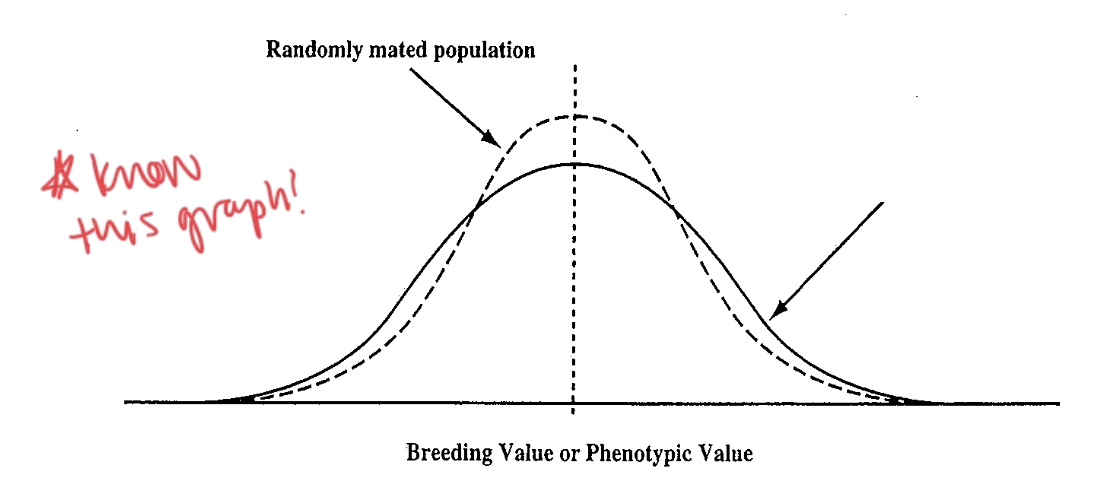
What type of mating does the solid line show?
positive assortative mating
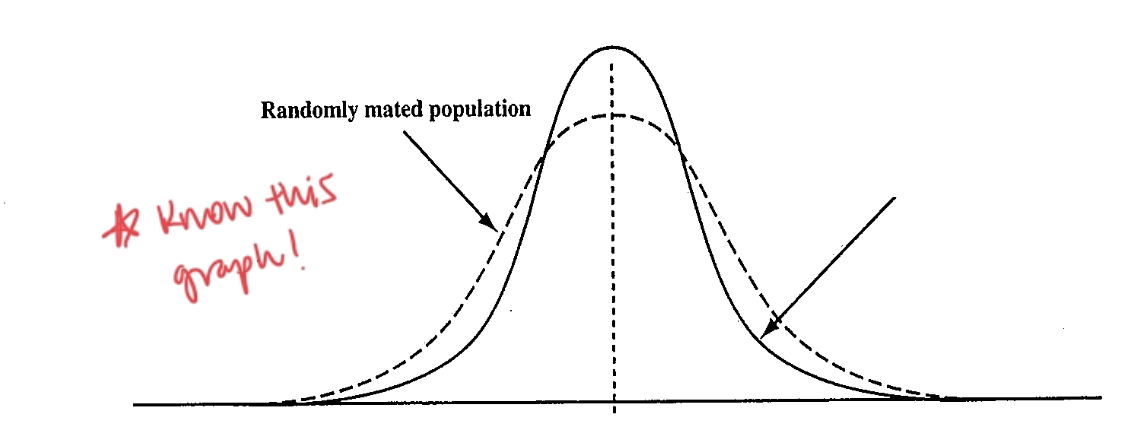
What type of mating does the solid line show?
negative assortative mating
Producing extremes makes sense if the breeding goal is to:
change the mean performance of a population
Negative assortivie mating =
mating like to unlike or best to worst
NAM:
dec variation
tends to produce more intermediate types
reduce number of extreme offspring
NAM is not a good strategy if you want to:
speed the rate of directional genetic change
If the cheif goal is to inc uniformity about some intermediate optimum:
NAM can be beneficial
NAM is best used to produce:
intermediates
Some NAMs can be considered:
corrective matings
Corrective mating =
a mating designed to correct in their progeny faults of one or both parents
Corrective mating is an example of breeding for:
complementarity
Complementarity =
an improvement in the overall performance of offspring resulting from the mating of individuals with different but complementary breeding values
Complementarity results from:
the prudent combining of breeding values — aka mixing and matching breeding values in such a way that the overall performance of offspring is superior to the performance of its parents
Breeders commonly use:
more than 1 mating strategy at a time
How can more than 1 mating strategy be used at the same time?
a breeder of registered diary cattle might use PAM with his highest producing cows, mating them to expensive AI bulls with extremely high predicted differences for milk in hopes of producing especially valuable offspring
at the same time, he might use negative assortative mating to correct in their offspring structural faults of some of his cows
he might also randomly mate a portion of his cows to young but promising bulls to save him time and provide unbiased data on those bulls when their daughters come into production
It is even possible to combine mating strategies in a single mating:
ex. if a diary breeder chooses a bull with an extremely high predicted difference for milk production to make to high high producing dairy cow the mating is PAM, if the breeder also seeks out a bull who’s high breeding value for fore udder attachement complements the cow’s loosely attached udder the same mating is also a NAM & if the breeder ignores other traits in choosing the bull for this cow the mating is random with respect to those ignored traits
Crossbreeding =
the mating of sires of one breed or beed combination to dams of another breed or breed combination
Linecrossing =
the mating of sires of one line or line combination to dam of other line or line combination
Breed complementarity =
an improvement in the overall perforamcne of crossbred offspring resulting from crossing breeds of differnet but complementary biological types
There is almost always some assortative strategy involved in:
crossbreeding programs — breeders rarely cross populations at random
When breeds of similar biological type are used (when like is mated to like), what systems work best?
rotational crossbreeding systems
Rotational crossbreeding systems =
a livestock breeding strategy that uses purebred males from two or more breeds in a rotating sequence to mate with crossbred females, producing replacement heifers and maximizing hybrid vigor (heterosis)
NAM of breeds is common in:
sheep, swine, and breed cattle
In swine, sheep, and beef cattle, breed complementarity typically comes from:
crossing maternal breeds with paternal breeds
Maternal traits =
a trait especially important in breeding females — examples include fertility, freedom from dystocia, milk production, maintenance efficiency, and mothering ability
Paternal breed =
a breed that excels in paternal traits
Maternal breed =
a breed that excels in maternal traits
Paternal trait =
a trait especially important in market offspring — examples include rate and efficiency of gain, meat quality, and carcass yeild
The ultimate breed complementairty is achived in:
terminal sire crossbreeding systems
Terminal sire crossbreeding system =
a crossbreeding system in which maternal breed females are mated to paternal breed sires to efficiently produce progeny that are especially desirable from a market standpoint — terminally sired females are not kept as replacements, but are sold as slaughter animals
Breed complementarity is sometimes a ____ function of the breeding values of parent breeds?
additive
At other times, breed complementarity is a multiplicative function:
when boars of a breed noted for especially rapid growth are mated to sows of a breed that produces exceptionally large litters, there is a multiplicative effect on weaned litter weight
Breed complementarity is distincly different from:
hybrid vigor
Hybrid vigor =
a function of GCV, has nothing to do with BV