Fluid Mosaic Model
 Call Kai
 Learn
Learn Practice Test
 Spaced Repetition
 Match
Match Flashcards
 Knowt Play
1/6

There's no tags or description
Looks like no tags are added yet.
Name | Mastery | Learn | Test | Matching | Spaced | Call with Kai |
|---|
No analytics yet
Send a link to your students to track their progress
7 Terms
Cell Membrane permeability
Is a selectively permeable or semi-permeable membrane, meaning it regulates the movement of substances.
The membrane allows some substances through more easily than others, with small pores or channels transporting particular substances.
Allows some substances in (or out) and not others.
Models in Science
Is a representation of a system or phenomenon
Are always changing with new evidence, new questions
Used to explain how things work, make predictions of expected results, simplify concepts, visually represent something that cannot be seen.
Model selection is important to get valid and reliable results. A model that is makes innacurate predictions will be revised or replaced.
Models need to be validated in order to be accepted. Limitations should be documented.
The fluid mosaic model of the cell membrane
Fluid - the phospholipid bilayer is viscous and individual phospholipids and some proteins can move laterally, allowing flexibility and self-repair.
Mosaic - is a mosaic of components embedded with proteins within or attached to the phospholipid bilayer, resulting in a mosaic of components.
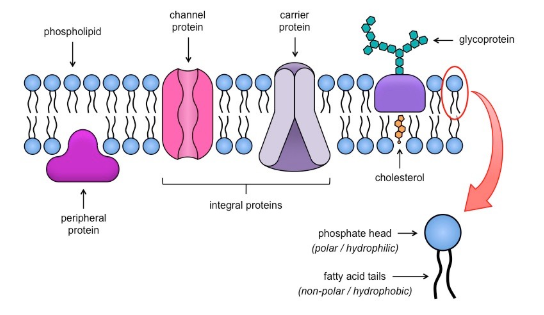
Components - Phospholipids
The lipids (fats) in membranes are called phospholipids.
In an aqueous (water environment) they form a bilayer arranged with phosphate heads facing outwards toward the cytoplasm and extracellular fluid and fatty acid tails facing inwards towards each other
The phosphate heads are hydrophilic and polar (water-loving) and the fatty acid tails are hydrophobic (water-hating).
This arrangement forms a stable barrier separating the internal and externa environments of the cell.
Components - Proteins
Can be either integral (transmembrane) or peripheral and serve a variety of roles
Proteins that are a temporary part of the cell membrane are called peripheral proteins. Integral proteins are permanent.
Peripheral proteins will bond with integral proteins.
When integral proteins span from one side of the bi-lipid layer to the other, they are called transmembrane proteins.
Components - Carbohydrates
In the cell membrane, they are linked to protruding proteins and are referred to as glycoproteins.
If attached to lipids they are called glycolipids.
Carbohydrates enable cells to adhere to one another. They are important markers in cell recognition for antibodies.
Components - Cholesterol
Is found in animal cell membranes
Improves stability and reduces fluidity