Week 8A – Attention I Practice Flashcards
 Call Kai
 Learn
Learn Practice Test
 Spaced Repetition
 Match
Match Flashcards
 Knowt Play
 Podcast
1/56

Earn XP
Description and Tags
Comprehensive vocabulary flashcards covering auditory and visual attention theories, key experiments, and psychological phenomena from the Week 8 lecture.
Name | Mastery | Learn | Test | Matching | Spaced | Call with Kai |
|---|
No analytics yet
Send a link to your students to track their progress
57 Terms
Attention (William James, 1890)
Taking possession by the mind, in clear and vivid form, of one out of what seem several simultaneously possible objects or trains of thought.
Dichotic listening task
An experimental setup where participants listen to two different messages, one presented to each ear via headphones.
Shadowing
The task of repeating back one of the messages heard in a dichotic listening experiment while ignoring the other.
Broadbent’s filter theory
An early selection theory stating a filter prevents overloading by allowing only one stream of information through, based on physical features.
Cocktail party effect
The phenomenon where one can notice a highly relevant stimulus, such as their own name, even when it is presented in an unattended channel.
Unattended message physical characteristics
Basic features noticed in the non-shadowed ear, such as voice vs. silence, pure tones, or a change from a male to a female voice.
Unattended message semantic properties
Higher-level content, such as individual words or language changes (e.g., English to German), which are typically not noticed in dichotic listening.
Von Wright et al. (1975)
A study showing that words paired with electric shocks (CS+) in the unattended message caused an increased galvanic skin response (GSR).
Galvanic skin response (GSR)
A physiological measure of emotional arousal used to show unconscious analysis of unattended content.
MacKay (1973)
A study where words like 'money' or 'river' in the unattended ear affected the interpretation of the ambiguous word 'bank' in the attended ear.
Breakthrough
When participants report a word from the unattended message, occurring more commonly when the word is highly likely given the context.
Treisman’s attenuation theory
A theory suggesting the filter does not completely reject unattended input but reduces its signal strength, allowing contextually likely words to exceed the processing threshold.
Deutsch & Deutsch’s late-selection theory
A theory suggesting all stimuli are analyzed equally and filtering occurs late, just before the response is determined.
Perceptual load theory
Lavie's theory proposing that attentional selection is variable; spare capacity not used by the primary task is automatically allocated to irrelevant stimuli.
Perceptual load
The number of units in a display and the nature of processing required for each unit, which determines the amount of attentional capacity allocated.
Inattentional blindness
The failure to notice an unexpected event, like a gorilla walking through a basketball game, while performing a primary task.
Simons & Levin (1998)
A real-life experiment where observers failed to notice that a person asking for directions was replaced with a different person.
Change blindness
The phenomenon of failing to notice changes in a visual scene, often demonstrated using the flicker task.
Attentional spotlight
Posner's concept that attention can be focused on a particular location in the visual field and shifted to other locations.
Covert attention
The ability to shift the attentional spotlight to a different visual location without actually moving the eyes.
Endogenous system
The goal-directed attentional system controlled by an individual's intentions and expectations, typically triggered by central cues.
Exogenous system
The stimulus-driven attentional system that automatically shifts attention to salient or uninformative peripheral cues.
Misdirection
A form of deception used in magic where attention is focused on one thing to distract from another.
Gaze cueing
The use of social signals, specifically where another person is looking, to direct one's own attention.
Zoom-lens model
The idea that the area of focal attention can be increased or decreased in size based on the specific demands of the task.
LaBerge (1983)
Research demonstrating that a letter-identification task created a narrow attentional beam, while a word-categorization task created a broader beam.
Split attention
The controversial idea that attention can be directed to two or more non-adjacent regions of space simultaneously.
Awh & Pashler (2000)
A study using a 5×5 grid showing that performance dropped in the space between two cued locations, arguing against a simple zoom-lens model.
Location-based attention
Selecting a specific area or region of space to attend to, regardless of the objects within it.
Object-based attention
The selection of a specific object or objects as the primary unit of visual attention.
What is attention?
Attention is the selective filtering out of irrelevant information.
it implies a withdrawal from somethings in order to deal effectively with others. -William James 1890
Earliest methods of studying attention
Dichotic listening task, this took the study of selective auditory attention into the lab. p listen to two messages one presented in each ea. the task is to shadow (repeat back) one of the messages.
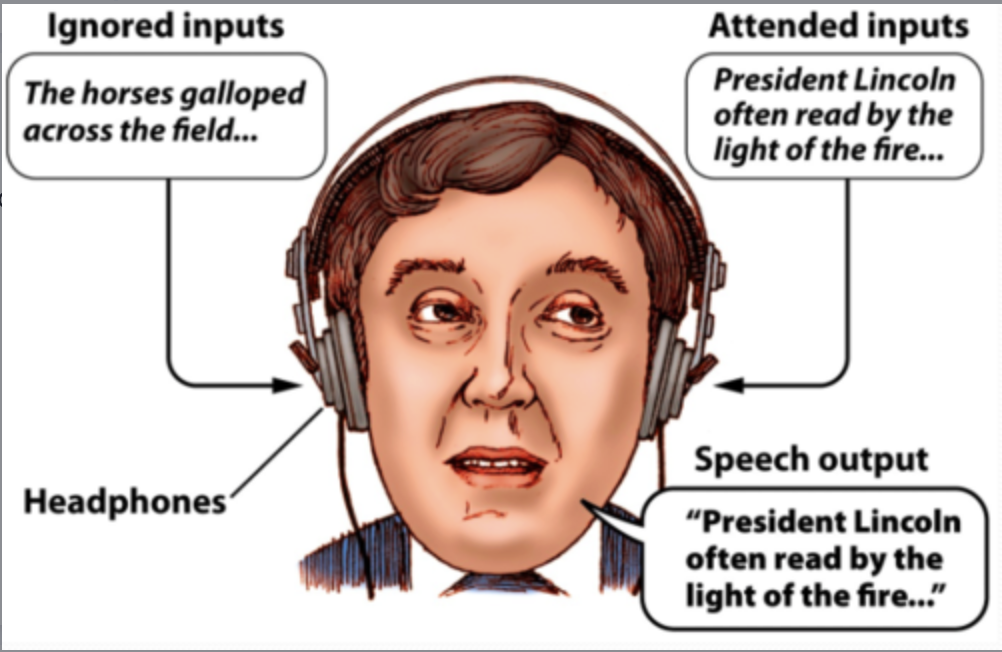
What do participants notice and not notice in the unattended ear in a dichotic listening task?
typically notice some basic characteristics of the unattended channel e.g change from male to female, voice vs silence vs pure tone.
- the tend to NOT recall any of the content, no individual words even if the same word is repeated.
- they don't notice when the language is changed or when speech is backwards
What is Broadbents filter theory? What does it account for?
the filter prevents overloading a limited capacity mechanism beyond it, filter allows one stream of information through based on its physical charecteristics.
some of the other information (outputs) such as that in the unattended ear might stay in short term stores or buffer for later processing
this accounts for the small amounts of information picked up on about the unattended channel.
What is an attentional paradox?
- How does it contradict broadbents filter theory?
-What two other theories account for this?
also know as cocktail part phenomena- when talking to your friend at a party you are actively engaged in a conversation and filtering out all of the background noise around you. however how can our name get through the selective filter and shift our attention?
trismans attenuation theory and deutsch and deutsch theory accounts for the concept of breakthrough.
The fate of unattended information in broadbents filter theory? Experiments that tested this are?
Broadbent believe that the unattended stimuli was not attended to but these experiments show otherwise...
von wright et el- they paired some words with giving the p an electric shock CS so the participants came to fear those words. then performed a dichotic listening task using some of the CS words presented in the unattended ear.
p showed in increase in GSR (galvanic skin response) when hearing the words as they feared the electric shock.
p still showed this response when the CS words were presented in the unattended ear showing they were not filtered out, suggesting there was some analysis of the content of the unattended message as it produced an automatic subconscious effect.
Can content of the unattended message change our behaviour?
Broadbent believe that the unattended stimuli was not attended to but these experiments show otherwise...
Mackay - performed another dichotic listening task. in the shadowed ear they would hear 'the man approached the bank'
in English bank is an ambiguous word
when the p were asked to paraphrase the message they found that they could change the reported meaning of the word by the participant dependent upon if 'money' or 'river' was played in the unattended message.
despite being unable to recall the content of the unattended message it still affected performance.
What is a con of Broadbents filter theory?
Treisman 1960 concept of breakthrough means- when a p says a word that was presented in the unattended message in a dichotic listening task.
would be more likely if the word is highly likely in the given context
in this example the p would switch ears half way through because it follows and makes sense - contextually relevant to each other.
Theory that followed broadbents filter theory? What does this theory not account for?
Treisman's attenuation theory. - he suggested that the unattended message isn't completely disregarded but rather the filter attenuates (reduces) analysis of the unattended ear.
the location of attenuation is flexible
processing proceeds in heretical fashion.
the threshold for processing stimuli which are consistent with context/expectations (name) is lowered.
explains why your name has a lower threshold which is why we sercum to the cocktail party phenomenon.
making it more likely that we process task relevant information.
-doesn't account for the perceptual load theory
Deutsch and Deutsch theory
late selection theory
suggested filtering occurs late so that all stimuli are analysed equally and the most relevant stimulus determines a response.
accounts for the extensive processing of unattended stimuli just as well as treimsans attenuation theory.
Arguments against late selection theory? What the theory explains these findings?
Triesman and Riley - during a dichotic listening task got p to stop shadowing and tap when they heard the target word in either message
they found more target words detected in the attended message that the unattended message.
coch et al 2005 amplitude of ERP which measures brain waves is related to processing.
bigger ERP amplitude when target word was in the attendee ear vs the unattended ear.
Broadbent filter theory accounts for theses findings
What is perceptual load theory -Lavie
suggestion that filtering is neither early or late.
everyone has limited attention capacity
total available capacity is always allocated (used)
spare capacity that is not required for our primary task is automatically allocated to irrelevant stimuli
the attentional capacity allocated to the main task depends on perceptual load
perceptual load means task difficulty (number of units in the display and the nature of processing required for each unit.
this theory is not considered by treisman
Perceptual load theory counter-intuitive prediction.
there will be less interference from the distractor on the more difficult task relative to the easier task.
a high perpetual load task requires more capacity to be used so there is less capacity remaining to process the irrelevant distractor.
How is perceptual load theory supported ?
on the graph a good response time is low
neutral distractor = not relevant
incompatible distractor = opposite to the target
in the high perceptual load task the type of distractor didn't effect performance.
In the low perceptual load task participants were much slower when there was an incompatible distractor relative to a neutral one
thus suggesting that stage of selection is variable and task irrelevant information can be processed if there is space capacity.
what is selective attention? inattention blindness?
the likeliness of noticing an unexpected event is dependant upon
task difficulty of primary task (perceptual load theory)
similarity to attended event
this is not just a lab based phenomenon. Simons and levinfound that observers didn't notice that a person who asked for directions was replaced by another in real life- as long as something gets in between those two people e.g a big map
Change blindness achieved through the flicker paradigm
relationship between attention and detection in a change blindness paradigm.
requires a blank screen for a few milliseconds
if there was no fixation to the target before the change - no chance the p noticed the change
but fixation was not sufficient for detection of change
as 60% of participants who did fixate on the target before still didn't detect the change.
not related to the number of fixations.
What are the units of attention ?
we may selectively attend to:
an area location or region of space (location based attention)
a given object(s) (object based attention
either to an area of space or a given object (location and object based attention
What is location based attention?
Visual attention is like an 'attentional spotlight' that can be focused on a particular location
posner suggested that the attentional spotlight can shift to a different visual location without eye movements.
this is called covert attention were what you are attending to is not the same thing you are looking at.
Mac screen but attending to the girls talking
How to control where we point the spotlight? 3 mechanisms
disengagement of attention from a given visual stimulus then
shifting of attention from one target stimulus to another then
engaging or locking attention on another stimulus
Describe exogenous attentional cueing
automatically shifts attention
uninformative peripheral cues are present
stimuli that are salient or that differ from other stimuli are most likely to be attended to
Describe endogenous attentional cueing
controlled by the individuals intentions and expectations
involved when central cues are present
Social cues to attention
more likely to look at what you think the person is looking at.
magicians take advantage of this- they call it 'misdirection and magic'
Spotlight or zoom lens ?
an area of our focal attention can be increase or narrowed based on the demands of the task - like a lens that we can zoom in and out of?
like when a pedestrian steps infant of our car our broad attention is now zoomed into the pedestrian.
Evidence for zoom lens (beam) theory rather than spotlight?
LaBerge 1983
the letter condition -press if S in a string of letters is rolled by R
word condition -press id a word is followed by R
probe position is were the letter s appeared in the task
in the letter condition if the probe appeared in the same position as the following R participants performed better. because it focused attention on the centre of the display before the R appeared in the centre
in the word condition p had to take in the whole word (broader attentional beam) so they detected the R at the same speed no matter where it was.
Theory for multiple spotlights rather than zoom lens?
what if we didn't have a broad spotlight on the word condition and a zoomed lens on the letter condition what if instead we have several attentional spotlights on each letter of the word?
participants were presented with a 5x5 grid filled with letters and 2 numbers. the p job was to report the two numbers within the grid. they were cued to the likely location of the numbers on 80% of the trials. what was of interest it what happened to the p who were invalidly cued.
accuracy of target detection was very good when the participants were validly cued. to support the zoom lens theory we would expect the 'near location' by the two cued locations to be included in the lens which would mean detection of the number in the near location would be as accurate as the numbers in the cued locations (left and right) - however this was no the case. instead there are two split lens'/spotlights.
-the space between the beam was not well attended - disproves the zoom lens beam theory
Visual attention - what is selected?
ugly suggested that attention is location and object based.
the task was to detect the target stimulus as quickly as possible
p fixate on the + then are exogenously cued to either the valid location or the invalid location
different kind of invalid cues- target would appear on the same object (rectangle) but a different location on the object (bottom). or the a different object. all of the invalid cues were equal distance from the target.
performance was obviously best on valid cues however following was the invalid cues that appeared on the same object but different location.
suggesting attention has an object based component to it.