DM- Ch 4 Adhesive Materials Pt 1
 Call Kai
 Learn
Learn Practice Test
 Spaced Repetition
 Match
Match Flashcards
 Knowt Play
1/49

There's no tags or description
Looks like no tags are added yet.
Name | Mastery | Learn | Test | Matching | Spaced | Call with Kai |
|---|
No analytics yet
Send a link to your students to track their progress
50 Terms
Adhesion/bonding
the joining together of two objects, using glue or cement (adhesion and bonding used interchangeably)
Adhesive
glue
Adherend
surface attached to
The oral environment is wet and hostile
this limits the types of adhesives used in dentistry
A molecular attraction between two contacting surfaces
can be a chemical bond, mechanical adhesion, or a combination of both
Not all adhesion or bonding to tooth structures
is truly adhesive
Adhesive
A material that can bond two surfaces together, particularly smooth surfaces
True adhesion
is through chemical bonds between materials being joined
Adhesives in dentistry
can be chemical bonds or mechanical bonds
Most dental materials that are adhesive
involve micromechanical adhesion
Micromechanical bonding (retention)
Most dental materials use this type of bond
Bonding using small surface irregularities
smaller than the eye can see or can be felt with explorer
Mechanical/structural interlocking of materials during micromechanical bonding is
NOT a chemical reaction bond
Glue or cement flows into the irregularities during micromechanical bonding
and hardens/sets, objects are joined
Micromechanical bonding is
STRONGER than Macro due to greater number of surface irregularities involved
Macromechanical bonding
• Surface roughness can be seen and felt
• Mechanical/structural interlocking of materials
• NOT a chemical reaction bond
In dentistry, macromechanical bonding
is used for cementing (luting) crowns and bridges to
teeth
Macromechanical bonding involves
undercuts in hard tissue
Adhesion/bonding helps retention of restorations
• Adhesion is used to keep restorations in place
• Undercuts and other mechanical locks are not necessary when adhesive materials are used
• Also used to attach orthodontic brackets and other appliances to teeth
Adhesion/bonding reduces
microleakage of restorations
Microleakage
seeping/leaking of fluids & bacteria between tooth/restoration interface (space between tooth and restoration)
Adhesion/bonding can also
reduce postoperative sensitivity
• sensitivity caused by fluids & bacteria moving in/out of interface between restoration and tooth and irritating pulp from microleakage
Restorative material
MUST have similar Coefficient of Thermal Expansion (CTE)
Percolation
when teeth are heated/cooled and the material and tooth surface don't have the same CTE, they expand/contract at different rates causing microleakage
Adhesion/bonding reduces staining
at margins of esthetic restorations
• keeps margins sealed to prevent microleakage and staining
Adhesion/bonding caries
reduction of recurrent caries
• the blocking of microleakage reduces secondary decay (recurrent decay) at margins of restorations, no space exists at interface
Development of Dental Adhesives
Acid etching of enamel to create a rough surface, allows low-viscosity adhesive to flow into irregularities to cure/set
The purpose of acid etching
is to open pores of tooth surface and create a rough
surface to improve adhesion
• this is a MICROmechanical bond
1950's
pit and fissure sealants
1960's
composite restorations
1970's-1980's other uses
• Orthodontic brackets bonded to labial surfaces
• Pit and fissure sealants
• Maryland bridges
• Veneers
Chemical adhesion examples in dentistry
- Polycarboxylate cements
- Glass ionomer cements
Polycarboxylate cements
1970's this first chemically adhesive cement enabled materials to be bonded to dentin
• Uses polyacrylic acid & zinc oxide powder
Glass ionomer cements
Use polyacrylic acid & glass powder to chemically bond to dentin and enamel
• Not as esthetic or mechanically tough as composites
Dentinal bonding agents
1990's composites bonded to dentin via acid etching
• Dentinal bonding systems now used to bond ceramic & cast metal to dentin and enamel
Surface factors
Cleanliness and biofilms
Cleanliness surface factor
Must bond to a clean surface, if surface is dirty adhesive (glue) bonds to debris and not surface irregularities of the adherend (surface)
If tooth surface becomes contaminated by oral fluids (saliva, blood, crevicular
fluid)
it becomes covered by layer of biofilm, so adhesive won't bond to surface now
When adhesive won't bond to the surface
using a rubber dam helps prevent contamination
• Tooth surface must be isolated to prevent contamination and failure
• Isolating tooth surface also protects soft tissue from chemical burn from etch
Testing adhesion
Adhesive and cohesive failure
Adhesive failure
When the bond breaks cleanly at the interface with tooth
• Adhesive material remains on the restoration/appliance
Cohesive failure
When the bond breaks within the bonding material
• Adhesive material remains on the tooth surface and restoration/appliance
Acid etching process (Steps 1-3)
1. Enamel surface cleaned with pumice or other abrasive
2. Cleaned surface is rinsed
3. Cleaned surface is dried
Acid etching process (Steps 4-6)
4. Acid or etchant is applied for 15-30 seconds, rinsed, dried
• Typically, 37% (+-) orthophosphoric acid
5. Etched surface is rinsed with water
6. Etched surface is dried
• If acid etching is successful, it causes enamel to become "chalky" or "frosty", bonding occurs at ends of enamel rods
Acid etching process (Step 7)
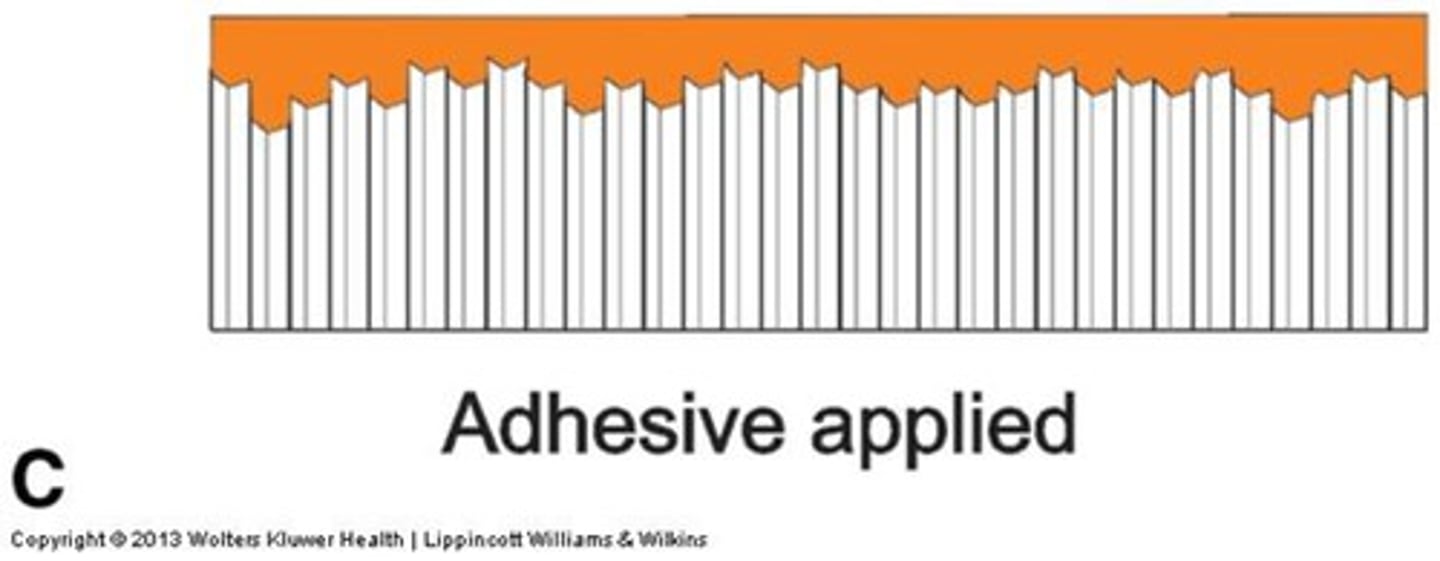
7. Liquid bonding resin (polymer system) applied, polymer chemically reacts, cures
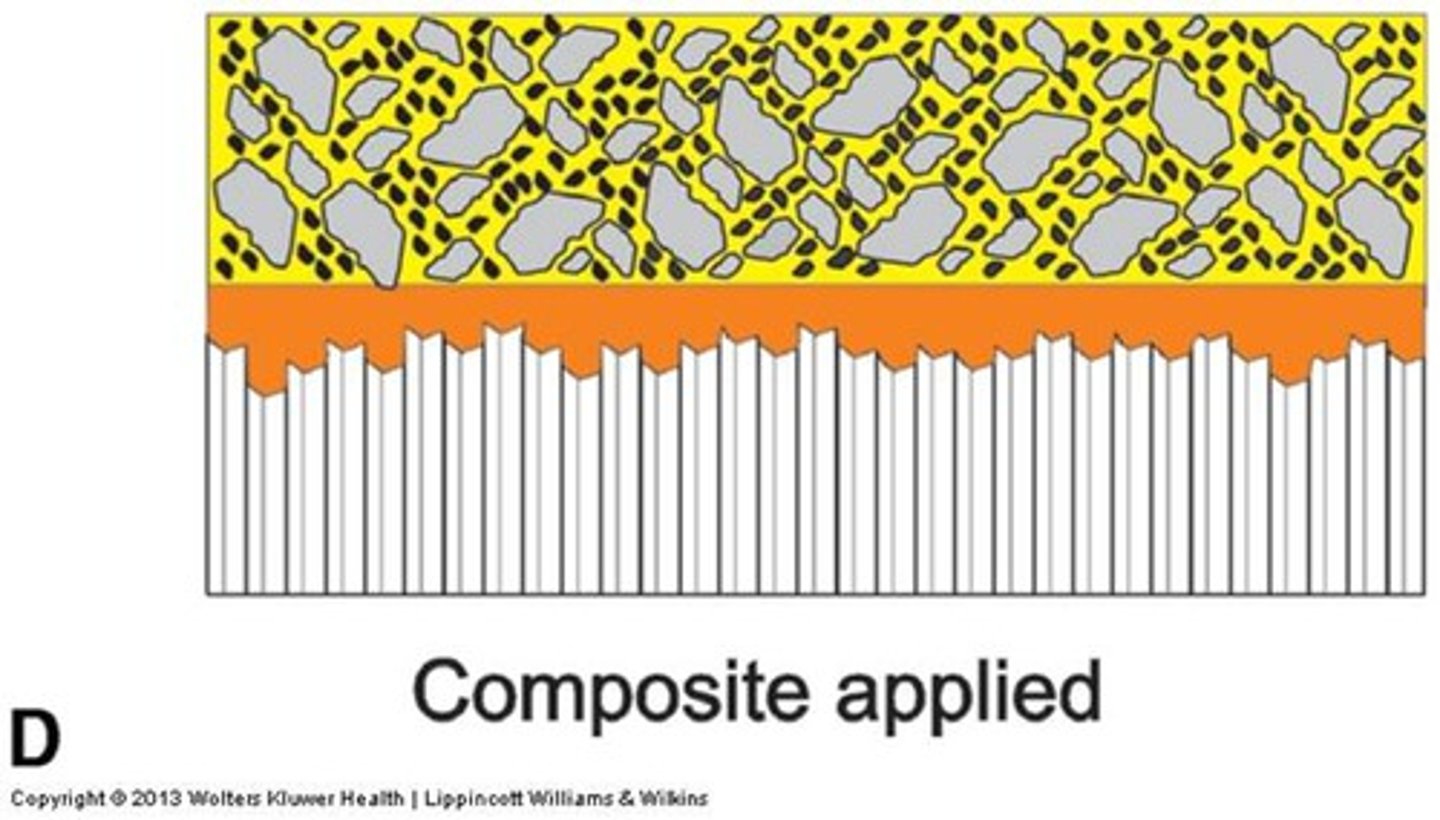
• Layers of restorative materials are chemically bonded to this initial layer to reach the depth/size of restoration desired
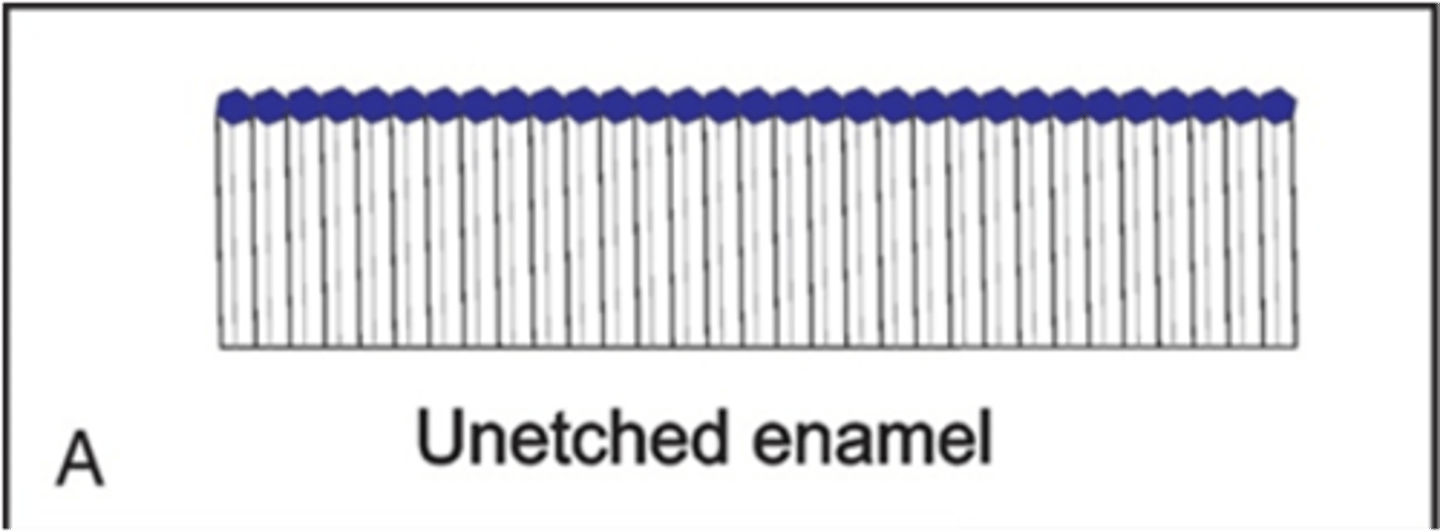
Unetched enamel
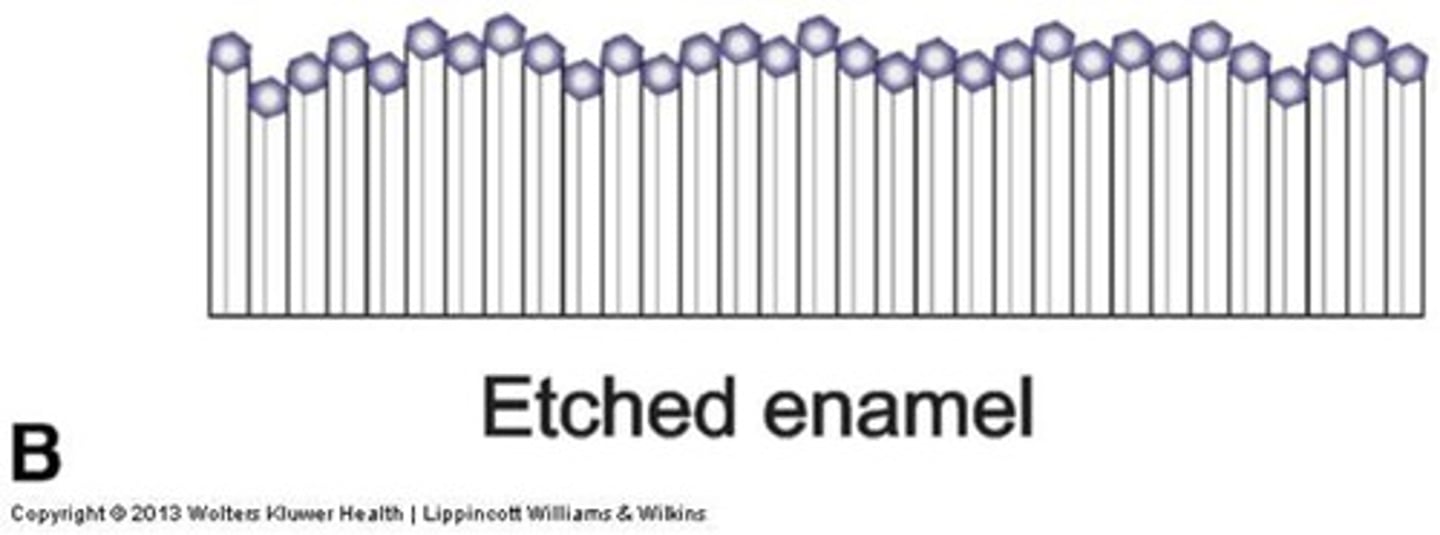
Etched enamel
Adhesive applied
Composite applied
Etched enamel
Acid etching causes micropores at ends of enamel rods, surface is rough
• Enamel looks "frosty" when dried