Amnesia + implicit memory - Chapter 7
 Call Kai
 Learn
Learn Practice Test
 Spaced Repetition
 Match
Match Flashcards
 Knowt Play
1/17

There's no tags or description
Looks like no tags are added yet.
Name | Mastery | Learn | Test | Matching | Spaced | Call with Kai |
|---|
No analytics yet
Send a link to your students to track their progress
18 Terms
What are the two types of amnesia
WHAT
WHAT
What are the two types of amnesia
Retrograde amnesia
Anterograde amnesia
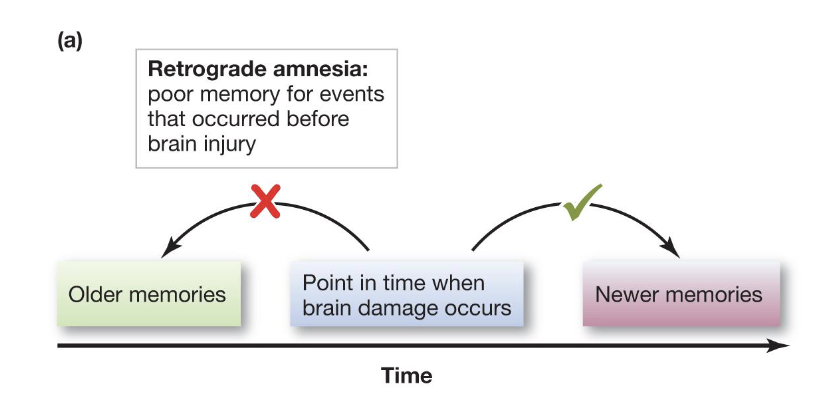
Retrograde amnesia
Poor memory for events that occurred BEFORE brain injury
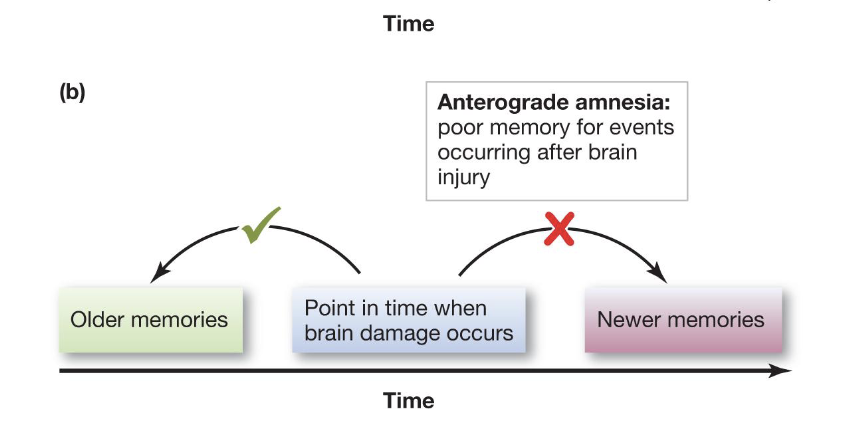
Anterograde amnesia
Poor memory for events occurring AFTER the brain injury
Retrograde Amnesia
Retro: WHAT
Grade: WHAT
Amnesia: WHAT
The loss displays a gradient across time—memories that are more WHAT in time from the brain damage are WHAT impaired by the amnesia
Retrograde Amnesia
Retro: BACKWARD
Grade: GRADIANT
Amnesia: the loss of memory or memory abilities caused by BRAIN DAMAGE or DISEASE.
The loss displays a gradient across time—memories that are more DISTANT in time from the brain damage are LESS impaired by the amnesia
Anterograde amnesia
Often seems more extensive because it disrupts WHAT from the time of the brain damage
A WHAT-only memory
Anterograde amnesia
Often seems more extensive because it disrupts LEARNING from the time of the brain damage
A READ-only memory
Patient K. C.
Suffered from a serious brain injury in the frontal regions in a motorcycle accident.
Shows a complete loss of WHAT memory—keeps no
WHAT knowledge.Cannot remember any WHAT events from both before or after his accident—has profound WHAT and WHAT amnesia.
K. C.’s WHAT memory is intact.
He cannot remember episodic events but can remember facts about some events (e.g., he could not remember that he had a brother but said that his brother’s funeral was sad because he knew that funerals are sad events).
His WHAT memory is damaged, but his WHAT memory is not affected by the damaged parts of the brain
Patient K. C.
Suffered from a serious brain injury in the frontal regions in a motorcycle accident.
Shows a complete loss of EPISODIC memory—keeps no
AUTOBIOGRAPHICAL knowledge.Cannot remember any PERSONAL EXPERIENCED events from both before or after his accident—has profound RETROGRADE and ANTEROGRADE amnesia.
K. C.’s SEMANTIC memory is intact.
He cannot remember episodic events but can remember facts about some events (e.g., he could not remember that he had a brother but said that his brother’s funeral was sad because he knew that funerals are sad events).
His EPISODIC memory is damaged, but his SEMANTIC memory is not affected by the damaged parts of the brain
Patient H. M.
Suffered from severe epileptic seizures.
Had a part of his WHAT lobes and his WHAT in both the left and right hemispheres removed surgically.
Outcome: pervasive WHAT amnesia.
Unable to learn or recall anything WHAT.
But memory of events before the surgery remains WHAT (no evidence for WHAT amnesia).
He could talk about his childhood and family.
He could explain the rules of baseball
His I.Q. was not affected by the surgery.
His language comprehension is normal, his vocabulary is above normal.
However, any task that requires him to WHAT information across a delay shows severe impairment, especially the delay is filled with an interfering task.
These impairments apply equally to nonverbal and verbal materials.
Surgery had interfered with the process of storing WHAT memory but had not touched previously WHAT memories.
What will happen when someone can only read, but not write anything on Long-term Memory?
The researchers who worked with him for 40 years had to introduce themselves every time they met.
He could hold a normal conversation but forgot the conversation in a minute or less.
He kept talking about the same subject/event without knowing that he had already talked about it.
H. M. became the research subject in hundreds of tasks, and he didn’t get bored!
In his words, “every day is alone in itself.
Patient H. M.
Suffered from severe epileptic seizures.
Had a part of his TEMPORAL lobes and his HIPPOCAMPUS in both the left and right hemispheres removed surgically.
Outcome: pervasive ANTEROGRADE amnesia.
Unable to learn or recall anything NEW.
But memory of events before the surgery remains INTACT (no evidence for RETROGRADE amnesia).
He could talk about his childhood and family.
He could explain the rules of baseball
His I.Q. was not affected by the surgery.
His language comprehension is normal, his vocabulary is above normal.
However, any task that requires him to RETAIN information across a delay shows severe impairment, especially the delay is filled with an interfering task.
These impairments apply equally to nonverbal and verbal materials.
Surgery had interfered with the process of storing NEW memory but had not touched previously STORED memories.
What will happen when someone can only read, but not write anything on Long-term Memory?
The researchers who worked with him for 40 years had to introduce themselves every time they met.
He could hold a normal conversation but forgot the conversation in a minute or less.
He kept talking about the same subject/event without knowing that he had already talked about it.
H. M. became the research subject in hundreds of tasks, and he didn’t get bored!
In his words, “every day is alone in itself.
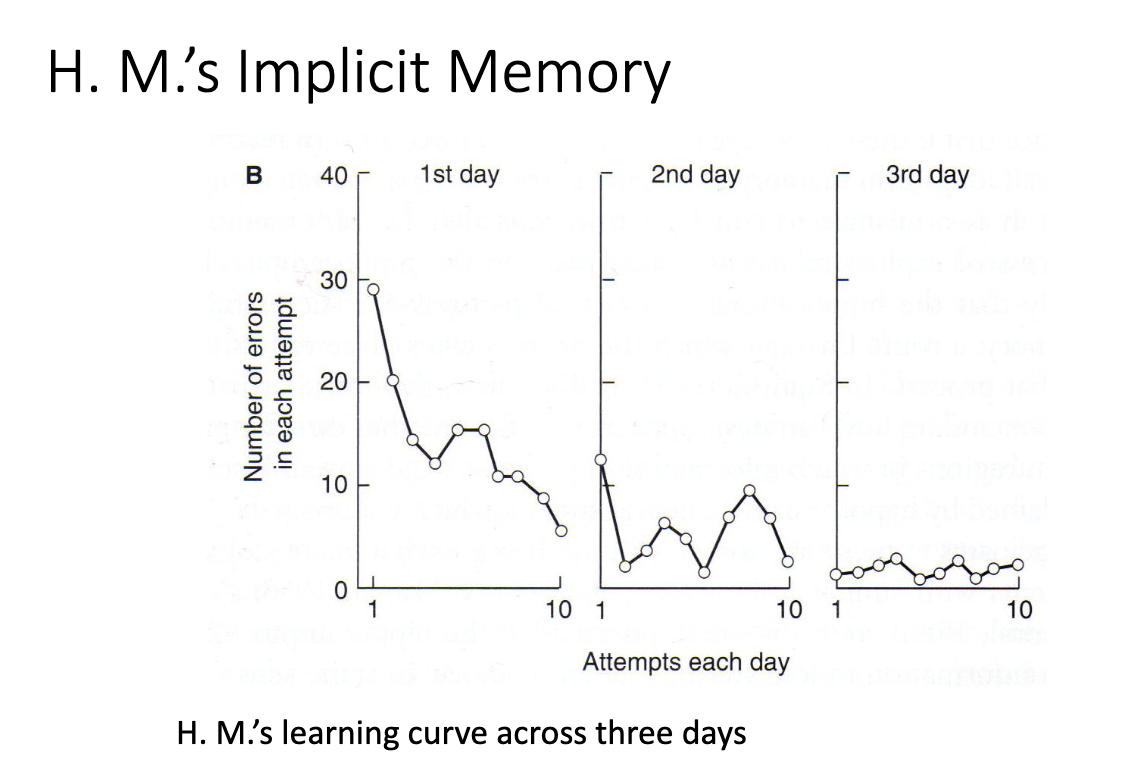
H. M.’s Implicit Memory
H. M.’s performance on the mirror-drawing task showed a completely WHAT learning curve, with very few errors on the WHAT day of practice.
On day 2 and 3, he did not WHAT ever having done the mirror- drawing task before
H. M.’s WHAT memory is normal even though he had no WHAT (or WHAT) memory of having learned the drawing task that involved motor learning
It suggests that motor learning is a type of WHAT memory that by-passes consciousness.
H. M.’s Implicit Memory
H. M.’s performance on the mirror-drawing task showed a completely NORMAL learning curve, with very few errors on the THIRD day of practice.
On day 2 and 3, he did not REMEMBER ever having done the mirror- drawing task before
H. M.’s MOTOR memory is normal even though he had no CONSCIOUS (or EPISODIC) memory of having learned the drawing task that involved motor learning
It suggests that motor learning is a type of IMPLICIT memory that by-passes consciousness.
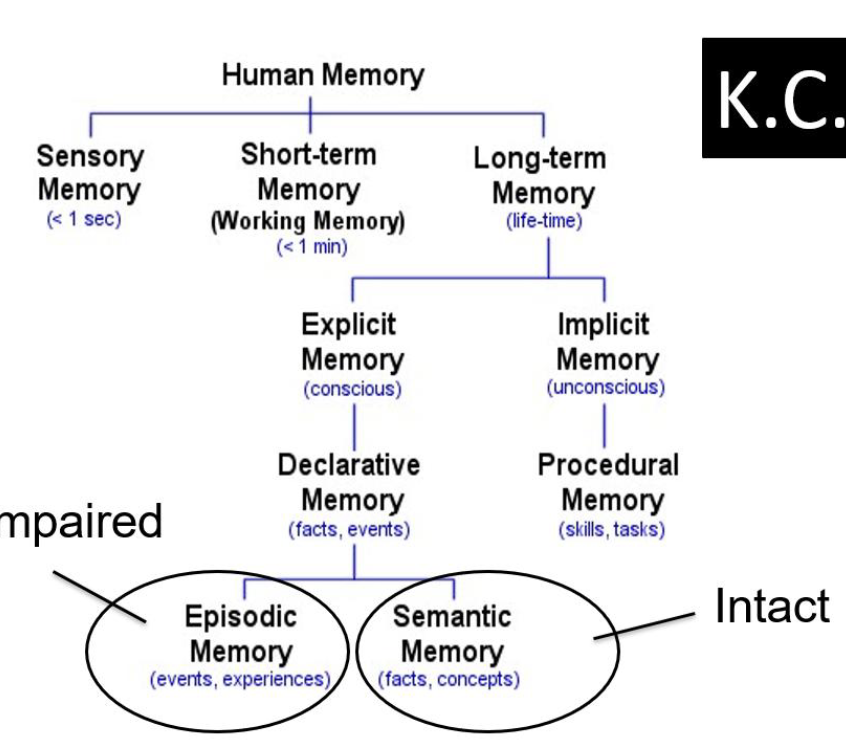
In K.C
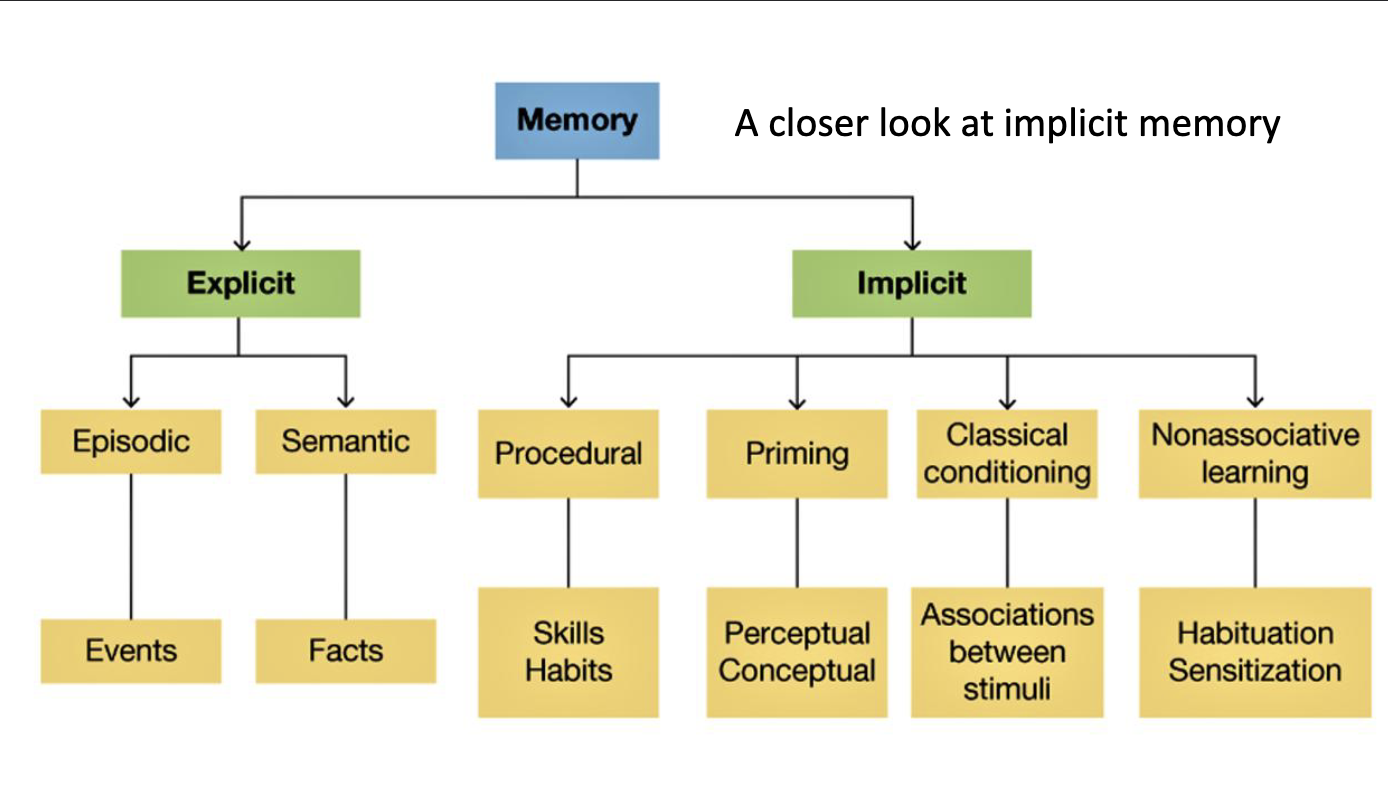
Episodic memory = WHAT
Semantic memory = WHAT
In K.C
Episodic memory = Impaired
Semantic memory = Intact
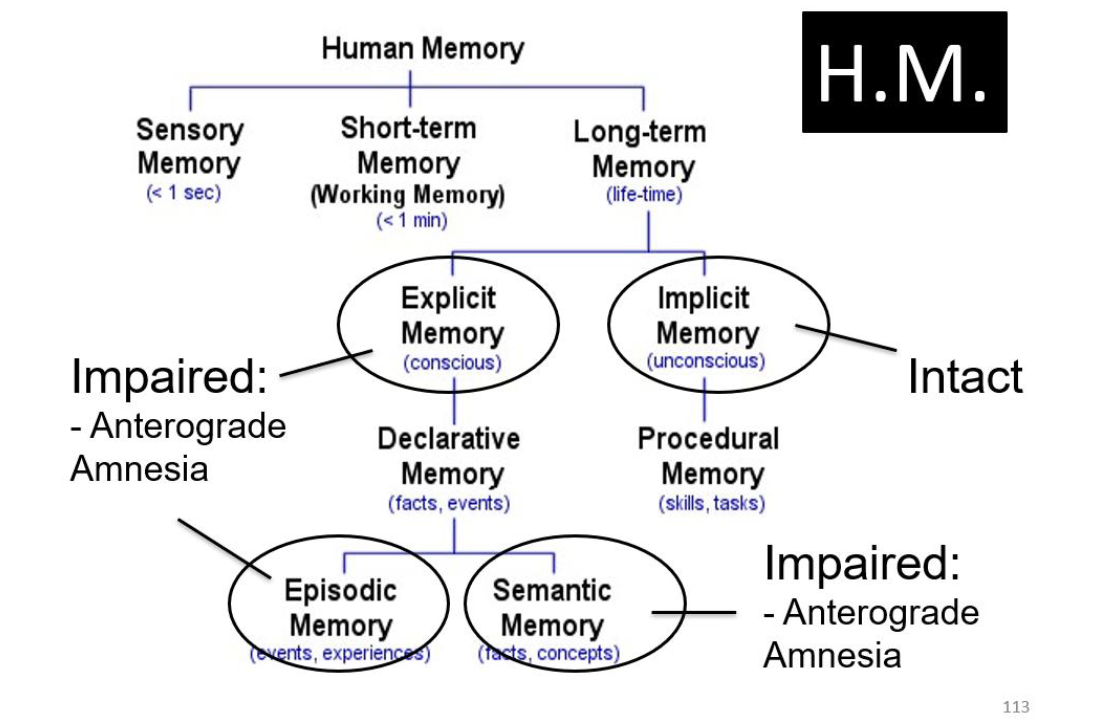
In H.M
Explicit memory = WHAT
Implicit memory = WHAT
Episodic memory = WHAT
Semantic memory = WHAT
In H.M
Explicit memory = Impaired
Implicit memory = Intact
Episodic memory = impaired
Semantic memory = Impaired
Explicit memory splits into
WHAT
WHAT
Explicit memory splits into
Episodic
Semantic
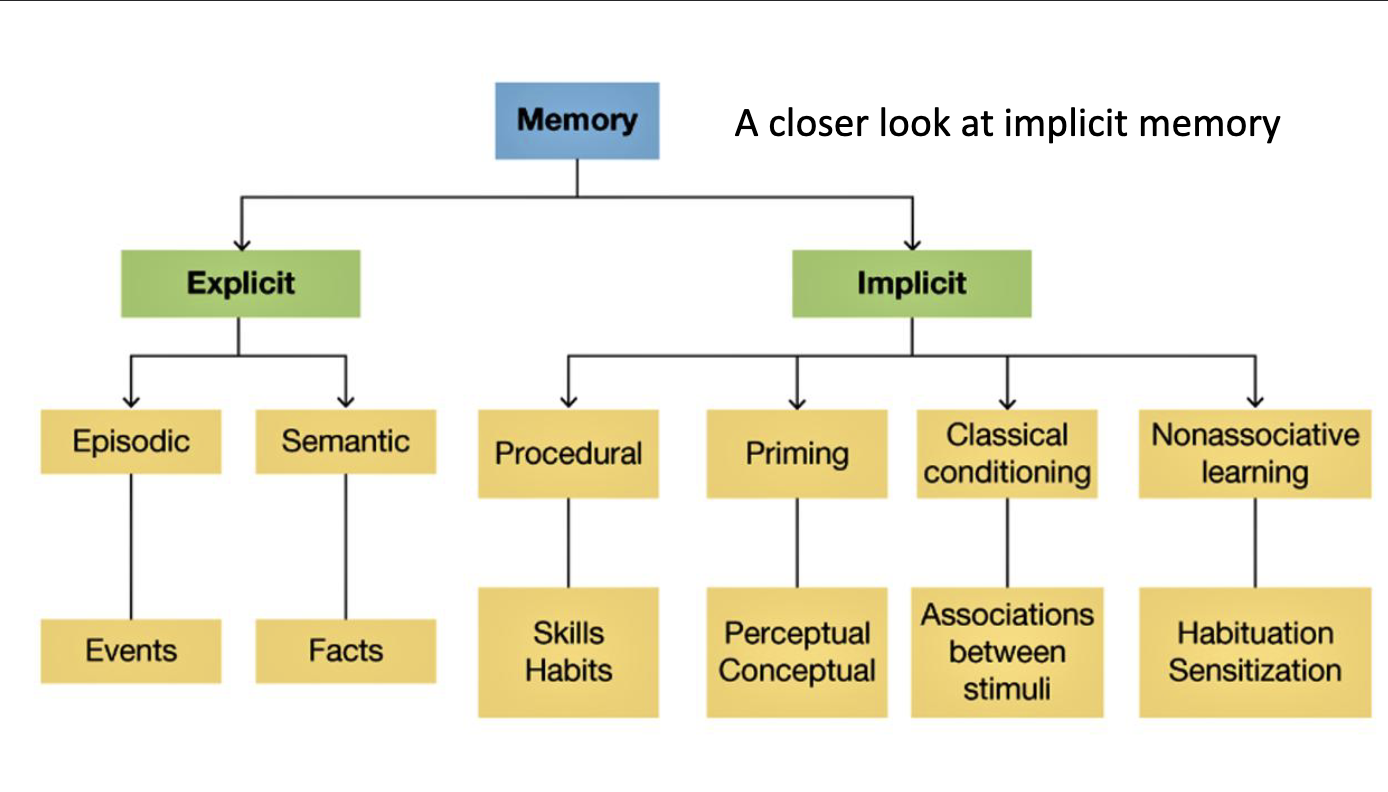
Episodic goes into
WHAT
Episodic goes into
Events
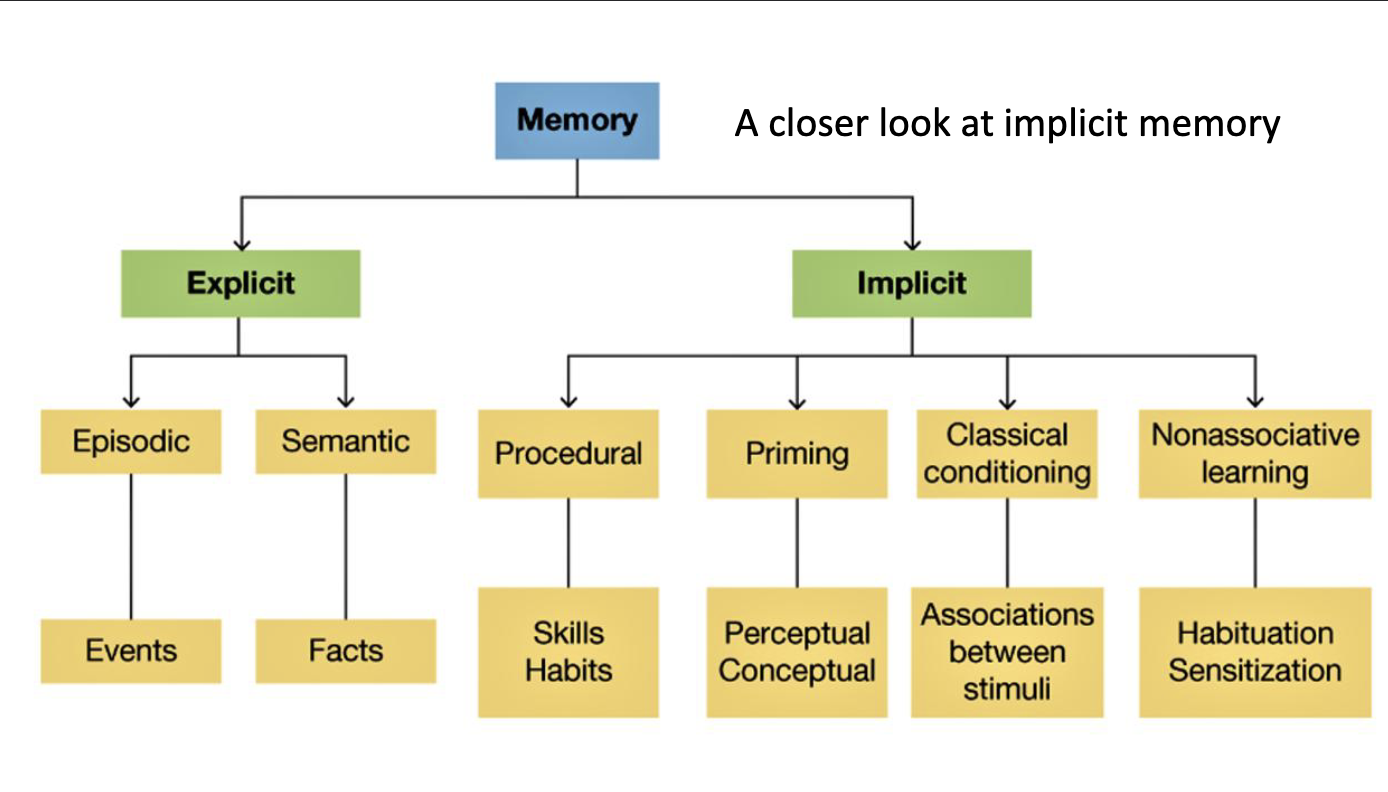
Semantic goes into
WHAT
Semantic goes into
Facts
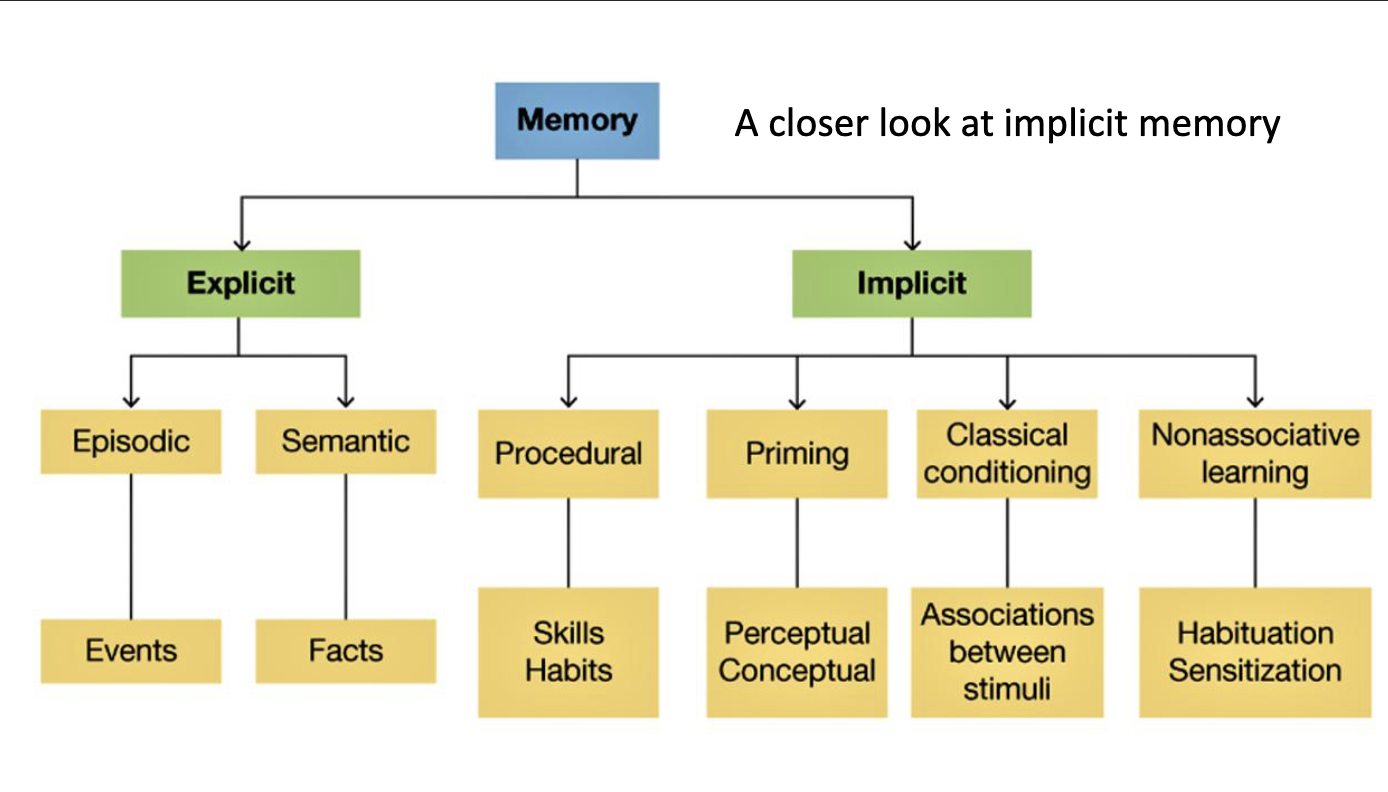
Implicit splits into
WHAT
WHAT
WHAT
WHAT
Implicit splits into
Procedural
Priming
Classical conditioning
Non-associative learning
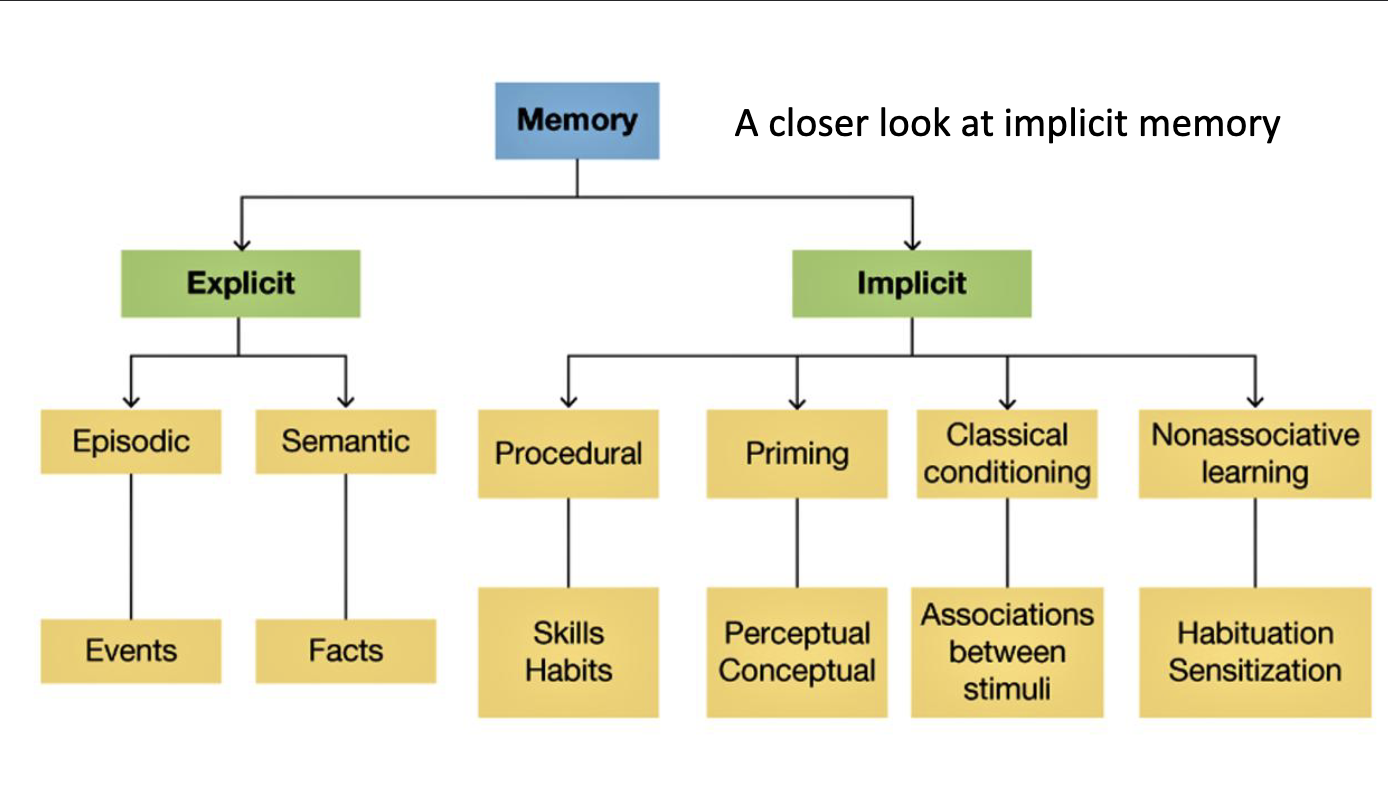
Procedural goes into
WHAT
Procedural goes into
Skills habits
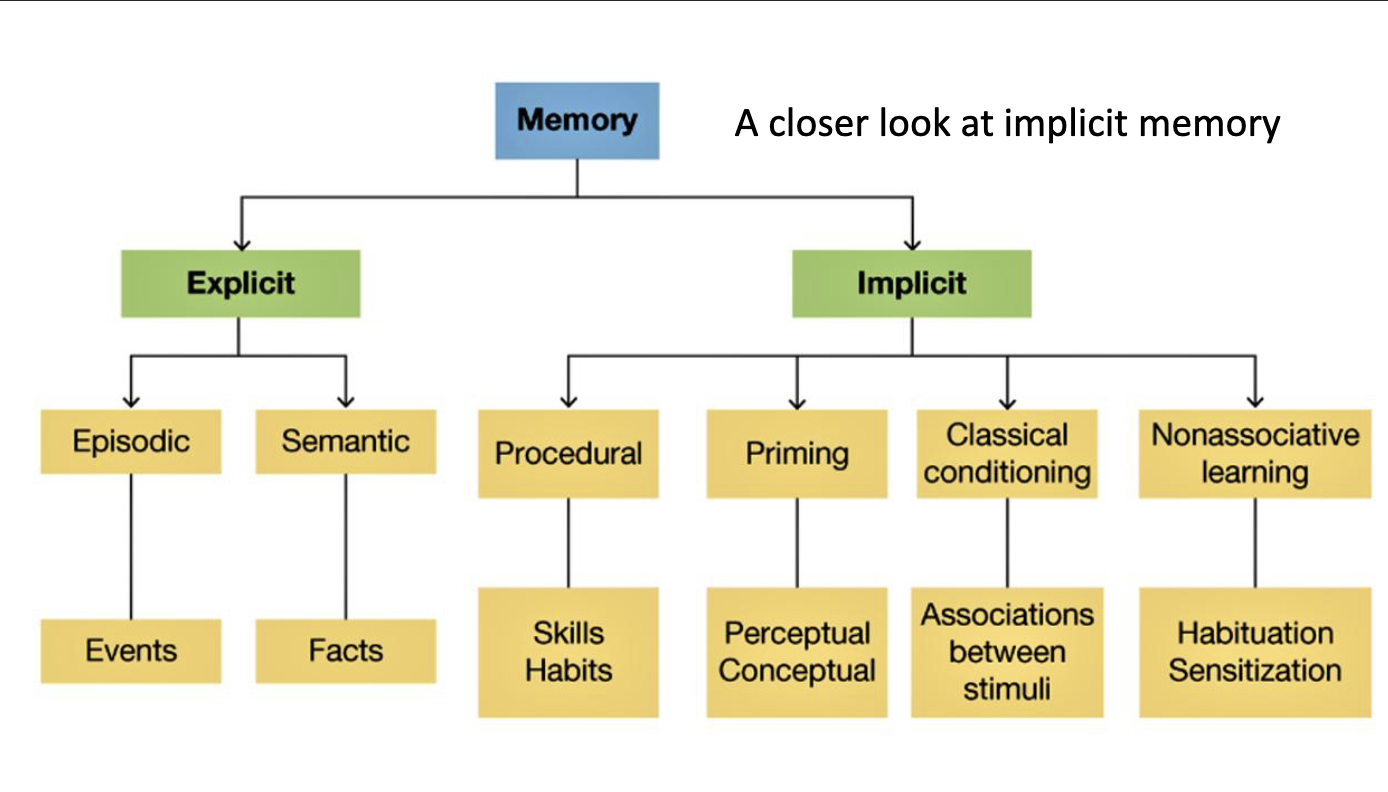
Priming goes into
WHAT
WHAT
Priming goes into
Perceptual
Conceptual
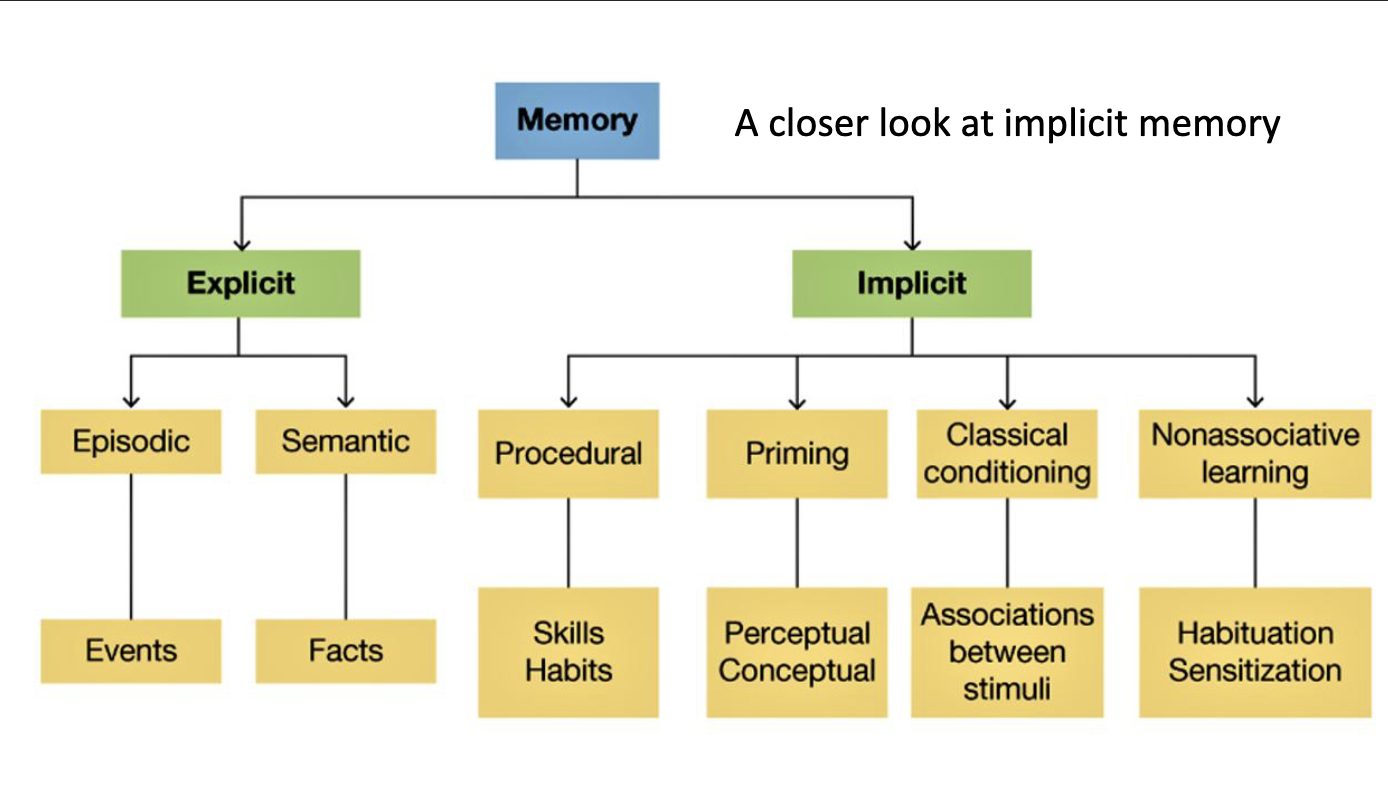
Classical conditioning goes into
WHAT
Classical conditioning goes into
Associations between two stimuli
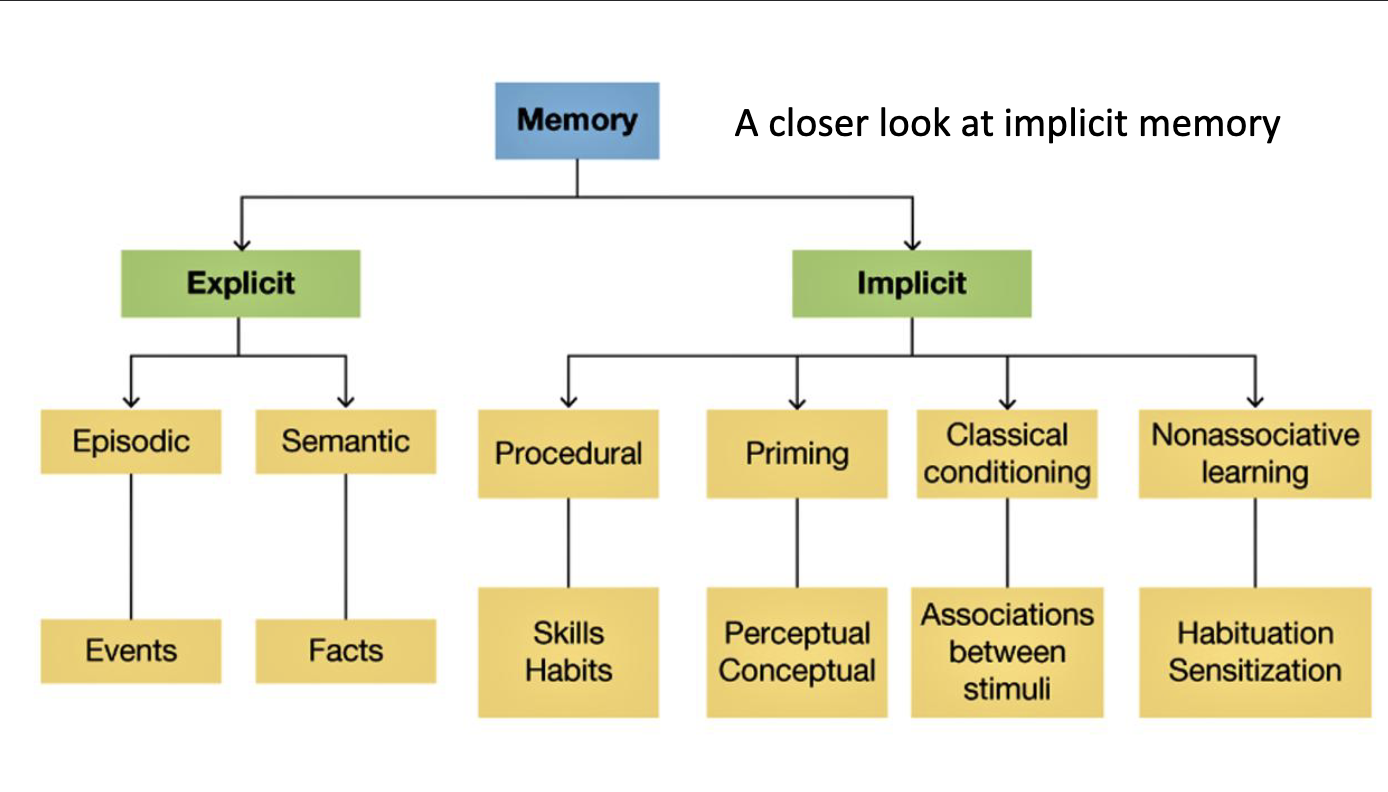
Non-associative learning goes into
WHAT
WHAT
Non-associative learning goes into
Habituation
Sensitization