Oral Exam
0.0(0)
Studied by 0 people Call Kai
 Learn
 Practice Test
 Spaced Repetition
 Match
 Flashcards
 Knowt Play
Card Sorting
1/20

Earn XP
21 Terms
1
New cards
What nervous system are autonomic reflexes and somatic reflexes mediated through?
* Autonomic or visceral reflexes are mediated through the parasympathetic/sympathetic nervous system.
* Somatic reflexes, on the other hand, include all reflexes involving skeletal muscle.
* Somatic reflexes, on the other hand, include all reflexes involving skeletal muscle.
2
New cards
Why is reflex testing important
Reflex testing is an important diagnostic tool because spinal cord damage or other nervous system pathology can result in diminished or exaggerated reflexes often before any outward symptoms occur.
* If the spinal cord is damaged, reflexes mediated below the damage will be affected but those mediated above the damage will not, thus testing can help locate the site of an injury.
* If the spinal cord is damaged, reflexes mediated below the damage will be affected but those mediated above the damage will not, thus testing can help locate the site of an injury.
3
New cards
What are the basic components of a reflex arc?
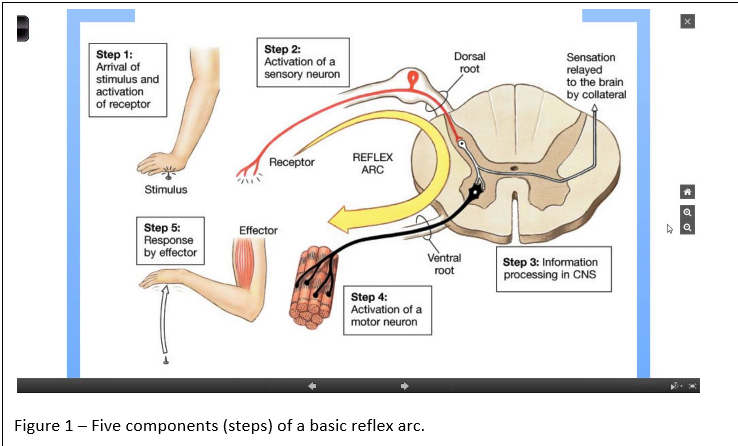
1. The receptor – which receives the stimulus or stimuli to initiate the reflex arc.
2. The sensory neuron – which transmits the sensory information to the CNS.
3. The integration center – consisting of one or more inter-neurons found within the CNS.
4. The motor neuron – which send efferent information away from the CNS.
5. The effector – which is either a muscle fiber (either skeletal, smooth or cardiac) or a gland. The muscle will contract and the gland will secrete a substance.
4
New cards
What are stretch reflexes
Somatic reflexes that are initiated by tapping a tendon or ligament which stretches the attached muscle
5
New cards
Describe the patellar reflex
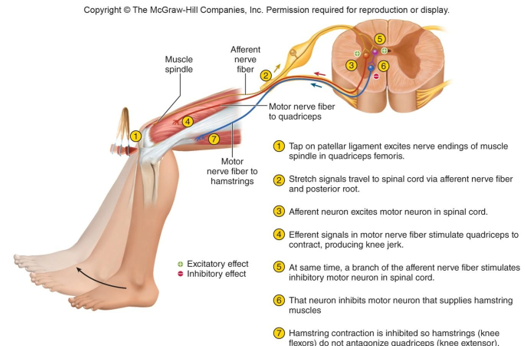
Test the Patellar or knee-jerk reflex by having a test subject sit in a chair or on the edge of a lab bench with legs dangling free (or with knee crossed). __Tap the patellar ligament sharply with the reflex hammer just below the knee between the patella and the tibial tuberosity__ (figure 2).
6
New cards
What does the knee jerk response in the patellar reflex access?
The knee jerk response assesses the L2-L4 level of the spinal cord.
7
New cards
Which muscles are contracting and relaxing in the patellar reflex?
The quadraceps contract and the hamstring relaxes
8
New cards
Fatigue also influences the patellar reflex. Have the subject jog in place until they are very tired (no slackin’). Then test the patellar reflex. Is the response more or less vigorous than before distraction? Why?
Less rigorous response because the muscles are currently active
* Its due to impaired muscle function
* Its due to impaired muscle function
9
New cards
Describe the biceps reflex
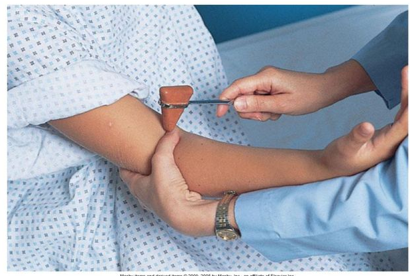
To test the biceps reflex, hold your patient’s partially flexed arm in the palm of your hand with your thumb over the antecubital space (see image below). Strike your thumb nail with the hammer. The normal response is partial flexion of the arm.
10
New cards
Describe the Calcaneal reflex
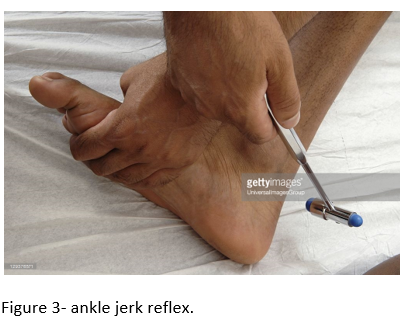
With the shoe removed grasp the ankle and slightly dorsiflex the ankle to increase the tension in the gastrocnemius. Sharply tap the calcaneal tendon with the reflex hammer (figure 3).
11
New cards
What is the result of the calcaneal reflex
Plantar flexion
12
New cards
During walking what is the action of the gastrocnemius at the ankle?
As your welking the gastrocnemius extends the ankle (like pointing the foot)
13
New cards
which spinal segment is tested with the calcaneal reflex.
S1 and S2
14
New cards
When you tap on the calcaneal tendon, you are stretching a muscle. Which muscle stretches?
Gastrocnemius
15
New cards
Why does it help to partially dorsiflex the foot before tapping on the Achilles tendon?
So, that the foot has farther to travel and the reflex is clear
* to increase the tension in the gastrocnemius
* to increase the tension in the gastrocnemius
16
New cards
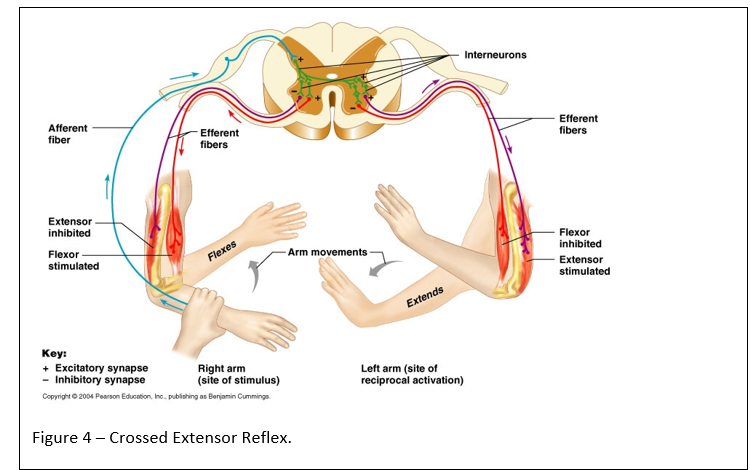
Describe the crossed extensor reflex
The crossed extensor reflex is used as a protective, multisynaptic withdrawal reflex so called because it involves both sides of the body (figure 4). Have your lab partner sit with their eyes closed with the palm of the hand facing up.
* The side that is being poked is supposed to pull away from the pencil
* The side that isn’t being poked is supposed to push forward
* The side that is being poked is supposed to pull away from the pencil
* The side that isn’t being poked is supposed to push forward
17
New cards
Was the crossed extensor reflex quicker, slower or the same speed as the knee jerk reflex? Explain.
Slower, because it’s more complex and more limbs are moving and contributing to the reflex
* The knee jerk refelx monosynaptic and this is polysynaptic
* The knee jerk refelx monosynaptic and this is polysynaptic
18
New cards
This same reflex occurs in the legs when you step on a nail. Explain why BOTH sides of the body NEED to be involved in this reflex.
Both sides need to be involved in this reflex because the sensory nerve gets sent to the interneurons which stimulate the motor neurons for both limbs
19
New cards
Describe the corneal reflex. What cranial nerve mediates it?
The corneal Reflex is mediated through the Trigeminal (V) nerve. Demonstrate this reflex by asking the subject to look away from you while you GENTLY touch the cornea of the eye with a wisp of clean cotton.Both eyelids will close. This functions to protect the eyeball from foreign objects.
20
New cards
What does absense of this reflex mean?
The absence of this reflex means that damage has occurred to the brain stem since this nerve exits the CNS at the brain stem
21
New cards
Describe the gag reflex. What cranial nerves mediate it?
The gag reflex is mediated by cranial nerves IX and X. When the oral mucosa of the uvula is stroked the patient gags.