essay 34 - isolation of the operative field in endodontics - goals and purpose. Basic instruments and materials for isolation - types, characteristics. working techniques. isolation of teeth with destroyed crowns - methods for approaching the problem
 Call Kai
 Learn
Learn Practice Test
 Spaced Repetition
 Match
Match Flashcards
 Knowt Play
1/16

There's no tags or description
Looks like no tags are added yet.
Name | Mastery | Learn | Test | Matching | Spaced | Call with Kai |
|---|
No analytics yet
Send a link to your students to track their progress
17 Terms
what is isolation of operative field in endodontics
the separation and protection of the tooth undergoing treatment from its surrounding oral environment - saliva, blood, gingival fluids, microorganisms and soft tissues
Isolation can be achieved by rubber dam, cotton roll or cellulose water
advantages of isolation
dry clean operating field
improves access and visibility
protection of patient and operator
operating efficiency
disadvantage of isolation
time consumption
patient objection
(rubber dam) cannot be used when : not erupted teeth, some third molars, malpositioned teeth, asthma, psychological reasons, latex allergy
goals and purpose of isolation
moisture control - excluding sulcular fluid, saliva and gingival bleeding from the operating field . Prevention of handpiece spray and restorative debris from being swallowed by the patient
Retraction and access - provide maximal exposure of the operating site and usually involves maintaining an open mouth and depressing or retracting gingival tissue, tongue, lips and cheek. For retraction and access we use rubber dam, high volume evacuator, absorbents, retraction cord and mouth prop
Harm prevention - for patient comfort and safety as the handpiece spray can alrm the patient and soft tissues can be damaged accidentally
list the basic instruments and materials needed for isolation
rubber dam material
holder
retainer
punch
retainer forceps
rubber dam napkin
lubricant
describe rubber dam material
size = 5×5 inch, 6×6 inch
sterile dam material is available packaged as individual sheets
thickness = thin (0.15mm), medium (0.2mm), heavy (0.25mm), extra heavy (0.3mm) and special heavy (0.35mm)
colour = dark colours are preferred for contrast, green and blue also available
shiny side and dull side = dull side is less light reflective so is placed facing occlusal side of isolated teeth
Thicker dam is more effective in retracting tissue and more resistant to tearing, while thinner dam passes through the contacts easier
Dark, heavy 6×6 inch sheets are recommended
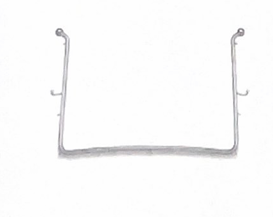
describe holder
maintain the border of rubber dam in position
the Young holder is a U shaped metal frame with small metal projections for securing the border of the rubber dam
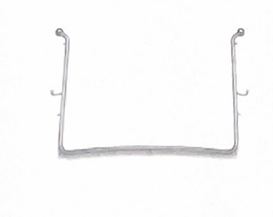
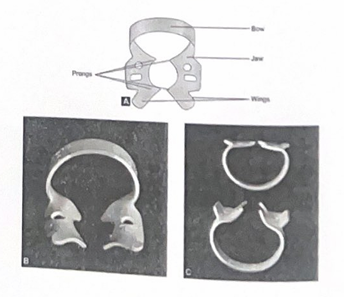
describe retainer
also known as clamp, consists of 4 prongs and 2 jaws connected by a bow
used to anchor the dam to the most posterior tooth to be isolated. Also used to retract tissue
Retainer should contact the tooth in 4 areas = 2 facial, 2 lingual, this 4 point contact prevents rocking or tilting of the retainer
Jaws of retainer should not extend beyond mesial and distal line angles of the tooth
wingless and winged retainers are available
winged retainer has anterior and lateral wings which provide extra retraction of the rubber dam. Disadvantage is that the wings often interfere with placement of matrix bands, band retainers and wedges
Bow of retainer should be tied with dental floss approx 30.5cm long before retainer is places in mouth
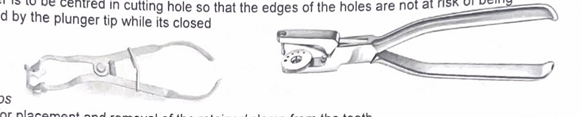
describe punch
used to make round holes of different diameters (for tooth being operated to come out of the dam)
precision instrument that has a rotating metal disk with 6 holes of different sizes and a tapered sharp pointed plunger
Plunger is to be centred in cutting hold so that the edges of the holes are not at risk of being chipped by the plunger tip while it’s closed
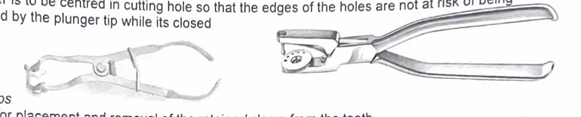
describe retainer forceps
used for placement and removal of retainer/clamp from the tooth
ivory forceps are preferred as the dentist can apply direct pressure toward the gum
describe rubber dam napkin
placed between rubber dam and patients skin
prevents skin contact with rubber to reduce possibility of allergic reactions
absorbs saliva seeping at corners of mouth
acts as cushion and provides a convenient method of wiping the patients lips on removal of the dam
describe lubricant
water soluble lubricant is applied in area of punched holes, facilitating in passing of dam septa through proximal contacts
Applied in both sides of the dam in areas of punched holes
technique when positioning the rubber dam during isolation
positioning of rubber dam
dental floss to check nature of contacts
select clamp and try it in the mouth. secure clamp with dental floss to protect the patient from ingestion of clamp. If clam p comes off easily it should be changed. If it appears stable, insert it in the opening of the rubber sheet following the appropriate technique
Place tooth in the centre of the dam, placing it asymmetrically with respect to the patients face. The more distal the tooth, the closer the opening must be to the centre of the rubber sheet. When the opening is asymmetrical to the patients face or in the centre of the dam, the metallic frame does not interfere with the X-ray machine
techniques for placing the rubber sheet
sheet with winged clamp and forceps, frame is last
rubber sheet is punched
rubber dam is stretched over the wings of the selected clamp
assistant helps to position the dam and clamps in patient mouth
forceps position the clamp around the tooth to be treated
young frame is positioned to produced tension in the dam
dam is slipped beneath the clamp wing on buccal side and same is done on lingual
floss used to force dam through interproximal contacts
sheet with winged clamp, forceps and frame as a single unit
dam with winged clamp stretched over Young’s frame
clamp, dam and frame positioned in mouth as a single unit
clamp on tooth, then rubber sheet and frame
wingless clamp is placed around tooth
the rubber sheet has been slid slowly below the clamp which is already in place
sheet on tooth, then clamp and frame
sheet with wingless clamp and forceps under the sheet
isolation of teeth with destroyed crowns - methods for approaching the problem
crowded teeth - no room for clamps
— rubber dam is held in place by tucking two fragments under the distal contact points of the adjacent teeth. This creates mechanical retention by friction and interproximal contacts
wingless clamps
— a wingless clamp is first positioned directly around the tooth, engaging the cervical region.
Then, the rubber dam sheet is stretched and slid below the clamp
Cutting dam instead of flossing
— in situations where the interproximal contact is too tight of irregular, the dam cannot be passed through easily. Instead of forcing it and risking tearing, the dam is carefully cut and placed directly around the teeth, then secured with ligatures or wedges. This is especially useful during removal to avoid trauma or damage to the dam or gingiva
describe cotton roll and cellulose wafer isolation
cotton rolls and cellulose wafers are absorbent materials used to control moisture in the oral cavity during dental procedures. They are especially useful when rubber dam isolation is impractical or not possible. Cotton rolls can be as effective as rubber dams in short procedures especially when combines with local anaesthesia and saliva ejector
— cotton rolls - cylindrical, absorbent rolls placed in the vestibular or lingual spaces
— cellulose wafers - flat, sponge-like absorbents that can sit on mucosa
— gauze sponges - flat pads used for blotting or packing
maxillary posterior teeth = place cotton roll in vestibule adjacent to the teeth
mandibular posterior teeth = place large cotton roll between tongue and teeth by ‘‘rolling’’ it into place. This helps to control saliva from sublingual glands
Facial and lingual placement = proper positioning improves both moisture control and visibility
technique when using cotton roll and cellulose wafer isolation
maxillary posterior teeth = place cotton roll in vestibule adjacent to the teeth
mandibular posterior teeth = place large cotton roll between tongue and teeth by ‘‘rolling’’ it into place. This helps to control saliva from sublingual glands
Facial and lingual placement = proper positioning improves both moisture control and visibility