A&P II- Capillaries
 Call Kai
 Learn
Learn Practice Test
 Spaced Repetition
 Match
Match Flashcards
 Knowt Play
1/3

There's no tags or description
Looks like no tags are added yet.
Name | Mastery | Learn | Test | Matching | Spaced | Call with Kai |
|---|
No analytics yet
Send a link to your students to track their progress
4 Terms
Vessel Function
Function:
Carry and control the flow of blood.
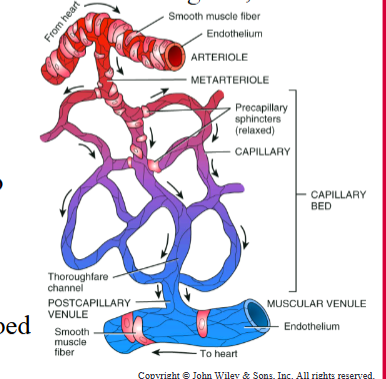
Capillaries – site of nutrient, waste, gas exchange
Vessel Structure and Function
1 basic layer or “tunic” which comprises the vessel wall:
• Tunica interna (intima): epithelial tissue and basement membrane
Capillaries :
• only sites in the entire vasculature where gases, water and other nutrients are exchanged.
Metarteriole :
• Branch from arteriole to venule
• Precapillary sphincter controls flow to capillary bed
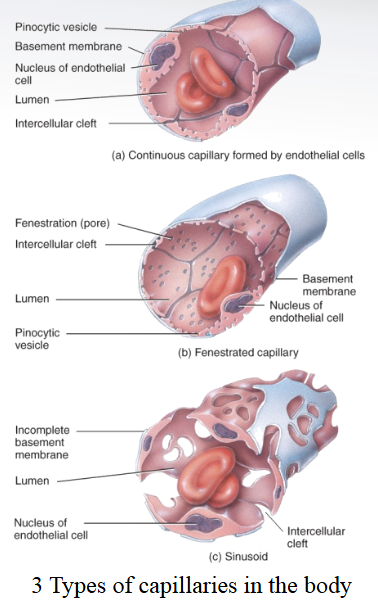
Three types of capillaries:
Continuous capillaries:
• most common
• continuous tube with
• small intercellular clefts.
Fenestrated capillaries (fenestra = windows):
• kidneys, villi of small intestines, and endocrine glands
• Pores through endothelial cells
Sinusoids: liver, spleen
• Large pores through which blood can percolate
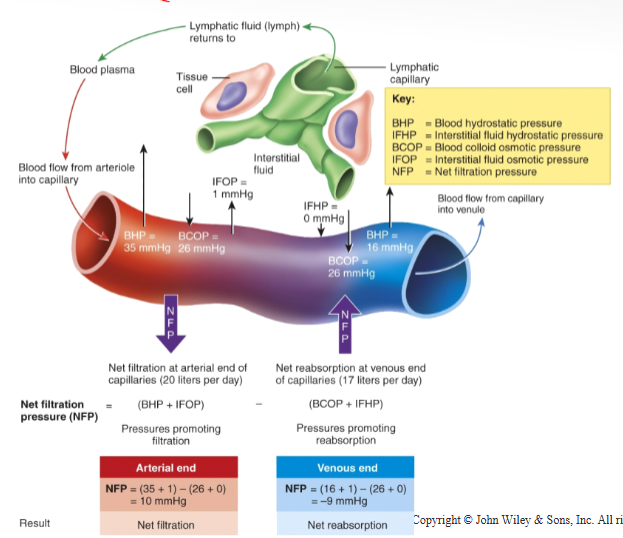
Fluid Exchange- Starling Forces
Starling Forces: hydrostatic and osmotic forces at the capillaries
determine
• Filtration: movement of fluid through the walls of the capillary into the interstitial fluid.
• Reabsorption: movement of fluid from the interstitial fluid back into the capillary
Hydrostatic pressure physically pushes fluid out, generated by mechanical forces like the heart pumping.
Osmotic pressure pulls fluid in, created by solute concentration gradients
Filtration:
• Blood hydrostatic pressure (BHP) : decreases from 35 to 16 from the arterial to the venous end of the capillary
• Interstitial fluid osmotic pressure (IFOP): constant at about 1 mmHg
Reabsorption:
• Blood colloid osmotic pressure (BCOP): due to the presence of plasma proteins too large to exit the capillary
averages 26 mmHg on both ends.
• Interstitial fluid hydrostatic pressure (IFHP) : close to zero except in states of edema
Most (about 85%) of fluid filtered is reabsorbed