EPS SCI 15 Lab 7 Readings and Review
 Call Kai
 Learn
Learn Practice Test
 Spaced Repetition
 Match
Match Flashcards
 Knowt Play
1/29

There's no tags or description
Looks like no tags are added yet.
Name | Mastery | Learn | Test | Matching | Spaced | Call with Kai |
|---|
No analytics yet
Send a link to your students to track their progress
30 Terms
What is the global ocean ecosystem critically dependent on?
Plankton
What is a pelagic organism?
An organism living in the surface waters who are unable to swim or have limited swimming ability (able to control position in water column)
What are nekton/nektonic organisms?
Those which expertly swim in the pelagic zone, able to move laterally and vertically
What are benthic organisms?
Live on, in, or near the seafloor
epifaunal: live on the seafloor sediment
infaunal benthos: live within the sediment
Who are the producers in the food chain?
Autotrophs, they produce complex and in/organic compounds
Who are the consumers of the food chain?
Heterotrophs, may feed on autotrophs or other heterotrophs for energy
Who are the decomposers of the food chain?
Saprotrophs
What is the difference between a food chain and a food web?
Food chain: simple arrangement of organisms according to predation order
Food web: complex networl of interactions among organisms
What is the single most important factor that determines the distribution of life in the oceanic province?
Sunlight, availability of sunlight
To what depth does seawater with relatively high transparency allow sunligh to penetrate?
~600 meters
To what depth do coastal waters allow sunligh to penetrate?
~100 meters
What does the actual penetration depth depend on?
Amount of suspended sediment, detritus, and plankton in the water, the latitude, season, and time of day
What is the pelagic zone?
An area of water not near the bottom or shore
What is the benthic zone?
Area directly associated with the seafloor
What is the photic zone?
Area where light exists and depth is variable
Includes euphotic and disphotic zone
What is the euphotic zone?
Region from surface to dysphotic zone where photosynthesis is larger than respiration
What is the dysphotic zone?
Region where light still exists but photosynthesis is smaller than respiration
What is the aphotic zone?
No light, no photosynthesis at all
What are some examples of macroplankton?
Jellyfish, snails
What is primary productivity?
Amount of photosynthetic production, gcarbon/year
What is phytoplankton growth limited by?
Availability of sunlight and nutrients
Considering the biogenous sediments from the earlier Marine Sediments lab, which plankton are likely to contribute to which type of biogenous sediment?
diatoms, radiolarians → siliceous ooze
coccolithophores, foraminiferans → calcerous ooze
The preserved remains of copepods and dinoflagellates are rarely found in young or old marine sediments. Is this proof that their remains never make it to the seafloor bottom? Are their fresh remains wholly consumed by larger zooplankton and/or nekton in the pelagic zone, or is there another process to account for their lack of preservation in the sedimentary record?
Copepods and dinoflagellates lack mineral skeletons. they possess exoskeletons or cell walls composed of organic material which decompose quickly by saprotrophic bacteria
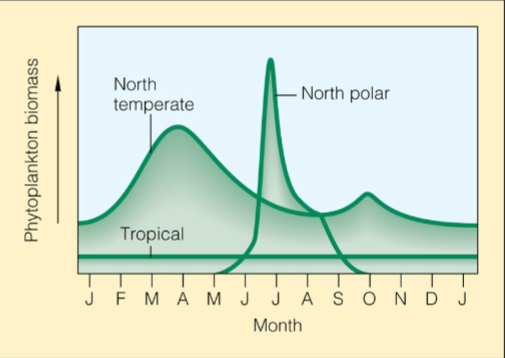
Consider this figure showing the relationship of phytoplankton biomass
to season. Over a full year, which latitude has the greatest total oceanic
primary productivity?
north temperate
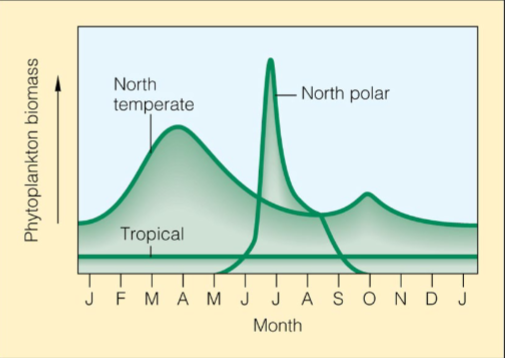
Why is the tropical productivity so low and flat?
Permanent thermocline, which forms a barrier to vertical mixing and the resupply of nutrients to the surface layer
What is tropical latitude productivity limited by?
Limited year round by nutrients
Why is the polar-latitude productivity sharply spiked June-August?
Because the north polar experiences continuous illumination (~24 hour daylight) during summer, and does not develop a thermocline as water temp. and density varies little with depth
What is polar regio productivity limited by?
Seasonal sunlight
“Red tides”, or more properly, algal blooms, are relatively common phenomena, induced by nutrient-rich influxes. Phytoplankton and zooplankton have a very close and direct relationship. During the initial stages of algal blooms, is it more likely that 1.) the phytoplankton population growth leads the zooplankton population growth, 2.) the two populations closely grow concurrently and equally, or 3.) the zooplankton population growth leads the phytoplankton population growth? Why?
Algal blooms are initiated by high nutrient availibility (during months of high sunlight), phytoplankton grows first in response as only they directly use the nutrients
Zooplankton lags a bit since their growth is only supported by phytoplankton populations
What is the critical depth?
When total GPP = total respiration