Chemistry Unit 9 Thermochemistry and Equilibrium
 Call Kai
 Learn
Learn Practice Test
 Spaced Repetition
 Match
Match Flashcards
 Knowt Play
1/25

There's no tags or description
Looks like no tags are added yet.
Name | Mastery | Learn | Test | Matching | Spaced | Call with Kai |
|---|
No analytics yet
Send a link to your students to track their progress
26 Terms
Conduction
heat transfer by COLLIDING of particles
Convection
heat transfer by CIRCULATION of a fluid (or gas)
Radiation
heat transfer by FLOW OF ELECTROMAGNETIC radiation
energy
CAPACITY for doing work/supplying heat
All chemical reactions and changes in physical state involve either
release of heat
absorption of heat
system
specific part of the universe that contains the reaction
surroundings
everything else
ENDOTHERMIC process
SYSTEM GAINS HEAT and SURROUNDINGS COOL DOWN
EXOTHERMIC process
SYSTEM LOSES HEAT and SURROUNDINGS GAIN HEAT
endothermic is defined as
positive (q has a positive value)
exothermic is defined as
negative (q has a negative value)
endothermic
ABSORBS energy (Endo=IN)
exothermic
RELEASES energy (Exo=OUT)
Average Kinetic Energy
Temperature
Heat of Fusion
energy required to change from SOLID to LIQUID
Heat of Vaporization
energy required to change from LIQUID to GAS
Calorie
quantitiy of heat needed to raise the temp of 1g of pure water by 10C
1 calorie is how many Joules?
4.184 J
Heat Capacity
increase the temperature of an object exactly 10C
Specific Heat Capacity
the amount of heat is takes to raise the temperature of 1 gram of a substance by 1 degree Celsius
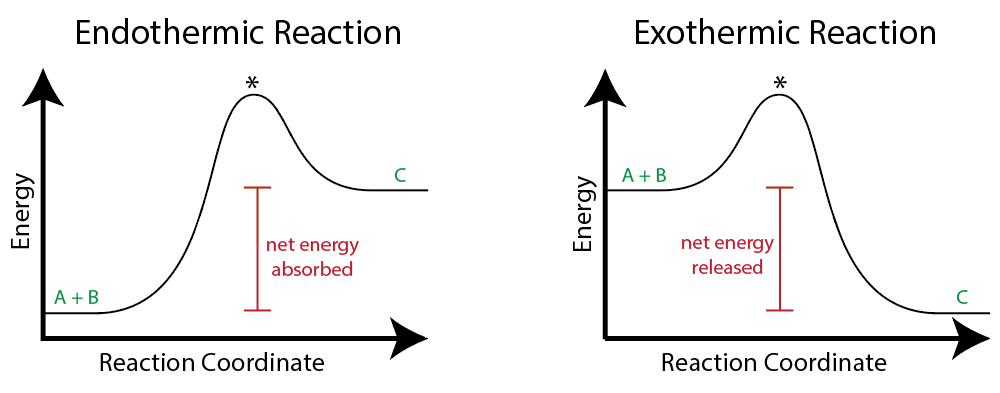
exothermic is faster with more collisions
Calorimetry
the measurement of the heat into or out of a system
heat released EQUALS
heat absorbed
the change in enthalpy
delta H of the reaction
if heat is a PRODUCT
it is EXOTHERMIC
if heat is a REACTANT
it is ENDOTHERMIC