Consumer Behavior Exam 3
 Call Kai
 Learn
Learn Practice Test
 Spaced Repetition
 Match
Match Flashcards
 Knowt Play
1/97

There's no tags or description
Looks like no tags are added yet.
Name | Mastery | Learn | Test | Matching | Spaced | Call with Kai |
|---|
No analytics yet
Send a link to your students to track their progress
98 Terms
5 Key dimensions or characters
Physical surroundings
Social surroundings
Temporal POVs
Task definition
Antecedent states
Physical Surroundings
Decor, sounds, aromas, lighting, weather, and configurations of merch/ other materials surrounding the stimulus object
External retail factors such as architecture, arrangement, and assortment or retailers
Store interiors designed to create specific feelings in shoppers
Store Atmosphere
the sum of all the physical features of a retail environment
Influences consumer judgement of store quality and image
Influence moods and willingness to visit and linger
Atmospherics
the process managers use to manipulate the physical retail environment to create specific mood responses in shoppers
Important online
Increasing attention from marketers
Servicescape
atmosphere when describing a service business
Ex. hospital, bank, restaurant
Classifies services according to the reason the customer is using the service and length of time the service will be used
Categorized from strictly utilitarian to hedonistic
Colors
Bright colors are more arousing than warm colors
Attention getting nature of warm colors can be used effectively as an accent color in areas where the retailer wants to attract attention and drive impulse purchase
Cool colors are capable of reducing wait time perceptions by inducing feelings of relaxation
Gold can increase tips in restaurants
Aromas
Scent preferences are highly individualized
Some shoppers object to anything being deliberately added to the air they breathe, worrying for allergic reactions
Some companies create scents of their products to emulate being in the store
Music
Can affect consumers’ behaviors in both traditional retailers settings and online settings
Sitdown restaurants/bars do well with slow tempo music and vice versa
Matching musical preferences of target audience is critical for positive retail outcome
Creates moderate levels of arousal yielding positive retail outcomes
High volumes lead to junk food consumption and low volumes lead to healthier options
Crowding
Generally produces negative outcomes for both the retail outlet and consumer
Consumers spend less time in store by buying less, making faster decisions, using less of the available information
Reduces likelihood of returning
Music tempo, extra personnel, additional checkout lines, can enhance the flow of consumers through a store during peak periods
Slow tempo music offsets negative emotions from crowding
Views of personal space vary with culture
Temporal Perspective
situational characteristics that deal with the effect of time on consumers behavior
The less time there is available the shorter will be the information search, the less available information will be used, and the more suboptimal purchases will be made
Can result in smaller number of product alternatives being considered
Antecedent States
eatures of the individual persian that are not lasting characteristics
Ex. momentary moods/conditions
Moods
transient feeling states that are generally not tied to a specific event or object
Less intense than emotions
Positive moods associated with increased browsing and impulse purchasing
Negative moods increase impulse and compulsive purchasing in some consumers
Shopping behaviors play as mood maintenance and mood enhancement
Consumers actively manage their mood states
Program Conext Effects
mood’s important role in the communications situation which relate to the nature of the programming surrounding the focal ad
Types of Consumer Decisions
A product may be selected not because of an attribute but because it makes them feel good or if their friends will like it
The decision process model provides useful insights into all types of consumer purchases
Consumer decisions are frequently the result of a single problem or the convergence of several
Can evolve into multiple goals
Purchase Involvement
the level of concern for or interest in the purchase process triggered by the need to consider a particular purchase
Temporary state of involvement
Nominal Decision Making (habitual decision making)
involves no decision
Problem is recognized, internal search (long term memory), provides a single preferred solution (brand), that brand is purchased, and an evaluation occurs only if the brand fails to perform as expected
Low involvement
Doesn’t consider alternative options to not purchase
2 categories of nominal decision making
Brand loyal decision
Repeat purchase decision
brand loyal purchase
It will be very difficult for a competitor to gain your patronage
Low purchase involvement since you already know what brand to purchase from
Repeat Purchases
You may not attach certain importance to specific product categories or purchase
However, once you find the right fit, you’re likely to repeat the purchase
Limited Decsion Making
involves internal and limited external search, few alternatives, simple decision rules on a few attributes, and little postpurchase evaluation
Middle ground between nominal and extended decision making
Simplest form (lowest level purchase involvement), limited decision making is similar to nominal
Occurs in response to some emotional or situational needs
Might evaluate a purchase in terms of the actual or anticipated behavior of others
Involves recognizing a problem for which there are several possible solutions
Extended Decision Making
involves extensive internal and external information search followed by a complex evaluation of multiple alternative and significant postpurchase evaluation
High level purchase involvement
Ex. homes, personal computers, home theatre systems
The Nature of Problem Recognition
The kind of action taken by consumers in response to a recognized problem related directly to the problem’s importance to the consumer, situation, and the dissatisfaction or inconvenience created by the problem
Actual State
the way one individual perceives one’s feelings and situation to be at the present time
Perceptions of the actual state also are determined by a consumer’s lifestyle and current situation
Consumer’s perception of the actual state that drives problem recognition, not some objective reality
Shows how a consumer lives given the constraints imposed by their resources
Desired State
the way an individual wants to feel or be at the present time
Ex. not wanting to be bored on a Friday Night so your desired state is to be pleasantly occupied
Foote Cone and Belding (FC&B) grid
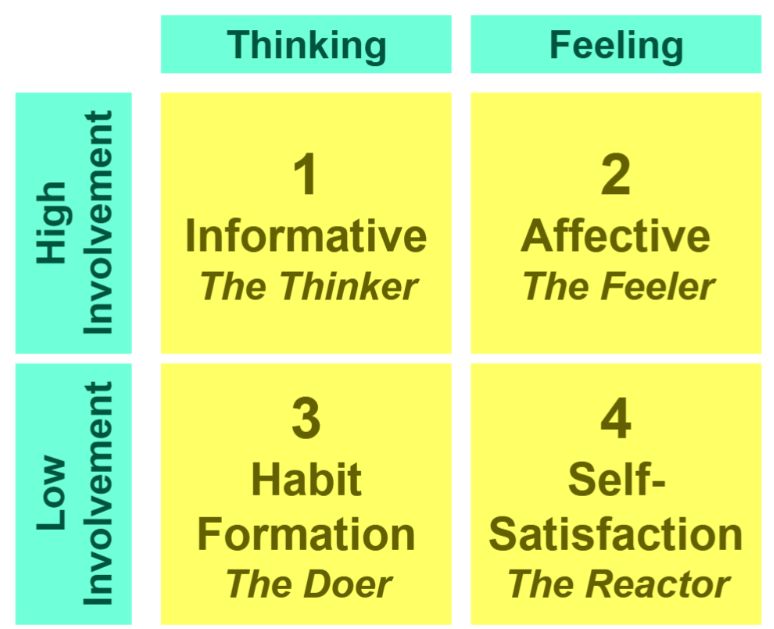
Informative (The Thinker)
thinking and high involvement
car, house, furnishings, new products
model: learn-feel-do (economic?)
Test: recall diagnostics
media: long copy format, reflective vehicles
creative: specific information, demostration
Affective (The Feeler)
feeling and high involvement
jewlery, cosmetics, ffashion goods
Model: feel-do-learn (psychological)
Test: attitude change, emotional arousal
Media: large space, image specials
creative: executional, Impact
Habit Formation (The Doer)
Thinking and low involvement
food, household items
model: do-learn-feel (responsive?)
test: sales
media: small space ads, 10 second ID’s, Radio, Point of Sale
Creative: reminder
Self Satisfaction (the reactor)
Feeling and low involvement
cigarettes, liquor, candy
model: Do-feel-learn (social?)
Test: Sales
Media: Billboards, Newspapera, Point of Sales
Creative: Attention
3 categories of Customer Journey
insights
strategy and tactics
communication
The Funnel
Awareness
Interest
Consideration
Intent
Evaluation
Purchase
Awareness
before anyone can become a custmer they have to become aware of your company
interest
leads begin to do research and grow interest in what you have to offer. Brands should be developing relationships and building trust
Consideration
leads are interested in your brand but the haven’t quite made up their mind. Automated emails, free trials, etc. are great tools to use during this stage
Intent
the lead has almost made up their mind. They may have even palced an item into their shopping cart, Don’t let them get away
Evaluation
leads are ready to commit, but may do one last comparison between you and the competitoin. This is when nurturing your lead is vital
Purchase
your lead has finally converted into a customer. Congratulations! If the experience is a positive one, you may get refferals
What are the 3 Factors of Intenal Seach?
Whether a satisfactory solution is known
What the characteristics of potential solution are
What appropriate ways exist to compare solutions
External Search
the search process is focused on external information relevant to solving the problem if internal search fails
Involves independent sources, personal sources, marketer based info, and product experience
Ongoing Search
s done both to acquire information for possible later use and because the process itself is pleasurable
extra information of external and intenal searching
Internal search is primarily dominant in nominal decision making
External search is primarily dominant in extended decision making where thc consumer typically examines and evaluates numerous alternative across numerous criteria using information from many sources
External search is also used in limited decision making playing a moderate role in some instances, particularly when the customer is aware of alternative solutions
Consumer decision requires informaiton on the following
The appropriate evaluative criteria for the solution of a problem
The existence of various alternative solutions
The performance level or characteristics fo each alternative solution on each evaluative criterion
evaluative criteria
the various dimensions, features, or benefits a consumer looks for in response to a specific problem
Evoked Set
composed of those brands or products one will evaluate for the solution of a particular consumer problem
Mainly composed of brands from single product category
However, substitute products also can play a role
Can vary due to situational factors like resource constraints or usage
Local Mobile Search
searches for information from a mobile device pertaining to the current or future planned geographic location of a consumer
Top two local mobile searches are for local restaurants and local coupons/discounts
Think of Google Maps and how its able to show you local places based on your location
Assumptions behind the rational choice theory. Do consumers behave rationally always?
Assumption: consumers seek one optimal solution to a problem and choose on that basis
Reality: consumers have all sorts of metagoals that are different from this
Assumption: consumers have the skill and motivation to find the optimal solution
Reality: consumers often lack both the skill or motivation to do so
Assumption: the optimal solution doesn’t change as a function of situational factors such as a time pressure, task definition, or competitive context
Reality: context effect are common
Note: consumers are not always rational in finding optimal solutions
Metagoal
the general nature of the outcome being sought
Bounded Rationality
a limited capacity for processing information
Prospect Theory
Developed by daniel kahneman
We map losses/gains incurred (x-axis)
Positive value v. pain in gaining/losing money (y-axis)
Basically the pleasure you get from gaining 5 cents is much smaller compared to the pain you get from losing 5 cents
Prospect Theory Example
Base car new sells cheaper but costs more used because there’s no need for the repair cost
Loaded car costs more new but sells cheaper used due to an extra repaired cost your’d have to personally pay to repair a part that equals the used price for the bas
Even though you get more of a steal price wise with the loaded car consumers would buy the base car used due to not wanting to spend that extra difference later
Acceleration Neglect Example
For direction of forces if the trend goes down people will assume it’ll continue, however if there’s a force (company announces an increase in profits) the trend will go up
But if there’s a decrease in profits people have a hard time adding up two forces going in the same direction in their mind and that’s the bias
Different direction events lead to correction of estimates, same direction events do not (bias)
Difficult to kill
Affective Choice Example
The consumer examines a camera thinking it looks sleek, modern, and cool.
The consumer examines another camera but thinks it looks too serious and boring.
After some time of contemplating what a great impression she’d make with the first camera she ends up buying the first camera
Attitude Based Choice Example
A consumer recalls their friend’s camera looking good
Consumer’s parents also has a camera (different from the friend) that works well too but it’s large and bulky
When browsing the camera store they see both cameras for the same price and ends up buying the friend’s camera model
Attribute Based Choice Example
After going online to determine what features are most important the consumer goes to a camera store and compares the various brands on identified attributes
Consumer mentally ranks each model based on attributes and general impression of each model’s quality
Based on these evaluations the consumer chooses a camera
Affective Choice
tends to be more holistic in nature and based on the way they make the user feel and their emotional response to the product/service
Conditioning, immediate feeling; Feel situation
Attitude Based Choice
involves the use of general attitudes, summary impressions, intuitions, or heuristics; no attribute by attribute comparison are made at the time of choice
memory-based; Feel situation
Attribute Based Choice
requires knowledge of specific attributes at the time the choice is made and it involves attribute by attribute comparisons across brands
Learn situation
Determination of which evaluative criteria are used:
Intangible Factors: style, taste, prestiges, feelings generated, brand image
Tangible Factors: cost and performance features
Direct methods include asking consumers what criteria they use in a particular purchase
Indirect techniques assumed consumers will not or cannot state their evaluative criteria
Projective Techniques and Perceptual Techniques
Projective Techniques
allow the respondent to indicate the criteria that someone else might use
Perceptual Techniques
researchers uses judgement to determine dimensions underlying consumer evaluations of brand similarity
Perceptual mapping
Measuring consumer judgements of brands performance on specific attributes can include
Rank ordering scales (don’t use this it’s hard to analyze)
Semantic differential scales
Likert scales
The importance assigned to evaluative criteria can be measured either by direct or by indirect methods:
The constant sum scale is the most common direct method
Conjoint analysis is the most popular indirect method
Surrogate Indicators
an attribute used to stand for or indicate another attribute
Ex. price, ad intensity, warranties, etc.
Think of quality and trust factors/signals
Operate more strongly when consumers lack th expertise to make informed judgements on their own and motivation/interest is low, relationship is modest at best
Conjuncive Rule
Have to have high levels of motivation
Establishes min required performance for each evaluative criterion
Selects the first or all brands that meet or exceed these min standards
If computer doesn't meet any of these they’re not chosen
Super picky
Disjuntive Rule
Low motivation
Establishes a min required performance for each important attribute (often high level)
All brands that meet or exceed the performance level for any key attribute are acceptable
Elimination by Aspects Rule
Choose brand that’s king of the hill
Evaluative criteria ranked in terms of importance
Cutoff point for each criterion is established
In order of attribute importance brands are eliminated if they fail to meet or exceed the cutoff
Lexicographic Decision Rule
Low involvement
Consumers ranks the criteria in order of importance
The selects brand tha performs est on the most important attribute
If two or more brands tie,they are evaluated on the second most important attribute
This continues through the attributes until one brand outperforms the other
Compensatory Decison Rule
High involvement
States that the brand that rates highest on the sum of the consumer’s judgements of the relevant evaluative criteria will be chosen
The only rule that isn’t strict
Meaning if it doesn’t have one attribute it can make it up in another
What happens when there are too many options when consumers are making decisions?
Not choose (retirement options)
Use suboptimal decision rules
Especially for:
Low involvement
Stressful situations
Poverty
Time poverty
Omni Channel Shopping
consumers who browse and/or purchase using multiple channels
Might use a mobile app to look for deals/coupons while at the store
Search internet about product at home to get more info before buying it at the store
Engages with webrooming
Webrooming
shoppers who search online and ultimately buy a product at a physical store
More common than showrooming
E
External Reference Price
a price presented by a marketer for the consumer to use to compare with the current price
Not entirely believed in by consumers despite being understood
Internal Reference Price
a price or price range that a consumer retrieves from memory to compare with a price in the market
Perceived Risk
considered a consumer characteristic as well as a product characteristic
Retail outlets perceived as having varying degrees or risk
The more traditional it is the lower the risk and the more online/innovative the higher the risk
Consumers May use these approaches to reduce dissonance
Increase the desirability of the brand purchase
Decrease the desirability of rejected alternatives
Decrease the importance of the purchase decision
Reverse the purchase decision (return the product before use)
Post Purchase Dissonance
occurs when a consumer has doubts or anxiety regarding the wisdom of a purchase made and is a function of the following:
The degree of commitment or irrevocability of the decision
The importance of the decision to the consumer
The difficulty of choosing song the alternatives
The individual’s tendency to experience anxiety
Consumption Guilt
negative emotions or guilt feelings are aroused by the use of a product or a service
How marketers can help consumers resolve post purchase dissonance
Ads
High quality website information about the product
Follow up sales efforts
Measurements of Satisfaction and dissatisfaction
instrumental performance
symbolic performance
affective performance
Instrumental Performance
relates to the physical functioning of the product.
Symbolic Performance
relates to aesthetic or image- enhancement performance.
Affective Performance
is the emotional response that owning or using the product or outlet provides
How to measure satisfaction through surveys?
customer pannels
sentiment analysis
Sentiment analysis, or opinion mining, is the process of analyzing large volumes of text to determine whether it expresses a positive sentiment, a negative sentiment or a neutral sentiment.
Based on limited sample size based on people who post their opinions of product
brand loyalty
a biased behavioral response expressed over time by a decision makin gunit with respect to one or more alternative brands out of a set of such brands that is a function of psychological processes
Measured through word of mouth and NPS
Churn Rate
the people who leave after paying for subscriptions
what are the 2 major areas of concern for children’s advertising?
The impact of commercial messages on children’s values
The impact of commercial messages on children’s health and safety
consumers union has the following classification system
In school ads
Ads in classroom
Corporate sponsored educational materials and programs
Corporate sponsored contests and incentive programs
Consumer Oriented commercial sites that collect personal identifying information from or about consumers should comply with 4 standards:
Notice of information collection and sharing
Choice as to how personally identifying information is used
Access to their information and to correct or delete information
Security firms should ensure that the collected information is secure
What are the 3 major concerns focused on the information that amrketers provide to consumers:
Accuracy of information provided
Adequacy of the information provided
Cumulative impact of marketing information on society’s values
Dark (Deceptive) Patterns
tactics used to trick or deceive users into taking a certain action. Sometimes, they give off a false sense of urgency, manipulate users into making a certain choice, or disguise advertising.
Ex. Amazon forces consumer to subscribe to amazon prime without consent and sabotaging their attempts to cancel
Used to buy more faster
Plays into our fears of scarcity
Framework for ethical decision making
Step 1: Identify Issues
Step 2: Gather information and identify stakeholders
Step 3: Brainstorm and evaluate alternative
Step 4: Choose a course of action
AMA statement of Ethics:
Do no harm
Foster and maintain integrity
Embrace ethical value
honesty
Be truthful in all situations at all times and with all stakeholders rejecting any manipulation coercion or approaches that negatively affect trust
Offer valuable solutions that reflect the intentions stated in communications and interactions
Honor explicit and implicit commitments and promises
Agency of choice
Responsibility
Acknowledge the social obligations to stakeholders that come with increased marketing and economic power
Consider environmental and societal stewardship in ou decision making
Strive to exceed industry or legal standards in the protection of private or sensitive information of customer, employees, and patterns
Recognize and accept the consequences of our marketing decisions and strategies
Equity
Build a diverse marketing workforce and support inclusive marketing practices by valuing and embracing individual, cultural, and ethnic differences.
Recognize the needs of, and commitments to, vulnerable market segments as well as those individuals not familiar with marketing and others who may be historically disadvantaged.
Never stereotype anyone or depict any group (e.g., gender, race, sexual orientation, religious beliefs, etc.) in a negative or dehumanizing way.
Make every effort to understand and respectfully treat buyers, suppliers, intermediaries, and distributors from all cultures
Transparency
Strive for a spirit of openness in all aspects of the marketing profession
Communicate clearly with all constituencies
Accept and acknowledge feedback from customers, colleagues, and other stakeholders
Take appropriate action to explain and mitigate potential significant risks or other foreseeable outcomes that will or could impact any stakeholder
Fully discourse any information that might affect interactions or decisions within the processes or protocols related to marketing
Avoid participation in conflicts of interest
Appropriately recognize the contributions of others to marketing endeavors, such as consultants, employees, and coworkers
Citizenship
Fulfill the economic, legal, philanthropic, and societal responsibilities that serve stakeholders.
Value the role that marketing plays in business and society.
Strive to protect the ecological environment and communicate sustainability efforts and aspirations honestly and transparently.
Give back to the community through volunteerism and charitable donations.
Contribute to the overall betterment of marketing and its reputation.
Compel all partners to ensure that trade and production is fair for all participants in the marketing ecosystem.