12.5 meiosis
 Call Kai
 Learn
Learn Practice Test
 Spaced Repetition
 Match
Match Flashcards
 Knowt Play
1/3

There's no tags or description
Looks like no tags are added yet.
Name | Mastery | Learn | Test | Matching | Spaced | Call with Kai |
|---|
No analytics yet
Send a link to your students to track their progress
4 Terms
describe meiosis and uses
chromosomes is reduced to diploid (2n) to haploid (n) - product is a gamete due to fertilisation
ensures chromosome number of individuals remains the same
2 division of chromosomes to make 4 daughter cells that arent genetically identical
meiosis I
prophase I: Chromosomes condense into two sister chromatids joined by a centromere.
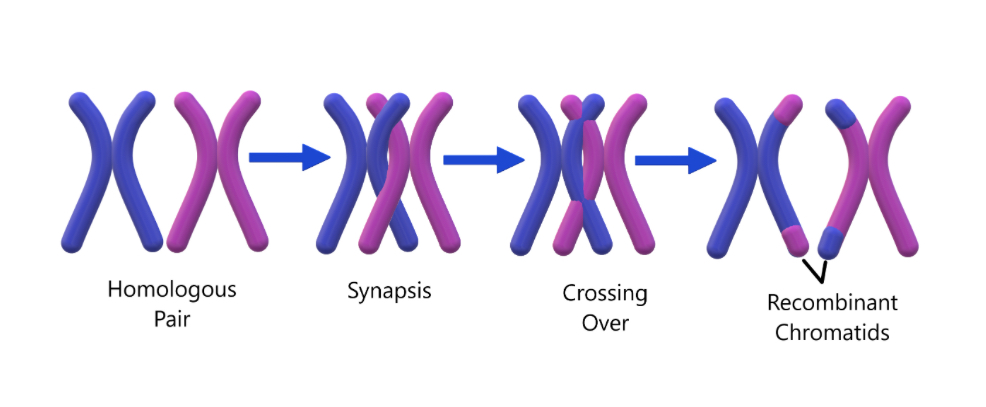
Homologous chromosomes pair to form bivalents.
Crossing over occurs at chiasmata between maternal and paternal chromosomes.
Spindle forms, centrioles move to poles, and nuclear membrane breaks down.
meta I: Bivalents line up at the equator and attach to spindle fibres.
Orientation is random → independent (random) assortment.
ana I: Homologous chromosomes are pulled to opposite poles.
Each chromosome still has two chromatids (genetically different due to crossing over).
telo I: Chromosomes reach poles, nuclear membranes reform.
Each nucleus is haploid (one chromosome from each pair).
cytokinesis: cell divides to two haploid cells
meiosis II
pro II Chromosomes condense into two chromatids joined by a centromere.
Spindle forms and nuclear membrane breaks down.
meta II Chromosomes line up at the equator and attach to spindle fibres.
Chromatids may orientate randomly → contributes to variation
ana II Centromeres divide and chromatids are pulled to opposite poles.
Chromatids are now called chromosomes
telo II Chromosomes reach poles and nuclear membranes reform
Cytokinesis Cells divide to form four genetically different haploid cells
compare meiosis and mitosis
Mitosis takes place in one division, meiosishas two consecutive divisions.
Mitosis produces two genetically identical cells, as identical sister chromatids are separated. Meiosis produces four cells that are not genetically identical because of crossing over in prophase I and random assortment in metaphase I and II.
Meiosis can only happen in diploid cells as the homologous pairs form bivalents in prophase I. The diploid number is reduced to the haploid number. Mitosis can happen in diploid or haploid cells as the sister chromatids from each chromosome are separated into new cells. Haploid cells undergoing mitosis produce haploid cells, diploid cells undergoing mitosis produce diploid cells.