Themes in development
 Call Kai
 Learn
Learn Practice Test
 Spaced Repetition
 Match
Match Flashcards
 Knowt Play
1/59

There's no tags or description
Looks like no tags are added yet.
Name | Mastery | Learn | Test | Matching | Spaced | Call with Kai |
|---|
No analytics yet
Send a link to your students to track their progress
60 Terms
5 sources of disparities between measured real income and actual advantages, citation
Sent (1999)
personal heterogeneities: disability, illness, age, or gender
environmental diversities: climate, pollution
variations in social climate: crime, violence
uneven distribution within the family
differences in relational perspectives: local customs and conventions
economic development definition
Todaro and Smith (2020)
The process of improving the quality of all human lives and capabilities by raising people’s levels of living, self-esteem and freedom
Harrod-Domar model what is growth determined by
Economic growth is determined by - ability to save and invest s - ability to convert capital into output θ - rate of capital depreciation δ - rate of population growth n
but exogenous assumptions on s theta and n, equiliibrium is growth, endowment rather than institution
Solow-Swan model
allows for non constant θ and adds effective labour,
means that multiple stable steady states exist
savings has transitionary but not growth effect
but exogenous technology shocks
absolute and conditional convergence
endogeneity issues with development accounting
Klenow and Rodriguez-Clare (1997)
solow elements are highly correlated, capital increases TFP which increases capital
more than 50% of differences is due to variation in exogenous A
Hirschman growth linkage
Hirschman (1958)
forward and backward linkage encourages invesetment in upstream or downstream
agriculture is a low linkage sector reduces investment and interdependence leading to economies of scale
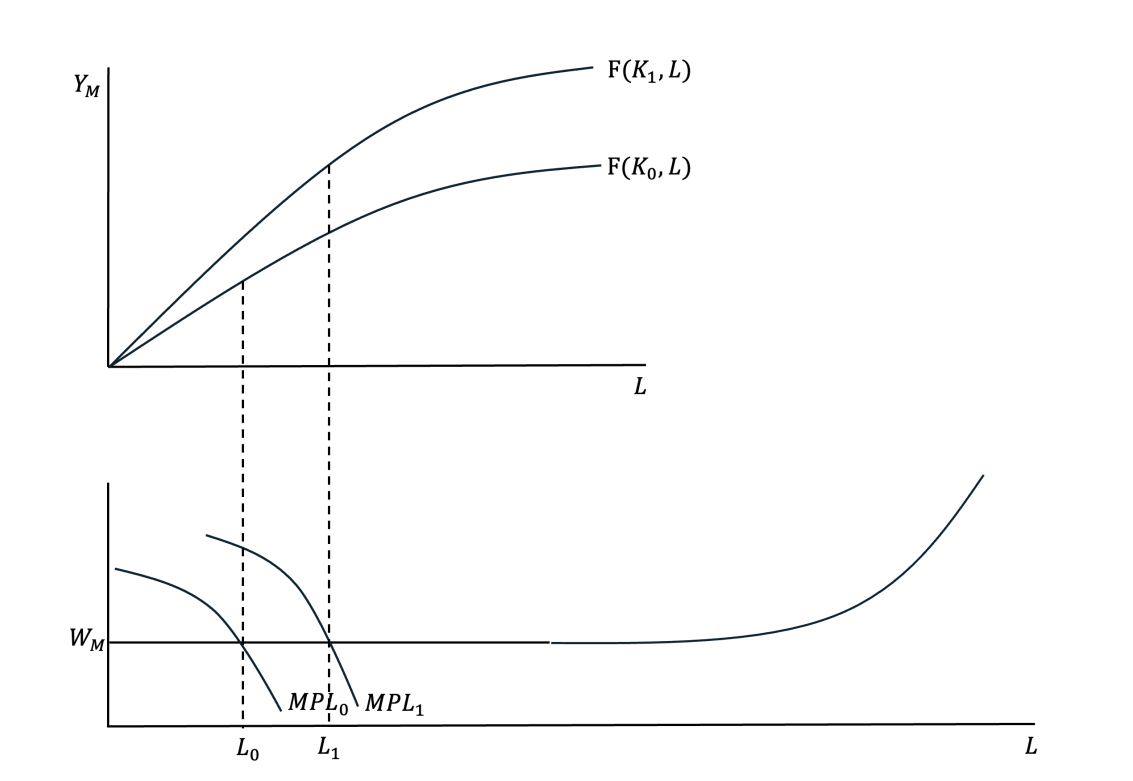
Lewis Dualistic model
Lewis (1954)
two sectors
traditional sector A with surplus labour and MPL=0
modern sector, M initially very small
use different input factors and in agricultural sector W^A> MPL,
go into modern sector unitl we dont have surplus labour in agriculture anymore
Eval
is MPLa=0 really realistic
Wa=0 not realistic if we account for the fact that familiies usually run farms, cultural subsistence ceiling where community members help each other
efficiency wages, paying workers a bit more helps them work harder
model assumes profit reinvested
constant terms of trade between sectors might not hold if workers demand more food after receiving higher wages
Schultz (1955) shows that epidemic in india which killed 9% of rural labour force resulted in negative shock implying that MPL does not equal 0
The big push
first developed by Rosenstein-Rodan (1943)
manufacturing sector more productive so need to move to this to develop
problem that it requires large fixed costs and higher wages, but increase in wage leads to general increase in demand but only part of the increase in marginal income goes back into the same manufacturing firm
hence need ig push of lots of manufacturing firms that create positive demand spillover to make it worth investing in the first place
need central planner to subsidise fixed costs
relation between big push and lewis model
both have two sector economy
lewis model only focuses on supply side forces
big push fixes demand side hole and it is the pre requisit for the lewis model to work
big push model gives role for policy makers
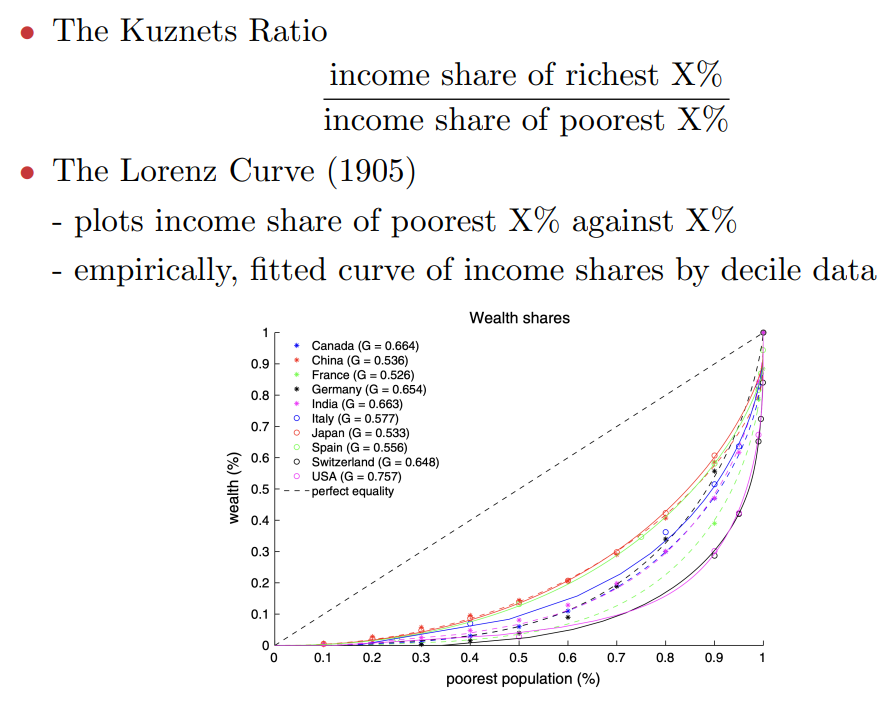
two different ways of measuring inequality
Lorenz curve then gives gini coefficient by taking area between lorenz and 45 degree line divided by total area under 45 degree line
Kuznets curve
hypothesis of change in inequality
curve follows inverted U shape with income inequality on Y and development on X
observation holds for some countries but the theory suggests no mechanism for why inequality has to increase or decrease
might be due to politics or demand composition
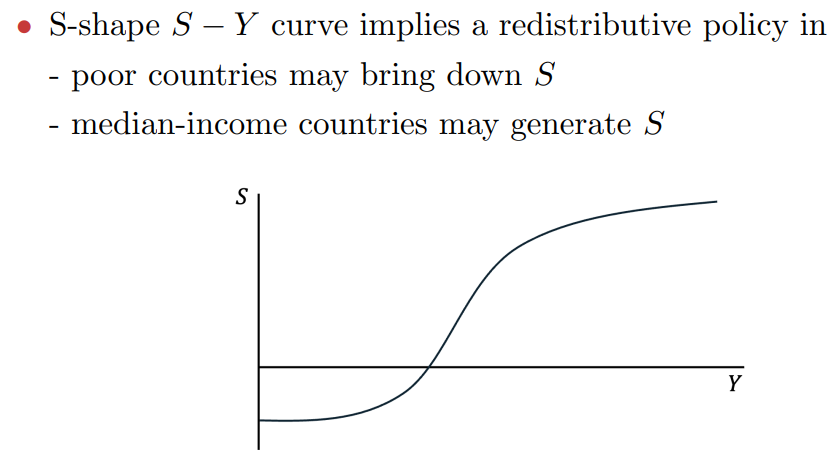
curve that describes saving behaviour for different levels of income
study\theory of why inequality is bad for growth
Alesina and Rodrik (1994)
explanation of why inequality is bad for growth
agents endowed with varying levels of capital
capital tax rate affects growth
capitalists prefer tax rate that maximises growth whilst others prefer higher tax rate
median voter theorem means that if high inequality median voter will vote for high tax harming growth
Results
find epsecially large negative effects on growth of land inequality
BUT
Perotti (1996) finds that inequality does not cause higher taxes and higher taxes do not necessarily hinder growth
inequality likely works through instability and poor credit market
international poverty line and how many people below it
3$ per day, 831 million people
Problems with objective poverty lines
PPP changes lead to large changes in poverty
different energy inputs needed in different climate potentially, shorter people
improving income to poor but it doesn’t lift someone above poverty line then it is not reflected in this measure
transfer principal does not hold from social welfare axiom
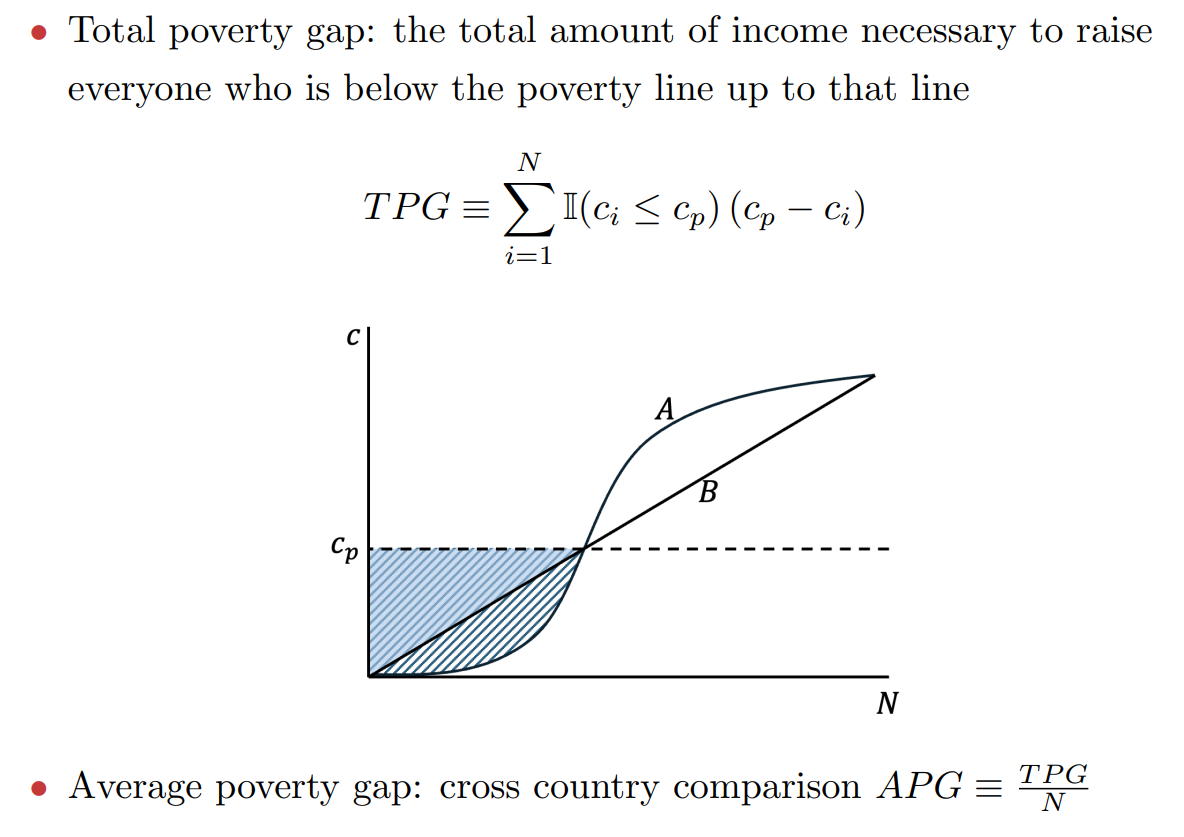
Total poverty gap
solves problem of transfer principal from poverty line
Foster Greer Thorbecke (1984) helps to account for amount of people are how far below poverty line
multidimensional poverty index
takes into account health, education and standard of living measures
Poverty trap
can be due to credit insurance risk
nutrition
stress and mental health, more prevalent in developing countries
poverty can be due to endowment or multiple equilibria
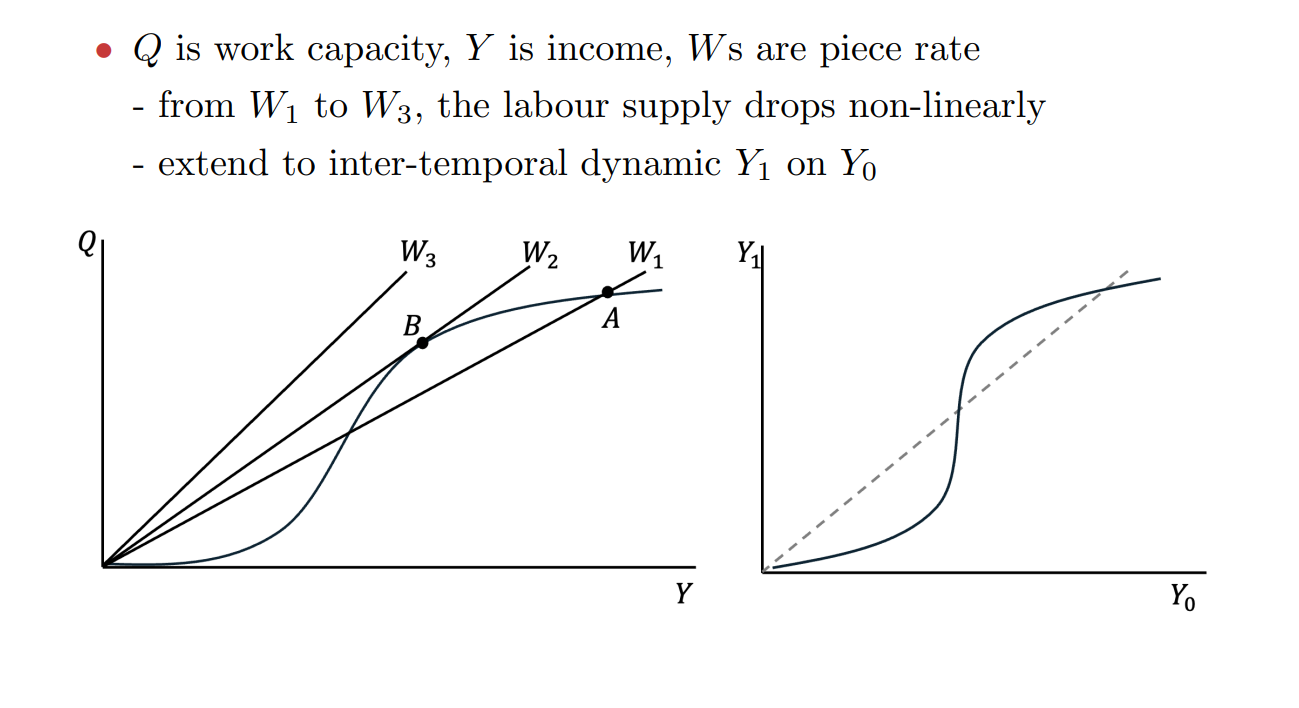
Positiv and negative externalities of population growth
Positive
increases market for goods and services
endogenous growth through new ideas
improves health services as it helps more
Negative externalities
social norm, upward spiral
human capital investment, trade off between quality and quantity
environmental externalities
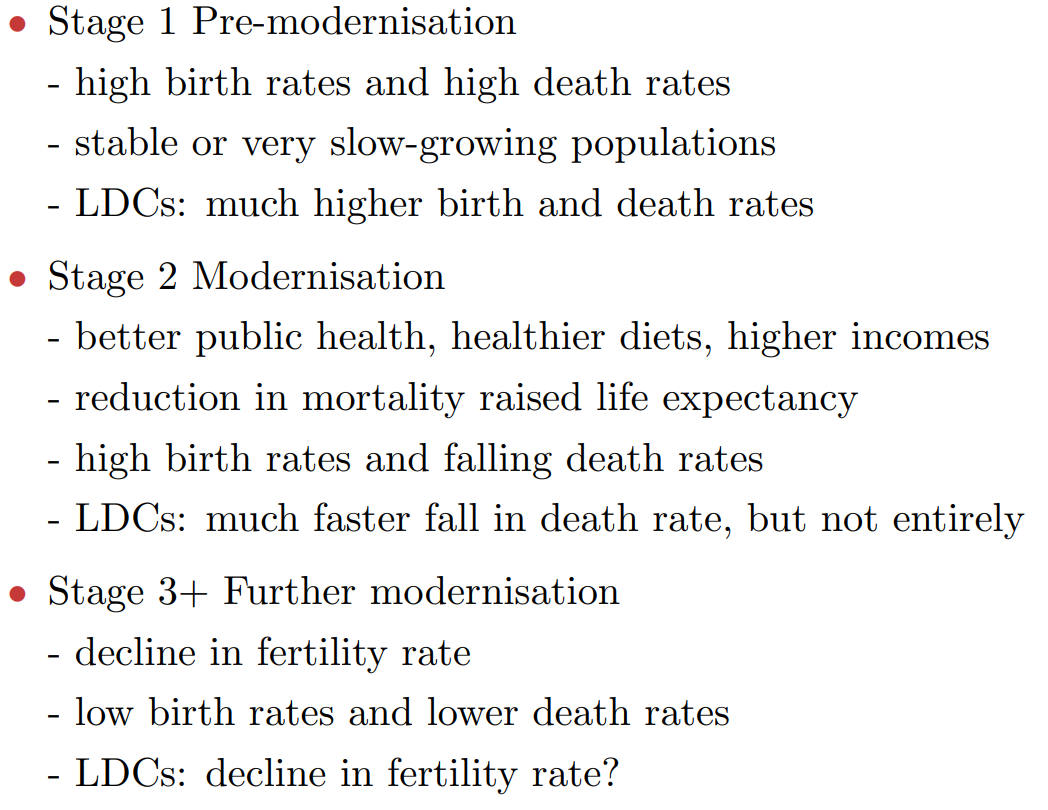
Demographic transition model
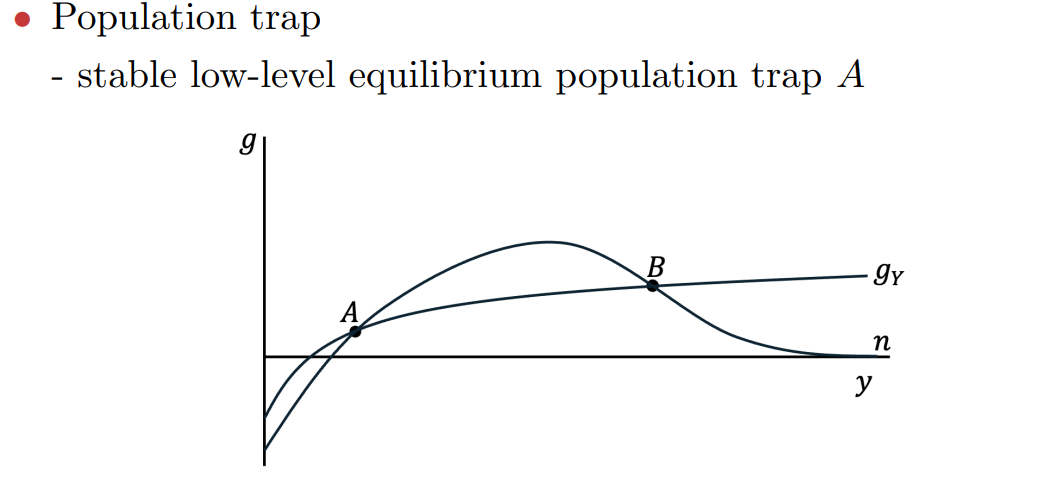
Malthusian model of population growth
population grows geometrically n, food supply grows arithmetically gy
avoiding the trap
lower n through
preventive checks: birth control or one child policy
normative checks: disease, war starvation
raise gy through investment and industrialisation
empirics support the idea of land productivity advancing population density but not income in pre industrial era
Household demand model
four key elements
household acts like firm combining time and market goods to produce
can produce household services or child services
must allocate resources between market activities and child services
quantity quality trade off in children, choose how many children to have and how much to invest into them
results in rising wages reducing child services due to higher opportunity cost and higher price of having children reduces number of children
also reproductive costs higher for women
assumption: relies on a unitary 'household' utility function (assuming the couple always agrees) and assumes families act with complete information
assumes fertility maximisation
better at explaining changes at the margin than over time
can however also use children as labour or investment
empirical evidence
economic developoment increases Q demand
some association between fertility and female economic activity
Cain (1977) children are costless by the time they reach adolescence in poor countries
evidence of children being used as pensions
reproductive externalities
Macro externalities
- no. of children: socially optimal 6= privately optimal •
Micro externalities
- intra-family externalities on fixed and variable costs the structure of the family: joint to nuclear higher direct cost lowering fertility
- couple may have different reproductive goals
Human development model with social interactions
individuals utility not only depends on private consumption but also how decision ligns up with social group
Vi=U(ci,zi,xi)+Sj(ci,c−ij)+ϵi
strategic complementarity, meaning the marginal utility of a woman's fertility decision increases if it aligns with the fertility choices of others in her group
social influences
Endogenous effects: Your choices are directly influenced by the choices of your reference group, average fertility
Exogenous effects: Your choices are influenced by the general characteristics of your group (e.g., the group's average education level), average characteristics
Correlated effects: People in the same group behave similarly simply because they face the same institutional environment or have similar individual traits
only endogenous effects create a social multiplier where reducing it for one will also reduce for others
empirical study on HDM with social interaction
Iyer and Weeks (2020)
strong ethnic identity in Kenya, and Kenya experienced on of the most rapid declines in fertility rate
endogenous effects: the impact of mean fertility in the cluster on individual fertility. difference
exogenous: impact of mean education
ethnic groups settle in distinct regions with distinct rainfall climates. So rainfall is essentially proxying for ethnic-region-specific economic conditions that shape cultural fertility norms over generations, not for short-run individual fertility decisions.
rainfall is a plausibly exogenous source of variation that primarily affects ethnic-region economic conditions over long horizons, and conditional on the controls, the residual variation is more likely to operate through group cultural norms than through other individual-level channels
Result
Endogenous social interaction effects within ethnic clusters are strong; exogenous (contextual) education effects and religion effects are weak or absent
this means that there's no extra effect. Group education doesn't operate through aspiration, role-modelling, or social pressure independent of behaviour. It only operates by changing group fertility behaviour
effect of targeted treatment depends on if it is effective in flipping cluster norm, need to impact enough people then will have positive multiplier effect
study on slow response to external interventions due to social norms
Munshi and Myaux (2006)
religious groups that do not mix, contraception differs across groups
examine low impact of contraceptive policy
used lagged fertility choice as an IV, same village different religion
result
Strong within-group endogenous effects
no cross group spillover
need to reach tipping point at which enough people use it to bring other people to use it too, changing group average
here religion is dominant reference group, in Iyer weeks paper it was ethnicity
study on son preference and daughter aversion in determining family size
Borooah and Iyer (2004)
son preference pushes family size up, daughter aversion pushes it down
theory
weighing the expected utility of an additional son against the expected disutility of an additional daughter
findings
since Muslims have similar son preference but lower daughter aversion than hindus, muslims should have larger family
some evidence of sex selection at birth, abortions better treatment of infant boys
model of marriage
Friedberg and Stern (2005)
changes utility function as couples share household services
advantages
share public goods
women have a comparative advantage in child raising
gender pay gap means men have comparative advantage in labour market
thus marriage is good for specialisation
age dependency ratio and support ratio

channels between health and poverty
stature is significantly positively correlated with income
poverty results in malnutrition
control for infectious disease
study of link bewteen health and education
Miguel and Kremer (2004) deworming project
deworming drug randomly given to different schools
analyse school absenteeism, externalities, cost
decompose effects into directe effect and within school externaltiy and cross-school externality
different groups given treatment at different times over 5 years
Result
school absenteeism fell 25%
found large within and cross school spillover for close schools
no significant improvement in health score in short term
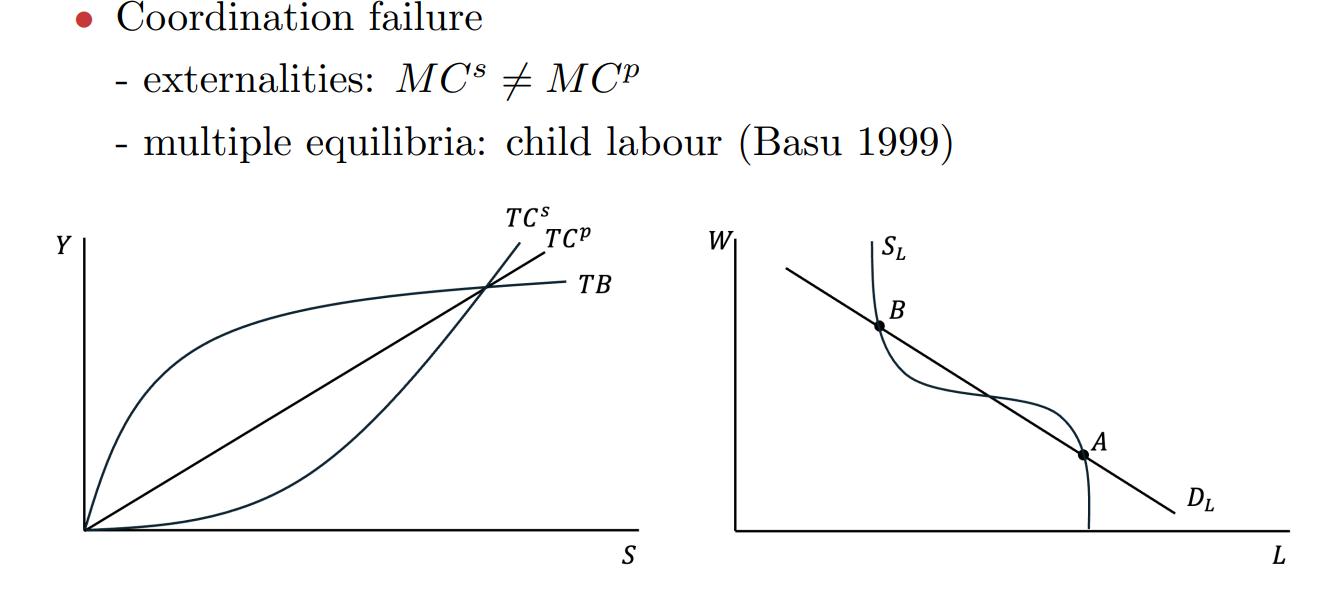
coordiantion and multiple equlibria
only need child labour if wages drop too low, but since this increases labour supply wages fall,
if all parents took children out of labour wages would be high enough
also positive externalities of education which are not internalised by private choices
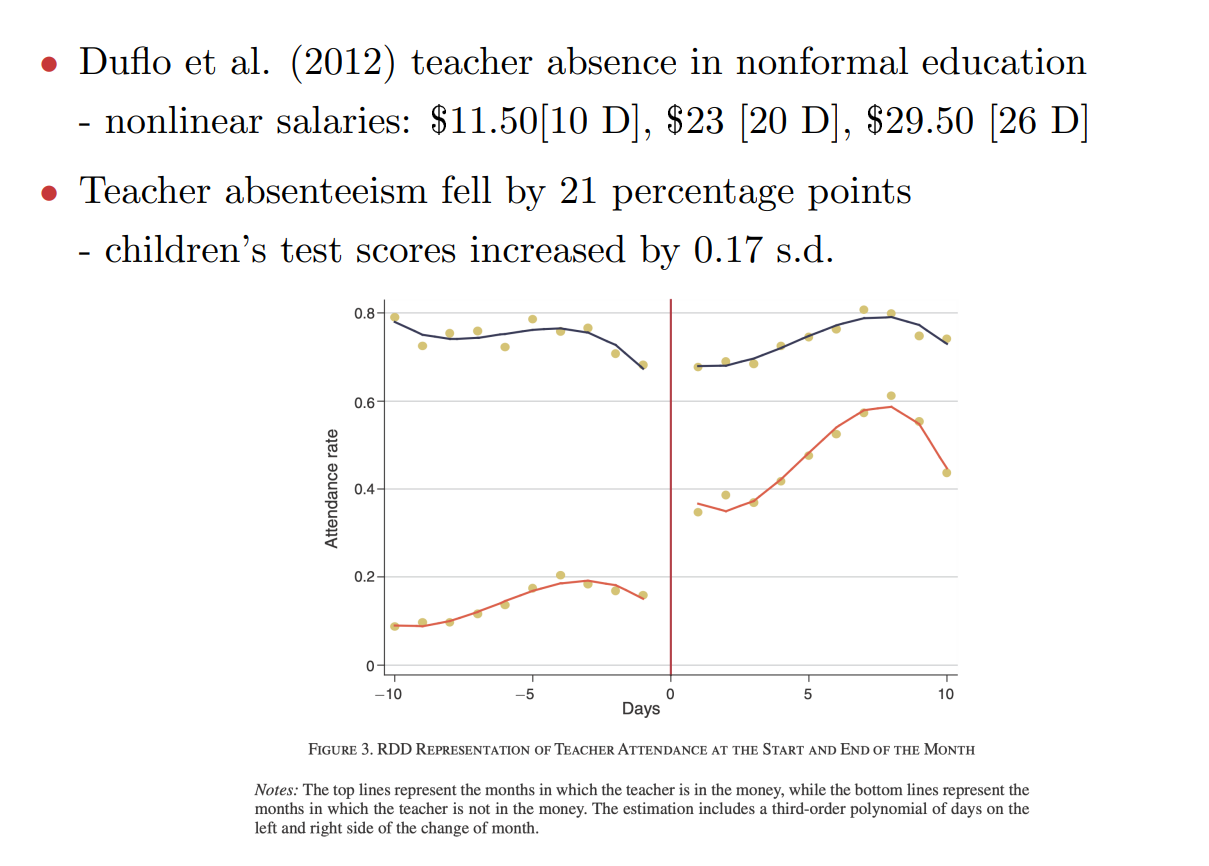
one way to increase teacher absence
Intra-household allocation model
households pool resources
but unequal distribution (lifeboat problem, feed highest earner in extreme poverty),
can have paterfamilias(dictatorship) or individual members bargain over resources,
theta is the fraction of household income that an individual can control, in paterfamilia husband controls100%
but Hoddinott and Haddad (1994, 1995) show that increasing womens share of income directly raises share of budget spent on food
boys also get more investment into education
parents can either borrow and get standard interest rate return, or invest long term into child and get returns later
since financial returns for boys are higher this is what they invest in, pecuniary gap
this leads to even larger attainment gap, boys gain from having a sister as they get a larger share of the pie

O ring theory of production
links education and growth
tasks are sequential and interdependent, if any stage fails whole product fails
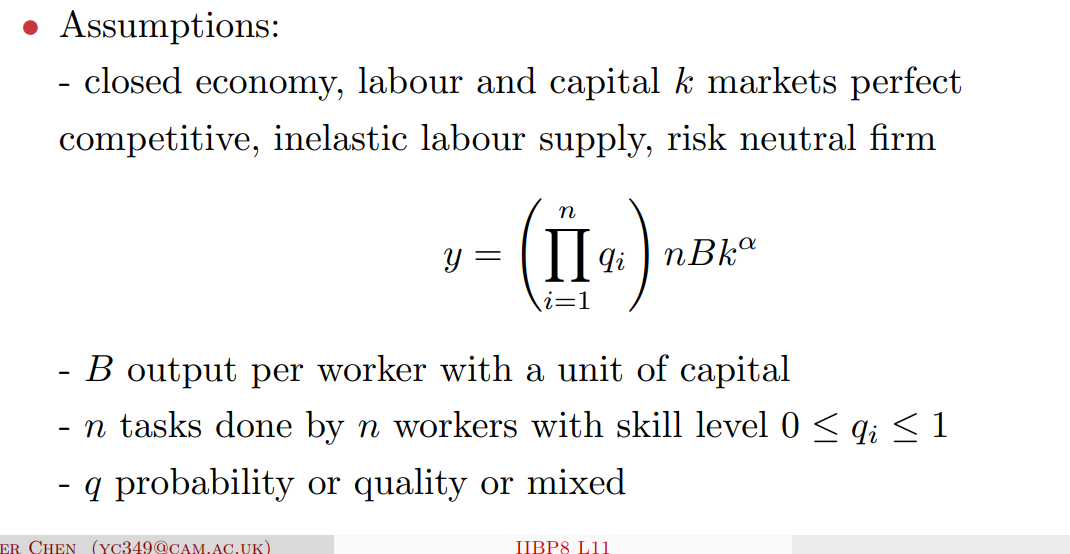
y=(q1×q2×q3×...×qn)×nBkα
production function is multiplicative where q is the skill of the worker and gives probability that the task will be a success
Positive Assortative Matching:Because highly productive firms can afford to pay more to protect their production chain, workers of similar skills end up working together
more skilled workers will earn exponentially higher wages because they work together
specialisation, developed countries with well educated labour can specialise in complex products
creates bottleneck in developmnet since there is no incentive to invest heavily in education because have to work together with other low skill individuals
need to raise broad education
empirical
Kremer and Maskin (1996) finds that workers do segregate by skill
Agglomeration and congestion
agglomeration
localising sectors in specific area
cost advantage to producer and consumers
linkages of lower transport cost and pool of workers with specific skills, links back to o ring
Congestion
land prices, pollution traffic
city size determined by CBD model and geographical restrictions
agglomeration effect study
Ahlfeldt et al. (2015)
berlin study look at floor space to ground ratio
how much more productive does a city become purely because density increases
produciton externalities: surrounding density of workers, environemntal production fundamentals (topography or natural supply of water)
residential externalities: surrounding density of workers, residental fundamnetals ( access to forests)
congestion: limited land, commuting costs
results
elasticity of productivity with respect to employment density is about 0.07
agglomeration spillover is highly localised
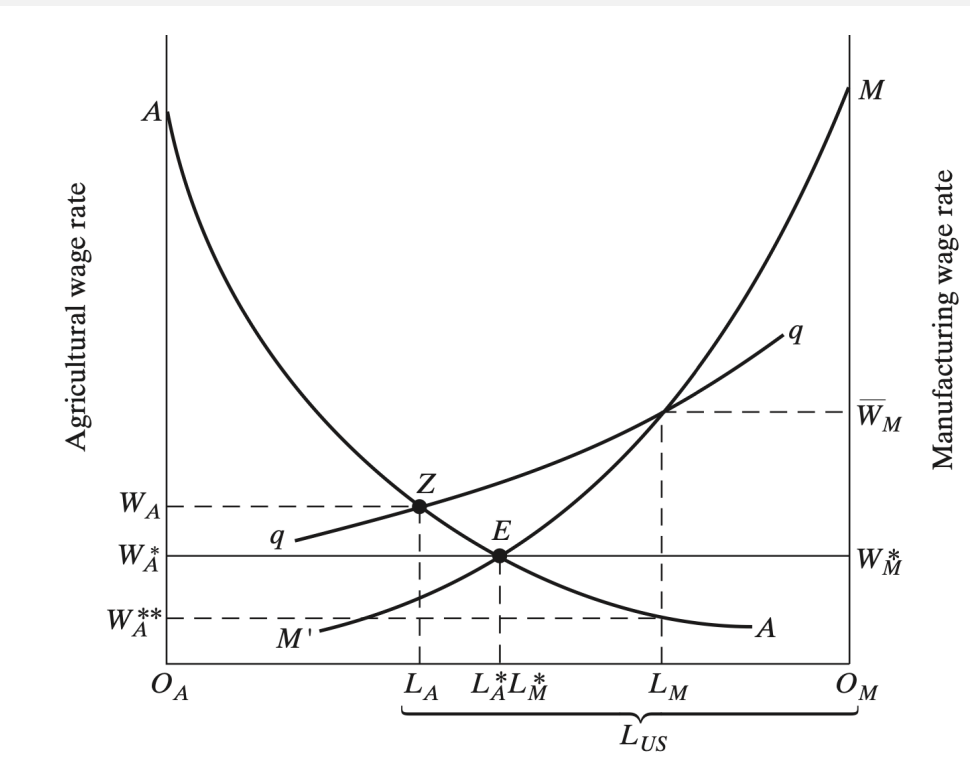
Harris-Todaro model
rural urban migration model
why do people migrate even though urban unemployment is so high
Assumptions
two sectors rural urban
labour demand is MPL with free movement
urban wage institutionally determined and fixed
rural wage efficiently determined Wm>Wa
leads to the urban rural wage parity
indifferent once urban unemployemnt becomes sufficiently large, wage in agriculture is equal to wage in urban times probability of getting a job
Potential costs and benefits of globalisation
benefits
growth
poverty alleviation, foreign aid, cheaper goods
human capital improvements
technological innovations
FDI
labour mobility, remittances
costs
inequality, intra and inter
dependence
environment
cultural and political issues
rough overveiw of Heckscher-Ohlin model and comare to ricardian
Ricardian model
specialise in sectors that you have a comparative advantage in to minimise opportunity cost, complete specialisation
HO model
same production technology differen t factor endoments
specialise in production for which you have relative factor abundancy
factor price equalisation
all countries gain from trade but does not predict full specialisation
local labour market impact of globalisation study
Autor et al. (2013)
China joined WTO led to massive increase in Chinese exports to US
created American geographical areas that specialised in specific goods
used IV of chinese imports of specific goods to other high income countries
The paper found that local labor markets highly exposed to Chinese import competition experienced severe, cascading economic damage. The assumption that workers would smoothly transition to new jobs was entirely wrong.
high unemployemnt
wage decline
geographical labour rigidity
trade liberalisation on firm productivity
Bustos (2011)
southern common market agreement
exporting firms are more likely to innovate
technology adoption most prominent amongst exporting firms
increases wage inequality between exporting and non-exporting firms
environmental Kuznets curve
- environmental degradation rises with early industrialisation
- further growth leads to worsening pollution
- post-industrial stage: cleaner technologies
Resource curse
(Humphreys, et al. 2007)
over reliance on natural resources for growth
soil erosion and deforistation
slower developmnet, corruption
need effective institutions
two factors that have made environment worse in developing countries
Rural-urban migration
Globalisation
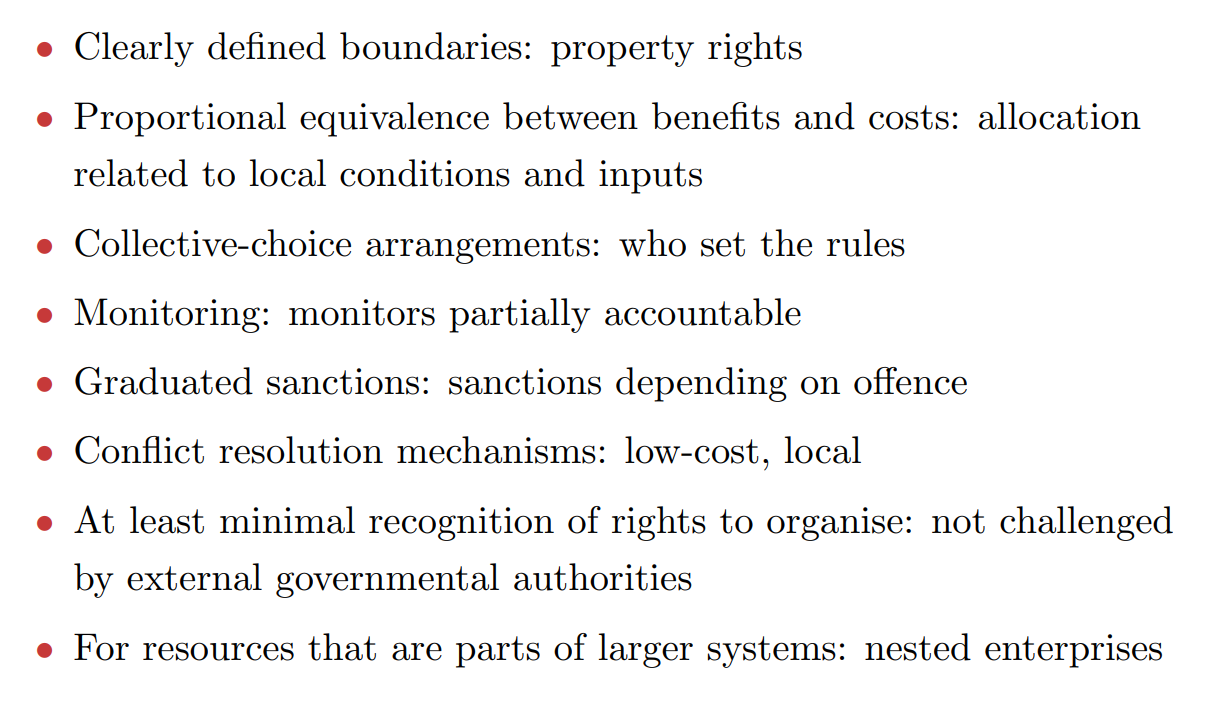
8 conditions for managing shared environmental resources
Elinor Ostrom (2005)
property rights as a solution to tragedy of the commons
Costello et al. (2008)
overfishing because of lack of property rights over ocean
implemented catch shares, can trade permits for how many fish you are allowed to catch, tradeable property rights
11 thousand fisheries globally over half a century
fisheries that implemented this saw drastic reduction in collapse rates
reasons why developing countries are more exposed to climate change
agricultural sensitivity
direct impact on productivity of heat, especially without climate control technology
studies for which IV is used as rainfall?
study of temperature change on growth
Dell et al. (2012)
take annual temperature fluctuations over half a century and 120 years
country and time fixed effects
find significant negative long and short term effects of rises in temperature but these are only significant for developing countries
solutions to protect environment with citation
Dasgupta (2021)
use Comprehensive wealth as a measure
economic solutions
direct subsidies away from fossil fuels and agriculture
green taxation
global cooperation
natural capital accounting
equity concerns
Monetary policy in developing countries
weak institutions undermine effectiveness
vulnerable to global interest rates, commoditiy prices and exchange rates
important to expand access to credit and cooperate with international institutions
Goncalves and Salles (2006) found inflation targeting to lead to greater drops in inflation and growth volatility, but constrains flexibility
alternative studies suggest not ideal for developing countries due to more susceptible to external shocks and central bank credibility
exchange rate volatility and growth
Aghion et al. (2009)
exchange rate volatility is more damaging with poor financial development
exporting firms experiencing an appreciation in ER will see slump in profits
to overcome liquidity shock need to borrow in short term
strong robust evidence supports this from 83 countries over 40 years
problems with fiscal policy
low tax base requires reliance on indirect taxation
natural resource dependence
vulnerable to external shocks
struggle to undertake large reforms which yield highest returns?
Case for Restricting Fiscal Policy Discretion
Fatas and Mihov (2003)
Key finding
- governments that use fiscal policy aggressively induce significant macroeconomic instability
- 1 pp volatility of output lowers growth by more than 0.8 pp
- prudent use of fiscal policy is explained by political constraints and other political and institutional variables
• Too much flexibility
- procyclical behaviour, exacerbating economic fluctuations, undermining long-term growth
- constraining discretion by imposing institutional restrictions
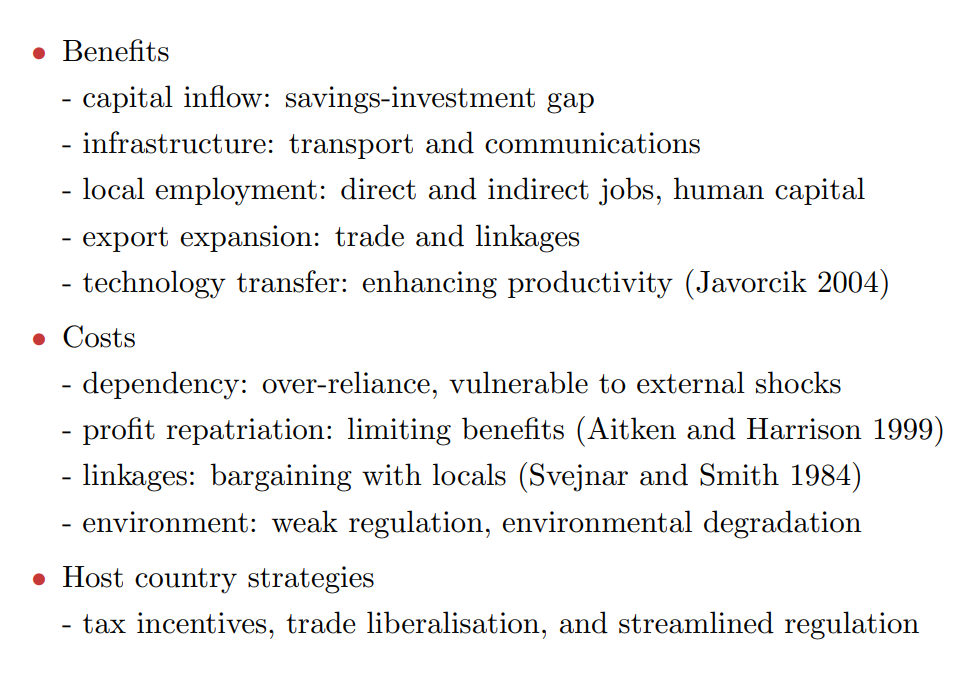
FDI costs and benefits
Financial globalisation study
Kose et al. (2009)
integrated global financial system
micro data shows benefits and distortionary effects of capital controls
macro evidence inconclusive
Channels
- supplement domestic savings
- technology transfer and managerial
- productivity and competitiveness in domestic firms
Remittances impact
- investment in education, health
Aggarwal et al. (2011) - positive impact: savings and lending activities - more likely to open bank accounts
• Potential issues - Brain Drain and local labor market effects - inequality - consumption or investment
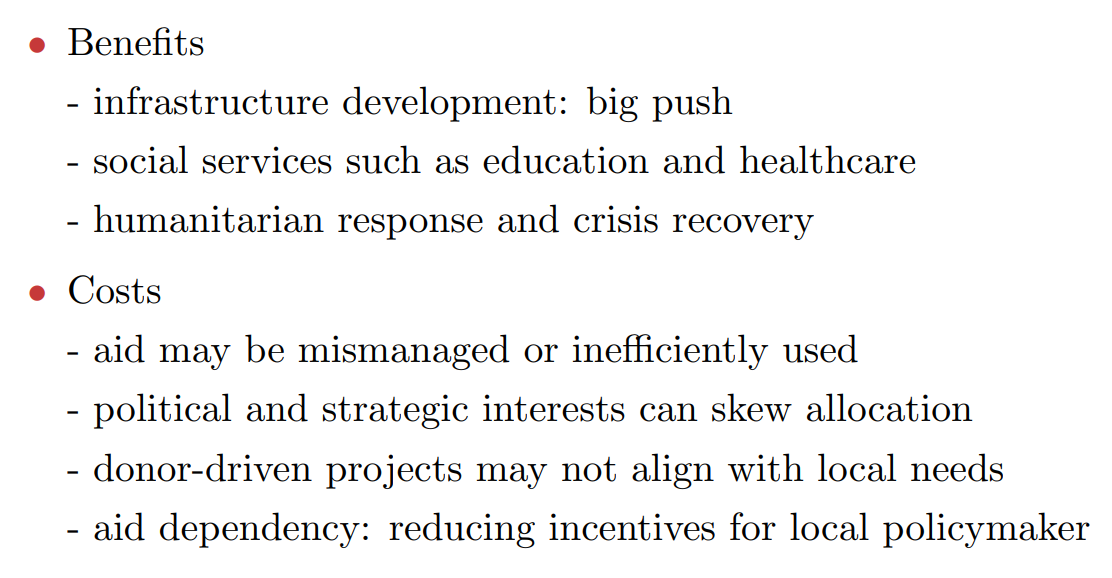
Foreign aid cost benefits
meausuring the fiscal multiplier in developing countries
Kraay (2012)
look at loans from world bank to aid depend countries
IV comes from world bank bureaucracy which means that timing of aid is exogenous
he found short term multiplier of only 0.5
due to import leakages
anticipation effects close to zero due to credit constraint
doesnt look at long run
I