Oral solid dosage forms
 Call Kai
 Learn
Learn Practice Test
 Spaced Repetition
 Match
Match Flashcards
 Knowt Play
1/31

There's no tags or description
Looks like no tags are added yet.
Name | Mastery | Learn | Test | Matching | Spaced | Call with Kai |
|---|
No analytics yet
Send a link to your students to track their progress
32 Terms
What is the aim of solid dosage form (SDF) design?
To develop dosage forms by understanding material properties and formulation factors,
that influence performance and manufacturability.
Why are APIs rarely administered alone in solid dosage forms?
Due to small dose size, poor processing characteristics, or need for specialised functionality.
Classify powders based on particle size.(4)
Coarse: >1000 µm
Intermediate: 100–1000 µm
Fine: 5–100 µm
Ultrafine: <5 µm
How does particle shape affect powder flow? (2)
Spherical: good flow
Acicular (needle-like): poor flow
How does particle density influence powder behaviour?
Higher density → heavier, better settling
Lower density → lighter, more prone to segregation
What are common light-based methods for particle size analysis? (4)
Light microscopy
SEM/TEM
Laser diffraction
Photon correlation spectroscopy
What is the principle of sieving in particle size analysis?
Particles smaller than the sieve aparatus pass through successive meshes, separating into fractions.
Used extensively for blends, granulations etc.
What is the limitation of sieving for API analysis?
Requires large sample volumes, so not suitable for APIs.
How are particle size results typically represented? (2)
Histograms or frequency curves
Cumulative distributions (oversize/undersize)
What is meant by “equivalent sphere” in particle sizing?
Representing irregular particles as spheres based on length or volume for measurement.
Why must powder samples be representative?
Powders segregate due to size, shape, and density differences.
Compare dynamic and static sampling.
Dynamic: •taking a proportion when the product is in motion (best). Take several samples at varying times when the powder is in motion.
Static: taken at rest (less reliable due to segregation)
Differentiate adhesion and cohesion.
Adhesion: attraction between different materials
Cohesion: attraction between similar materials
What determines powder flow behaviour AND SHAPE?
Balance between cohesive and external forces.
Define angle of repose.
The maximum angle between a powder heap and horizontal plane, indicating flowability.
How do particle size and moisture affect angle of repose?
Smaller size and higher moisture → increase angle → poorer flow.
What is bulk density?
Density of a powder including
void spaces (air) between particles/packing fraction (k). .
What does a high bulk density indicate about flow?
Better flow due to reduced porosity.
Percentage of the volume which is taken up by air is known as the bed porosity.
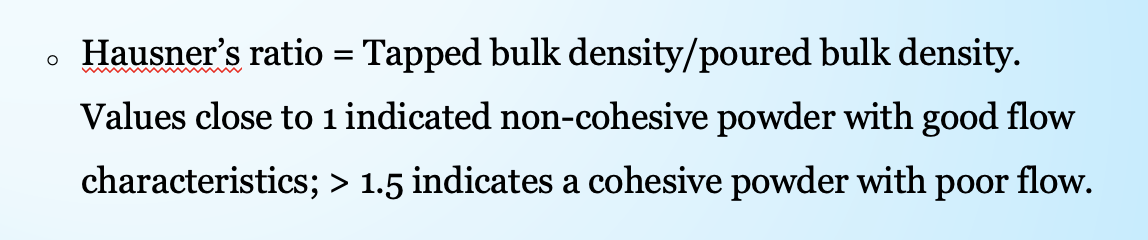
What is Hausner’s ratio and what does it indicate?
Hausner’s ratio = tapped BD / poured BD
≈1 → non-cohesive powder with good flow
1.5 → cohesive powder with poor flow
What is Carr’s Compression Index (CCI)?
CCI = [(tapped BD – poured BD) / tapped BD] × 100
<10 → excellent flow
20 → poor flow
![<p>CCI = [(tapped BD – poured BD) / tapped BD] × 100</p><ul><li><p><10 → excellent flow</p></li><li><p></p></li></ul><figure data-type="blockquoteFigure"><div><blockquote><p>20 → poor flow</p><p class="not-prose mt-0! mb-0! flex-auto truncate"></p></blockquote><figcaption></figcaption></div></figure><p></p>](https://assets.knowt.com/user-attachments/dab020f5-8215-4322-8351-509e44ca2abe.png)
Define powder mixing.
A unit operation that ensures uniform distribution of all components at particle level.
What is segregation in powder systems?
Separation of mixed particles due to differences in size, density, or shape.
Describe three types of segregation.(3)
Percolation: small particles move downward
Trajectory: heavier particles travel further
Elutriation: fine/light particles rise with airflow
What is trituration?
Mixing powders using a mortar and pestle.
Types of mixtures(3)
•. Positive mixture- Diffusion, irreversible – no problems
Negative mixtures -Density, size or shape differences.
•Spontaneously separate out (segregate).
Neutral mixtures- No movement without addition of energy.
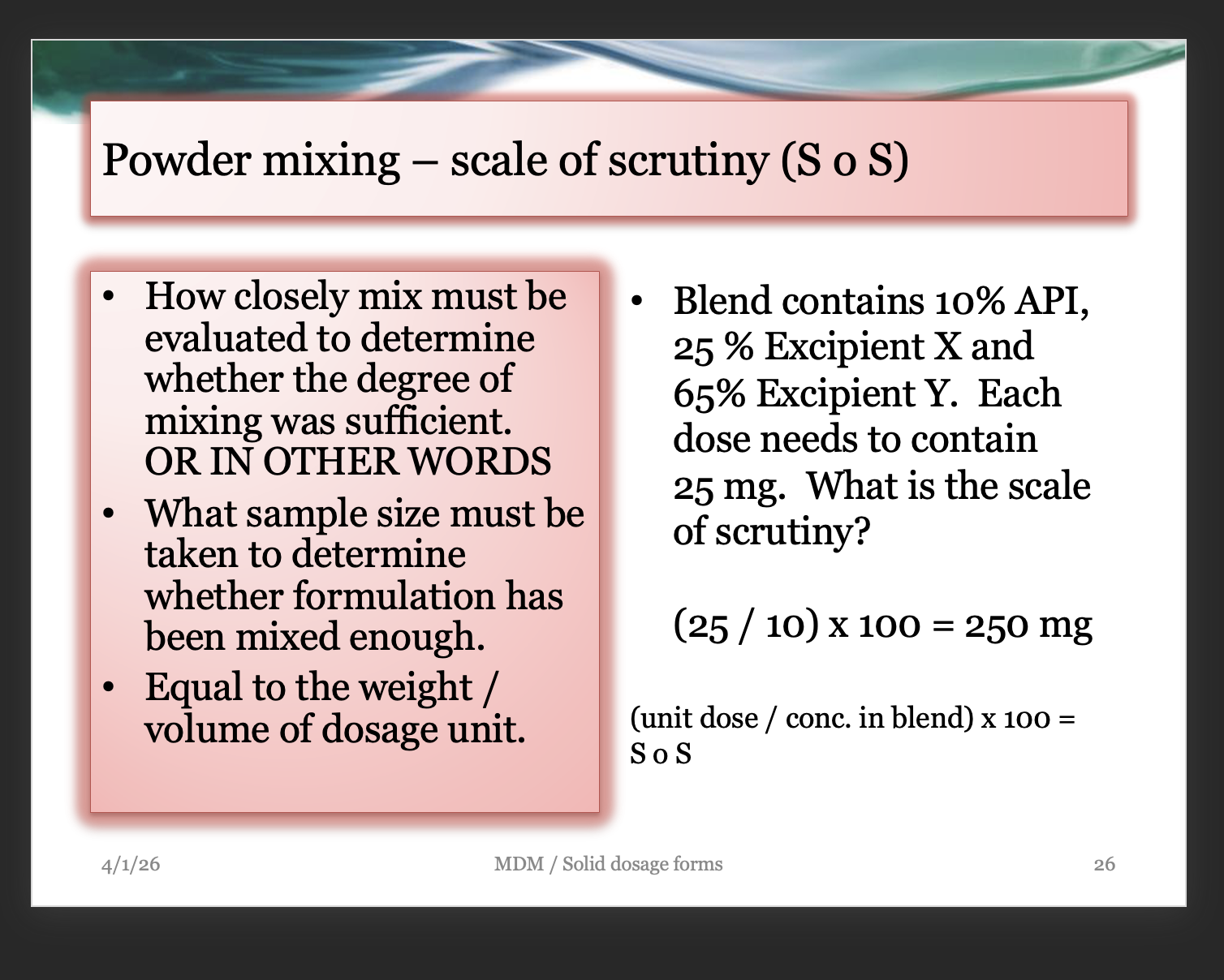
What is the scale of scrutiny (SoS)?
The sample size required to determine whether the formulation has been mixed enough,
also equal to the dose unit weight/volume.
How is SoS calculated?
SoS = (dose / %API in blend) × 100
Define comminution?
Reduction of large solid masses into smaller units by mechanical means.
What factors must be considered in particle size reduction?(4)
Material properties (hardness, structure)
Desired particle size/shape
Equipment used
Energy input and losses
What problems can arise during particle size reduction?
(5)
Aggregation
Degradation
Polymorphic changes
Moisture changes
Contamination
What are excipients and their functions in solid dosage forms?(5)
Help convert API into dosage form
Various specialized functions:
Aid manufacture
Improve stability and bioavailability
Enhance patient compliance
Provide bulk and identification
what is the use of disintegrants ? (4)
• To promote the break-up of solid unit dosage forms following ingestion.
• Three mechanisms:
-•Facilitation of water uptake
-•Rupture of tablet by swelling
-•Rupture of tablets by CO2 production