Pathology KC #6
 Call Kai
 Learn
Learn Practice Test
 Spaced Repetition
 Match
Match Flashcards
 Knowt Play
1/81

There's no tags or description
Looks like no tags are added yet.
Name | Mastery | Learn | Test | Matching | Spaced | Call with Kai |
|---|
No analytics yet
Send a link to your students to track their progress
82 Terms
What is the term to describe a malignant tumor in bone?
-Osteosarcoma
-Osteoma
-Lipoma
-Carcinoma
-Osteosarcoma
What is the treatment for a benign cementoblastoma?
-No treatment needed
-Surgical excision and drainage
-Enucleation of tumor and tooth extraction
-Surgery and radiation therapy follow-up
Enucleation of tumor and tooth extraction
Osteosarcoma occurs more often in the _____ and more often in _____.
maxilla; males
maxilla; females
mandible; males
mandible; females
mandible;males
The adenomatoid odontogenic tumor features ductlike structures that
A. resemble those found in major salivary glands.
B. resemble those found in minor salivary glands.
C. are actually ameloblast-like cells that resemble ducts because of their circular arrangement.
D. are actually odontoblast-like cells that resemble ducts because of their circular arrangement.
C. are actually ameloblast-like cells that resemble ducts because of their circular arrangement.
Which choice is not regarded as an initiating factor in the development of oral cancer?
-Cigar, pipe, and cigarette smoking
-Snuff dipping and tobacco chewing
-Consumption of alcohol
-Chronic irritation
Chronic irritation
Clinical signs and symptoms of a pleomorphic adenoma include the following except one. Which is the exception?
-Nonulcerated lesion
-Painless
-Quickly enlarging
-Dome-shaped mass
Quickly enlarging
A common location of the oral neurofibroma is the
-tongue.
-palate.
-gingiva.
-buccal mucosa.
tongue
Squamous cell carcinoma of the oral epithelium usually metastasizes first to which site?
-Spleen
-Lungs
-Liver
-Lymph nodes
Lymph nodes
Intraoral minor salivary gland tumors are most commonly located
-on the labial and buccal mucosa.
-at the junction of the hard and soft palate.
-on the retromolar area.
-on the floor of the mouth.
at the junction of the hard and soft palate.
_____ means new growth.
-Metastasis
-Neoplasia
-Hypertrophy
-Hyperplasia
Neoplasia
According to the TNM staging system for oral squamous carcinoma, T2, N1, M0 would mean tumor _____ cm in diameter, _____ palpable nodes, and _____ metastasis.
-less than 2; ipsilateral; no distant
-2 to 4; ipsilateral; no distant
-2 to 4; contralateral; no distant
-2 to 4; contralateral; distant
2 to 4; ipsilateral; no distant
Multiple myeloma is a systemic, malignant proliferation of
red blood cells.
plasma cells.
eosinophils.
basophils.
plasma cells
The majority of adenomatoid odontogenic tumors occur in _____ years of age.
females over 40
males over 40
females under 20
males under 20
females under 20
**70% occur in this age group in impacted teeth
**maxilla more than mandible
Most cases of verrucous carcinoma occur in the _____ years old.
-posterior lateral border of the tongue of women over 40
-floor of the mouth of women over 70
-vestibule and buccal mucosa of men over 55
-bone of the mandible of men over 20
vestibule and buccal mucosa of men over 55
Which intraoral lesion appears as a smooth red patch or a granular red and velvety patch?
-Sarcoma
-Papilloma
-Erythroplakia
-Leukoplakia
Erythroplakia
Patients who have undergone radiation therapy for malignant tumors of the head and neck often experience severe xerostomia as a result of radiation damage to _____ tissue.
-oral mucosa
-striated muscle
-salivary gland
-tooth
salivary gland
Squamous cell carcinomas on the vermilion border of the lips and skin of the face are
A. associated with lack of exposure to the sun and vitamin D deficiency.
B. more common in individuals with dark skin.
C. associated with a poorer prognosis than that for squamous cell carcinoma of the oral mucosa.
D. associated with color changes of the vermilion border from dark pink and uniform to mottled grayish pink.
D. associated with color changes of the vermilion border from dark pink and uniform to mottled grayish pink.
An ameloblastoma may appear as a _____ on radiographic images.
-unilocular radiolucency
-multilocular opacity
-multilocular, soap-bubble radiolucency
-unilocular or multilocular radiopacity
multilocular, soap-bubble radiolucency
Bence Jones proteins are associated with
-osteosarcoma.
-leukemia.
-lymphoma.
-multiple myeloma.
multiple myeloma
Sarcomas are _____ common than carcinomas.
-10 times more
-3 times more
-3 times less
-10 times less
10 times less
Which statement about malignant melanoma is true?
A. It has a benign counterpart known as the benign melanoma.
B. Most malignant melanomas arise on the skin as a result of prolonged exposure to chemicals such as benzene.
C. Primary malignant melanoma of the oral cavity is rare.
D. The most common intraoral location is the tongue.
C. Primary malignant melanoma of the oral cavity is rare.
**most arise on the skin as a result of prolonged sun exposure (all melanomas are malignant)
When a mucoepidermoid carcinoma arises within bone, it will usually be found in the _____ region.
-maxillary anterior
-maxillary posterior
-mandibular anterior
-mandibular posterior
mandibular posterior
***FLIP
D. ameloblastoma.
The name of the benign tumor that is slow growing but locally aggressive and derived in association with an impacted tooth and dentigerous cyst is termed
A. calcifying odontogenic cyst.
B. odontogenic myxoma.
C. compound odontoma.
D. ameloblastoma.
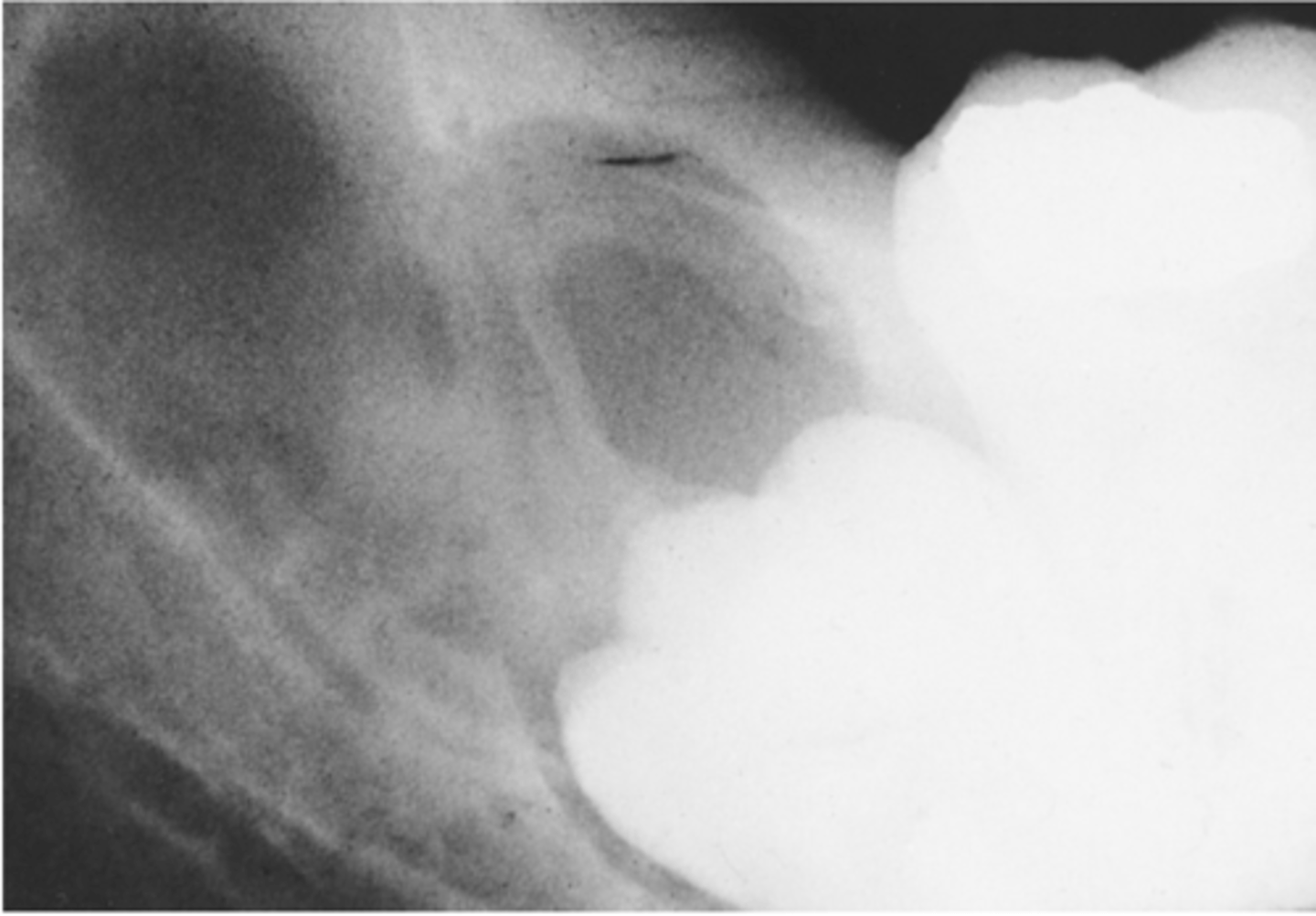
The granular cell tumor
A. most often occurs on the tongue followed by the buccal mucosa.
B. appears as a painful, ulcerated nodule.
C. occurs most commonly in children.
D. occurs most often in men.
A. most often occurs on the tongue followed by the buccal mucosa.
Because the origin of these tumors is glandular epithelium, benign tumors of salivary gland origin are termed
-adenomas
-nevi
-chondromas
-lipomas
adenomas
Anaplastic means the tumor:
A) is composed of cells that vary in size and shape.
B) has cells with darker nuclei than those of normal cells.
C) has cells that exhibit an increased nuclear-to-cytoplasmic ratio.
D) does not resemble the tissue from which it was derived.
D) does not resemble the tissue from which it was derived.
The papilloma will appear whiter clinically because of additional amounts of what substance?
A) Keratin
B) Exudate
C) Granulation tissue
D) Macrophages
A) Keratin
Approximately _____% of patients with chondrosarcoma involving the jaws survive 5 years after the diagnosis.
A) 10
B) 30
C) 50
D) 70
B) 30
Which tumor occurs most frequently in the anterior part of the jaws?
A) Ameloblastoma
B) Calcifying epithelial odontogenic tumor
C) Adenomatoid odontogenic tumor
D) Odontogenic myxoma
C) Adenomatoid odontogenic tumor
Severe epithelial dysplasia involving the full thickness of the epithelium is termed
A) anaplasia.
B) squamous cell carcinoma.
C) carcinoma in situ.
D) metastasis.
C) carcinoma in situ.
For each neoplasm description below, choose whether the neoplasm is benign or malignant:
Cells closely resemble their cells of origin.
Benign
For each neoplasm description below, choose whether the neoplasm is benign or malignant:
Mitosis is uncontrolled with rapid division.
Malignant
For each neoplasm description below, choose whether the neoplasm is benign or malignant:
Growth expands by invasion and replaces normal tissue.
Malignant
For each neoplasm description below, choose whether the neoplasm is benign or malignant:
The majority of these neoplasms are encapsulated.
Benign
For each neoplasm description below, choose whether the neoplasm is benign or malignant:
Recurrence of the tumor is not common.
Benign
For each neoplasm description below, choose whether the neoplasm is benign or malignant:
In naming the neoplasm, the word sarcoma or carcinoma is used.
Malignant
For each neoplasm description below, choose whether the neoplasm is benign or malignant:
Cells are poorly differentiated.
Malignant
The Warthin tumor:
A) is a unique type of pleomorphic adenoma.
B) presents as a painless, soft mass, usually in the sublingual gland.
C) often develops bilaterally in adult women.
D) contains sheets of lymphocytes that surround the cystic structures.
D) contains sheets of lymphocytes that surround the cystic structures.
Which tumor is an unencapsulated, infiltrating tumor composed of a combination of mucous cells interspersed with squamous-like epithelial cells?
A) Adenoid cystic carcinoma
B) Mucoepidermoid carcinoma
C) Monomorphic adenoma
D) Pleomorphic adenoma
B) Mucoepidermoid carcinoma
Which statement about hemangiomas is true?
A) The gingiva is the most common intraoral location.
B) They are more common in boys than in girls.
C) They appear as variably sized, deep red or blue lesions that do not blanch when pressure is applied.
D) They may occur in adults as a response to trauma and represent an abnormal proliferation of blood vessels during the healing process.
D) They may occur in adults as a response to trauma and represent an abnormal proliferation of blood vessels during the healing process.
Which statement is true of the odontogenic myxoma?
A) It occurs most often in people over 50.
B) It exhibits a unilocular radiolucency with well-defined margins.
C) The tumor may become quite large and cause displacement of teeth.
D) Most cases arise in the posterior maxilla.
C) The tumor may become quite large and cause displacement of teeth.
Adenoid cystic carcinoma is commonly seen in which demographic group?
A) Men
B) Women of childbearing age
C) Fifth and sixth decades of life
D) Children
C) Fifth and sixth decades of life
Epithelial dysplasia is a microscopy-based diagnosis; it indicates disordered growth and is considered a premalignant condition.
A) Both statements are true.
B) Both statements are false.
C) The first statement is true; the second is false.
D) The first statement is false; the second is true.
A) Both statements are true.
Where is the most frequent intraoral site for metastatic tumors of the jaws?
A) Nares
B) Maxilla
C) Mandible
D) Zygoma
C) Mandible
Kaposi sarcoma is
A) caused by a human herpesvirus.
B) seen only in association with HIV infection.
C) most often seen intraorally on the tongue.
D) a malignant striated muscle tumor.
A) caused by a human herpesvirus.
"Keratin pearls" are a characteristic feature of
A) squamous cell carcinoma.
B) Basal cell carcinoma.
C) pleomorphic adenoma.
D) monomorphic adenoma.
A) squamous cell carcinoma.
Which is a common characteristic of benign neoplasms?
A) Inability to spread to distant sites
B) Nonencapsulated
C) Undifferentiated and pleomorphic
D) No resemblance to surrounding cells
A) Inability to spread to distant sites
Acute leukemia is characterized by a proliferation of _____ cells.
A) immature white blood
B) mature white blood
C) immature plasma
D) mature plasma
A) immature white blood
An intraoral mucosal lesion that shows a mixture of red and white areas is termed:
A) erythroplakia.
B) speckled erythroplakia.
C) speckled leukoplakia.
D) leukoplakia.
C) speckled leukoplakia.
Squamous cell carcinoma of the oral epithelium usually metastasizes first to the lymph nodes of the neck. Common distant sites include:
A) kidneys and spleen.
B) lungs and liver.
C) breast and lungs.
D) liver and spleen.
B) lungs and liver.
For each vocabulary word below, select the corresponding definition from the list provided.
a. central
b. odontogenic
c. in situ
d. hyperchromatic
e. pleomorphic
f. aberrant
g. enucleation
a. Central: occurring within bone
b. Odontogenic: tooth forming
c. In situ: confined to the site of origin without an invasion of neighboring tissues
d. Hyperchromatic: microscopic staining that is more intense than normal
e. Pleomorphic: occurring in various forms
f. Aberrant: deviating from the usual or natural type
g. Enucleation: complete surgical removal without cutting into the lesion
The central cemento ossifying fibroma is most likely derived from which cells?
-Ameloblasts
-Odontoblasts
-Osteoblasts
-Cells of the periodontal ligament
-Cells of the periodontal ligament
A _____ both invades and destroys surrounding tissue and has the ability to spread throughout the body.
-benign tumor
-malignant tumor
-hypertrophy
-hyperplasia
malignant tumor
Squamous cell carcinoma may appear anywhere in the oral cavity; where is the most common site?
-Floor of the mouth
-Gingiva
-Retromolar pad
-Midline of the hard palate
Floor of the mouth
The most common intraoral location for the pleomorphic adenoma is the
-parotid gland.
-submandibular gland.
-palate.
-floor of the mouth.
-palate.
A basal cell carcinoma will _____ metastasize.
never
rarely
often
always
rarely
The most common location for an intraoral lymphoma is the
-floor of the mouth.
-posterior lateral border of the
tongue.
-tonsillar area.
-vestibule.
-tonsillar area.
Which statement about epithelial dysplasia is true?
-It is considered a malignant condition.
-Unlike squamous cell carcinoma, cellular changes in epithelial dysplasia may revert to normal if the stimulus, such as tobacco smoking, is removed.
-It presents clinically as an erythematous lesion and not a white lesion (leukoplakia).
-Lesions often arise on the hard and soft palate.
-Unlike squamous cell carcinoma, cellular changes in epithelial dysplasia may revert to normal if the stimulus, such as tobacco smoking, is removed.
Idiopathic leukoplakia
-is a malignant lesion of the oral mucosa.
-can be rubbed off with gauze squares.
-is caused by direct irritation, as in tobacco pouch keratosis.
-does not have a specific known cause.
-does not have a specific known cause.
The multiple myeloma is a benign proliferation of plasma cells that produce large amounts of immunoglobulin. Patients usually experience bone pain and swelling.
-Both statements are true.
-Both statements are false.
-The first statement is true; the second is false.
-The first statement is false; the second is true.
-The first statement is false; the second is true.
**it is malignant
Where do most cases of papilloma occur?
-Hard palate
-Buccal mucosa
-Soft palate or tongue
-Retromolar area
Soft palate or tongue
Which is the most common salivary gland neoplasm?
-Adenoid cystic carcinoma
-Mucoepidermoid carcinoma
-Pleomorphic adenoma
-Monomorphic adenoma
Pleomorphic adenoma
As a general rule, a patient should be referred to an oral and maxillofacial surgeon or dermatologist to have a biopsy performed on any non healing ulcer of the skin or lips that has been present for more than
24 hours.
2 weeks.
3 months.
1 year.
2 weeks
Approximately _____% of leukoplakias examined microscopically demonstrate epithelial dysplasia.
1 to 2
5 to 25
50 to 60
90
5 to 25
Which is the most common malignant salivary gland tumor found in children?
-Adenoid cystic carcinoma
-Mucoepidermoid carcinoma
-Monomorphic adenoma
-Pleomorphic adenoma
Mucoepidermoid carcinoma
How does an adenomatoid odontogenic tumor differ from a dentigerous cyst on radiographic images?
-It will not be associated with an impacted tooth.
-It extends beyond the cementoenamel junction and can involve 50% to 60% of the root.
-It will not form calcifications within the tumor, as does a dentigerous cyst.
-It will not form a well-circumscribed radiolucency.
-It extends beyond the cementoenamel junction and can involve 50% to 60% of the root.
All terms are associated with malignancy except one. Which is the exception?
-Invasive
-Encapsulated
-Cancer
-Metastasis
Encapsulated
All carcinomas are malignant tumors that originate from squamous epithelium except one. Which is the exception?
-Adenoid cystic
-Basal cell
-Verrucous
-Squamous cell
Adenoid cystic
All are common warning signs of malignant neoplasms except one. Which is the exception?
-Leukoplakia
-Bleeding
-Erythroplakia
-Pigmentation
Bleeding
The adenoid cystic carcinoma is
-a benign tumor of salivary gland origin.
-well encapsulated and does not infiltrate surrounding tissue.
-most commonly seen intraorally on the palate.
-painless.
most commonly seen intraorally on the palate.
A central mucoepidermoid carcinoma is derived from either salivary gland tissue trapped within bone or
-a periapical abscess surrounding the apex of a nonvital tooth.
-the transformed epithelial lining of a dentigerous cyst.
-a lateral periodontal cyst.
-an incisive canal cyst.
-the transformed epithelial lining of a dentigerous cyst.
The _____ is a unique type of monomorphic adenoma.
-verrucous carcinoma
-mucoepidermoid carcinoma
-cylindroma
-papillary cystadenoma lymphomatosum
-papillary cystadenoma lymphomatosum
A(n) _____ is composed of islands and sheets of polyhedral epithelial cells with deposits of amyloid-like material that is thought to represent a form of abnormal enamel protein.
-adenomatoid odontogenic tumor
-calcifying epithelial odontogenic tumor
-ameloblastoma
-mucoepidermoid carcinoma
-calcifying epithelial odontogenic tumor
Basal cell carcinoma is a _____ tumor that _____ in the oral cavity.
-benign; occurs
-malignant; occurs
-benign; does not occur
-malignant; does not occur
-malignant; does not occur
A _____ is a benign proliferation of capillaries.
-hematoma
-hemangioma
-hamartoma
-lymphangioma
hemangioma
Which choice represents a characteristic of malignant tumors?
-Encapsulated
-Ability to spread to distant sites
-Benign
-Cells resemble normal cells
-Ability to spread to distant sites
A benign tumor of bone is called a(n):
A) osteoma
B) osteogenic sarcoma
C) chondroma
D) carcinoma.
A) osteoma
Verrucous carcinoma:
A) has a better prognosis than other forms of squamous cell carcinomas.
B) appears clinically as a quick-growing exophytic tumor with a pebbly white surface.
C) is characterized by poorly differentiated epithelium with atypical cells.
D) shows invasion of tumor cells through the basement membrane.
A) has a better prognosis than other forms of squamous cell carcinomas.
The ameloblastoma:
A) occurs exclusively in the mandible.
B) is a benign, encapsulated tumor.
C) is commonly known as a Pindborg tumor.
D) may cause expansion of bone.
D) may cause expansion of bone.
Ghost cells are characteristic of which lesion?
A) Calcifying odontogenic cyst
B) Adenomatoid odontogenic tumor
B) Calcifying epithelial odontogenic tumor
D) Ameloblastoma
A) Calcifying odontogenic cyst
A compound odontoma:
A) consists of a mass of enamel, dentin, cementum, and pulp that does not resemble a normal tooth.
B) usually occurs in the posterior mandible.
C) appears on radiographs as a cluster of miniature teeth surrounded by a radiolucent halo.
D) appears as a radiolucent mass surrounded by a thin radiopaque halo.
C) appears on radiographs as a cluster of miniature teeth surrounded by a radiolucent halo.
Which is the false statement about basal cell carcinoma?
A) It often occurs in white adults with fair complexions.
B) It appears as a non healing ulcer with rolled borders.
C) It is usually seen on the skin of the face.
D) It occurs intraorally.
D) It occurs intraorally.