D1.1 - DNA Replication
 Call Kai
 Learn
Learn Practice Test
 Spaced Repetition
 Match
Match Flashcards
 Knowt Play
1/21

There's no tags or description
Looks like no tags are added yet.
Name | Mastery | Learn | Test | Matching | Spaced | Call with Kai |
|---|
No analytics yet
Send a link to your students to track their progress
22 Terms
Purpose of DNA replication
Produce new cells
Semi conservative replication
New strands consist of one original strand and one new strand
Helicase
Breaks hydrogen bonds to unzip DNA
Polymerase
Forms sugar phosphate backbone
PCR
Gene technology that makes billions of copies of DNA
Taq polymerase
Thermostable enzyme that does not denature
Primers
Starting point for polymerase and to which a new DNA is attached
What degrees is used in the 3 stages of PCR
95, 54, 72
Process of PCR
Select DNA sequence to be copied
Raise temp to 95 to separate strands
Lower temperature to 54 degrees to allow binding of primers to DNA
raise temp to 72 to allow rapid DNA replication by Taq polymerase
What is gel electrophoresis used for
Creating DNA profile for comparison
What happens in gel electrophoresis
Billions of DNA copies are cut into small sections using restriction enzymes that cut at a specific section e.g TTCT. Segments are separated through gel using electrical current. Small sections move further
Difference between deoxyriboses and ribose structurally
C2 on deoxyribose has 2 Hs but C2 on ribose has OH and H
What direction does helices break H bonds in
3’ to 5’ end
Polymerase III
Adds nucleotides to primers, checks for errors
What direction are new nucleotides added in DNA replication from the original (leading) strand
5’ to 3’
Draw the replication fork
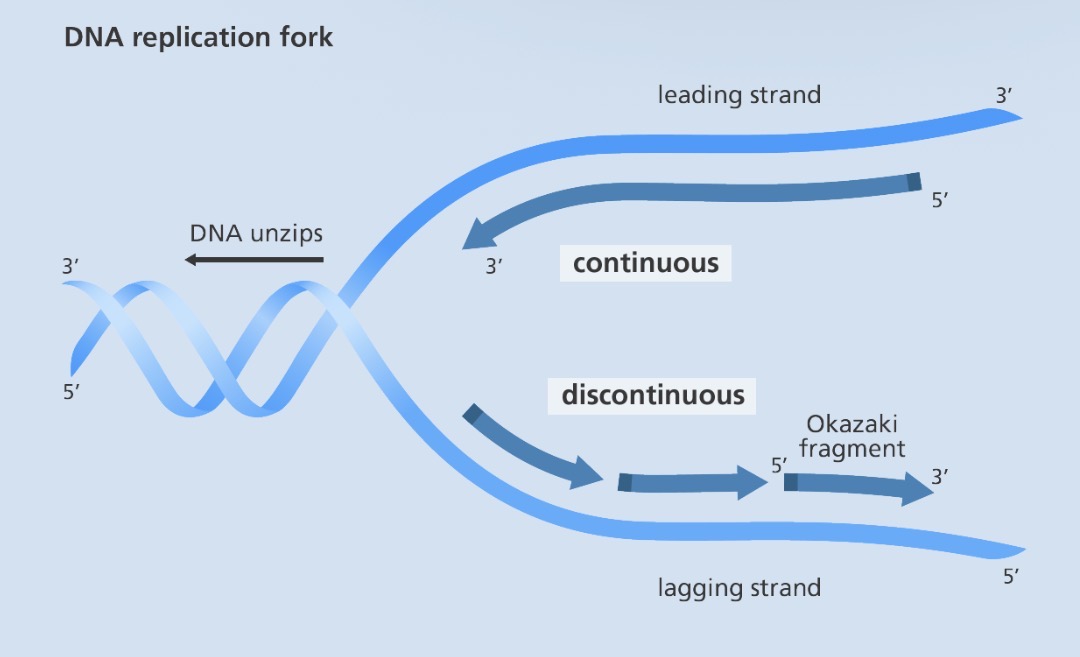
Ligase
Joins Okazaki fragments by forming covalent bonds where the primers are
What enzyme checks for errors in DNA replication (proofreading)
Polymerase III
What end of the new strand are nucleotides added to?
3’
Primase
Adds RNA primers to allow polymerase III to start adding nucleotides
Polymerase I
Removes the RNA primers
DNA gyrase
relives stress in DNA molecule by adding supercoils as it is being unwound