Probability for Engineers Final
 Call Kai
 Learn
Learn Practice Test
 Spaced Repetition
 Match
Match Flashcards
 Knowt Play
1/68

There's no tags or description
Looks like no tags are added yet.
Name | Mastery | Learn | Test | Matching | Spaced | Call with Kai |
|---|
No analytics yet
Send a link to your students to track their progress
69 Terms
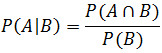
Conditional Probability Formula: P(A|B)
Disjoint
A and B = empty set
Bayes Rule: P(A∣B)
P(A∣B)=P(B)P(B∣A)⋅P(A)
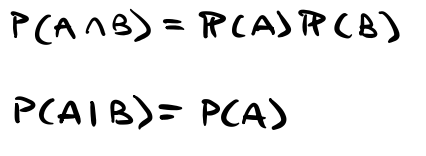
Independence
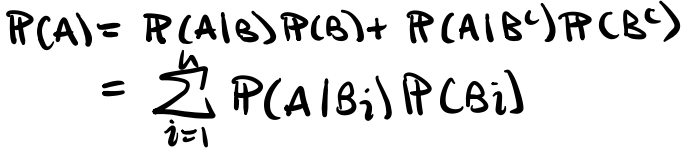
Law of Total Probability
Pairwise Independence

Jointly Independent

How many ways to assign k states to each n things?
With replacement, order
kn
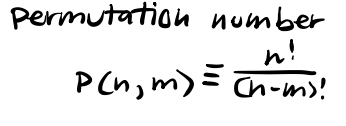
How many ways to list m distinct things out of n?
W/o replacement, ordered
How many ways to fill a bag with m items out of n items?
W/o replacement, unordered
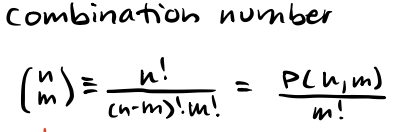
Discrete Random Variable
Finite or countably infinite set of values
Probability Mass Function (PMF) of discrete random var X

Bernoulli: X~Bernoulli(p)
single binary experiment with two possible outcomes: "success" (1) with probability or "failure" (0) with probability
E[X]=p
Var(x)=p(1-p)
![<p>single binary experiment with two possible outcomes: "success" (1) with probability or "failure" (0) with probability</p><p>E[X]=p</p><p>Var(x)=p(1-p)</p>](https://assets.knowt.com/user-attachments/5fea2229-ee23-48c1-a961-80eea1316328.png)
Geometric: X~Geometric(p)
Parameter: 0 < p < 1 success probability
Models: # of independent trials until 1st success
E[X] = 1/p
Var(X) = (1-p)/p²
![<p>Parameter: 0 < p < 1 success probability</p><p>Models: # of independent trials until 1st success</p><p>E[X] = 1/p</p><p>Var(X) = (1-p)/p²</p>](https://assets.knowt.com/user-attachments/4f7036be-1fb4-476d-9388-37819e832bb9.png)
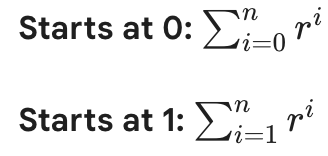
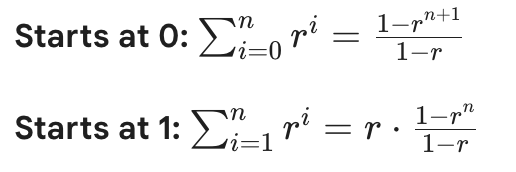
Finite Geometric Series
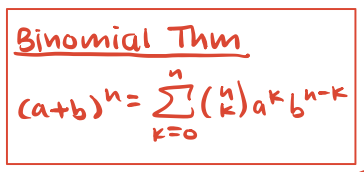
Binomial: X~Binomial(n,p)
Parameters: p = success prob (0<p<1), n = # trials to be performed
Models: # success from n independent trials, w/ each trial success prob p
E[X] = np
Var(X) = np(1-p)
![<p>Parameters: p = success prob (0<p<1), n = # trials to be performed</p><p>Models: # success from n independent trials, w/ each trial success prob p</p><p>E[X] = np</p><p>Var(X) = np(1-p)</p>](https://assets.knowt.com/user-attachments/54d81722-67dc-4dfe-9a16-563c7475be2e.png)
Binomial Theorem
Poisson: X~Poiss(lambda)
Parameter: lambda > 0 (rate parameter)
Models: (A) # arrivals within some unit of time, (B) “Rare events”
E[X] = lambda
Var(X) = lambda
![<p>Parameter: lambda > 0 (rate parameter)</p><p>Models: (A) # arrivals within some unit of time, (B) “Rare events”</p><p>E[X] = lambda</p><p>Var(X) = lambda</p>](https://assets.knowt.com/user-attachments/a411afcf-9926-432e-89b6-8750eef1fe6e.png)
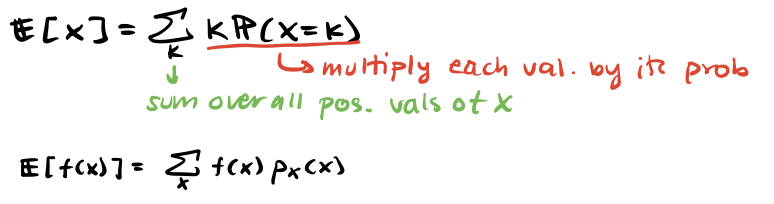
Expected Value: E[X] and E[f(x)]
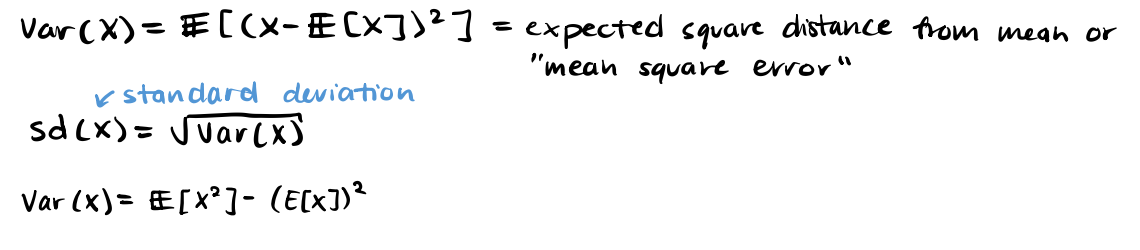
Variance, standard deviation
Marginal PMF (discrete)

E[f(X,Y)] - Discrete

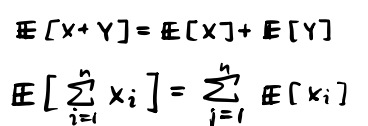
Linearity of Expectations (Discrete)
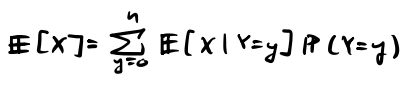
Law of Total Expectation
Independence for X, Y
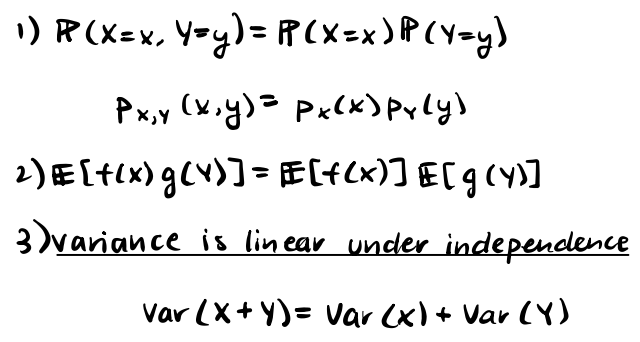
Covariance: Cov(X,Y)
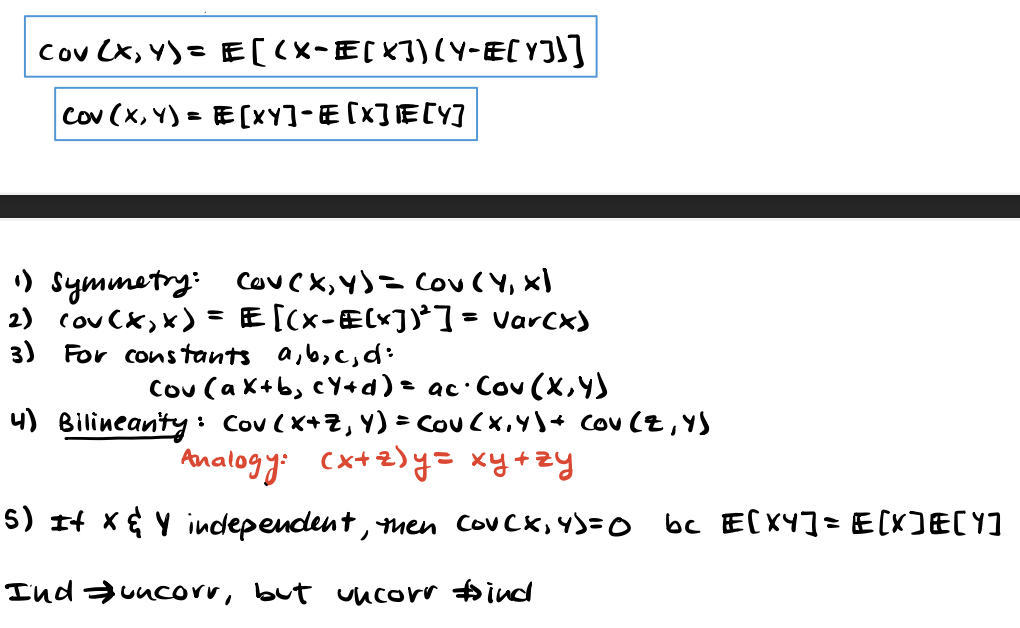
Correlation: Corr(X,Y)

Continuous Random Variables

Defining Properties of PDF

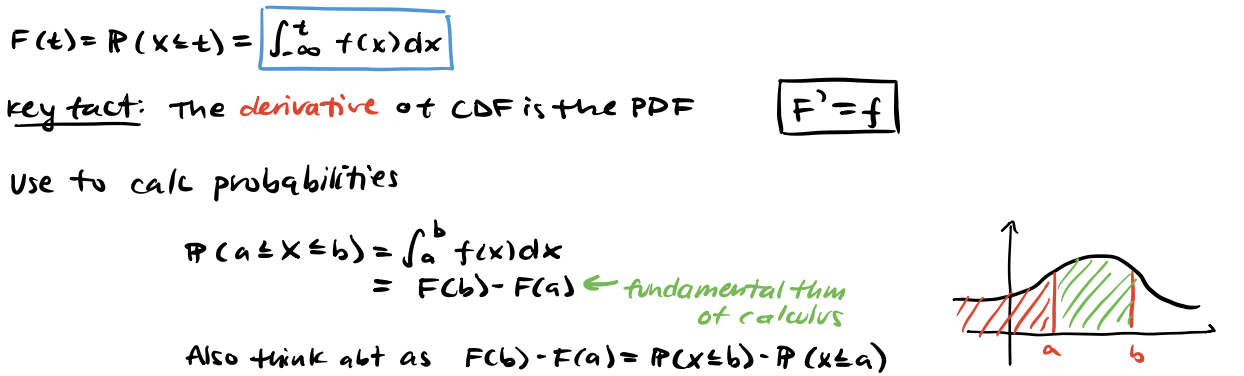
Cumulative Distribution Function (CDF)
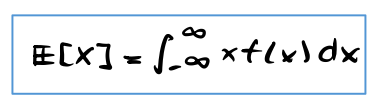
Expected Value of Continuous RV
Uniform: X~Unif[a,b]
E[X] = (a+b)/2
Var(X) = (b-a)²/12
![<p>E[X] = (a+b)/2</p><p>Var(X) = (b-a)²/12</p>](https://assets.knowt.com/user-attachments/ebd70d94-e99a-4e06-8b62-a2f7dae3dc24.png)
Exponential: X~Exp(lambda)
Parameter: lambda > 0 (rate)
Models: Waiting times; (1) How long wait until next train (2) lambda = # arrivals per unit time on average
(vs. Poisson counts how many arrivals in one unit time)
E[X] = 1/(lambda)
Var(X) = 1/(lambda²)
![<p>Parameter: lambda > 0 (rate)</p><p>Models: Waiting times; (1) How long wait until next train (2) lambda = # arrivals per unit time on average</p><p>(vs. Poisson counts how many arrivals in one unit time)</p><p>E[X] = 1/(lambda)</p><p>Var(X) = 1/(lambda²)</p>](https://assets.knowt.com/user-attachments/4fb6d540-5c91-4714-91b4-5b9f96a46fd7.png)
Transformations of RVs
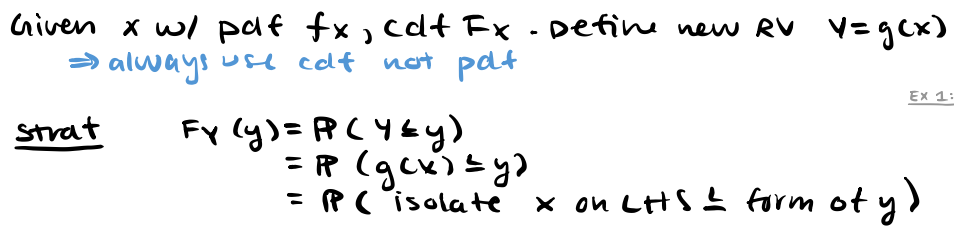
Normal Distribution: X~N(mu, sigma2)
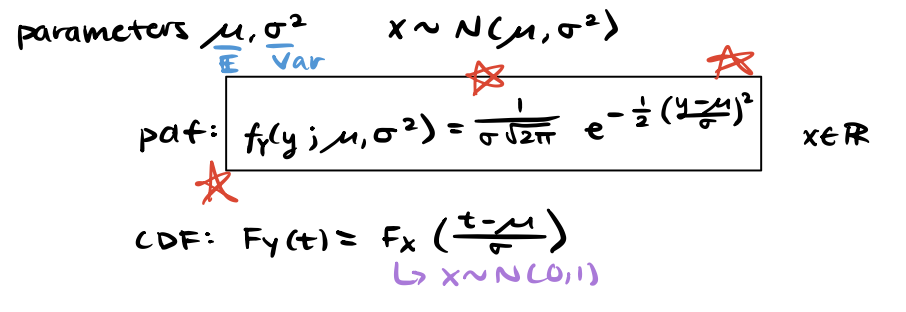
Standard Normal Distribution

Continuous joint distributions

Continuous joint distributions properties & expected value
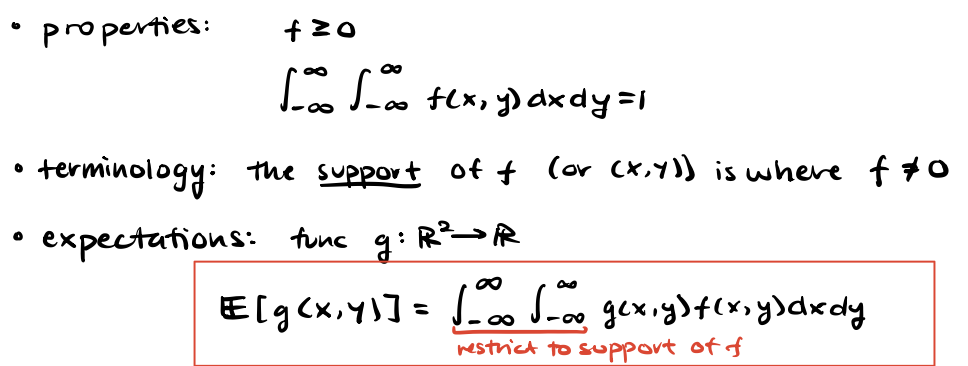
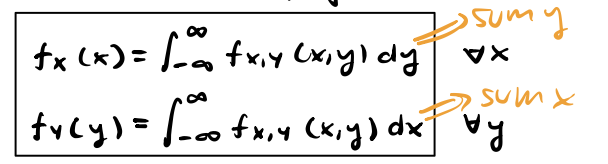
Marginal PDFs of Joint PDF
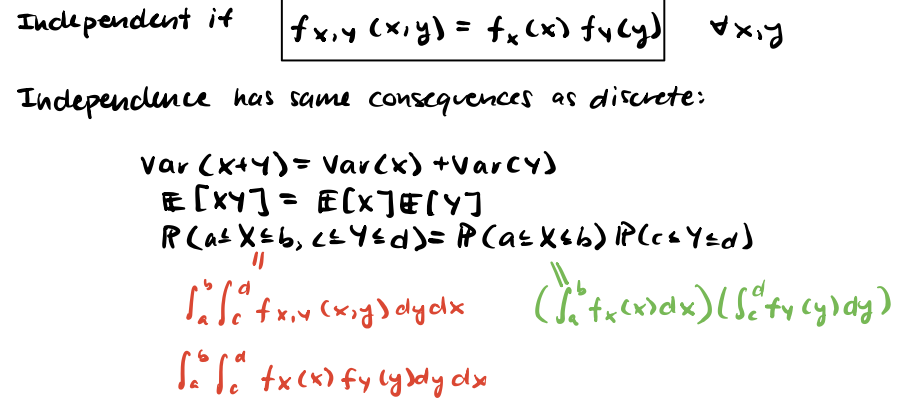
Independence of joint PDF (continuous)
Conditional PDF of X given Y
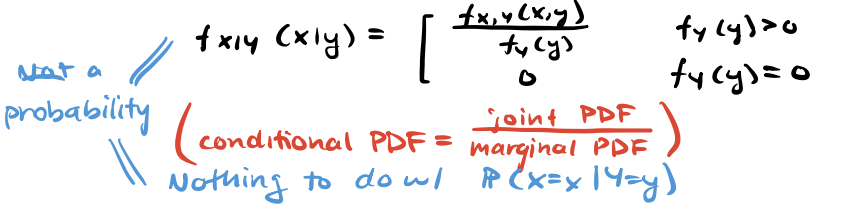


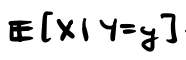
(Continuous)

Law of total expectation with conditional PDF (continuous)

Tower Property (Law of Iterated Expectations)

Law of Total Variance (Conditional)
Consequence: Var(X) >= Var(E[X|Y]) always
Variance decreases after observing Y
![<p>Consequence: Var(X) >= Var(E[X|Y]) always</p><p>Variance decreases after observing Y</p>](https://assets.knowt.com/user-attachments/c6137ac9-e1de-41ad-be70-ef894b20a7c0.png)
X~Binomial(n,p):
E[X], E[X|Y=y], E[X|Y]
= np
= yp
= Yp
X~Binomial(n,p):
Var(Y), Var(X|Y=y), Var(X|Y)
= Var(Y)
= y*p*(1-p)
= Y*p*(1-p)
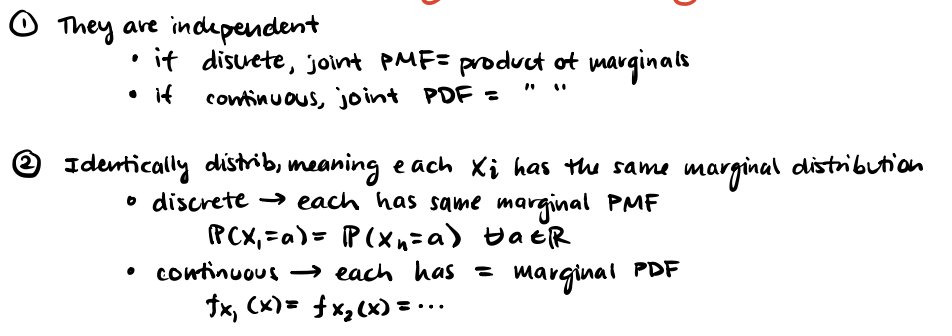
IID Random Vars (Independent & Identically Distributed)
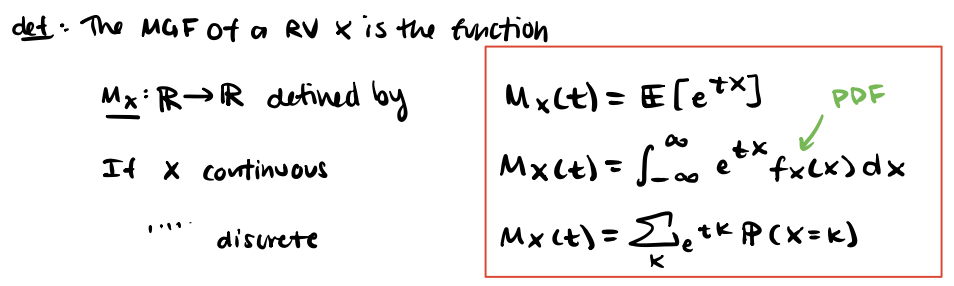
Moment Generating Functions (MGF)
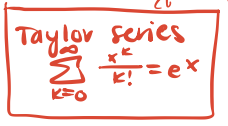
Taylor Series for ex
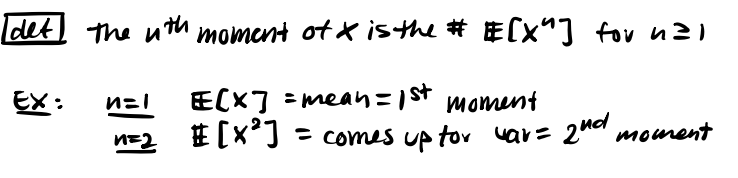
nth moment of X
(dMx/dt)(0), (d²Mx/dt²)(0), …, (dnMx/dtn)(0)
E[X], E[X²], …, E[Xn]
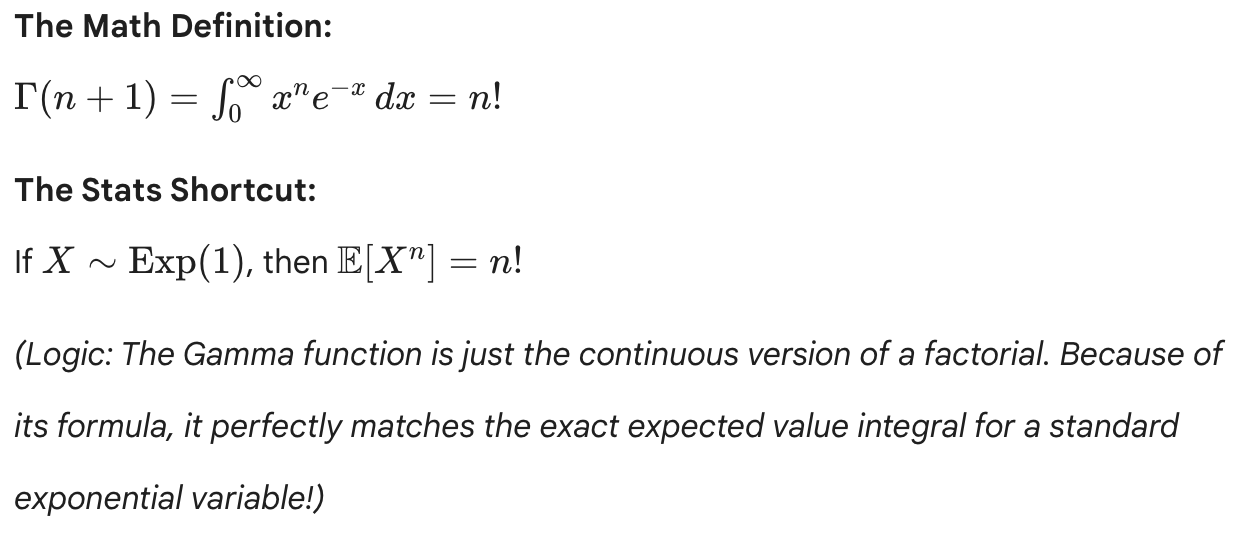
Gamma function: generalizes factorial to non-integer values
MGF of Normal Distribution N(mu, sigma²)
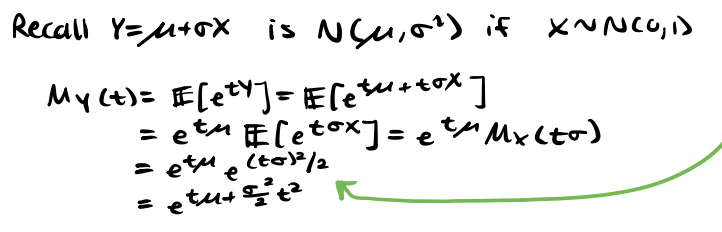
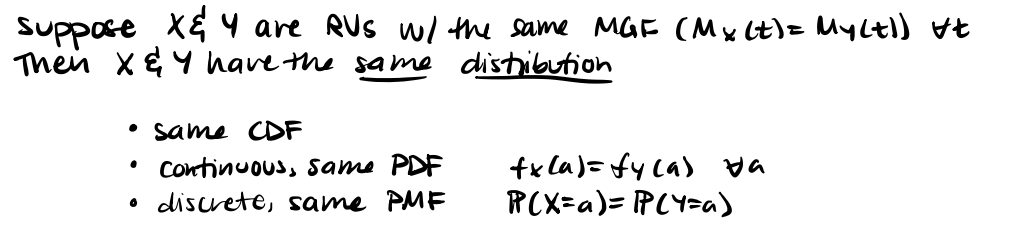
MGF: Inversion Theorem
Identify distributions from MGF form
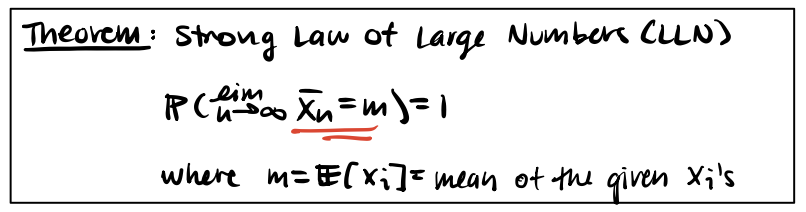
Sample Average of n of our RVs

Strong Law of Large Numbers (LLN)
Weak Law of Large Numbers
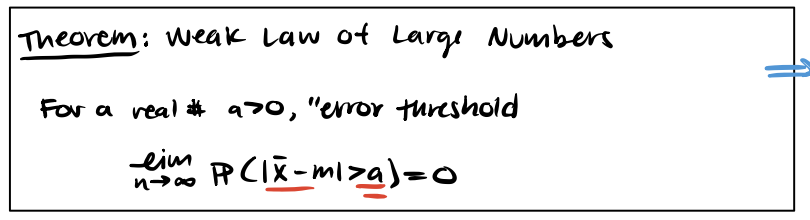
Error Probability

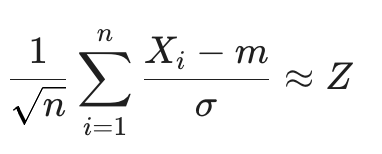
Central Limit Theorem (CLT)
Solve for m, sigma depending on the distribution. Plug into formula accordingly.
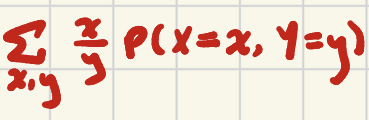
E[X/Y] - Discrete, Dependent
If independent, is it correlated?
If independent, it is uncorrelated BUT if uncorrelated, not necessarily independent.
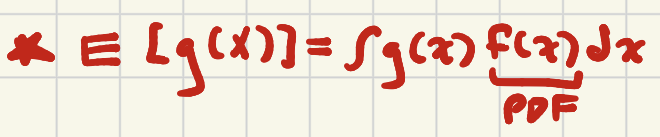
Continuous: E[g(X)]
Bounds: -inf, to inf


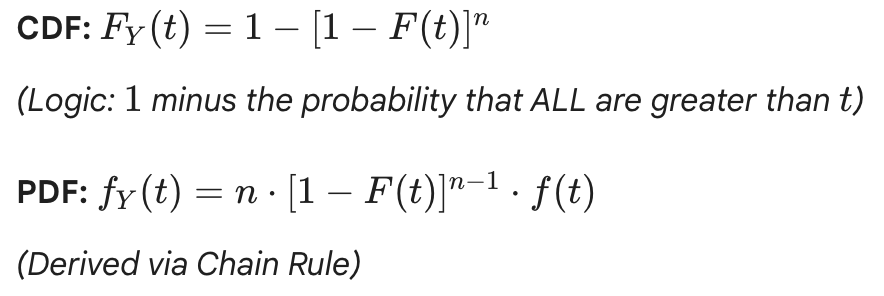
MGF of N(0,1)
Mx=et²/2
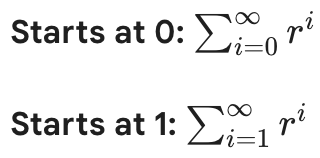
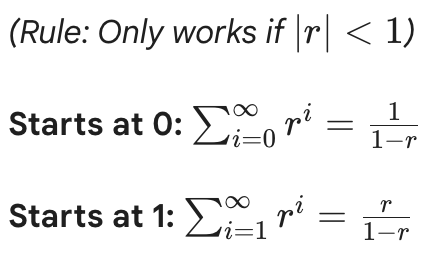
Infinite Geometric Series
Var(X+Y)
Var(X) + 2Cov(X,Y) + Var(Y)