Physics M4C12 Waves 2
 Call Kai
 Learn
Learn Practice Test
 Spaced Repetition
 Match
Match Flashcards
 Knowt Play
1/15

There's no tags or description
Looks like no tags are added yet.
Name | Mastery | Learn | Test | Matching | Spaced | Call with Kai |
|---|
No analytics yet
Send a link to your students to track their progress
16 Terms
State the principle of superposition
When two waves meet at a point, the resultant displacement at that point is equal to the vector sum of the displacements of the individual waves
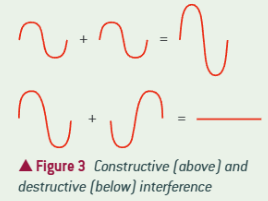
What is constructive interferernce?
What is destructive interference?
When two waves in phase superpose, resultant displacement with increased amplitude (‘maxima’)
When two waves 180* out of phase (in antiphase) superpose, resultant displacement with decreased amplitude (‘minima’)
NB: Fully destructive int. only happens at exactly 180* out of phase, not just any ‘out of phase’ waves
What happens to intensity when:
Constructive interference?
Destructive interference?
Constructive: intensity proportional to amplitude2, Intensity increases (quadruples when fully constructive)
Sounds get louder, light is brighter
Destructive: intensity proportional to amplitude2, Intensity decreases
Sounds get quieter, light is dimmer
If two waves with same amplitude destructively interfere, displacement is 0 and intensity is 0
Define coherence
Frequency of coherent waves?
Waves are coherent if they have a constant/fixed phase difference
Therefore they will have the same frequency
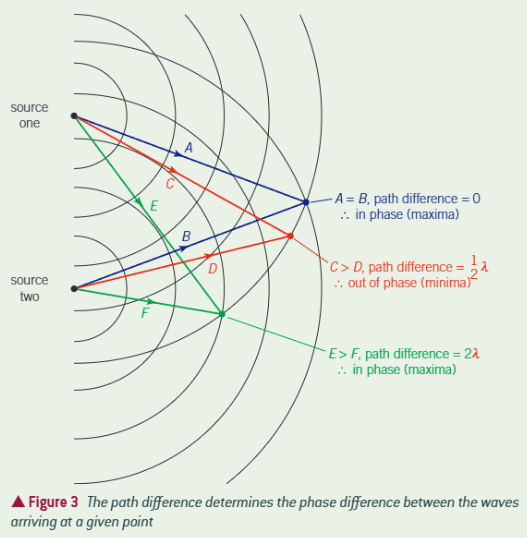
Define path difference
Will waves arrive in phase or out of phase?
Difference in distance travelled by two waves in terms of wavelength
If n(lambda), will arrive in phase, constructive int., maximum amplitude
If half wavelengths , will arrive out of phase,d estructive int., minimum ampltiude
Young’s double slit equation?
Requirements?
How to measure fringe spacing accurately?
x = (lambda)D / a
Coherent, monochromatic - achieved using a colour filter
Measure distacne between 10 fringes, divide by 9
Energy in stationary waves vs progressive waves?
Amplitude in stationary waves vs progressive waves?
How are they formed?
Requirements?
Do not transfer energy along direction of travel
Amplitude is constant across all points in progressive waves, amplitude varies across a stationary wave
When two progressive waves with same frequency and similar amplitude travel in opposite directions along the direction of travel
Opposite direction, same (lambda) and frequency, similar amplitude
What are nodes?
What are antinodes?
Areas on stationary wave of destructive interference, where displacement is 0
Areas on stationary wave of constructive interference, where amplitude is at its maximum
Phase differences along stationary wave
In between adjacent nodes, all points are in phase (p.d. of 2π)
All reach max their displacement at the same time
However max amplitude is still at the antinode
If odd number of nodes between them, they are in antiphase (p.d. of π)
Wavelength in a stationary wave
Distance between adjacent nodes is half the wavelength of the progressive waves that form the stationary wave
What are harmonics?
What is fundamental frequency?
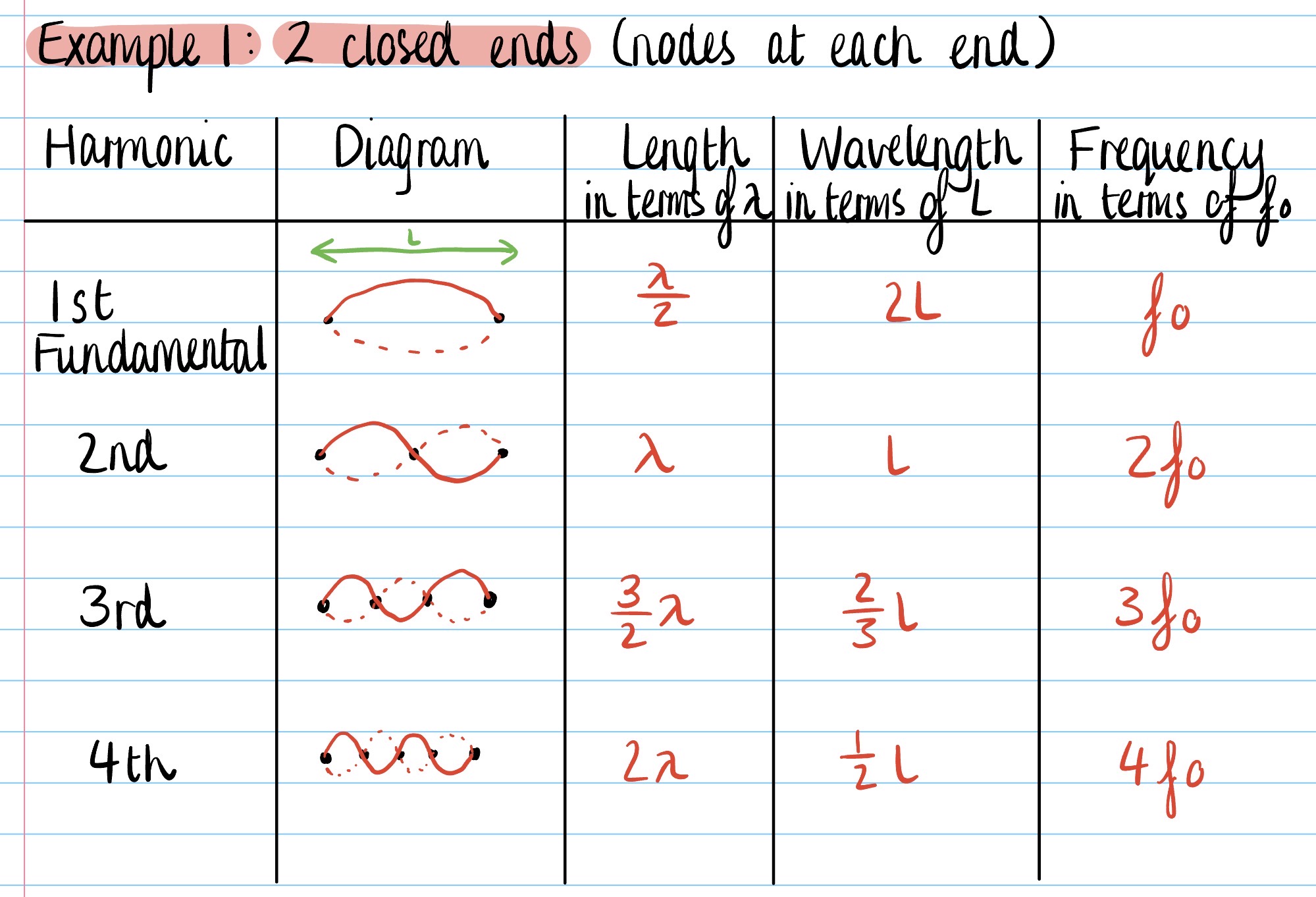
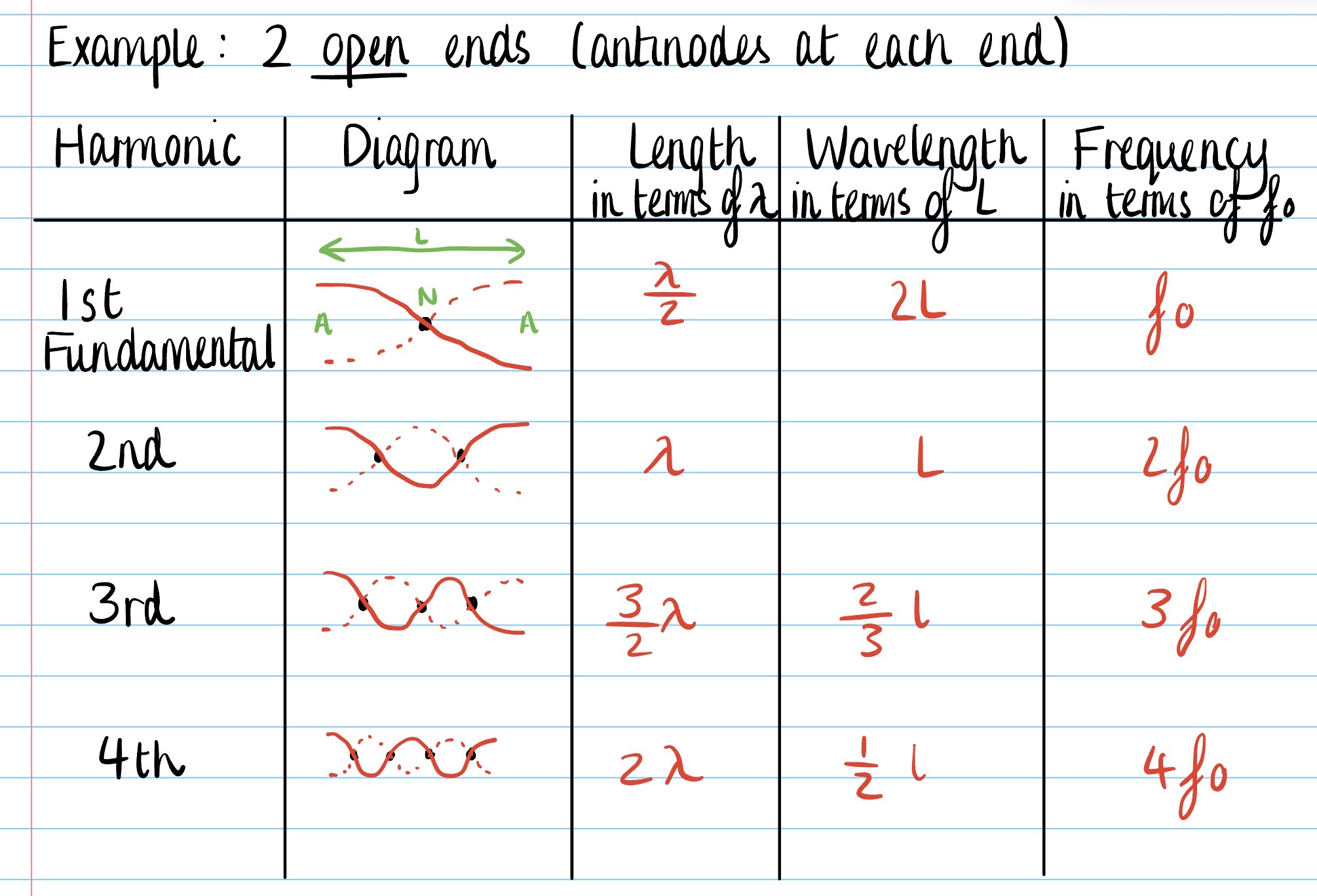
Specific frequencies of waves that create stationary waves
Minimum frequencies a statioanry wave can exist at
Harmonics with 2 nodes?
Harmonics with 2 antinodes?
Harmonics with 1 node and an anti node?
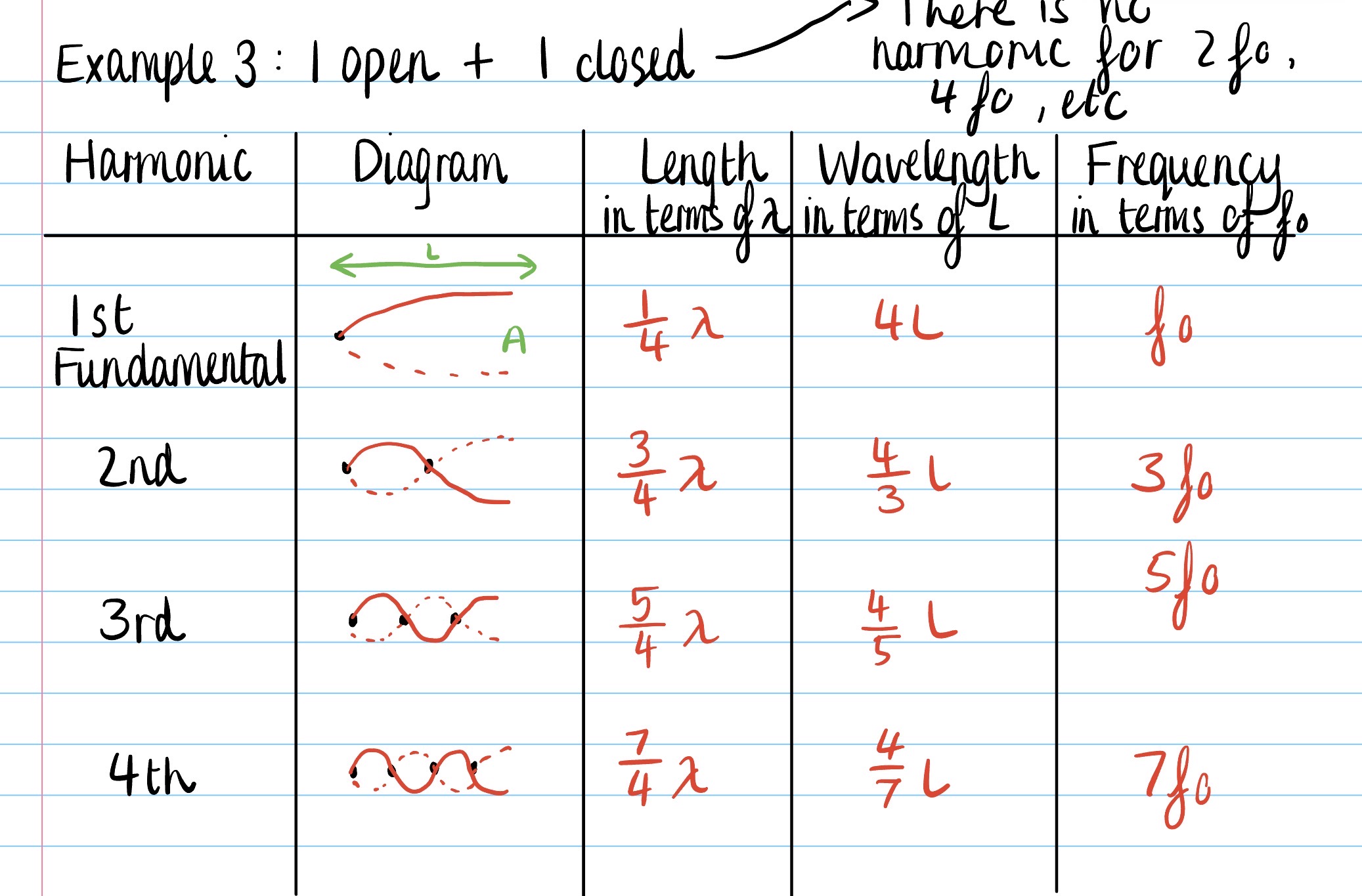
Where can stationary waves form in air column?
In a tube with a node and antinode at each end - Only at odd number multples of fundamental frequency
In a tube with 2 antinodes at both ends - All integer multiples of fundamental frequency
NOT a tube 2 nodes at both ends
Because antinode would be inside the tube