Quiz 10 chapter 41
 Call Kai
 Learn
Learn Practice Test
 Spaced Repetition
 Match
Match Flashcards
 Knowt Play
1/19

There's no tags or description
Looks like no tags are added yet.
Name | Mastery | Learn | Test | Matching | Spaced | Call with Kai |
|---|
No analytics yet
Send a link to your students to track their progress
20 Terms
lacteal vessels |
hepatic portal artery |
hepatic portal vein |
lymphatic system |
Nutrient-rich blood from the intestine is carried through the ________ to the liver.
Question 1 options:
hepatic portal vein: This unique vein carries nutrient-rich (but potentially toxin-laden) blood directly from the GI tract (mouth, pharynx, esophagus, stomach, small intestine (duodenum, jejunum, ileum), large intestine (colon), rectum, and anus) to the liver for processing before it reaches the heart.
The mammalian trachea and esophagus both connect at the
Question 2 options:
pharynx. | |
stomach. | |
large intestine. | |
rectum. |
pharynx: The pharynx is the common passageway for both air (heading to the trachea) and food (heading to the esophagus).
Ticks are parasites that obtain nutrients by ingesting blood from a host animal. Ticks would be classified as ________.
Question 3 options:
filter feeders | |
substrate feeders | |
fluid feeders | |
bulk feeders |
fluid feeders
Stomach cells are moderately well adapted to the acidity and protein-digesting activities in the stomach by having ________.
Question 4 options:
a sufficient colony of H. pylori | |
a thick, mucous secretion and active mitosis of epithelial cells | |
a high level of secretion of enzymes by chief cells | |
a cell wall impermeable to acid |
A thick, mucous secretion and active mitosis of epithelial cells: The mucus protects the lining from $HCl$, and rapid cell division ensures the lining is constantly "refreshed" after being damaged by the harsh environment
The absorption of fats differs from that of carbohydrates in that ________.
Question 5 options:
fat absorption primarily occurs in the stomach, whereas carbohydrates are absorbed from the small intestine | |
carbohydrates need to be emulsified before they can be digested, whereas fats do not | |
most absorbed fat first enters the lymphatic system, whereas carbohydrates directly enter the blood | |
fats, but not carbohydrates, are digested by bacteria before absorption |
most absorbed fat first enters the lymphatic system, whereas carbohydrates directly enter the blood: While sugars and amino acids enter the blood, fats are packaged into chylomicrons and enter lacteals (lymphatic capillaries).most absorbed fat first enters the lymphatic system, whereas carbohydrates directly enter the blood: |
The function of chylomicrons is to ________.
Question 6 options:
digest nucleic acids in the intestine | |
break down carbohydrates in the mouth | |
transport lipids from the intestine to other organs | |
move proteins across plasma membranes of cells |
transport lipids from the intestine to other organs: Chylomicrons are water-soluble globules that allow hydrophobic fats to travel through the aqueous environment of the lymph and blood.
The large surface area in the gut directly facilitates ________.
Question 7 options:
secretion | |
absorption | |
filtration | |
temperature regulation |
absorption: Structures like villi and microvilli (Villi and microvilli are primarily located in the small intestine (duodenum, jejunum, and ileum), increase surface area to maximize the rate at which nutrients can be moved into the body.
insulin; glucagon |
glucagon; protein |
glucagon; glucose |
insulin; glucose |
In a healthy person, after a carbohydrate-rich meal, the production of ________ will increase, causing the uptake of ________ from the blood into liver cells.
Question 8 options:
insulin; glucose: High blood sugar triggers the pancreas to release insulin, which tells the liver and muscles to take up glucose and store it as glycogen.
Why do the cells of the digestive system secrete proteolytic enzymes, such as pepsin, in their inactive forms?
These proteolytic enzymes, in active form, would digest the very tissues that synthesize them.
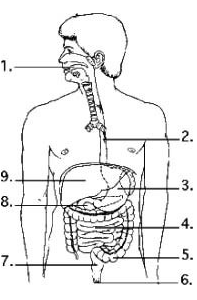
Examine the digestive system structures in the figure.
A. The agents that help emulsify fats are produced in location ________.
B. The highest rate of nutrient absorption occurs at location ________.
C. Most of the digestion of fats occurs in structure
D. Bacteria that produce vitamins are found in the greatest concentration in location ________.
A. The agents that help emulsify fats are produced in location 9. Location 9 is the liver, which produces bile. Bile acts as a detergent to emulsify large fat globules into smaller droplets, increasing the surface area for enzymes to work.
B. The highest rate of nutrient absorption occurs at location 4. Location 4 is the small intestine. Due to its immense surface area (provided by villi and microvilli), it is the primary site for absorbing broken-down nutrients into the bloodstream and lymphatic system.
C. Most of the digestion of fats occurs in structure 4. While the liver (9) and pancreas (8) provide the necessary "tools" (bile and lipase), the actual chemical breakdown and absorption of fats take place within the lumen of the small intestine (4).
D. Bacteria that produce vitamins are found in the greatest concentration in location 5. Location 5 is the large intestine (colon). It houses a massive microbiome of symbiotic bacteria that ferment undigested materials and synthesize essential vitamins, such as Vitamin K and certain B vitamins.
Structure Key for Reference:
Oral Cavity
Esophagus
Stomach
Small Intestine
Large Intestine
Anus
Rectum
Pancreas
Liver
In a hydra, digestion is completed ________.
intracellularly
When used appropriately, antibiotic treatment can effectively reduce bacteria populations and help fight infections. However, antibiotic treatments can have unintended effects. What is one concern when using antibiotics?
Antibiotics may also kill the beneficial bacteria...Antibiotics are often not "target-specific" and can wipe out the gut microbiome, leading to digestive issues or secondary infections like C. diff.
The process by which digested dietary substances cross cell membranes to be used by the body is known as ________.
absorption: This is the specific stage of food processing where small molecules enter the body's cells; it follows ingestion and digestion.
A relatively long cecum is characteristic of animals that are ________.
herbivores: The cecum is a fermentation chamber. Animals that eat high-cellulose diets (like rabbits or horses) require a larger cecum to house symbiotic bacteria.
Over-the-counter medications for acid reflux or heartburn block the production of stomach acid. Which of the following cells are directly affected by this medication?
parietal cells: Parietal cells use "proton pumps" to secrete $H^+$ and $Cl^-$ ions into the stomach lumen. Acid reflux meds (like PPIs) target these specific pumps.
Cattle are able to survive on a diet consisting almost entirely of plant material because cattle ________.
Mammals lack the enzyme cellulase. Ruminants (cattle) rely on microbes in the rumen to break down the tough cell walls of plants:
have cellulose-digesting, symbiotic microorganisms in chambers of their stomachs |
In the digestive system, peristalsis is ________.
smooth muscle contractions that move food along the esophagus: Peristalsis is the rhythmic, involuntary wave of contraction that pushes a bolus through the entire alimentary canal.
After surgical removal of an infected gallbladder, a person must be especially careful to restrict dietary intake of ________.
fat: The gallbladder stores and concentrates bile. Without it, the body cannot release a large "bolus" of bile to emulsify a high-fat meal.
Pepsinogen is converted to its active form in the stomach by ________.
HCl: Hydrochloric acid provides the low pH necessary to clip a small piece off the inactive pepsinogen molecule, unfolding it into the active enzyme pepsin.
Feelings of hunger can be stimulated by the hormone ________, but suppressed by the hormone ________.
ghrelin; PYY : Ghrelin: is secreted by the stomach wall to signal hunger; PYY (from the small intestine) and Leptin (from fat tissue) signal satiety (fullness).