Hydrological hazards (Droughts)
 Call Kai
 Learn
Learn Practice Test
 Spaced Repetition
 Match
Match Flashcards
 Knowt Play
1/53

There's no tags or description
Looks like no tags are added yet.
Name | Mastery | Learn | Test | Matching | Spaced | Call with Kai | Chat |
|---|
No analytics yet
Send a link to your students to track their progress
54 Terms
Unique characteristic of drought in NZ
Usually short lived
Definition of drought
Drier than normal conditions
Are all arid areas in drought
No, an area can be arid, and not be in drought, it is the deviation from average conditions that makes a drought
How do droughts impact LDCs
leads to famine which can lead to death and huge economic loss
How do droughts impact MDCs
Droughts don’t kill people but cause significant economic and agricultural losses
The severity of drought impacts depends on
The nation’s wealth
Multifactorial elements of drought
climate, politics, conflict, energy. Causes and consequences of drought are difficult to isolate and understand
How should drought be viewed
Should be seen as a process not an event (slow onset)
What areas can experience drought
All areas, it’s all relative and about the access to usable water
Why is it difficult to predict droughts
Variability in rainfall patterns (year to year), changes in trends (longer term wetter or drier)
Meteorological drought
Based on rainfall shortfall, does not directly equate to plant stress or a decrease in water resources, depends on region
Minimum duration of rain-free period before considered drought in Bali
6 days
Minimum duration of rain-free period before considered drought in Southern Canada
30 days
Minimum duration of rain-free period before considered drought in Lybia
2 years
Hydrological drought
Low stream flow or ground water levels, brought about when the water reserves available in sources like aquifers, lakes, and reservoirs fall below average levels, occurs slowly
Steps in a drought cycle and how meteorological drought causes hydrological drought
1) Meteorological drought
Prolonged period of poor precipitation
2) Propagation
reduced soil moisture, reduction in ground water, reduction in discharge
3) Hydrological drought
sustained low groundwater, low soil moisture, low discharge
4) Meteorological drought breaks
precipitation improves, improved surface water availability
5) Lag time
time delay between meteorological drought ending and hydrological drought ending
6) Hydrological drought ends
Ground water and soil moisture levels return to normal
Where is the Aral Sea
Central Asia, Kazakhstan, Uzbekistan
What happened with he Aral Sea
Significant river diversions for irrigation (particularly the Amu Dar’ya and Syr Dar’ya rivers, up to 90% in 1960s), water was used for Soviet era central planning and cotton cropping, only 12% of the canals were sealed (incurred high loss of water) causing sea to shrink and salinity to increase
What was the size of the Aral sea by 2007
10% of its original size
How much did salinity increase in the Aral Sea due to diversions
from 10 g/l to 100 g/l (seawater is 35 g/l), caused fishery collapse
What happened to the Aral Sea between 1989 and 1990
It split into two parts (the large and small areas)
What happened to the environment in the Aral Sea
Aquatic ecosystem largely destroyed, environmental toxicity of the exposed lakebed, land was used for weapons testing, industrial projects, was subject to pesticides and fertilizer runoff
What were the social impacts of what happened to the Aral Sea
deflation of salt and sand lead to pasture destruction, unemployment and population exodus, affected the health of 5 million people (spikes in anemia, asthma and typhoid), life expectancy dropped from 64 to 51, 100,000 people displaced
What organization is trying to save the Aral Sea
International Fund for Saving the Aral Sea (IFAS) established by heads of central Asian states (Kazakhstan, Uzbekistan, Turkmenistan, Tajikistan, Kyrgyz)
When was IFAS established
1993
Definition of famine
Famine is a situation in which a substantial proportion of the population of a country or region are unable to access adequate food, resulting in widespread acute malnutrition and loss of life by starvation and disease
How meteorological drought leads to famine
Rainfall deficit → streamflow/groundwater deficit → soil moisture deficit → Food deficit
Milankovitch cycles
Describe the collective effects of changes in the Earth’s movements on its climate over thousands of years. Earth’s orbit around the sun varies between nearly circular and mildly elliptical due to gravitational forces from other bodies. Elliptical orbits cause more variability in the amount of solar radiation. Tilt of the earth also varies slightly which changes intensity of seasons (greater tilt more extreme season)
What are physical factors that change climate and drought probability
Large scale circulation systems are inherently variable which changes climate (can experience variability on short and long scales), Milankovitch cycles,
El Nino Southern Oscillation
The cycle of El Nino and La Nina in the central and eastern tropical pacific, loosely operates over timescales of 1-8 years
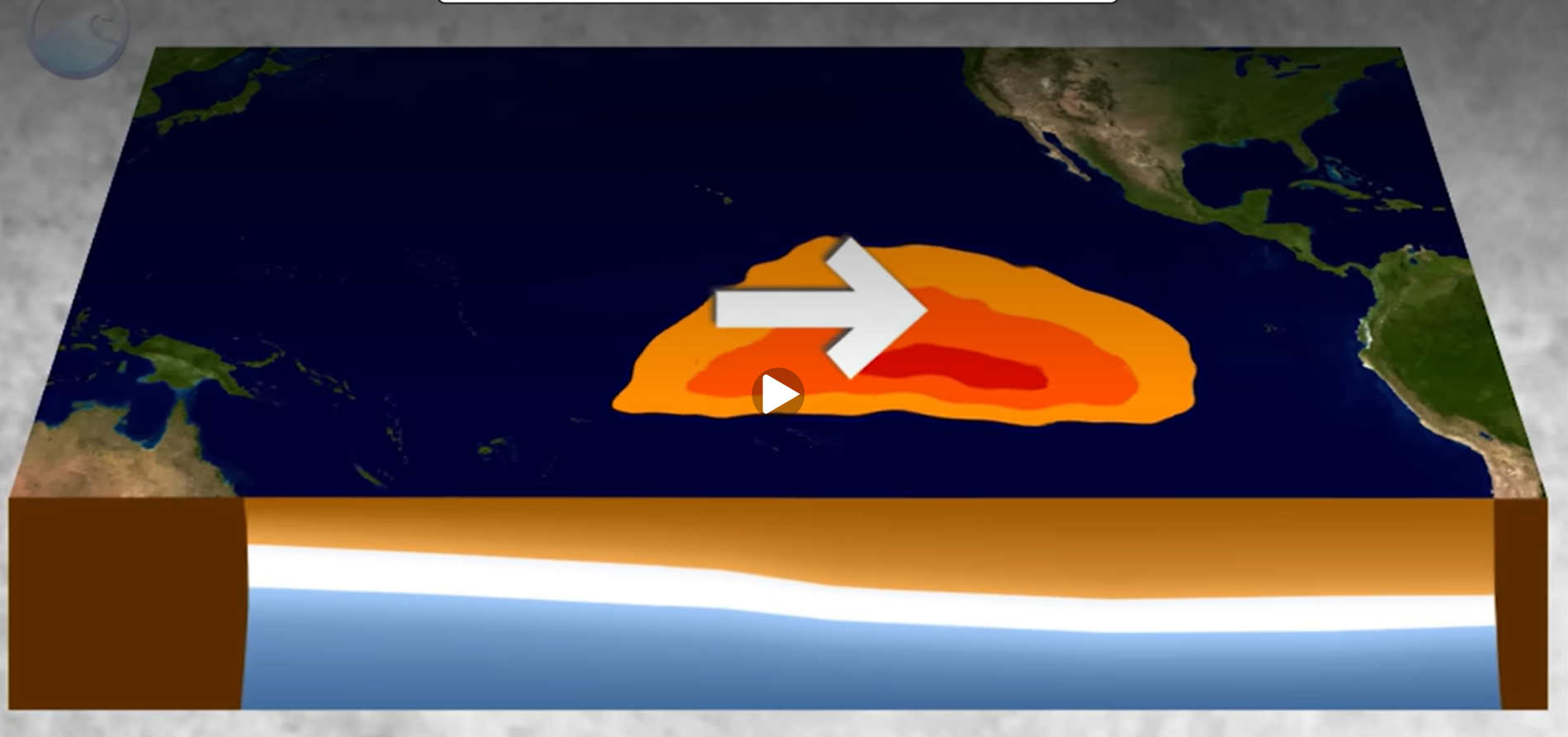
El nino
Warm conditions in the tropical pacific (west coast of north and south America) due to weak trade winds letting warm ocean water travel back to that area. Can cause storms and flooding in southern US and sunny dry conditions in Northern US
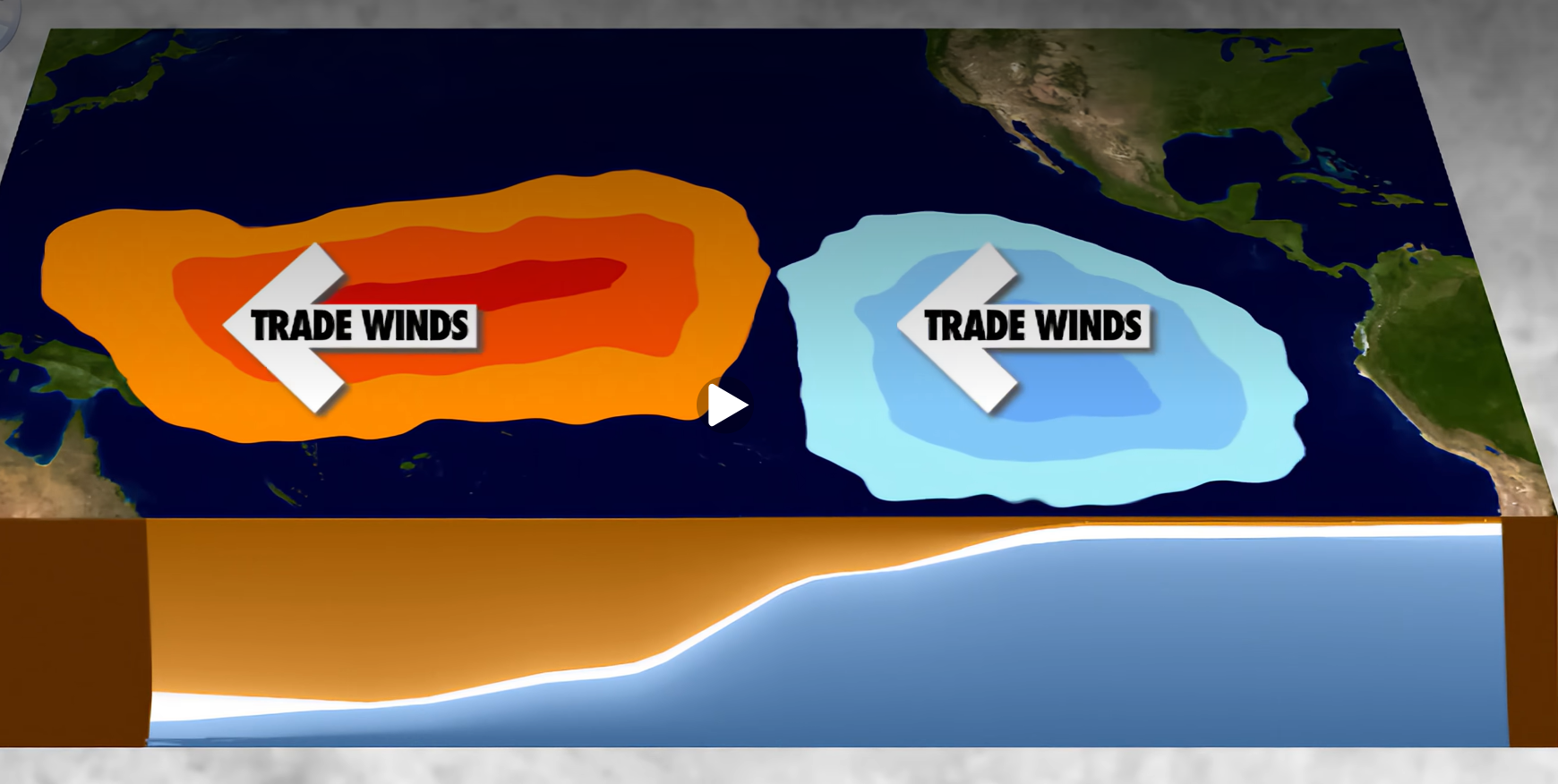
La nina
Strong trade winds blow warm water west toward Indonesia and Australia allowing cold water to upwell along the west coast of north and south America (eastern pacific), can lead to drought in southern US, and cooler temps, heavy rain, and flooding in north western US
Effects of El Nino in Australia
Low rainfall
Effects of La Nina in Australia
High rainfall
Effects of El Nino in NZ
Summer more westerly, drier east coast
Effects of La Nina in NZ
Summer more NE, wetter east coast
What is the Southern Annular Mode (SAM)
Is a ring of climate variability that encircles the South Pole and extends over New Zealand, involves alternating windiness and storm activity. Has two phases (positive and negative)
Positive SAM
Associated with higher than normal air pressure in New Zealand, brings light winds and tranquil weather conditions, windiness and storm activity is increased over Southern Ocean and Antarctica
Negative SAM
Usually results in lower than normal air pressure around New Zealand and higher pressure well to the south of the country. Cause cooler and wetter conditions in the west of both islands
Human causes of drought
Deforestation, overgrazing, improper water use management, urbanization, high poverty makes areas more susceptible because they don’t have the option to make sustainable descisions
Technological responses to drought
Rainfall seeding (not viable for high populations), groundwater (difficult to manage sustainably), Dams, Shifting water through pipelines and aqueducts (more common in MDCs), Desalinization (expensive and energy intense)
Characteristics of All American Canal
Irrigates 250,000 ha of land, has 8 hydro plants, resulted in 500 deaths
Community-based drought responses and adaptations
Agricultural diversification, increase/decrease livestock in sync, debt for farmers to get through, crop improvement
Predicting and forecasting droughts
Important to understand meteorology and climatology (closely related to drought, some intergovernmental agencies responsible for predicting and forecasting, Importance of early warning and mitigation
Example of an agency that assists with drought
Global Information and Early Warning Systems (GIEWS) — Food and Agriculture organization (FAO) since 1975 improving food security in 22 drought-prone African nations
Sustainable drought practices to deal with droughts
Lower stocking rates, soil conservation measures (cover crops, no till), less intensive land use, use of ponds (artificial recharge or aquifers)
Impact of climate change on drought
The impacts like the Milankovich cycle are predictable but climate change is causing deviations from this cycle. Temperatures are rising and the hydrological cycle is becoming more volatile
Climate change impacts on irrigation and food production
Some regions will be able to produce more food, some will be able to produce similar or more by increasing irrigation, some regions will produce less food, increased conflict over water resources, higher likelihood of agricultural drought and hydrological drought
Hydropower makes up what percent of NZ’s power grid
60%
What is the Waitaki scheme
Is a hydropower scheme consisting of eight power stations along the Waitaki river. Generates enough energy to power about 832,000 average homes annually
What plays an important role in the Waitaki scheme
Spring snowmelt recharges reservoir levels which maintains river levels and energy output
What is New Zealand energy production vulnerable to
Short term variability in precipitation and hydrological drought
Impacts of climate change on climate system and drought
Increased variability in the climate system, potential increased in frequency, intensity, and duration of drought conditions due to changes in thermo-dynamic forcings and land atmosphere feedbacks, reduced precipitation in some regions, increased precipitation deficits due to increase in evaporation in others, weakening of the water cycle, initiation of negative feedback loops that reinforce drought conditions, increases in global land area affected by meteorological drought from 10% in 1990 to 30% in 2025
Where do most famine droughts occur
Africa