W10: Language
 Call Kai
 Learn
Learn Practice Test
 Spaced Repetition
 Match
Match Flashcards
 Knowt Play
1/5

There's no tags or description
Looks like no tags are added yet.
Name | Mastery | Learn | Test | Matching | Spaced | Call with Kai |
|---|
No analytics yet
Send a link to your students to track their progress
6 Terms
Understand the concept of lateralisation and discuss hemispheric contributions to language
Lateralisation
*Idea that 2 hemispheres of the brain specialise in different functions
^certain abilities are dominant in one hemisphere
Language Lateralisation
Language is mostly lateralised
LEFT is dominant for language in 90% of population
- Words
- Grammar
- Speech
RIGHT dominant in 27% left-handed people and 15% ambidextrous but only 4% right-handed people
Role of the Right Hemisphere
*Comprehension & SPATIAL RELATIONSHIPS
Damage might affect talking about spatial relations, maps and complex geometrical forms, organising a narrative, understanding figurative aspects of language
- Prosody
- Context
- Emotion
Describe key processes involved in language comprehension
Language Comprehension
Prosody: intonation and emphasis to convey meaning
Language also includes more complex, abstract meaning like metaphors
Brain works like a dictionary
Audio and visual entries; we look up words depending on how they look and sound (Wernicke's area)
Memories associated with words are activated (via posterior language area)
Bilingualism
*Ability to use 2 languages in everyday life
Majority of people in the world are bilingual or multilingual
By 12 months infant brain learns to process sounds of language/present in the environment
Bilingual babies show stronger responses in the PFC
Potential advantages in attention, task switching inhibitory control
Localising bilingualism
Are different languages processed by different brain areas?
- Electrostimulation studies review (Guissani et al, 2007)
- Some overlapping
- Primary or secondary language specific regions
Identify main brain areas involved in language and language problems
Integrated Language Network
Laterization is not absolute
Both hemispheres work together connected by the corpus callosum
Surgical Cutting of the Corpus Callosum
Split brain surgery…
Surgical procedure used to stop seizures in severe cases of epilepsy
Corpus callosum is cut and communication is between hemispheres is disrupted
*In research it helps us understand what each side can/can't do alone
E.g. Input from the left field of view is processed by the right hemisphere and visa versa
- When they showed image in RVF- info went to left & able to name the word
- When they showed image in LVF- info went to right & unable to name but can draw it
What can split-brain studies teach us about language?
Evidence that language is lateralised, both localised and distributed
If information doesn’t reach language areas we may not be able to describe it
The left hemisphere acts as "interpreter" (builds explanations)
The right hemisphere knows it- the left hemisphere says it
The left hemisphere speaks but both hemispheres think
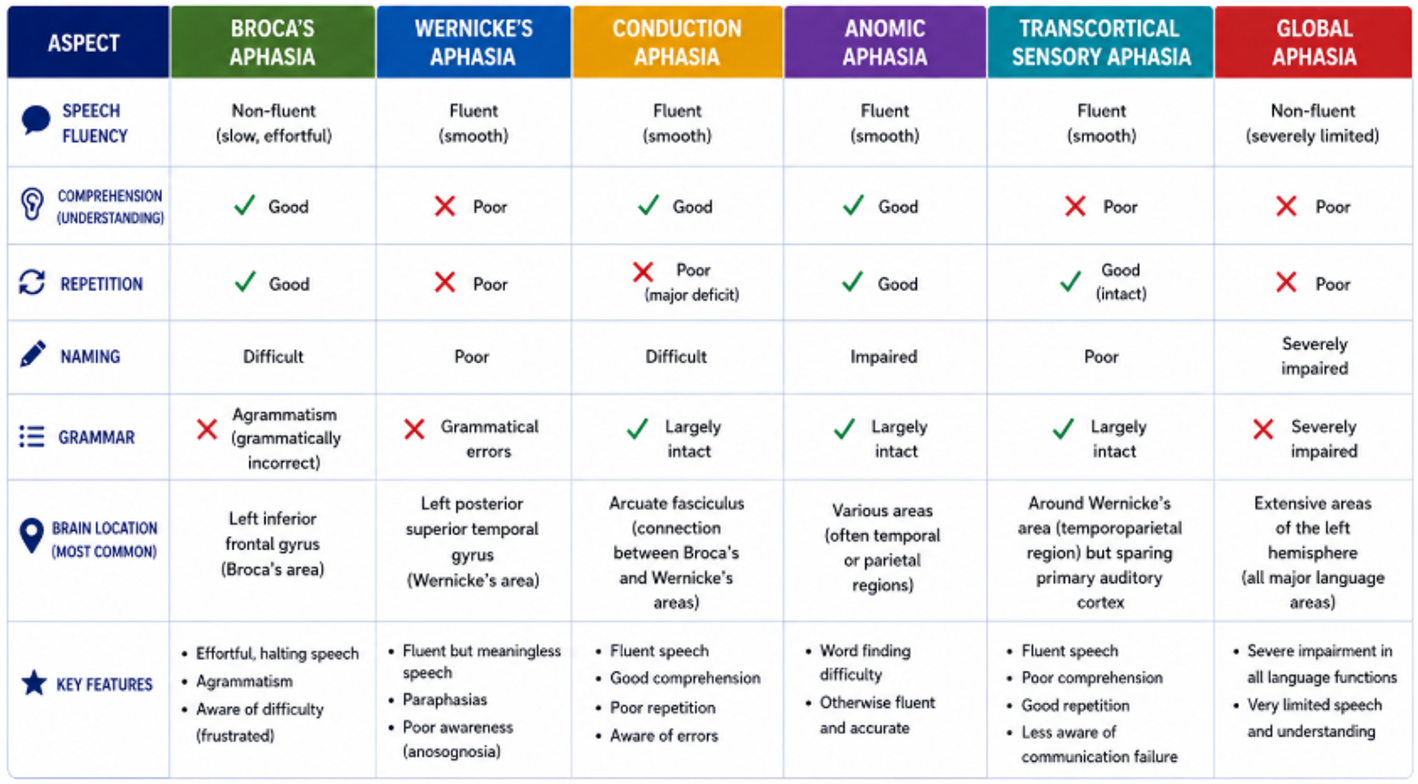
Different types of aphasia: non-fluent
Aphasia
*Language disorders associated with difficulties in understanding and producing language caused by brain damage
^not explained by hearing loss, motor deficit or general intelligence
Prevalence & causes
>350,000 people in the UK live with aphasia
35,000 new cases every year in the UK following a stroke
Causes: stroke, brain tumours, head injuries
^significant psychosocial impact
Nearly 60% of people with aphasia experience depression with a year post-stroke
Broca’s Aphasia
Patient Tan…
- Cavity left frontal lobe filled with fluid
- Patient can comprehend but not express speech
- Speech is associated with left hemisphere
- Damage to the inferior left frontal lobe and underlying subcortical white matter
Comprehension of speech is intact
Speech is slow, broken, effortful
Loss of the production of complete sentence structures in speech and writing
Speech deficits in Broca's…
Agrammatism (loss of grammar)
—> difficulty in use of grammatical constructions but also word order to decode sentences
- "content" words are still used (e.g. nouns, verbs)
- "function" words are more difficult (e.g. a, the, in)
Broca's Anomia (accessing the word)
—> word-finding difficulties (function words)
Articulate problems
—> mispronunciations, often alter the sequence of sounds
Preserved functions in Broca's…
Language comprehension
Meaning of words
Awareness of deficits
Non-verbal communications (gestures/facial expressions)
Understanding humour/sarcasm/tone
Prosody/expression of emotions
Global Aphasia
*Sever impairment in all language functions
Different types of aphasia: fluent
Wernicke's Aphasia
Repetitive or fluent aphasia
Main difficulty is understanding language (spoken or written)
Speech remains smooth and well-paced but might lack meaning
Linked with damage in the left temporal gyrus
Pure word deafness…
- Auditory verbal agnosia
- Rare disorder of the recognition of speech
- Patients cannot understand spoken words despite having normal hearing, reading, and writing skills
- Typically caused by disconnection rather than direct destruction of Wernicke's area itself
Transcortical Sensory Aphasia
Poor comprehension but preserved repetition
Speech is fluent, grammatically correct but meaningless
May not be aware of difficulty
Linked with disconnection between Wernicke's area and posterior language regions
People with TCA may struggle to…
Understand Y/N questions
Follow directions
Understand stories
Anomic Aphasia
Problem with word findings and naming things
Difficulty retrieved certain words, especially nouns and verbs
They know what they want to say but can't get the words to come out correctly
Might use substitution words or related words (e.g. dog or cat)
Wernicke's area and the broader left posterior temporal and parietal regions involved
*Broca's anomia= can't get the word out
*Wernicke's anomia= gets the wrong word out
Conduction Aphasia
Meaningful fluent speech and comprehension, but poor repetition
Extreme difficulties repeating lists or words (although related words may be repeated)
May replace word they are asked to repeat with another with the same meaning
Caused by damage to pathway between Broca and Wernicke area responsible for conveying sound- arcuate fasciculus
Hearing sentence evokes imagery, which allows individual to describe the meaning but using different words