w6 percept & cogn FIRST COGNITION CLASS
 Call Kai
 Learn
Learn Practice Test
 Spaced Repetition
 Match
Match Flashcards
 Knowt Play
1/23

There's no tags or description
Looks like no tags are added yet.
Name | Mastery | Learn | Test | Matching | Spaced | Call with Kai |
|---|
No analytics yet
Send a link to your students to track their progress
24 Terms
The mind is often associated with…
Cognition
Cognition
The collection of mental processes and activities used in perceiving,
remembering, thinking, and understanding, as well as the act of
managing those processes (mental control).
(Ashcroft, 2010)
In (slightly) other words…
• Cognitive processes are mental activities (e.g. thinking) which enable
us to acquire, store and use knowledge in everyday life
• Cognitive Psychology – the scientific study of how the mind works
when thinking about things
Cognitive Neuroscience
the scientific study of how the brain implements cognitive function.
Neural bases of cognition and behaviour in Humans (and Animal research) …measured with brain recording techniques.
Cognitive Neuropsychology
understand cognition through affected brain function, e.g. brain injury (lesions)
Relationship between brain function and behaviour.
Examination of changes in normal function after brain injury.
Experimental Cognitive Psychology
Cognitive psychology focused on using experimental designs.
ex: eye-tracking/eye movements to see what ppl pay attention to. Virtual Reality & Neuro-VR (see Seftleben & Kessler 2024).
Scientific Method
Theory, prediction, experiment, observation
Experimental design
Independent Variable(s) (IV) under experiment’s control: e.g. Experimental group (lesions patients) vs Control group (no lesions) Or: different conditions, experimental (distractions) vs control (no distractions)
Dependent Variable(s) (DV), e.g. data measured through a task: e.g. Performance and/or brain activity on a memory or attention task
Experimental Cognitive Psychology Pros
• Control
• Cause – effect relationships
• Large N
• Inferential Statistics
• Tasks can be used for
complex measures of
behaviour and brain activity - Cognitive Neuroscience
Experimental Cognitive Psychology Cons
• Indirect
• Artificial (not realistic)
• May lack ecological validity
• Narrow range of tasks
• Traditionally tends to
ignores individual
differences
Lesion studies
• Disruption of brain function comes about through natural damage (strokes, etc.)…
• …elicited damage (e.g. animal models)
• Infer the function of a region (or cognitive mechanism) by “removing it” and measuring the effect on the rest of the system
Reverse Inference
• Infer the function of a region (or cognitive mechanism) by “removing it” and measuring the effect on the rest of the system
Two Traditional questions of Human Neuropsychology
(1) What functions are disrupted by damage to region X?
– Addresses questions of functional specialization
– Tends to use group study methods
(2) Can a particular function be spared/impaired relative to other cognitive functions?
– Addresses questions of what the building blocks of
cognition are (irrespective of where they are)
– Tends to use single case methodology
Hemispatial Neglect
damage in right parietal lobe
struggle to see contralesional side of objects/visual field
Neuro-methods
CONSIDER: temporal resolution vs spatial resolution
CT, MRI, PET, fMRI, TMS, EEG, ERP, MEG
Functional Magnetic Resonance Imaging
fMRI
Neural activity requires energy. Energy acquired by breaking down glucose. (glycolysis) Glycolysis requires oxygen.
Oxygen is carried to the brain in the blood by haemoglobin.
Oxyhaemoglobin and de-oxyhaemoglobin have different
magnetic properties;
MR signal is increased for highly oxygenated blood and
is decreased for de-oxygenated blood
FMRI HAS BAD TEMPORAL RESOLUTION (blood response takes seconds to peak) but excellent spatial resolution!
Magnetism and electricity
H.C. Oersted, 1820:
Deflection of compass needle by electric current
Transcranial Magnetic Stimulation (TMS)
• Coil contains a wire carrying an electric current. Rapid change in the current creates a magnetic field
• The magnetic field induces a current in the nearby neurons through electromagnetic induction (causing them to "fire", i.e. generate action potentials)
• This disrupts the cognitive function that they may be doing at that point in time
One can elicit finger movements (motor evoked potentials, MEP) by stimulating the correct cortical hand/finger area.
TMS conditions
• TMS brain stimulation is relatively mild.
• Not used on people with epilepsy or pregnant women
• Number and rate of pulses is regulated by ethical guidelines
• Relatively high spatial and temporal specificity.
• Can help ascertain CAUSALITY (e.g. of effects obtained with a correlational method)
Magnetoencephalography
Direct measurement of neural activity with high temporal and good spatial resolution (MEG)
Electroencephalography
Direct measurement of neural activity with high temporal and low (EEG) spatial resolution
Event Related Potentials (ERP)
• Based on EEG (or MEG = ERF) (electroencephalography) recordings
• EEG signal is averaged over many events & synchronized to some aspect of the event (e.g. onset of a stimulus, e.g. picture of a face)
• Electrodes record a series of positive and negative peaks
• Timing and amplitude of the peaks is related to different aspects of the stimulus and task (e.g. an attention task)
Neural Oscillations in EEG and MEG
look at the brain worms
BTW, Berger initially wanted to “find” telepathy…
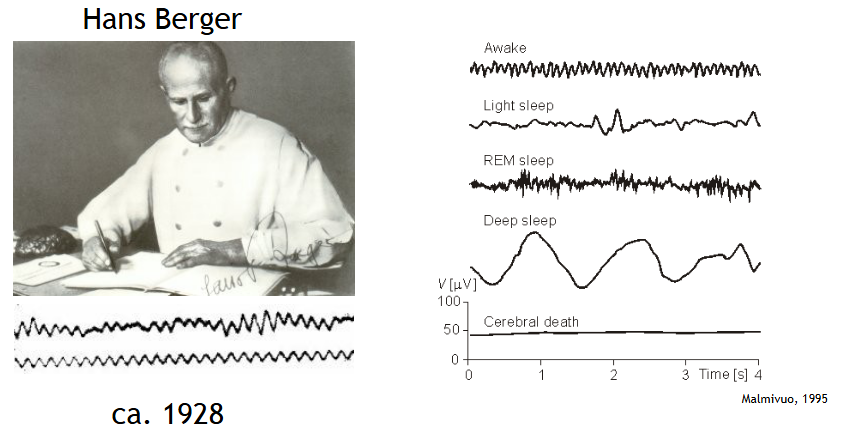
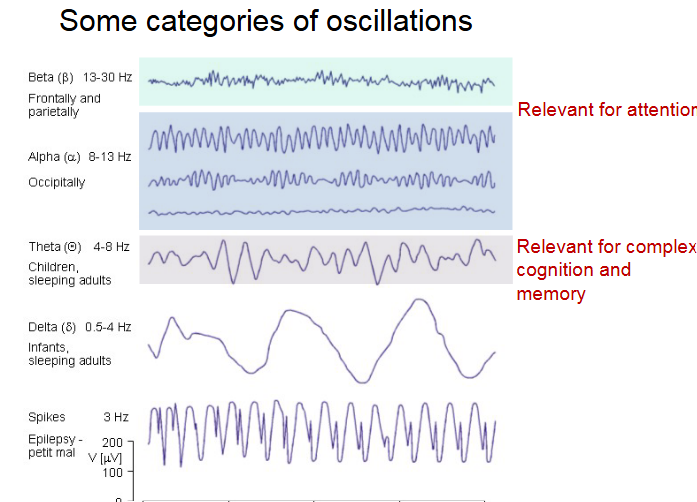
DIFFERENT OSCILLATION CATEGORIES
KEEP WORKING LAD. EXAMS OVER SOON.
pros/cons of looking at oscillations (eeg/erp/meg)
• Brain oscillations can be extracted from the same EEG or MEG data that you use for ERPs you just don’t average before extracting the different frequencies.
• Brain oscillations are directly related to neural activity and this electrical activity is conducted instantaneously to the scalp – like ERPs.
• The major frequency ranges (or bands) relevant for cognition are theta (3-7 Hz), alpha (8-12 Hz), beta (13-30 Hz, and gamma (30+ Hz).
• Oscillations can tell us about spontaneous, ongoing (continuous), or top-down brain activity that is averaged out in ERPs.
• But for extracting frequencies you lose temporal resolution or precision. ERPs can reflect the timing of brain processes more precisely.