Aristotle: Subject of Metaphysics & the Categories | Aristotle on Substance & Accidents
 Call Kai
 Learn
Learn Practice Test
 Spaced Repetition
 Match
Match Flashcards
 Knowt Play
1/20

There's no tags or description
Looks like no tags are added yet.
Name | Mastery | Learn | Test | Matching | Spaced | Call with Kai | Chat |
|---|
No analytics yet
Send a link to your students to track their progress
21 Terms
Aristotle is trying to answer a major philosophical problem:
What does it mean for something to be?
He argues that “being” is not one single thing, but had many meanings
“Being” is said and understood in many ways”
This becomes the foundation of metaphysics
Main Points
Being is said in many ways
The Parmenides Problem (recap)
Aristotle’s solution: Subject vs Accident
The four-fold division of being
The ten categories of being
Metaphysics - study of being as being
Being is said in many ways
Aristotle rejects the idea that “being” has only one meaning. Instead, we understand being through analogy —- we compare different kinds of being to each other.
Reasoning: If “being” had only one meaning, we couldn’t explain differences between things like substances, qualities, or actions
The Parmenides Problem (recap)
Plato’s Parmenides creates a dilemma about Forms:
If the whole form is in each thing → the form becomes “separate from itself”
If only part of the form is in each thing → the form becomes many, not one
“If the whole form is in each participant”
“If only part of each form is present”
Reasoning- Plato’s theory struggles to explain how one universal can exist in many individuals without contradiction
Aristotle’s solution: Subject vs Accident
Aristotle solves the dilemma by distinguishing:
Said of a subject (what something is)
Present in a subject (what something has)
Ex. from text = “White is said of the particular color that is present in this cat”
Reasoning- This avoids Plato’s problem because qualities (like “white”) don’t need to be whole or divided — the simply inhere in a subject
The four-fold division of being
Aristotle divides being using two questions:
Is it said of a subject?
Is it present in a subject?
This creates four types: *check image
Reasoning- This helps categorize everything that exists without confusing substances with qualities or universals with particulars

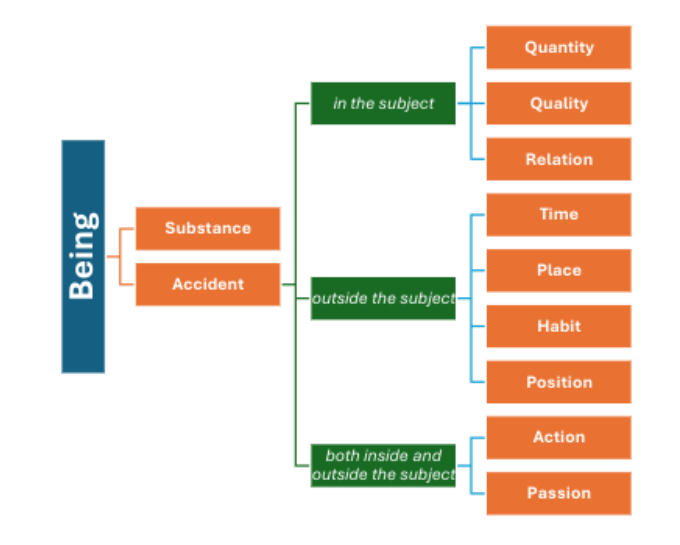
The ten categories of being
Aristotle lists 10 ways something can “be”
These are the fundamental types of existence
Substance- What is it? (the thing itself)
Quantity- How much?
Quality- What is it like?
Relation- Compared to what?
When- Time
Where- Place
Position - How arranged?
Habit- What condition/state?
Action- What is it doing?
Passion - How is it being affected?
Reasoning- these categories allow us to describe anything that exists by identifying what kind of being it has
Metaphysics - study of being as being
Text concludes: “Metaphysics is the study of being as being… being is said in many ways.. being is known analogously”
And most importantly: “To study being is to primarily study substance”
Reasoning- Substance is the foundation of all other categories— qualities, quantities and actions all depend on substance to exist
Takeaway Keypoints
“Being” had many meanings, not one
Aristotle solves Plato’s problem by distinguishing what something is vs what is in it
He divides being into four types and ten categories
Metaphysics studies being in the most general way, focusing mainly on substance
Aristotle on Substance & Accidents
Aristotle argues the being appears in many ways, and we understand it analogously— by comparing different kinds of being
“Being presents itself in a multitude of different ways. It is known analogously.”
But among all the ways of being, substance is primary. Everything else— qualities, quantities, relations— are accidents that exist in a substance
Accidents vs Substances
The Fourfold Table
What is an Accident?
Substance is primary
Analogy of Health
Key Terms - Essence
Universal
Genus & Species
What Substance is Not
What Substance Is
Takeaways Points