nucleur fusion and fission
 Call Kai
 Learn
Learn Practice Test
 Spaced Repetition
 Match
Match Flashcards
 Knowt Play
1/41

There's no tags or description
Looks like no tags are added yet.
Name | Mastery | Learn | Test | Matching | Spaced | Call with Kai |
|---|
No analytics yet
Send a link to your students to track their progress
42 Terms
What is the mass defect?
The difference between an atom’s mass and the sum of the masses of its protons and neutrons.
What is binding energy?
The amount of energy required to separate a nucleus into is constituent protons and neutrons, or the amount of energy released when a nucleus is formed from its constituent nucleons.
What is mass- energy equivalence?
E=mc²
shows that energy and mass are interchangeable so a mass change corresponds to an energy change.
why is a nucleus less massive than separate nucleons?
some mass is converted into binding energy when the nucleus forms.
why do nuclei need binding energy?
protons repel eachother, so energy is needed to hold nucleons together.
why do nucleur reactions release much more energy than chemical reactions?
nucleur reactions involve changes in binding energy which are much larger than electron binding energies.
what is the atomic mass unit, u?
the mass of 1/12 of a carbon-12 atom
how do you estimate mass of a nucleus?
nucleon number *u
what is the question for binding energy?
E= ∆mc²
what is nucleur fusion?
the joining together of two small nuclei to produce a larger nucleus. it releases energy and happens in extremely hot dense environments, such as the core of stars.
why is fusion difficult to achieve on earth?
the nuclei need high Ek to get close enough to fuse because of electrostatic repulsion between positively charged protons. strong nuclear force only acts at short distances so nuclei must be brought together very close first.
what happens in the sun and other stars?
four hydrogen nuclei fuse to form a helium nucleus, releasing energy, this is the source of the stars energy.
what is nucleur fission?
the splitting of large atomic nuclei into smaller nuclei. high mass nuclei such as uranium can undergo fission and release energy.
how is fission started?
by firing a neutron at a nucleus, which then absorbs the neutron and becomes unstable, then splits into two or more daughter nuclei.
what is a chain reaction in fission?
in fission a nucleus splits into two daughter nuclei and 2 or 3 fast moving neutrons, these neutrons can strike other nuclei and cause more fission events, this continues until the fuel is used up or the reaction is controlled by a moderator.
why is fission useful in power stations but dangerous in bombs?
in power stations the chain reaction is carefully controlled to produce energy safely. if uncontrolled the chain reaction can rapidly cascade and cause a nucleur explosion.
why is energy released in fusion and fission?
In both reactions nuclei rearrange into new nuclei that are more stable and tightly bound than before. whenever nucleons get into a tighter arrangement energy is released and mass is lost.
what is the relevance of iron-56?
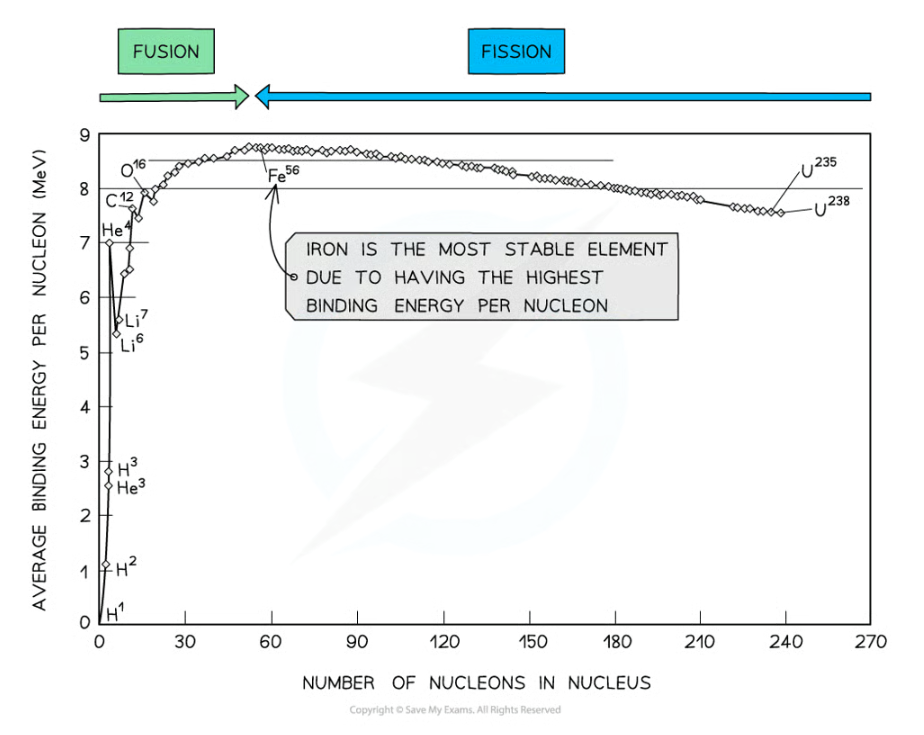
it is the most stable element, it has the highest binding energy per nucleon.
explain nucleur fission in detail?
fission happens using a large unstable nucleus such as uranium-235, which is to the far right of iron-56. since it has so many protons pushing away from each other its nucleons are arranged in a very loose strained way, the strong nucleur force is only just overpowering electrostatic repulsion. it hasn’t lost as much mass as it potentially could. Fission happens when a slow moving neutron is fired at the nucleus. The nucleus is already unstable but when the neutron is fired at it, it absorbs the neutron and the extra energy causes it to become highly unstable, causing the nucleus to elongate. the strong nucleur force can no longer hold the ends together, allowing electrostatic repulsion between the protons to split the nucleus apart into two daughter nuclei. since the nucleons in the two nuclei are no longer trapped in loose uranium structure, the daughter nuclei have a higher binding energy per nucleon, making them more stable.
explain nucleur fusion in detail
fusion happens using two nuclei to the far left of iron-56 such as two hydrogen nuclei, the nuclei are unstable since they have less nucleons so they do not experience the maximum attraction of the short range nucleur force and therefore have a low binding energy per nucleon. when the two nuclei are forced together under immense heat and pressure they fuse together to form one helium nucleus, this nucleus is much more tightly bound and closer to iron-56 stability, with a higher binding energy per nucleon.
What is the binding energy per nucleon?
The binding energy of a nucleus divides by the number of nucleons in the nucleus. a higher binding energy per nucleons indicates a higher stability.
does fusion or fission release more energy?
per individual reaction fission releases more energy, as more nucleons are undergoing a change in binding energy.
per unit mass, fusion releases more energy, in 1kg of hydrogen there are vastly more nuclei than in 1 kg of uranium, since there are many more individual fusion reaction happening per kg more energy is released.
on the binding energy per nucleon graph why is the gradient steeper for fusion?
in very light nuclei most nucleons are on the surface and do not experience the max attractionof the short range strong nucleur force, adding a small number of nucleons dramatically increases the number of neighbouring interactions via the strong force rapidly increasing the stability of the nucleus resulting in a sharp increase in binding energy per nucleon.
fission does not have this steep gradient because of how the infinite range of electrostatic repulsion compares with the short range strong nucleur force as nuclei become massive. as you add more nucleons electrostatic repulsion increases continuosly but nucleur force is already saturated so there’s no significant change, gradually chipping away at the nucleus’s stability.
what is the mass defect equal to?
the binding energy released.
What is critical mass?
the minimum mass of fuel required to maintain a steady chain reaction.
if mass< critical mass, the reaction would die out, a small mass has a large surface area to volume ratio so neutrons have a short distance to travel before reaching edge of material, causing many neutrons to escape from the surface without hitting another nucleus.
if mass= critical mass, on average 1 neutron from each reaction goes on to cause subsequent reactions , resulting in constant rate of fission and a self sustaining chain reaction
is mass> critical mass, smaller surface area to volume so on average more than 1 neutron from each reaction goes on to cause another reaction, the rate of fission increases exponentially, resulting in an uncontrolled chain reaction causing a massive release of energy in a very short time (explosion)
what does the binding energy per nucleon graph look like?
start graph from A= 2 and just above 1Mev, include anomalous spike at helium-4 because it is a particularly stable nucleus.
what are neutrons involved in fission known as?
thermal neutrons, they have low Ek (3/2 kT) and are defined as a neutron which is in thermal equilibrium with its surroundings,
when a nucleur reactor is producing energy at the required rate, what factors must be controlled?
the number of free neutrons in the reactor, the energy of the free neutrons.
in a nucleur reactor what is the moderator?
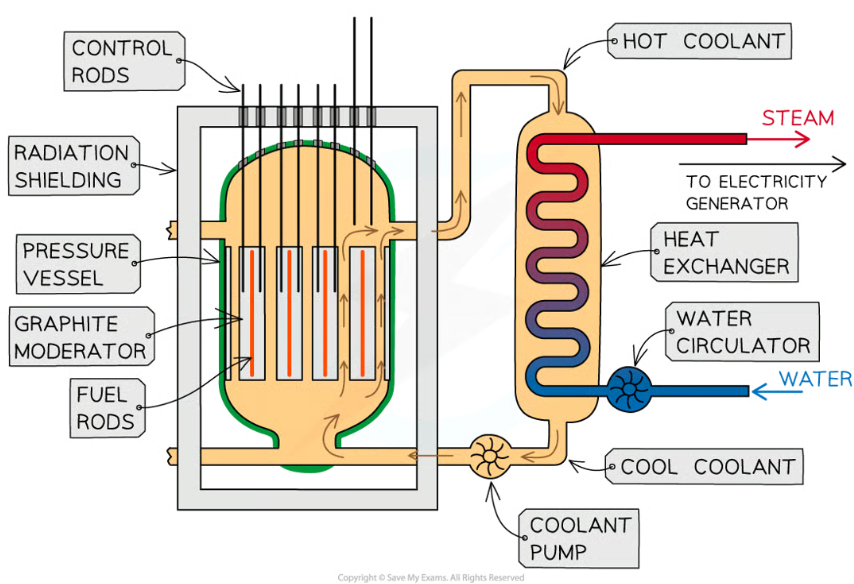
its purpose is to slow down neutrons to mantain the chain reaction, its a material that surrounds the fuel rods and control rods inside the reactor core, they are made from materials that will not absorb neutrons but will absorb a large amount of energy from them, commonly graphite or water.
what are the control rods?
made from a non fissionable material that absorbs neutrons without becoming dangerously unstable, typically boron or cadmium, they control the number of neutrons absorbed by varying the depth of the control rods in the fuel rods. If the nucleur reactor needs to be shut down they can be lowered all the way so no reaction takes place.
what are fuel rods?
rods that contain the fissile fuel.
What is the coolant?
a substance such as water that is pumped into the reactor at cold temperature to extract the heat released from fission reactions. in the heat exchanger the coolant transfers the heat to water that is pumped in externally to produce steam, this steam then goes on to power electricity- generating turbines.
what does the diagram of a nucleur reactor look like?
how do moderators work?
first few collisions of a neutron transfers sufficient energy to excite nuclei in the moderator without being absorbed, when they deexcite this energy is released as gamma radiation. the following collisions of a neutron with a moderator are elastic, momentum is transferred to the moderator atoms, with each elastic collision the neutron slows down until the average Ek corresponds with moderator nuclei, eventually neutrons reach speeds where they can cause fission rather than rebound of nuclei.
why is water often used as a moderator and coolant?
it has a high specific heat capacity so can transfer large amounts of thermal energy
What is sheilding?
used in nucleur reactors to ensure there are no radiations leakages as gamma radiation is highly penetrating, lead or concrete.
How are waste products from nuclear power stations stored?
water tanks or sealed underground for the remaining time they are radioactive.
What is the fuel used in nucleur reactors?
enriched uranium, U-238 enriched with U-235, U-235 is the isotope that undergoes fission, the U-238 isotope absorbs fission neutrons helping control the rate of fusion reactions.
how are workers kept safe from radiation?
fuel rods are handled remotely, nuclear reactor surrounded by a very thick sheilding, in emergency control rods are fully lowered.
what are the three types of nucleur waste?
low level- lightly contaminated clothing, gloves, tools etc, will be radioactive for a few years so must be encased in concrete and stored a few metres underground
intermediate level- between daily used items and fuel rods, longer half life, must be encased in cement in steel drums and stored securely underground.
high level- unusable fission products, most dangerous, initially placed in cooling ponds for numbers of years, isotopes harvested to be used again, waste mixed with molten glass and made solid, encase in containers made from steel, lead or concrete, stored very deep underground.
benefits of nucleur power?
very little pollution, green house gas emissions of nucleur power stations is very low compared to coal or gas power stations, far more sustainable.
highly reliable, continous energy output
nucleur fuel has highest energy density
nuceur reactors produce some useful by-products
risks of nucleur power
nonrenewable energy resources
radioactive waste is very dangerous and expensive to deal with
commissioning and decommissioning power stations is very expensive and time consuming
nucleur meltdown has catastrophic consequences