Ap calc BC
 Call Kai
 Learn
Learn Practice Test
 Spaced Repetition
 Match
Match Flashcards
 Knowt Play
1/54

There's no tags or description
Looks like no tags are added yet.
Name | Mastery | Learn | Test | Matching | Spaced | Call with Kai |
|---|
No analytics yet
Send a link to your students to track their progress
55 Terms
AROC
Slope between two points
y2-y1 / x2-x1
Instantaneous ROC
The slope of the tangent line at a specific point on a curve, representing the rate of change of a function at that point.
AROC except the points get infinitely close together (LIMIT!!)
Limit notation
The super script on a tells if you are approaching from left or right
- is left +is right
If the left and right limits ARE NOT EQUAL then the limit does not exist overall
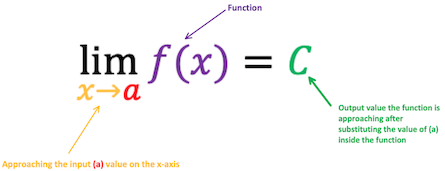
Understanding limits graphically and tabularly
Graphs: look at points and their behavior near the limit, while in a table, analyze values approaching the limit from both sides (if they are really big or small its infinity, if they approach the same left and right the limit exists, etc.)
Limit Constant Rule
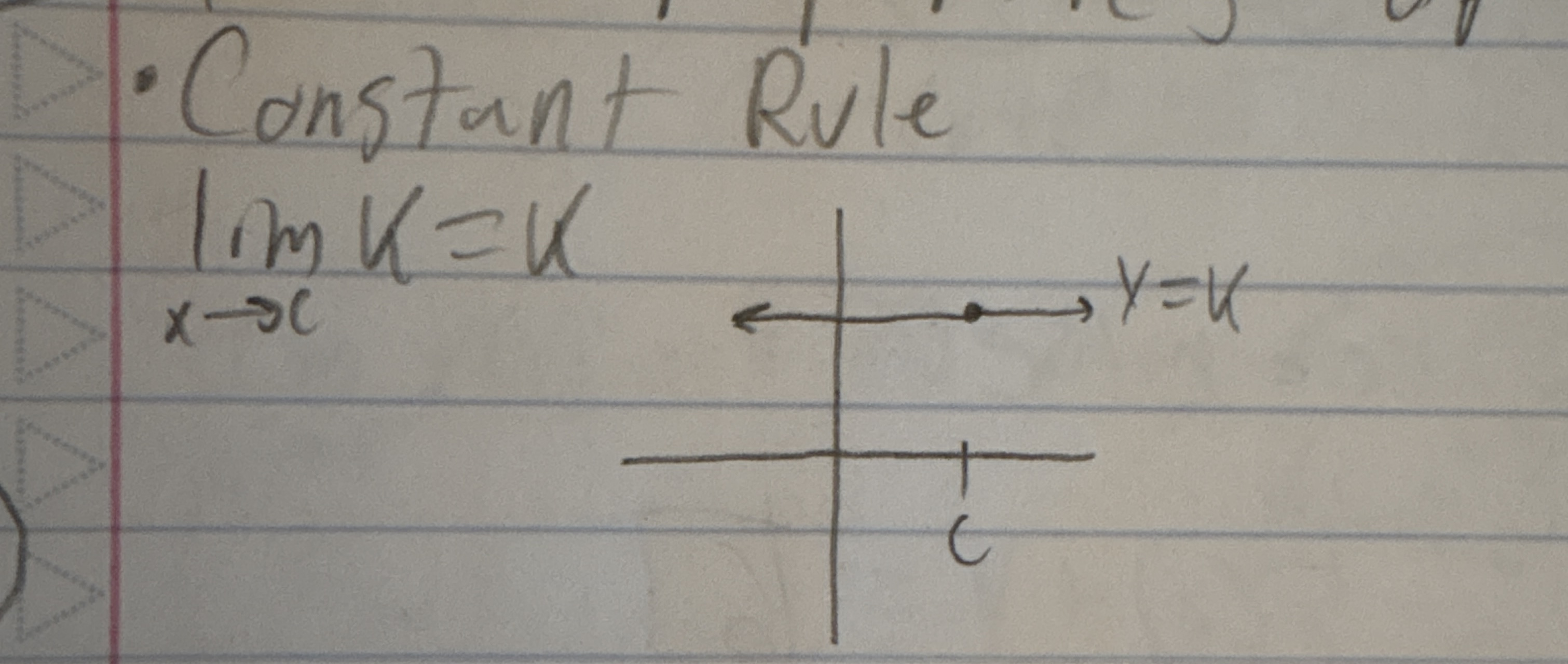
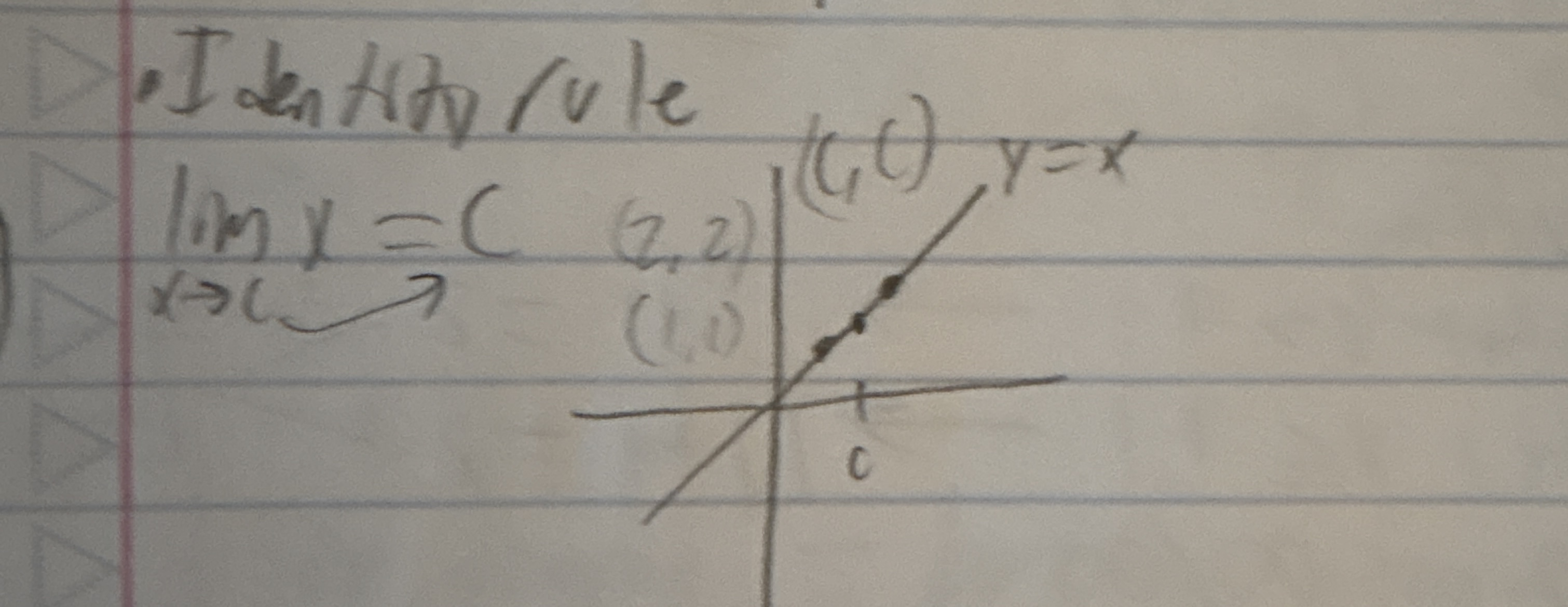
Limit Identity rule
If you plug c in for x
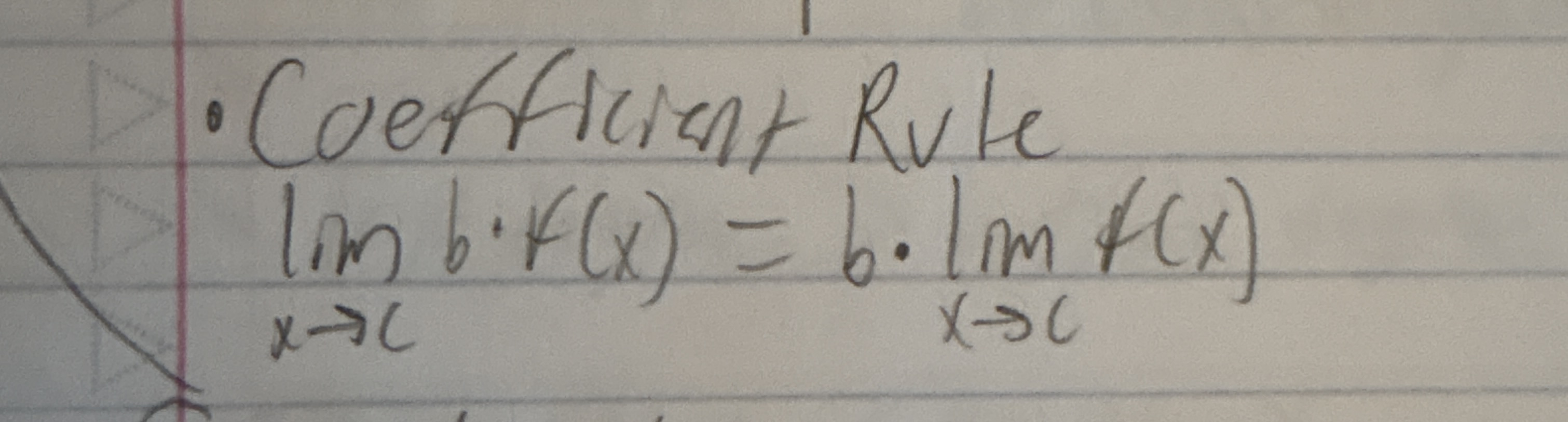
Limit Coefficient rule
Coefficient can come outside
Limit Sum/difference rule
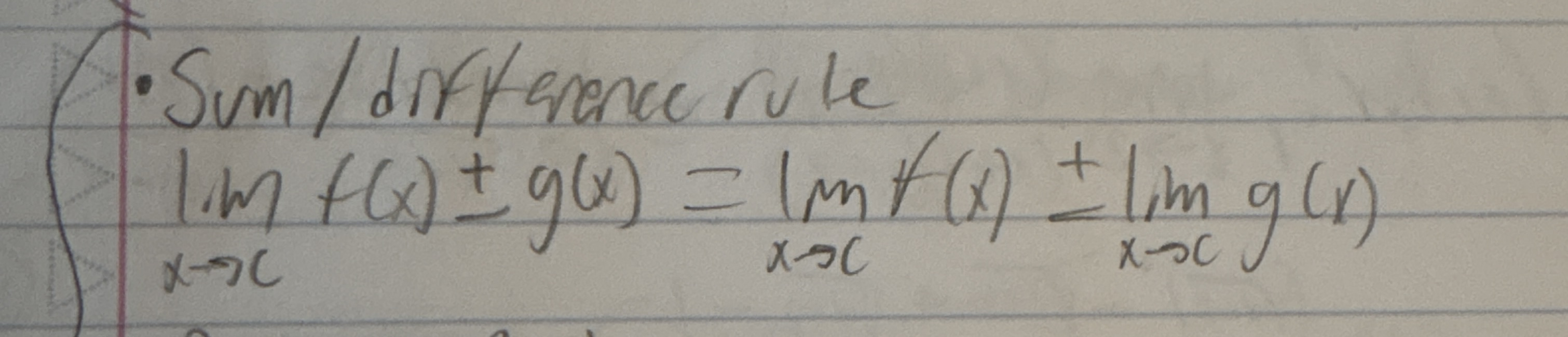
Limit product rule

Limit quotient rule

Limit power rule
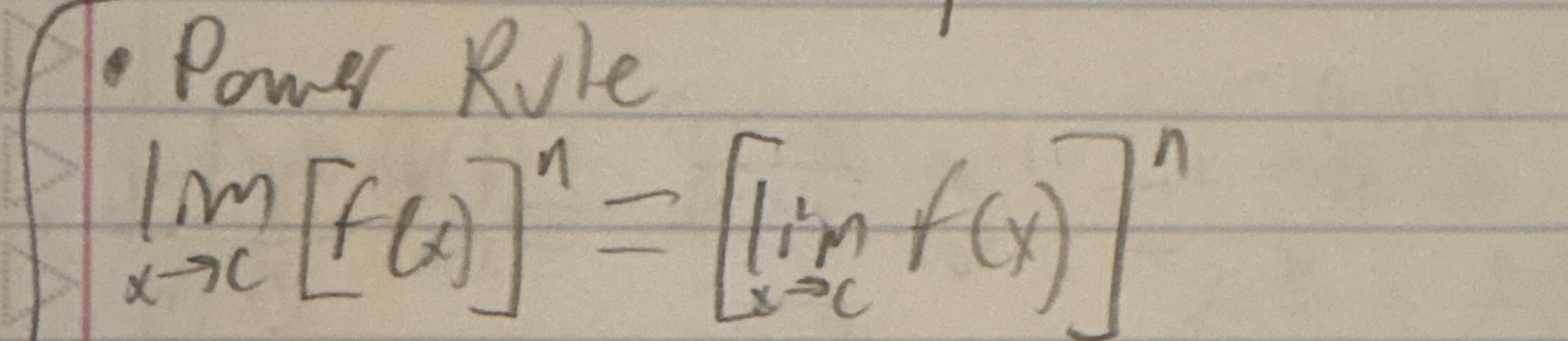
Limit root rule
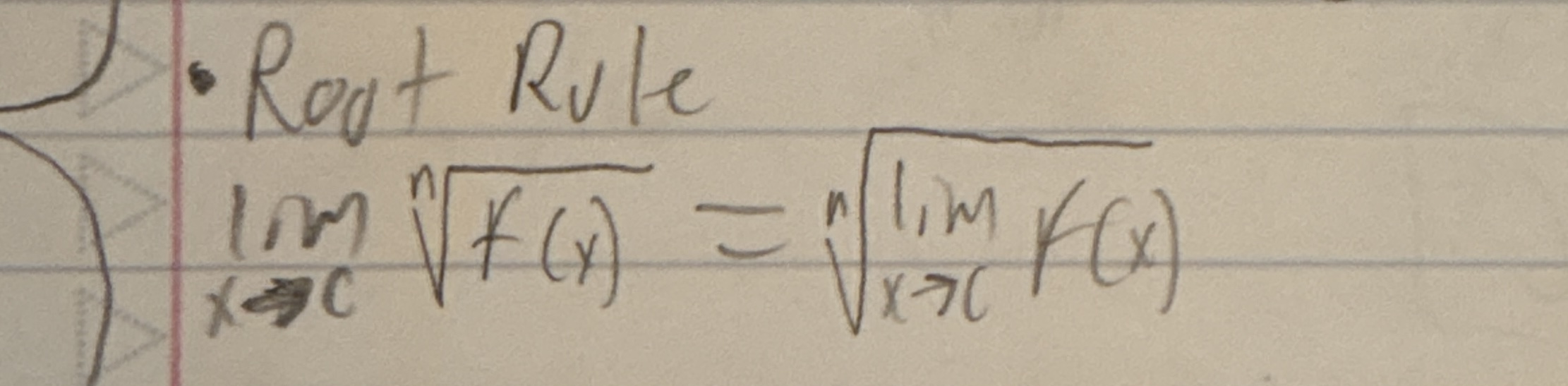
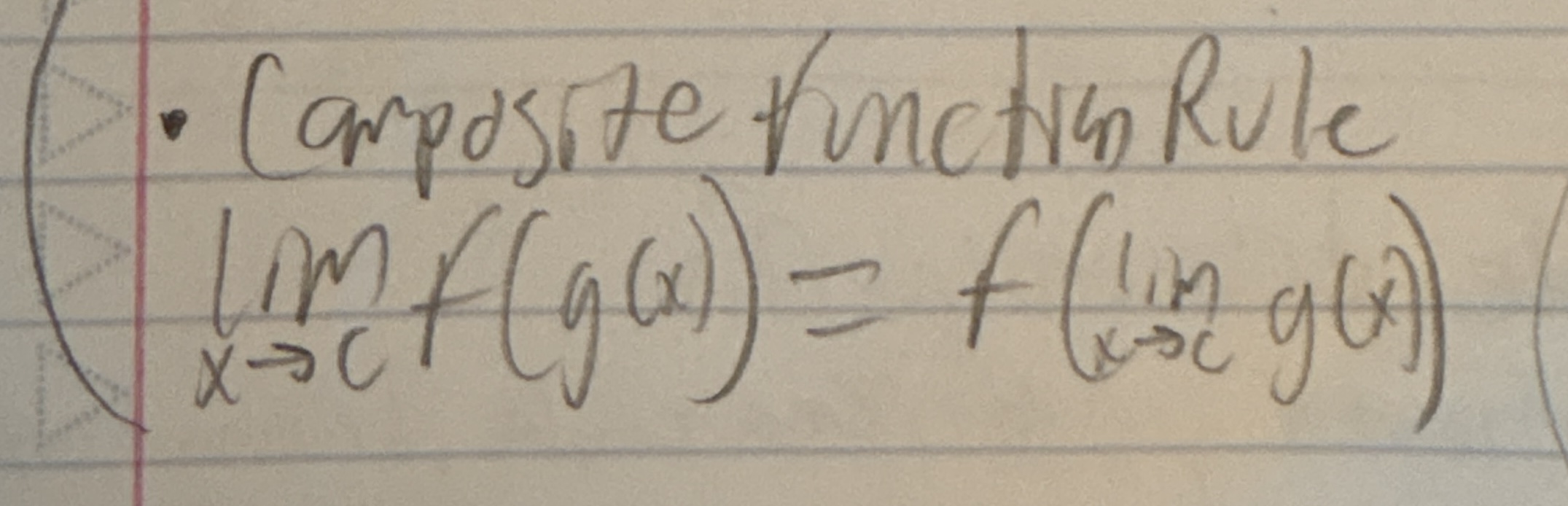
Limit composite function rule
(do the limit of the INSIDE function and then just plug the answer into the outside fcn)
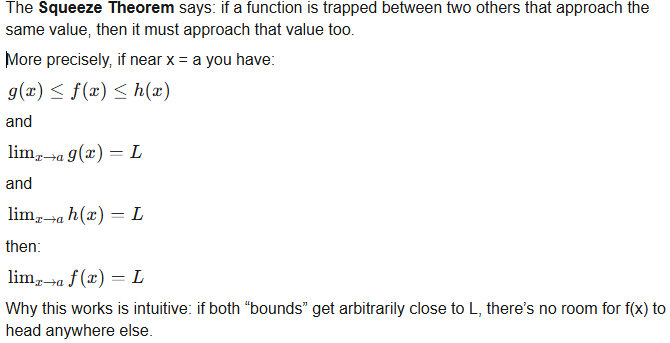
Limit Squeeze Theorem
Steps to solve limits algebraically
Direct substitution
Get a number = plug it in and solve
Function or Piecewise
Get indeterminate form = simplify algebraically
Factoring (polynomials)
Conjugates (radicals)
Common denominator (fractions)
Direct substitution for regular functions
plug into function and solve
Direct substitution for piecewise functions
Plug in for both the left and right side to find left/right hand limits. If they give the same value that is the answer for overall limit
Indeterminate limit algebra simplification: factoring for polynomials
When you plug into the polynomials on top and bottom you get 0/0
Factor both polynomials, and something should cancel out
Re-substitute value into limit and solve!

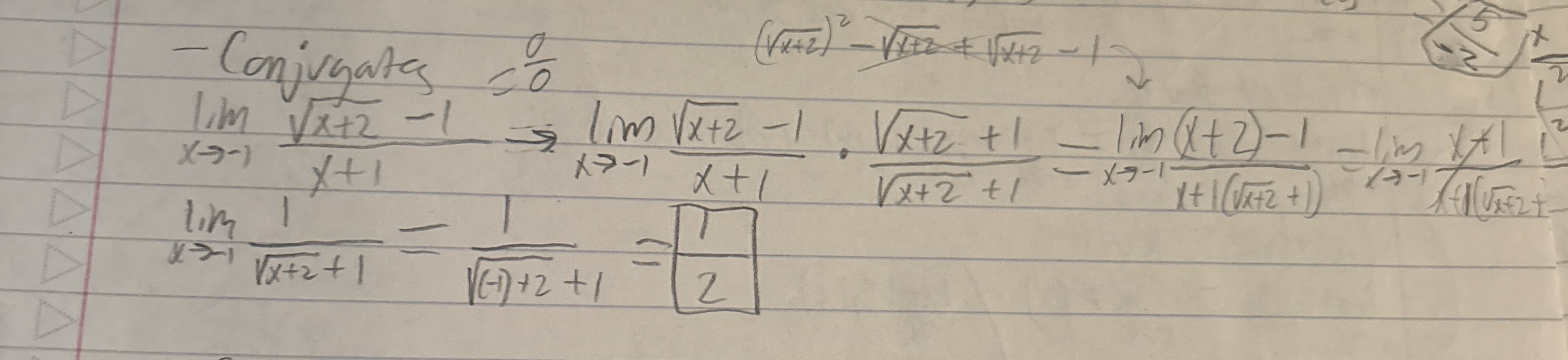
Indeterminate limit algebra simplification: conjugates for radicals
When you plug into top and bottom with the radical you get 0/0
Multiply on top and bottom by the expression with the radical BUT the signs are flipped (multiply by conjugate (conjugate of (a-b) is (a+b))
Something should cancel
Substitute and solve!
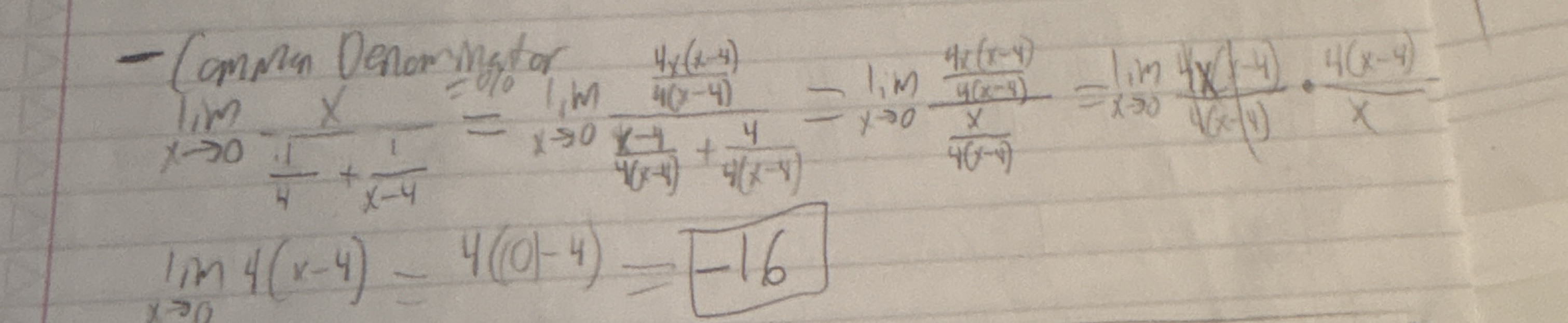
Indeterminate limit algebra simplification: Common Denominator for fractions
When you plug into the top and bottom including fractions you get 0/0
Multiply top and bottom of individual fractions and overall fraction to get common denominator
Simplify and cancel stuff
Substitute and solve!
Definition of continuity
Function exists
OVERALL limit exist
Function = limit
Types of Discontinuity
Removable discontinuity: the limit exists, but either f(a) is undefined or f(a) is not equal to the limit. Graphically: a hole (maybe with a misplaced dot). (Removeable)
Jump discontinuity: the left and right limits exist but are different. This occurs when the curve “breaks” and resumes at a different height. (Nonremovable)
Infinite discontinuity (also called essential/infinite discontinuity): the function becomes unbounded near the point, typically because there is a vertical asymptote. (Nonremovable)
How to tell algebraically if a discontinuity is removeable
If a factor cancels: the point that would go there is removable
Factors left in denominator: the point that goes there is nonremovable
Limits that solve to infinity
If the bottom is 0 after simplifying, there is an asymptote and it goes to infinity
To find out if it is positive or negative infinity you must find the top and bottom signs
On top plug in and solve
On bottom plug it .1 away from the number and see if it would be + or -
(plug in .1 less for - left hand lims)
(plug in .1 more for + right hand lims)
Solving for limits when x→infinity
Top degree = bottom degree
Use leading coefficients of top and bottom to tell you the exact number
Top degree < bottom degree
The limit approaches 0
Top degree > bottom degree
Use polynomial long division to find and graph slant asymptote and then figure out end behavior based on slant
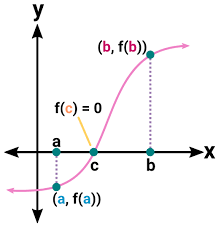
Intermediate value theorem
If a fcn is continuous
and f(a) DOES NOT EQUAL f(b)
then there is a value c such that if a < c < b then f(a) < f( c) < f(b)
Derivative of Constant
0
Derivative if a single variable (x)
1
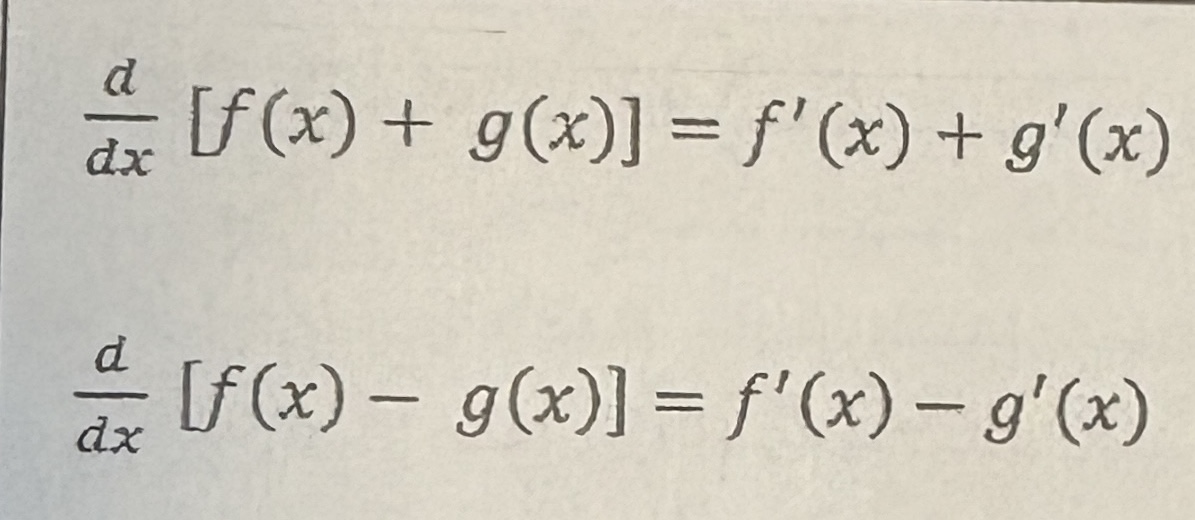
Sum and Difference rule for derivatives
Power rule
Derivative sinx
cosx
Derivative of cosx
-sinx
derivative of tanx
sec²x
derivative of secx
secx • tanx
derivative of cscx
-cscx • cotx
derivative of cotx
-csc²x
Product rule
derivative of f(x) • g(x)
f’(x)•g(x) + f(x)•g’(x)
quotient rule
derivative of f(x) / g(x)
( f’(x)•g(x) - f(x)•g’(x) ) / (g(x))²
chain rule
derivative of f(g(x))
f’(g(x)) • g’(x)
Things to know for find tangent lines to curves
Point slope form: (y-y1) = m(x-x1)
Point (x1,y1) comes from the function values at the point
Slope (m) comes from the value of the derivative at that point
You can also convert this to standard form (y=mx+b) by multiplying m and adding y1 to both sides
Finding a normal line
Normal lines can still be point slope form (y-y1)=m(x-x1)
The point (x1,y1)
The slope (m) is the perpendicular line to the tangent line
This means the slope is the opposite sign reciprocal to the derivative value at the point
What are position velocity and acceleration of a particle in relation to each other
s(t)=position
v(t)=s’(t)=velocity
a(t)=s”(t)=acceleration
How to know which way a particle is moving
If v(t) is positive, the particle moves up or right
If v(t) is negative, the particle moves down or left
If v(t) is 0 the particle is stopped
What is the speed of a particle in rectangular form
speed = l velocity l
How to tell if a particle is speeding up or slowing down
Speeding up if a(t) and v(t) have the same sign
Slowing down if a(t) and v(t) have opposite signs
Requirements for differentiability
The derivative/slope must be the same value on the left and right
Cannot have cusps/corners
Cannot have vertical tangent
Cannot have discontinuity
Steps for implicit differentiation
Differentiate BOTH sides with respect to independent variable (x)(Must obey chain rule with dy/dx)
Get all dy/dx terms to one side and others to opposite
Factor out dy/dx if necessary
Solve for dy/dx
Formula for inverse derivatives
[f-1]’(x) = 1 / f’(f-1(x))
Tips for derivatives of inverse fcns
The derivative of the inverse function at x is the reciprocal of the derivative of the function at y.
To find (f-1(x)) take whatever x value is given, find what y is at that point and plug that y value in as f-1(x)
derivative of (sin-1(u))
u’ / √(1-u2)
derivative of (cos-1(u))
-u’ / √(1-u2)
derivative of (tan-1(u))
u’ / 1+u2
derivative of (cot-1(u))
-u’ / 1+u2
derivative of (sec-1(u))
u’ / |u| * √(u2-1)
derivative of (csc-1(u))
-u’ / |u| * √(u2-1)