4.1 Human Body Systems
 Call Kai
 Learn
Learn Practice Test
 Spaced Repetition
 Match
Match Flashcards
 Knowt Play
1/54

There's no tags or description
Looks like no tags are added yet.
Name | Mastery | Learn | Test | Matching | Spaced | Call with Kai |
|---|
No analytics yet
Send a link to your students to track their progress
55 Terms
Urinalysis
A test that determines the contents of urine
What can a urinalysis be used to detect?
Some types of disease, particularly in the case of metabolic disorders and kidney disease
What are the main roles of the kidney?
Removing waste products from the blood
Leaving nutrients such as proteins and glucose in the blood
Maintaining the acid base balance
Regulating water and electrolyte balance
What are the components of a urinalysis?
Macroscopic examination
Chemical analysis
Microscopic examination
What physical properties are you looking for during a urinalysis?
Color & clarity
What is being looked for in terms of color during a urinalysis?
Normal urine is a straw to amber color
Abnormal urine can be colorless, dark yellow, orange, pink, red, green, brown, or black
What is being looked for in terms of clarity during a urinalysis?
Normal urine is clear
Abnormal urine can be hazy, cloudy, or turbid
What are the chemical properties of urine?
Specific gravity, pH, protein content, glucose content, and ketone content
What are urine strips used to detect?
The chemical properties of urine
Parts of a chemical analysis: pH
Measures if urine is acidic, basic, or neutral
Normal urine ranges from 4.6-8
Parts of a chemical analysis: specific gravity
Measures the concentration of particles in the urine & evaluates the body’s water balance
The more concentrated the urine, the higher the urine specific gravity
The most common increase in urine specific gravity is the result of dehydration
Normal urine ranges from 1.002 to 1.028
Parts of a chemical analysis: ketones
Measures the presence of or absence of ketones in urine
Normal urine does not contain ketones
What are ketones?
The endpoint of rapid or excessive fat breakdown
Parts of a chemical analysis: proteins
Normal urine levels of proteins are very small, about 0 to 8 mg/dl
Parts of a chemical analysis: glucose
Measures the amount of sugar in a urine sample
Normal urine does not contain glucose
What elements may be seen in a microscopic examination of urine?
Red blood cells (not found in normal urine)
White blood cells (not found in normal urine)
Epithelial cells (found in normal urine)
Crystals (small amounts found in normal urine)
Bacteria
What is the role of epithelial cells in the urinary system?
They line the urinary tract
What are examples of common crystals?
Calcium oxalate, triple phosphate, and amorphous phosphate
What does a large number of crystals indicate?
Either kidney stones are present or there is a problem with how the body is using food
What structures are permeable to water?
The collecting duct and descending loop (the ascending loop is permeable to sodium, but not water)
What structures primarily assist in filtration?
The glomerulus and Bowman’s capsule
What structures primarily assist in reabsorption?
Primarily the proximal convoluted tubules (many others assist)
What structures primarily assist in secretion?
The distal convoluted tubules and the collecting ducts
What does the urinary system control?
The production of urine, getting rid of waste, and water levels
What is the correlation between water in the body and blood pressure?
As water levels rise, pressure rises
What do the kidneys do concerning blood pressure?
They maintain osmolarity and get rid of excess solutes to lower your blood pressure
What substances can’t come out of capillaries?
Red blood cells and proteins
What is ADH?
A hormone secreted in the pituitary gland and created in the hypothalamus that recognizes high solutes, regulating blood pressure and solute concentration
What kind of feedback loop is the urinary system?
A negative feedback loop
What does ADH direct the kidneys to do?
To retain water, reducing thirst and the volume of urine produced
Where is urine formed?
In the nephrons
Gestational Diabetes
Pregnancy hormones cause high blood sugar and insulin resistance
Symptoms include thirst, lethargy, and weight loss
Proteinurea
Protein is present in the urine
There are oftentimes no symptoms
Urinary Tract Infection (UTI)
Infection/inflammation causing white blood cells and crystals in the urine
Symptoms include peeing frequently, burning sensation when peeing, lower back pain, and a low-grade fever
Anorexia Nervosa
Ketoacidosis is developed (fat is broken down for fuel, creating ketones)
Symptoms include low energy, losing hair, and losing period
Central Diabetes Insipidus
Deficiency of ADH, making the kidneys unable to conserve water
Symptoms include constant thirst, trouble sleeping, and family history of pituitary problems
Kidney Disease/Failure
Blood is not properly filtered and ends up being found in the urine
Symptoms include lethargy, dizziness, trouble sleeping, swollen feet, ankles, and face, back pain, and dark urine
What type of tissue is the bladder?
Transition epithelium, allowing for a change in shape of the bladder
What shape is the bladder when it is empty?
Cubodial
What shape is the bladder when it is full?
Squamous
What are the processes where food and drinks are converted to waste products?
Digestion and filtration
Filtrate
A liquid which has passed through a filter
Glomerulus
Cluster of capillaries inside of the Bowman’s capsule where blood filtration begins
Pressure is extremely high when first entering from the artery, causing water and other products to be diffused out
Proximal Convoluted Tubule
Reabsorbs nutrients from the filtrate
Loop of Henle
Helps with urine concentration
Distal Convoluted Tubule
Connects the Loop of Henle to the collecting duct, helping with final adjustments to the filtrate
Collecting Duct
Runs vertically through the medulla of the kidney, receiving fluid from many nephrons and directing it toward the renal pelvis
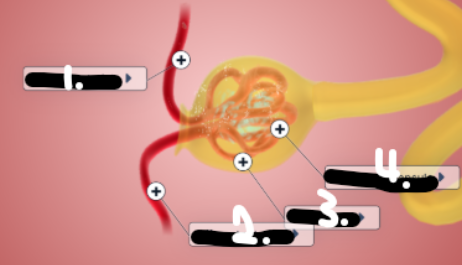
Label the image
Efferent arteriole
Afferent arteriole
Glomerulus
Bowman’s capsule
Efferent Vessel
Exits
Carried filtered blood away from the nephron
Afferent Vessel
Arrives
Brings unfiltered blood to the nephron
Bowman’s Capsule
Collects the fluid filtered out of the blood and is continued towards the proximal convoluted tubules
Tubular Reabsorption
As the filtrate moves towards the tubules, necessary substances are reabsorbed from the tubules into the surrounding capillaries
Explain the whole process of the nephron
The renal artery dumps large volumes of blood into capillaries of the glomerulus, and the high pressure forces water and solutes out of the blood and into the Bowman’s capsule
Filtration occurs where water, ions, glucose, and waste pass while blood cells and proteins are retained in the blood
Reabsorption occurs where the filtrate moves through tubules and necessary things like water, glucose, and ions are reabsorbed from the tubules into the surrounding capillaries
Capillaries excrete any other waste to the kidney tubules to be excreted as urine
The remaining liquid called urine passes into the collecting duct to then be secreted by the body
Tubular Secretion
Waste products that were not initially filtered are secreted from the capillaries into the tubules to be excreted via urine
Glomerular Filtration Rate
Represents how rapidly the body is cleansed of metabolic waste, and the amount of fluid and dissolved substances the kidneys are capable for filtering per minute