Electric Current Physics
 Call Kai
 Learn
Learn Practice Test
 Spaced Repetition
 Match
Match Flashcards
 Knowt Play
1/24

There's no tags or description
Looks like no tags are added yet.
Name | Mastery | Learn | Test | Matching | Spaced | Call with Kai |
|---|
No analytics yet
Send a link to your students to track their progress
25 Terms
electric current
the flow of charged particles
measured by the amount of charges that pass per second
only flows when there is a potential difference/voltage
What is the equation for current?
I= q/t
I= current (amps)
q= charge (coulombs)
t= time (IN SECONDS)
resistance
opposition to a flow of current
unit = ohms (Greek letter)
variable= R
due to collisions between electrons and fixed atoms
What are the three parts to an electrical current?
current, resistance, battery (source of potential difference)
What is the relationship between current, voltage, and resistance?
higher the resistance —> lower the current (inverse relationship)
higher the voltage= more potential difference —> faster current (directly proportional)
Ohms law
V=IR or any variation of this
circuit diagrams
a way to draw circuits
short line next to a longer line = battery (voltage)
resistor = squiggly line
connect with a wire/ a line
What does an ammeter measure?
measures amps so CURRENT
needs to be placed in the circuit/ in series
if you want to measure the current coming out of a specific resistor then put it in line with that resistor
What does a voltmeter measure?
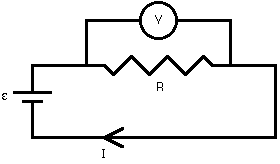
volts so the potential difference of a resistor
has to be placed on either side of a resistor
Electrical power
work over time = power (units = WATTS)
P=VI=I²R=V²/R (in ref table)
the equation you use depends on the the variable you have
What is another way to say power?
at what rate is electrical energy transformed in the light bulb
rate of energy
What happens in terms of energy when an electron hits an atom/ the resistance?
electrical energy is transformed into thermal energy
resistance = more collisions = more heat generated
Electrical energy
basically same kind of formula as with power but solved for work and has time (in seconds)
W=VIT=I²RT= V²T/R
in ref table
What determines resistance?
bigger the area —> less resistance (more space for current to travel through)
longer something is → more resistance (more atoms to bump into)
material also affects resistance
resistivity
a material’s ability to resist the flow of electrical charge (how much it can resist)
Variable = slanted p (Greek r)
Units= Ohms x meters
will have to look up the resistivity in ref table (like coefficient of friction) depending on the material (also has the units)
metals have a low resistivity (lets current/ electrons go through them)
resistivity equation
R= slanted p L/A
R= resistance (ohms)
slanted p= resistivity (ohms x meters) (100 cm = 1 m)
L= length (meters)
A= cross sectional area (m²)
If a problem says 20 Celsius it is a resistivity problem (not actually relevant to solving)
series circuit
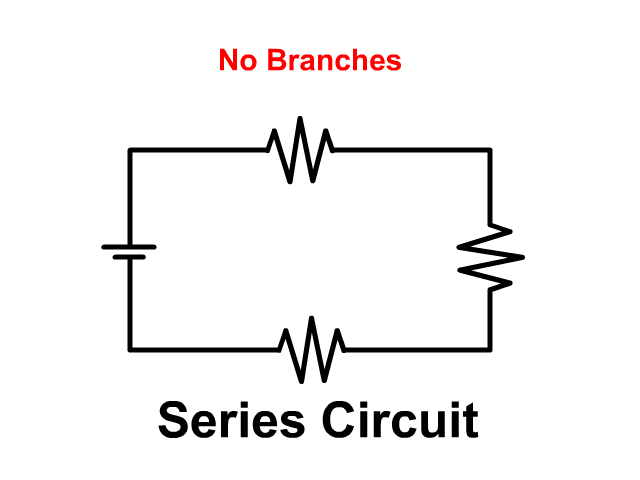
one device is connected after another in a simple loop
current only has one path to take
voltage is DIFFERENT (add up voltage of each resistor to get total)
current is the SAME
the total resistance = just add up the separate resistances
What is the analogy for a series circuit?
waterfalls that flow from high potential to low potential
start at different heights and are different heights (have different voltages)
but the current has to stay the same otherwise the water would run out or overflow (current has to be the same)

How would a break in a series circuit affect the other resistors/ lightbulbs?
everything would go out
no elections flowing/ no current
Parallel Circuits
several paths for the current to take
resistors are parallel to each other
the current is DIFFERENT
voltage is SAME (at the same height = no potential difference in relation to each other)
Parallel circuits waterfall analogy
the waterfalls are at the same height —> has the same potential difference
there is a different amount of water flowing in each —> current changes in each resistor

How do you find the total resistance in a parallel circuit?
1/Rt = 1/R1 + 1/R2
take each resistor and put it under one
solve BUT you have to FLIP the fraction in order to find Rt NOT 1/Rt
How does a break in a parallel circuit affect the circuit?
does not affect the other branches
there are still other paths for the electrons to go
Kirkoff’s Rule
current going in = current going out
if 10A is going in and then comes to a junction (multiple paths), the current in has to equal the current going out
if 10 A is in, 10 A has to go out
Example of Kirkoff’s rule?
5A and 7A in (12A) - only 3A out what value has to also be going OUT 9A because 12= 9+3