Week 5 Combine
 Call Kai
 Learn
Learn Practice Test
 Spaced Repetition
 Match
Match Flashcards
 Knowt Play
1/47

There's no tags or description
Looks like no tags are added yet.
Name | Mastery | Learn | Test | Matching | Spaced | Call with Kai |
|---|
No analytics yet
Send a link to your students to track their progress
48 Terms
Contour plot =
Take multiple level curves to construct the full function
Always 1 dimension below actual function dimension
Level curve =
A "slice" of a 3D multi-variable function at a specific constant/height to get a 2D image
Clairaut's Theorem =
Let f_x and f_y be partial derivatives
if f_x and f_y and f_xy exists near (a, b) AND f_xy is continuous near (a, b) then f_yx must also exist
also: f_xy(a, b) = f_yx(a, b)
Tangent plane equation =
z = z_0 + [f_x(x_0, y_0)](x - x_0) + [f_y(x_0, y_0)])(y - y_0)
Where (x_0, y_0, z_0) is the point of tangency
Define mini-max/saddle point =
point that can be local max or min depending on the angle
partial derivative =
∂
Derivative of one variable in a multi-variable function, rest of the variables are constant
Change-of-variable formula (double integral) =
∬_{D_xy} f(x, y) dxdy = ∬_{D_uv} f(g(u, v), h(u, v)) det(J) dudv
Where J = [∂(x, y)] / [∂(u, v)],
det(J) = (∂x/∂u)(∂y/∂v) - (∂y/∂u)(∂x/∂v)
ONLY IF J = [∂(x, y)] / [∂(u, v)] ≠ 0
Inverse property of Jacobian =
[∂(x, y)] / [∂(u, v)] = 1 / [(∂(u, v)) / (∂(x, y))]
What does dxdy become after change of variables?
dxdy = det([∂(x, y)] / [∂(u, v)]) dudv
Jacobian of transformation for polar coords =
dxdy = rdrdθ
Change-of-variable for polar coords =
∬_{D_xy} f(x, y) dxdy = ∬_{D_rθ} f(rcosθ, rsinθ) rdrdθ
Polar coordinates =
(r, θ)
Where r = radius from origin, θ = angle with positive x-axis
Radius in polar coordinates ALWAYS =
Positive
Directional derivative =
The dir. derivative at point a→ = (a, b) in the direction of UNIT VECTOR u→
D_u→ f(a, b) = ∇f(a→) · u→
Tangent plane using gradient vector =
Eqn of tangent plane to the level surface at the point a→ = (a, b, c) can be expressed as
∇f(a→) · (x→ − a→) = 0
How to find rate of change + special cases using dir. derivatives =
At point a→, rate of change = ‖∇f(a→)‖ × cos θ
Steepest ascent/increase = ||∇f||
cos θ = 1
Steepest descent/decrease = -||∇f||
cos θ = -1
No change = 0, when ⟂∇f(a→)
cos θ = 0
ex.) ∇f(a→) = [6, 6], then ⟂∇f(a→) = [6, -6] or [-6, 6]
Define critical point =
∇f(a, b)→ = (0, 0)
What does it mean if D(a, b) > 0 and f_xx(a, b) > 0?
(a, b) is a local minimum of f.
What does it mean if D(a, b) > 0 and f_xx(a, b) < 0?
(a, b) is a local maximum of f.
What does it mean if D(a, b) < 0?
(a, b) is a saddle point.
What does it mean if D(a, b) = 0?
The second derivative test is inconclusive, and (a, b) is a degenerate critical point.
Determinant of Hessian Matrix =
D(x, y) = f_xx(x, y) · f_yy(x, y) − [f_xy(x, y)]².
How to find abs max/min =
Find critical points f_x = 0 and sub into f_y = 0 to get critical pts → evaluate f at crit points
For boundary points: substitute constraint → differentiate the 1D function, set = 0, check endpoints → evaluate f at boundary points
Abs max/min will be the largest/smallest values
Gradient vector =
A vector with all single order partial derivatives, acts as the derivative for multi-variable functions
Given function f :
∇f = [∂f/∂x, ∂f/∂y]
Multi variate chain rule equation =
∇f(r(t))*r'(t)
or
dz/dt = ∂z/∂x(dx/dt) + ∂z/∂y(dy/dt)
What does parametrizing curves do =
Allows curves to be split up into multiple single-variable functions, expressed as a path travelled over time instead of a static curve
Tangent plane approximation =
To approximate (x, y, z)
df = f_x(x_0, y_0)dx + f_y(x_0, y_0)dy
Where (x_0, y_0, z_0) is the centre of approx (easy value to calculate)
dx = (x - x0) and dy = (y - y0)
z = z_0 + df
How to calculate greatest percentage error =
Given V = πr^2h and r has max 2% error and h has max 0.5% error
Calculate dV/V and sub in dr/r and dh/h error values into the inequality for maximum
dV/V = 2dr/r + dh/h <= 0.045 or 4.5% error max
differential formula =
Let f(x,y) be the function and with the point (a, b)
df = f_x(a, b)dx + f_y(a, b)dy
what is relative change of X =
dX/X
how to prove limits EXIST/DNE =
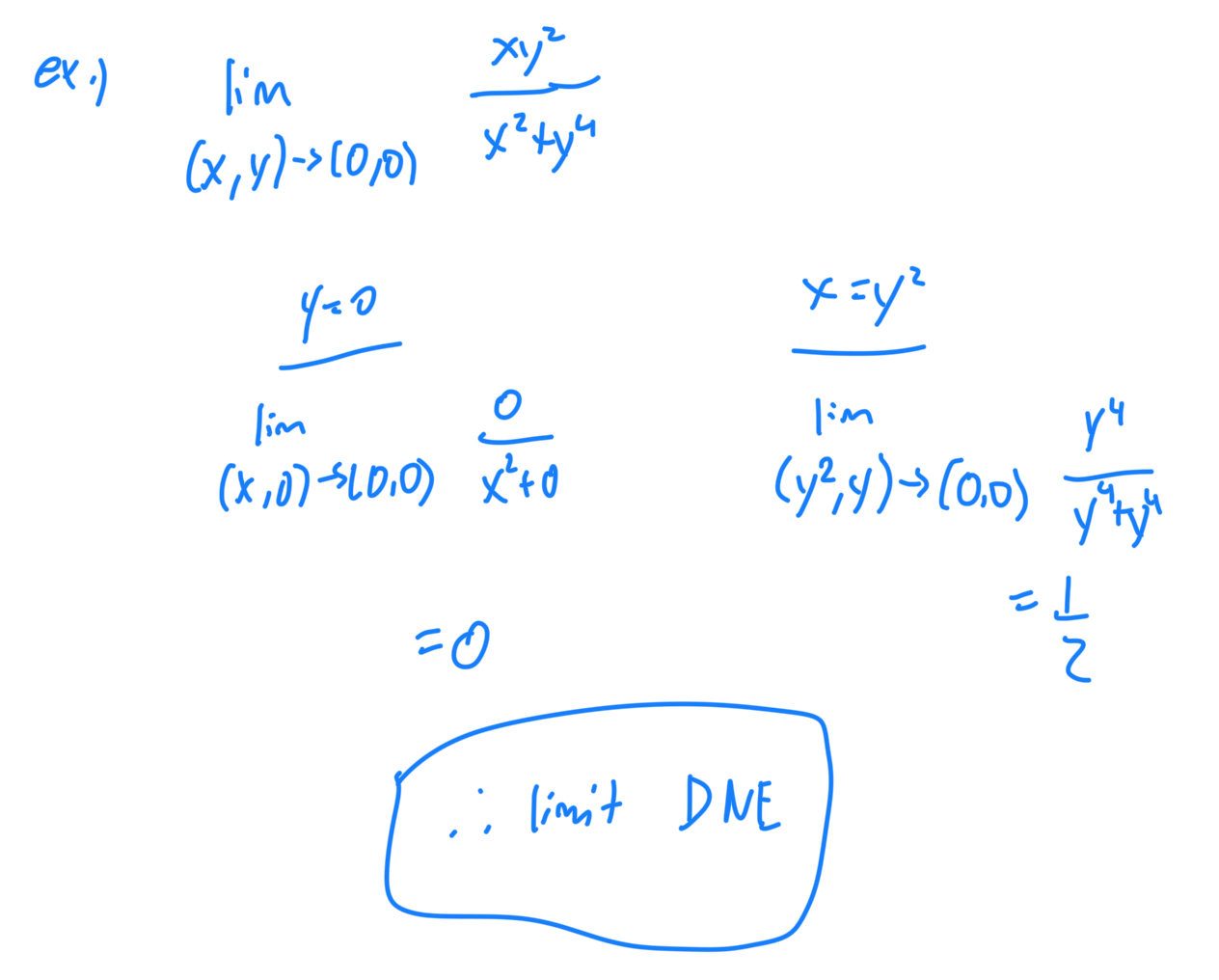
DNE = show that the limit gives different values through different paths
EXISTS = algebra or squeeze theorem
3 step process for sketching parametric curves =
Find intercepts (x = 0 or y = 0)
Find points where curve is horizontal/vertical
Take dy/dt / dx/dt
horizontal when numerator = 0
vertical when denominator = 0
Get test points
HAVE ARROWS TO LABEL DIRECTION
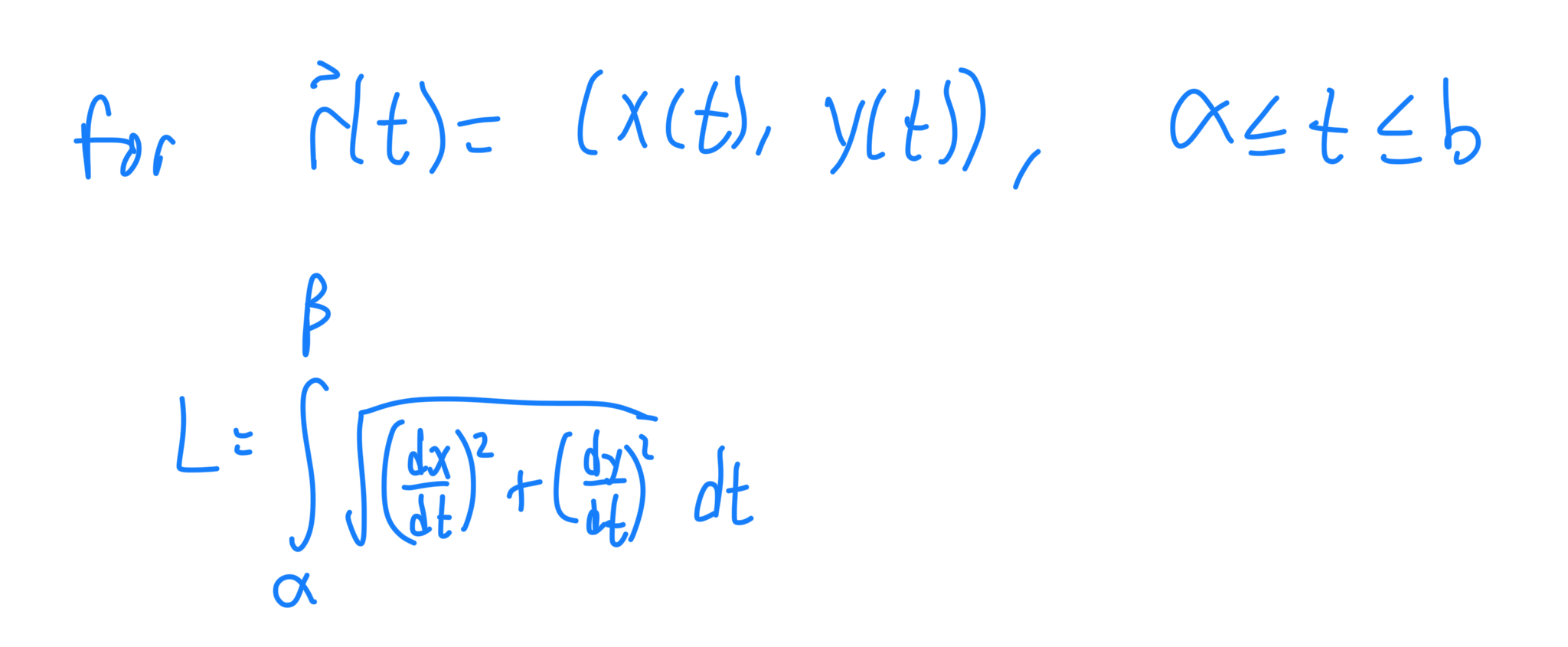
length of a parametric arc formula =
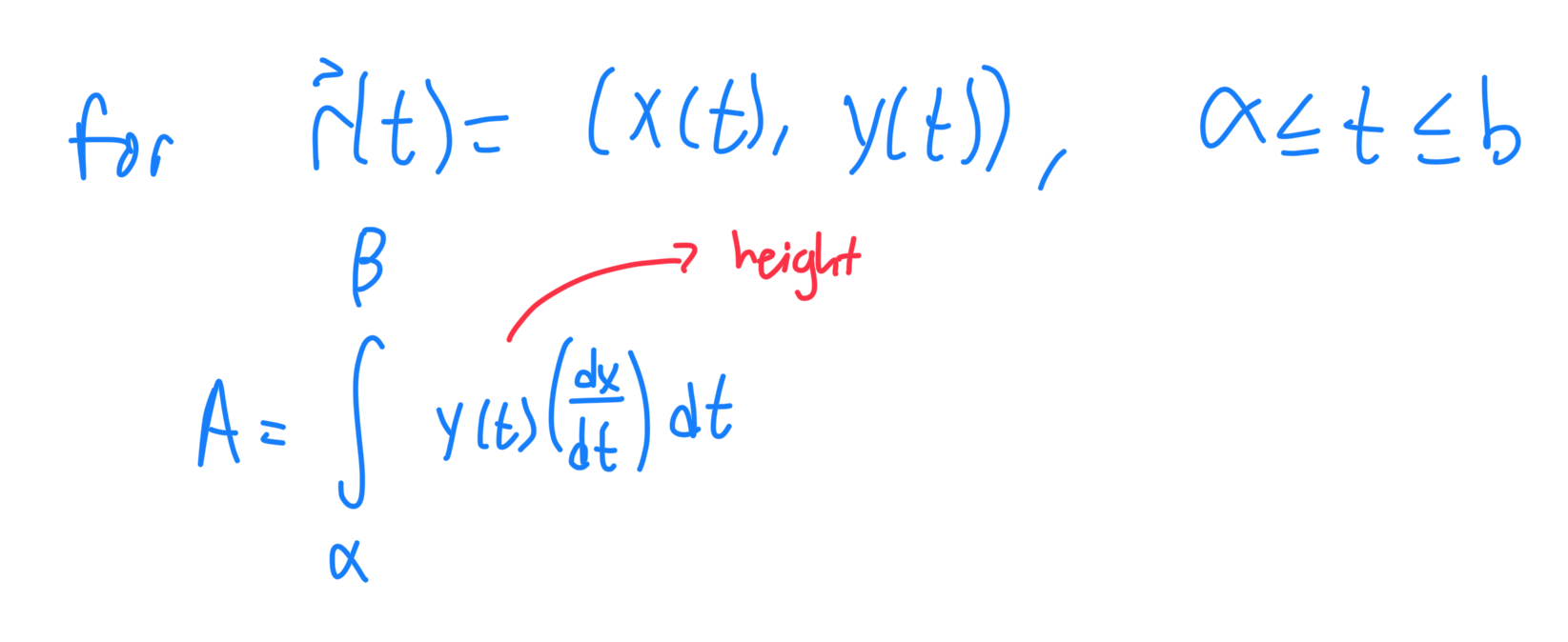
area under a parametric curve formula =
given ax + by + cz = n, what is the normal vector to the plane =
<a, b, c>
Lagrange Multiplier formula and purpose =
λ = lagrange multiplier. Optimizes a function constrained by a function g(x, y) = k ONLY.
∇f→ = λ∇g→ ONLY IF ∇g→ ≠ 0→
How to find abs max/min with lagrange multipliers =
IF INEQUALITY: Find critical points ∇f→ = 0→ and sub into f(x, y). (Must satisfy constraint)
Solve ∇f→ = λ∇g→ and g(x, y) = k to get points, sub in f(x, y)
Solve ∇g→ = 0→ and g(x, y) = k, sub in f(x, y) [IF THERE EXISTS SOLUTIONS]
If the constraint g(x, y) = k has endpoints, evaluate f(x, y) at these points
max = largest computed f
min = smallest computed f
Average value of a 2D function over a region D =
[∬_D f(x, y) dA] / [∬_D dA]
If D is difficult to integrate whole (∬_D f dA), what to do =
Split up into two non overlapping regions.
∬_D f dA = ∬_D₁ f dA + ∬_D₂ f dA
ONLY IF D₁ ∩ D₂ = ∅ and D = D₁ ∪ D₂
Plane intercept formula =
[x / a] + [y / b] + [z / c] = 1
Line intercept formula =
[x / a] + [y / b] = 1
How to calculate volume under a surface z =
Given z = h(x, y) and region D in the xy-plane
∬_D h(x, y) dx dy
ONLY IF h(x, y) ≥ 0
If m ≤ f(x, y) ≤ M on region D =
m ∬_D dA ≤ ∬_D f(x, y) dA ≤ M ∬_D dA
also: mA ≤ ∬_D f(x, y) dA ≤ MA
how to create height function for volume =
Function/curve on TOP - Function/curve on BOTTOM
ex.) f: 3z = 4 - x² - y²
g: z = x² + y²
f opens DOWN, g opens UP
h(x, y) = f(x, y) - g(x, y)
f is ABOVE g
how to solve lagrange multipliers if there are more variables than equations =
solve in terms of one variable, then sub them into constraint eqn
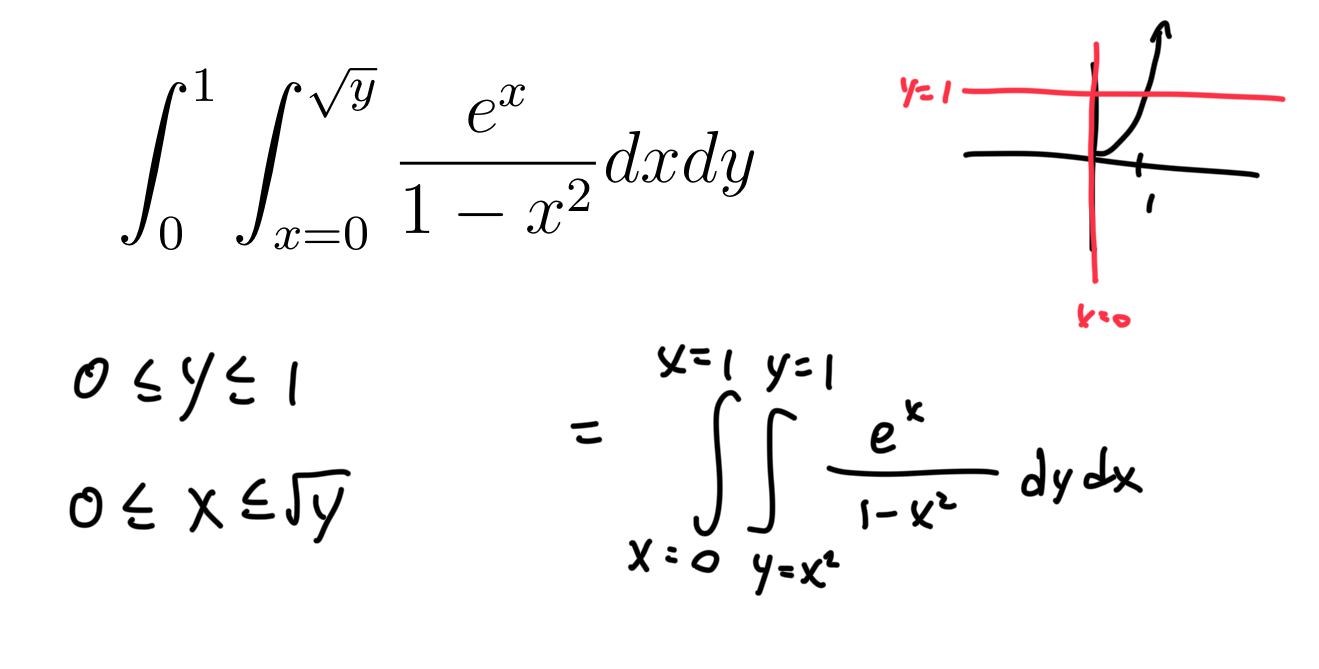
how to reverse order of integration (double integral)
get intervals, + graph it
for bounds: look for the swapped variable:
lower function = lower bound
higher function = higher bound
cos²(x) half angle identity =
(1 + cos2x)/2
sin²(x) half angle identity =
(1 - cos2x)/2