1.11 electrode potentials and cells, commercial electrochemical cells
 Call Kai
 Learn
Learn Practice Test
 Spaced Repetition
 Match
Match Flashcards
 Knowt Play
1/45

There's no tags or description
Looks like no tags are added yet.
Name | Mastery | Learn | Test | Matching | Spaced | Call with Kai |
|---|
No analytics yet
Send a link to your students to track their progress
46 Terms
oxidation vs reduction
oxidation
loss of electrons / loss of hydrogen
reduction
gain of electrons / gain of hydrogen
oxidising agent vs reducing agent
oxidising agent
electron acceptor
gets reduced
reducing agent
electron donor
gets oxidised
half equations
what they show
where we find e- in a half equation for reduction and oxidation
either show reduction OR oxidation
represent a dynamic equilibrium as reduction and oxidation are reversible processes
reduction: e- on LHS of half equation
oxidation: e- on RHS of half equation
redox equations
what they show
where we find e- in a redox equation for reduction and oxidation
show both reduction AND oxidation, is a combination of 2 half equations
e- cancel out on both sides so not shown
anode vs cathode
anode = positive electrode
cathode = negative electrode
electrode potential, EƟ
a number that indicates how readily a substance gains electrons
i.e. how well a substance acts as an oxidising agent
electrochemical series
a list of standard electrode potentials for half equations in numerical order
always shows the half equations as reversible reduction reactions
oxidising agents on LHS of half equation in series
reducing agents on RHS of half equation in series
largest electrode potential means…
best oxidising agent
forward reaction (where e- is gained) is very likely to occur
reverse reaction (where e- is lost) is very unlikely to occur
smallest electrode potential means…
best reducing agent
the reverse reaction (where e- is lost) is very likely to occur
forward reaction (where e- is gained) is very unlikely to occur
components of a standard electrochemical cell
2 half cells
different solutions and electrodes
voltmeter
measures EMF (pd)
high resistance to prevent current flow so that current is zero, so max EMF accurately measured
salt bridge
ions are able to move through it
it completes the circuit (provides an electrical connection between the two solutions)
standard electrode potentials, EƟ, refers to what conditions?
298 K
1 moldm-3 solution of ions (aqueous ionic compound, e.g. a chloride)
100 kPa of gases
what substance is used as the salt bridge and why?
saturated potassium nitrate solution, KNO3 (aq)
soluble ionic solution
does not react with chemicals in the half cells
can also use KCl
why and when platinum may be used as an electrode
why:
it is chemically inert
it is an electrical conductor and provides a surface for electron transfer
it stays stable in acidic conditions
when:
used for standard electrochemical cells
used for a mixture of two solutions
used for a solution and a gas
types of half cells
solid metal with metal ions
electrode: piece of pure metal, e.g. Cu and Zn
electrolyte: aqueous ions from 1 moldm-3 chloride solution, e.g. CuCl2 (Cu2+) and ZnCl2 (Zn2+)
mixture of two solutions, or one solution one gas
electrode: piece of platinum, Pt
electrolyte: aqueous ions from 1 moldm-3 chloride solution, e.g. FeCl2 (Fe3+) and FeCl3 (Fe2+)
LHS half cell vs RHS half cell
LHS
R → O
gets oxidsed
smaller EƟ
more reactive metal
RHS
O → R
gets reduced
larger EƟ
less reactive metal
conventional cell representation
R O | | O R
LHS = gets oxidised, smaller EƟ
RHS = gets reduced, larger EƟ
| | in the middle for salt bridge
oxidising agents are closest to the salt bridge
~
always include state symbols
phase boundaries
comma if in same phase
vertical line if in different phases
~
if platinum electrode used, place on outermost point and use vertical line for phase boundary
include H+ but not water

give the conventional cell representation
Zn (s) | Zn2+(aq) | | Cu2+(aq) | Cu (s)


give the conventional cell representation
Fe (s) | Fe2+(aq) | | VO2+ (aq) , H+(aq) , V3+(aq) | Pt(s)

electromotive force (EMF)
potential difference
the difference between the electrode potential of 2 half cells or 2 half equations
the energy that is transferred per unit charge/per mole of electrons flowing between 2 points
Ecell or EMF = ?
EƟ RHS - EƟ LHS
larger EƟ - smaller EƟ
if EƟ a > EƟ b, then…
a can oxidise b, because a is a better oxidising agent
b can reduce a, because b is a better reducing agent
to oxidise another species, i need to have…
a larger EƟ than that species
to reduce another species, i need to have…
a smaller EƟ than that species
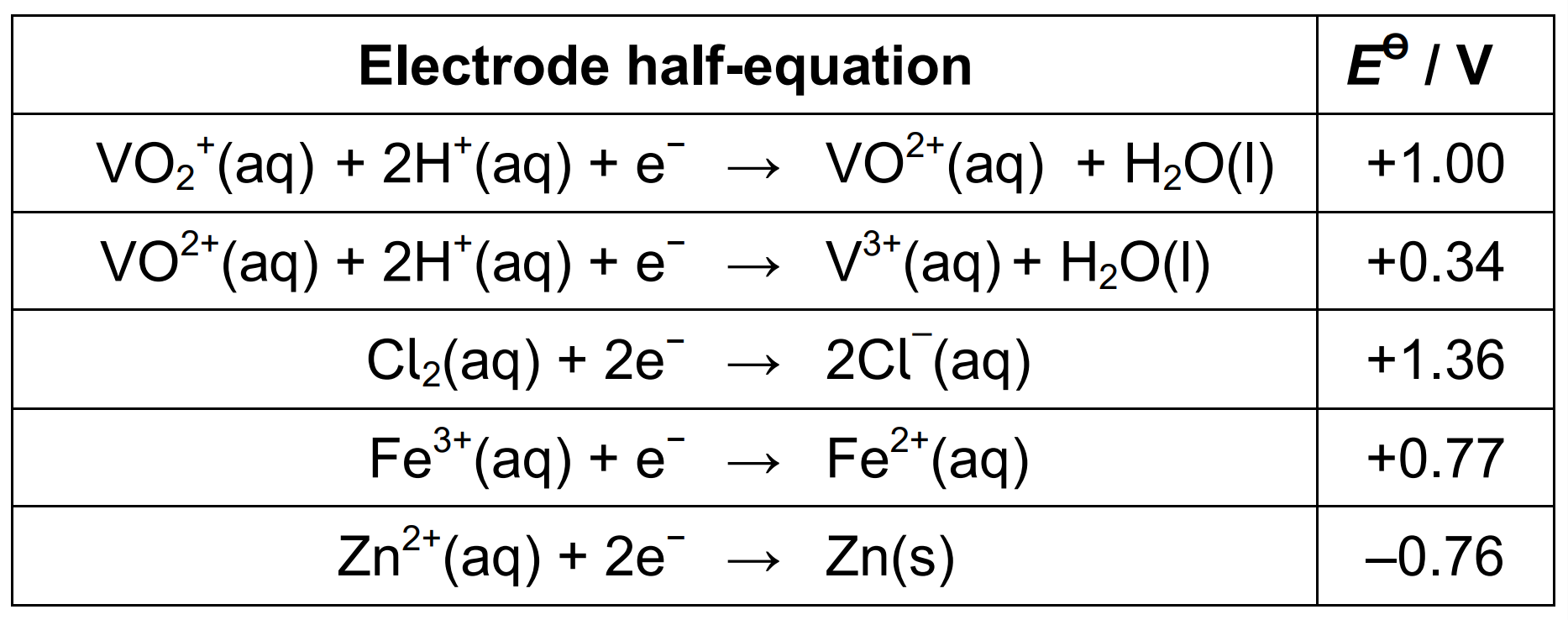
Identify the species that can be used to reduce VO2+ ions to VO2+ ions in aqueous solution and no further.
Explain your answer.
(2 marks)
Fe2+
(NOT Fe3+, remember reducing agents are on the RHS)
EƟ VO2+ > EƟ Fe3+ > EƟ VO2+
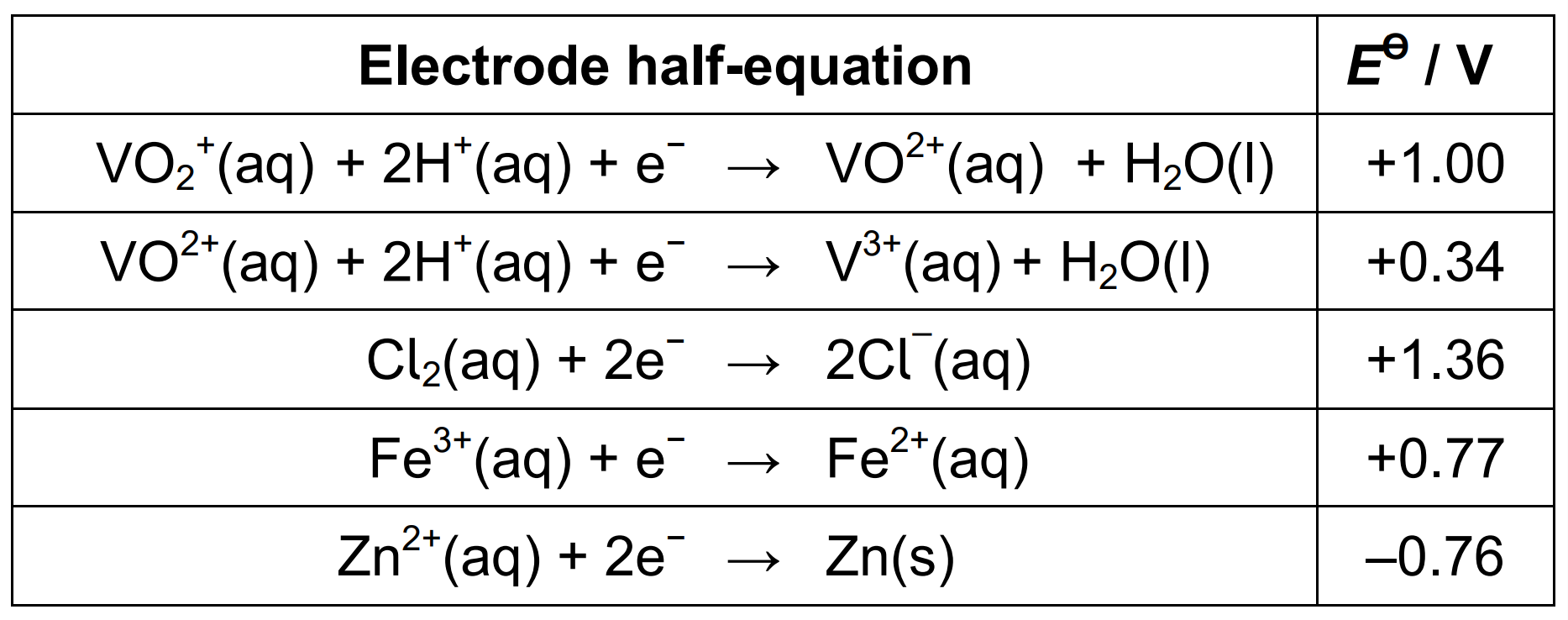
Au+ + e- → Au EƟ = +1.68 V
O2 + 4H+ + 4e- → 2H2O EƟ = +1.23 V
Explain what happens when a soluble gold (I) compound containing Au+ ions is added to water.
State what you would observe.
Write an equation for the reaction that occurs.
EƟ Au+ > EƟ O2 + H+
so Au+ oxidses H2O to form O2
observation: effervescence, solid gold forms
equation: 4 Au+ + 2 H2O → 4 Au+ + 4 H+ + O2
when would a redox reaction not occur?
Ecell or EMF is negative
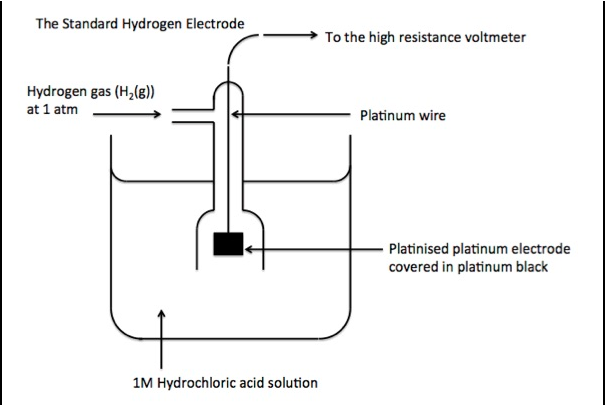
the standard hydrogen electrode
how to set it up
is a reference used to measure unknown electrode potentials
has EƟ = 0.0 V
set up:
solution of aqueous HCl, with H2 gas pumped in from the side to react with the H+ on a Pt electrode
this half cell is placed on LHS and connected to the standard cell of another species, using a voltmeter and a salt bridge
voltmeter has high resistance → no current flowing, so voltmeter reading accurately indicates max EƟ of the unknown
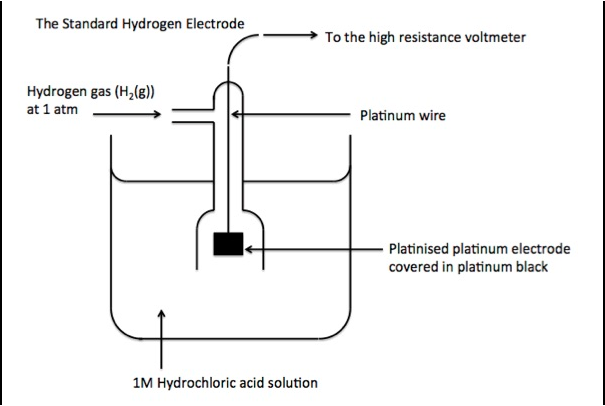
conditions of standard hydrogen electrode
conventional cell representation for standard hydrogen electrode
conditions:
298 K and Pt electrode
1 moldm-3 HCl solution (or HNO3)
H2 gas at 100 kPa
representation:
Pt (s) | H2 (g) | H+ (aq) | | other standard cell
how do reaction conditions affect EMF?
changes in concentration of ions or gas pressure shift equilibrium
e.g. conc is not / is less than 1 moldm-3
EƟ increases if conditions shift equilibrium to RHS of the reduction reaction
EƟ decreases if conditions shift equilibrium to LHS of the reduction reaction
more electrons formed = more negative EƟ
effects of replacing the voltmeter with a lamp / wire / ammeter
chemical reaction occurs
conc of reactants will decrease as they are being used up
cell reaction goes to completion
current will flow through circuit
EMF decreases to 0 V
what doesn’t affect electrode potentials?
changes that don’t affect equilibrium
e.g. changing the surface area of electrodes
commercial electrochemical cells
electrochemical cells used as a commercial source of electrical energy
negative and positive cathode in commercial electrochemical cells
negative terminal / negative electrode:
half equation with smaller EƟ
oxidation, as reducing agent loses e-
positive terminal / positive electrode:
half equation with larger EƟ
reduction, as oxidising agent gains e-
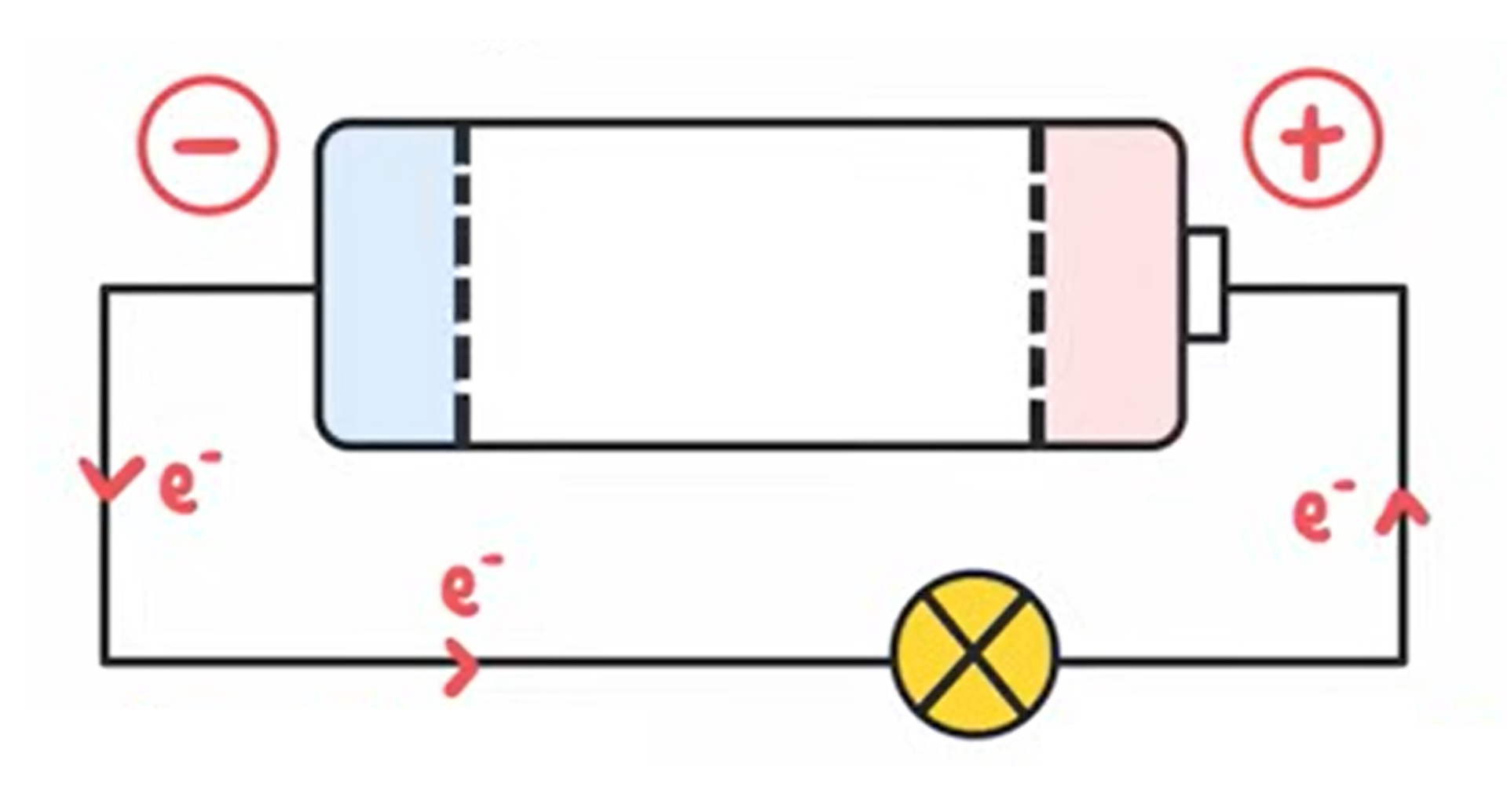
movement of electrons and ions in commercial electrochemical cells
reducing agent releases e- released at negative electrode
e- move through an external circuit
e- transfer their energy to a lamp/bulb/etc.
oxidising agent gains e- at positive cathode
ions move through salt bridge (electrolyte) from positive cathode to negative cathode, to complete the circuit and balance overall charge
potential difference created that can drive an electrical current to do work
why could the EMF in commercial electrochemical cells be different than expected?
non-standard conditions
rechargeable cell
the reactions are reversible
to recharge, apply a reverse potential to force electrons to move in the opposite direction, causing the redox reaction to reverse
pros
minimises waste and use of natural resources
cons
more expensive to make and buy
if electricity used to recharge the cell is generated by burning fuels, CO2 is released so contributes to global warming
reactants are used up, so conc of reactants decreases, and evenutally conc of ions in the two solutions become equal, so EMV decreases to 0 V
rechargeable cell example and uses
lithium ion cells
used in phones, laptops and cars
rechargeable cell example - electrodes and half equations at these electrodes
negative electrode - graphite (oxidation)
Li → Li+ + e–
positive electrode - lithium cobalt oxide (reduction)
Li+ + CoO2 + e– → Li+ [CoO2 ]–
overall
Li + CoO2 → Li+ [CoO2]–
rechargeable cell example - why an aqueous electrolyte is not used
Li would react (violently) with water / electrolyte
EƟ H2O > EƟ Li, so water will oxidise Li to Li+
non-rechargeable cells
one or both of the reactions are not reversible
pros
cheaper to produce and buy
cons
single use
reactants are used up, so conc of reactants decreases, and eventually conc of ions in the two solutions become equal, so EMV decreases to 0 V
use finite resources
release toxic chemicals as they corrode so pollute environment
porous separator
acts as a salt bridge:
ions are able to move through it
it completes the circuit
fuel cells
generate an electric current without needing to be electrically recharged
EMF does not change with use because:
concentrations of reactants remain constant
reactants / fuel can be continuously supplied
more energy efficient than combusion reactions so less energy is wasted as heat, because energy gets converted into a useful form such as kinetic energy for vehicles
which type of fuel is stored and transported more easily:
liquid fuel or gas fuel?
liquid
hydrogen-oxygen fuel cells
uses a continuous supply of H2 (fuel) and O2 from air, to generate a continuous current
pros:
water is the only waste product, no CO2 or SO2 released
same overall reaction as combusion of hydrogen but is much more energy efficient than combustion → less energy wasted as heat
cons:
expensive to produce as H2 is very flammable
use of finite resources to generate H2, e.g. using methane and reacting with steam
CH4 (g) + 2H2O (g) → 4H2 (g) + CO2 (g)
burning fossil fuels to generate electricity to generate H2
use renewable energy resources to power electrolysis of water
alkaline hydrogen-oxygen fuel cell half equations
KOH electrolyte between electrodes (OH- moves through salt bridge)
negative electrode (oxidation)
2 OH- + H2 → 2 H2O + 2 e-
positive electrode (reduction)
O2 + 2 H2O + 4 e- → 4 OH-
overall
2 H2 (g) + O2 (g) → 2 H2O (l)
why are the EMF values of acidic and alkaline hydrogen-oxygen fuel cells are the same?
because same overall reaction:
2 H2 (g) + O2 (g) → 2 H2O (l)