DNA Replication
 Call Kai
 Learn
Learn Practice Test
 Spaced Repetition
 Match
Match Flashcards
 Knowt Play
1/23

Earn XP
Description and Tags
SBI4U - Howes
Name | Mastery | Learn | Test | Matching | Spaced | Call with Kai |
|---|
No analytics yet
Send a link to your students to track their progress
24 Terms
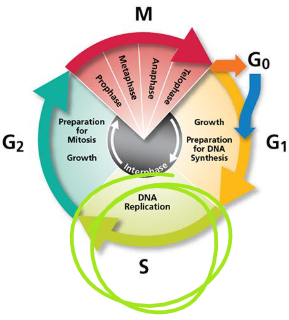
DNA replication takes place during the __ phase of ___________
S, interphase
Meselson & Stahl hypothesis
DNA replication is semiconservative
describe Meselson & Stahl’s experiment
grew E.coli bacteria on a medium w. a heavy nitrogen isotope (15N)
since nitrogen is used to make the bases, after ~17 gens, almost all bacteria’s DNA contained 15N bases
some bacteria were then placed onto a medium w. a light nitrogen isotope (14N) and allowed to replicate
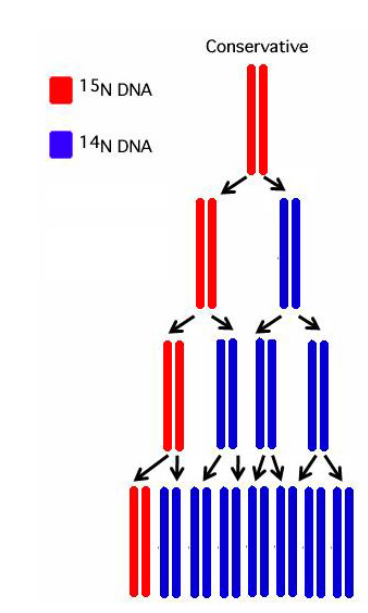
if DNA was conservative, what would the results be?
the 1st gen would be 50% light, 50% heavy
the 2nd gen would be 75% light, 25% heavy (the “untouched” OG dna)
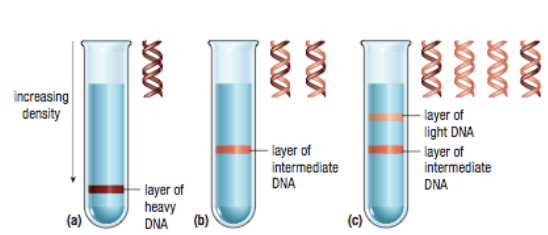
since DNA is semiconservative, what were the results?
the 1st gen was 100% intermediate weight
the 2nd gen was 50% light, 50% intermediate
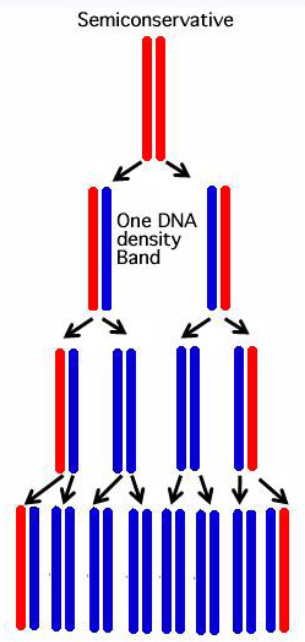
describe what it means to for DNA to be semiconservative
each new DNA molecule consists of one original (parental) strand and one newly synthesized strand
⇨ instead of conservative: the new DNA molecule is 100% new stuff
3 steps of DNA replication
DNA is prepped (unzipping)
New DNA is synthesized
The finishing touches
Helicase
an enzyme that unwinds and separates DNA strands by breaking H-bonds btn bases
when helicase separates DNA strands, this creates:
a replication bubble
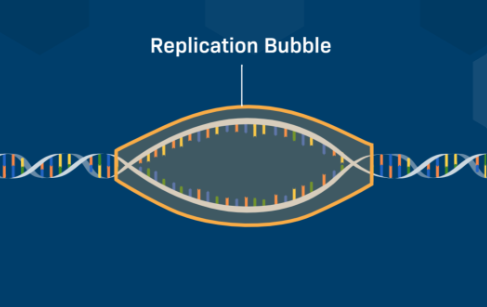
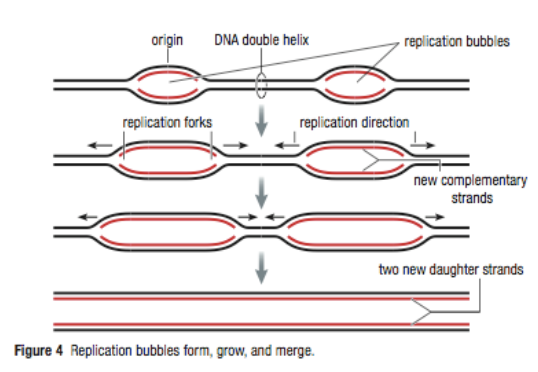
__ to __ replication bubbles occur _____________ at many spots along the DNA strand; they _____ and then ______
1-3, simultaneously, grow, merge
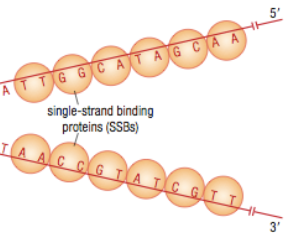
Single-Stranded Binding Proteins (SSBP)
bind to exposed bases to prevent hydrogen bonds from reforming/bases from annealing
Topoisomerase
relieves tension: cuts both strands of DNA, allowing them to swivel, and then resealing
DNA is always synthesized in the __ to __ direction
5’ ➙ 3’
RNA Primase
makes an RNA primer, which it attaches to the parent strand
importance of RNA primers
indicates to DNA polymerase III where to start synthesizing
DNA Polymerase III
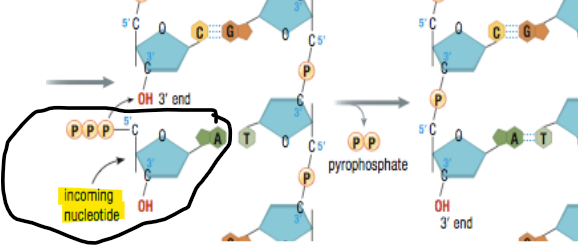
makes complementary DNA using deoxyribonucleoside triphosphates
DNA polymerase III can only attach a new __________ to the ___ end
nucleotide, 3’ end
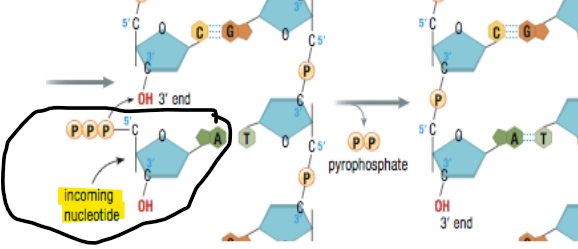
Deoxyribonucleoside Triphosphates
composed of a deoxyribose sugar, nitrogenous base, and 3 phosphates
☆ the other 2 phosphates are used to provide energy!
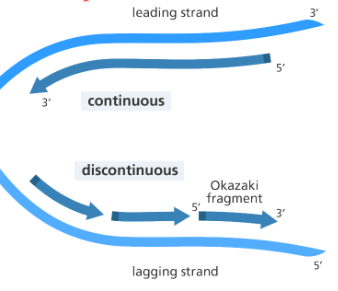
Leading vs Lagging Strand
Leading: continuous, built towards replication fork
Lagging: discontinuous, built away, from replication fork in Okazaki Fragments
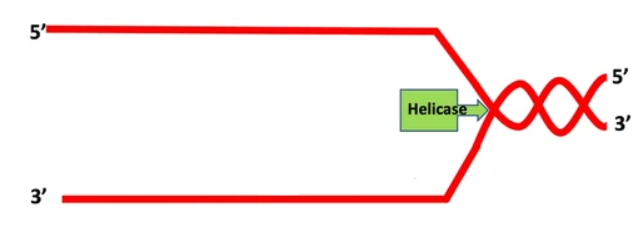
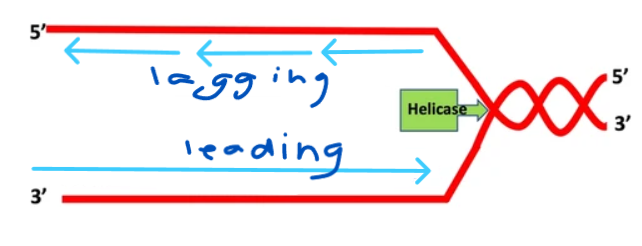
identify the lagging and leading strands
Top: LAGGING strand
Bottom: LEADING strand
DNA Polymerase I
cuts out the RNA primers and replaces them with the appropriate DNA nucleotides
DNA Ligase
forms phophodiester bonds that join the okazaki fragments together
After the finishing touches of DNA polymerase I and DNA ligase, the two new ________ _____ will then ____ into a double helix
daughter strands, twist
how is proofreading done during replication?
DNA polymerase I and III proofread the bases, and if a mistake is found it’s cut out and replaced witht the correct nucleotide