Proteins
 Call Kai
 Learn
Learn Practice Test
 Spaced Repetition
 Match
Match Flashcards
 Knowt Play
1/21

There's no tags or description
Looks like no tags are added yet.
Name | Mastery | Learn | Test | Matching | Spaced | Call with Kai |
|---|
No analytics yet
Send a link to your students to track their progress
22 Terms
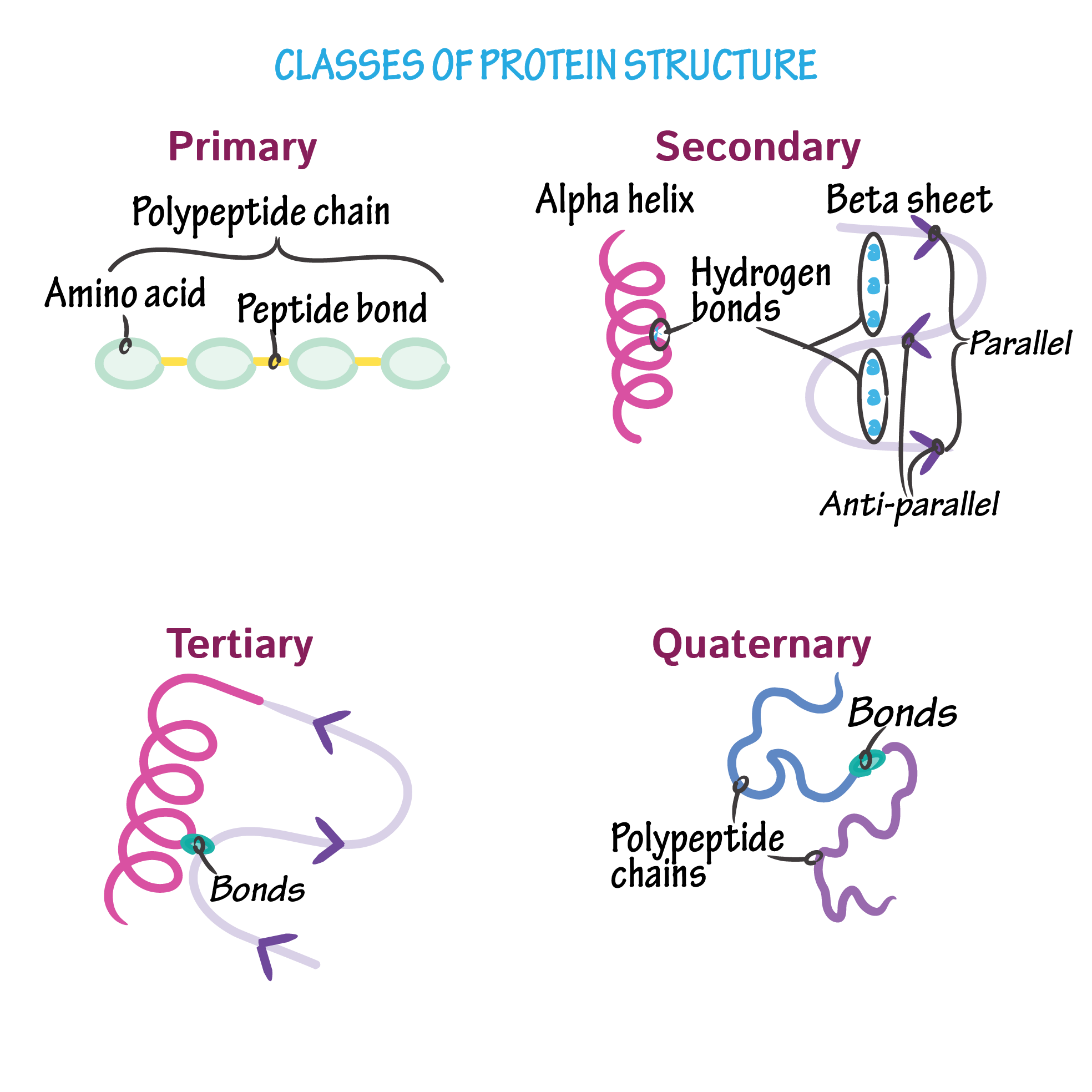
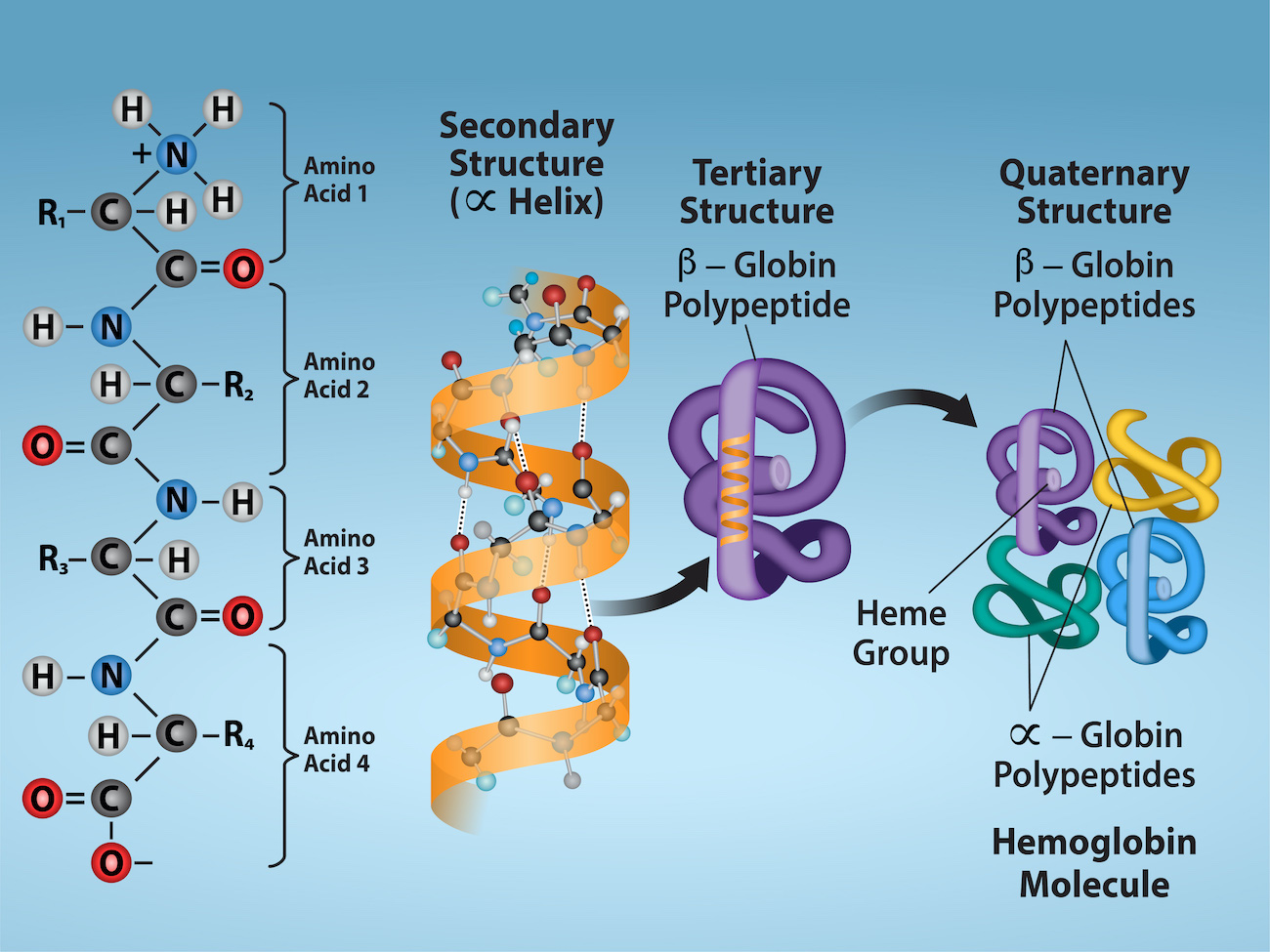
primary structure
sequence of amino acids that spontaneously fold into 3D structures determined by sequence
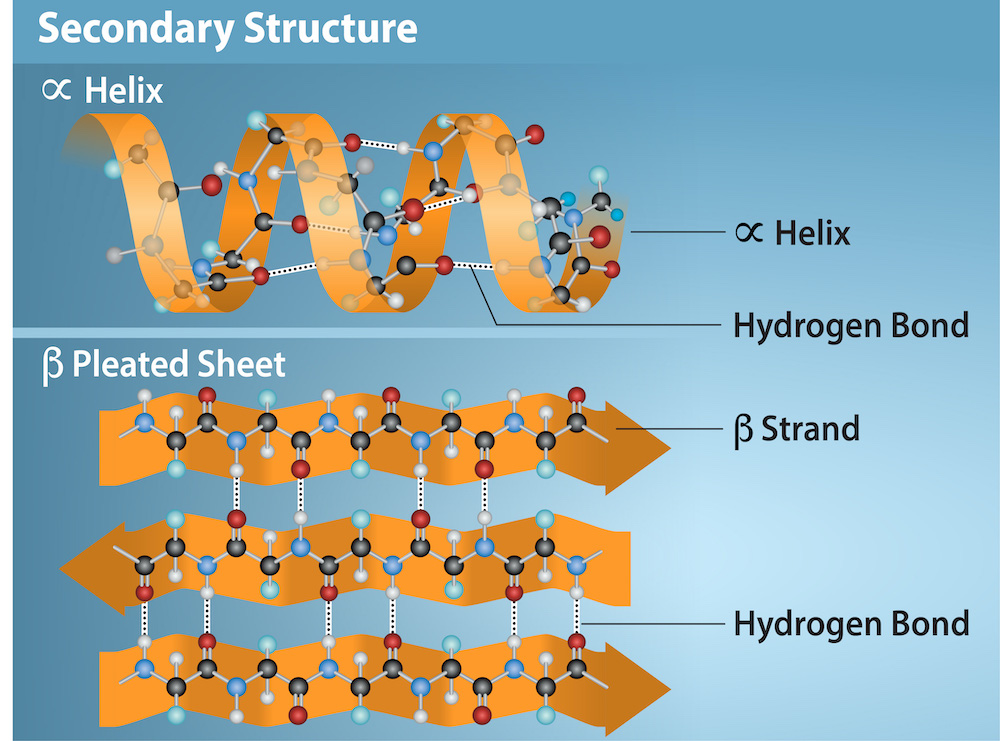
secondary structure
3D structure formed by H-bonds (non-covalent bonds) between amino acids near one another
e.g. alpha helices, beta pleated sheets
tertiary structure
formed by long-range interactions between amino acids; structure that protein dunction depends on
“Proteins are embodiment of the transition from 1D world of sequence to 3D world of molecules capable of diverse activities“
quartenary structure
structure many proteins display where functional protein is composed of several distinct polypeptide chains
proteins
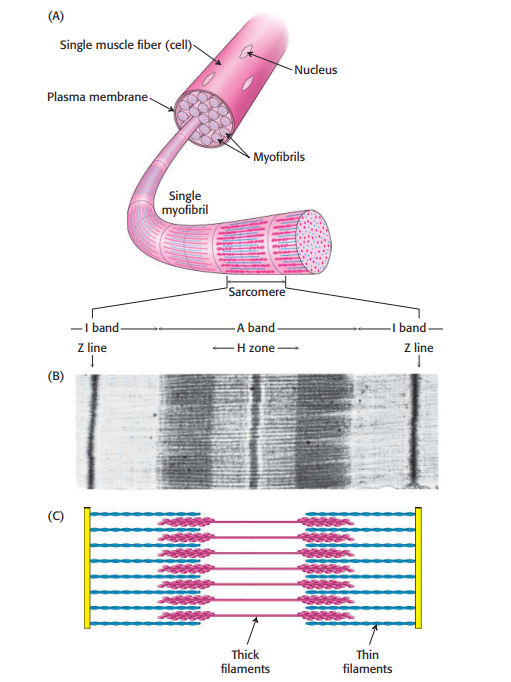
versatile macromolecules in living systems and serve crucial functions in essentially all biological processe
catalysts, transport, cell communication, support & immune protection, generate movement, transmit nerve impulses, control growth, control differentiation, etc.
Key properties of proteins
Proteins are linear polymers built of monomer unites called amino acids
Proteins contain a wide range of functional groups
functional groups (e.g. alcohols, thiols, thioethers, carboxylic acids, carboxamides, basic groups, etc.)
often chemically reactive
when combined in various sequences (array of functional groups accounts for broad spectrum of protein functions)
Proteins can interact with one another & with other biological macromolecules to form complex assemblies
proteins in assemblies can act synergistically (generate capabilities that individual proteins may lack)
Some proteins are quite rigid, whereas others display considerable flexibility
rigid units can function as structural elements in cytoskeleton or connective tissue
proteins (flexibility): act as hinges, springs, levels
conformational changes within proteins → enable regulated assmebly of larger protein complexes & transmittion of info within and between cells (e.g. lactoferrin undergoes conformational change on binindg iron - allows other molecules to distinguish between ion-free and iron-bound forms)
amino acids
building blocks of proteins
alpha-amino acid
1) central carbon atom (alpha carbon)
2) amino group
3) carboxylic acid group
4) hydrogen atom
5) distinctive R group (side chain)
4 different substituents of asymmetric carbon atom → assigned priority according to atomic number (lowest often H - positioned away from viewer)
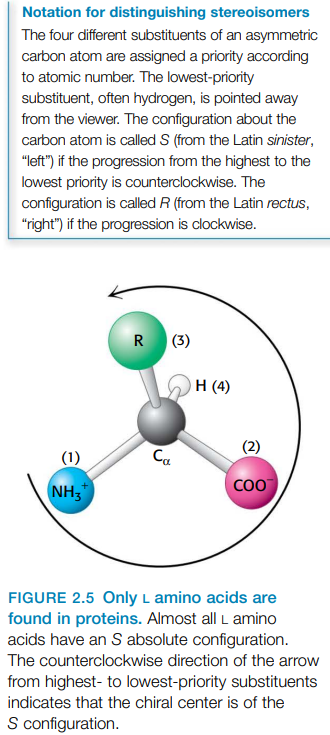
alpha amino acids = chiral
with 4 different groups connected to tentrahedral alpha amino acids
= may exist in one or the other of 2 mirror-image forms (L isomer & D isomer)
S vs. R progression
S (left) progression = if progression from highest to lowest priority is counterclockwise (what almost all L amino acids have, only L amino acids found in proteins)
R (right) progression = if progression from highest to lowest priority is clockwise
Why only L amino acids constituents of proteins?
A. Preference for L over D amino acids as consequence of chance selection
B. L-amino acids slightly more soluble than D + L (tend to form crystals) - small solubility difference → pot. amplified over time so that L isomer become dissolves in solution
isomer
a molecule or polyatomic ion that shares the same molecular formula as another compound, but possesses a different arrangement of atoms in space
zwitterions & amino acids + properties
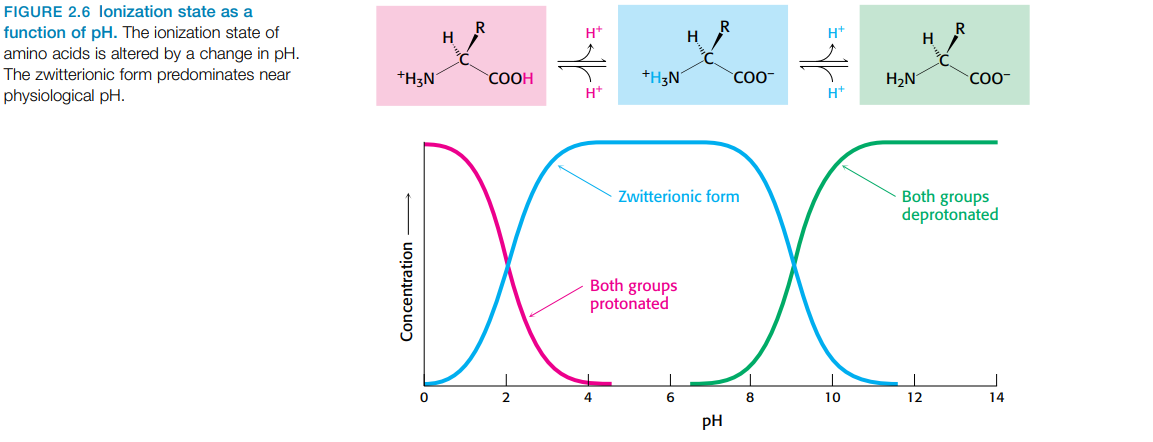
= dipolar ions in solution at neutral pH
amino group protonated (— NH3+) — also in acid solution
carboxyl group deprotonated (— COO-) — in acid carboxyl gorup not dissociated (—COOH), first group to give up proton inasmuch as its pKa = near 2
ionization state of amino acid → varies with pH
dipolar form persits unitl pH of around 9 (amino group loses proton)
pKa
negative base-10 logarithm of the acid dissociation constant Ka of a solution. It serves as a quantitative measure to indicate the strength of an acid. The lower the value, the stronger the acid and the more easily it will give up its protons
20 main types of amino acids in natural proteins (variation)
vary in size, shape, charge, hydrogenbonding capacity, hydrophobic character & chemical reactivity
Classification of amino acid (based on general chemical characteristics of their R groups)
1. Hydrophobic amino acids with nonpolar R groups
2. Polar amino acids with neutral R groups but the charge is not evenly distributed
3. Positively charged amino acids with R groups that have a positive charge at physiological pH
4. Negatively charged amino acids with R groups that have a negative charge at physiological pH
hydrophobic amino acids
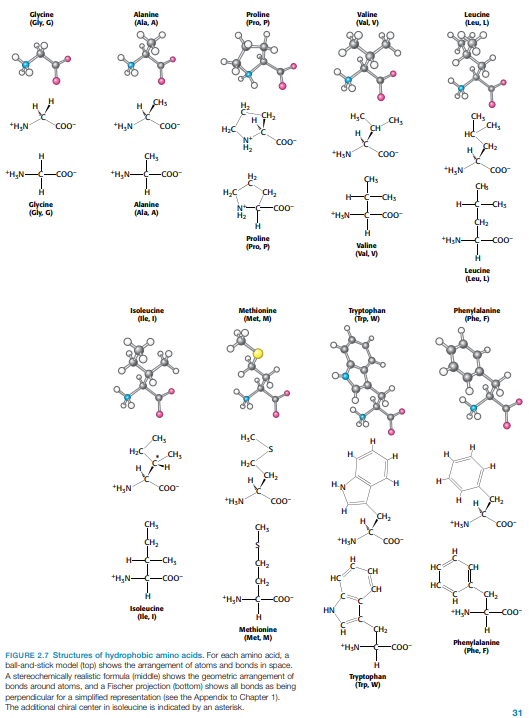
= non-polar R groups, hydrophobic (some more strongly than others)
e.g.
glycine → single hydrogen atom as side chain (2 hydrogens bonded to alpha carbon atom => achiral)
alanine → side chain = methyl group (—CH3)
valine, leucine, and isoleucine → larger hydrocarbon side-chains (isoleucine: side chain includes additional chiral center, only 1 isomer found in proteins)
methionine → largely aliphatic side chain, includes a thioether (— S —) group
proline → aliphatic side chain (bonded both to nitrogen and alpha carbon atoms => pyrrolidine ring), influences protein architecture bcs cyclic structure makes more conformationally restricted than other amino acids
2 amino acids with relatively simple aromatic side chains:
phenylalanine → phenyl ring in place of one of H-atoms of alanine (purely hydrophobic)
tryptophan → has indole group joined to a methylene (—CH 2—) group, two fused rings containing an NH group (also synthesis of serotonin), not purely hydrophobic bcs NH group
polar amino acids
= polar, overall neutral R groups
serine, threonine, and tyrosine → contain hydroxyl groups (— OH) - serine: version of alanine with hydroxyl group attached; threonine: resembles valine with a hydroxyl group in place of one of valine’s methyl groups & asymmetrical center with only one isomer in proteins; tyrosine: version of phenylalanine with hydroxyl group replacing a hydrogen atom on aromatic ring
asparagine & glutamine → contain a terminal carboxamide, side chain of glutamine one methylene group longer than that of asparagine
cysteine → structurally similar to serine, contains sulfhydryl, or thiol (—SH), group in place of hydroxyl (—OH) group (sulfhydryl - much more reactive)
hydroxyl group → makes amino acids more hydrophilic & reactive
positively charged amino acids
negatively charged amino acids
aliphatic side chain
chains contain only carbon and hydrogen atoms arranged in straight, branched, or cyclic chains
especailly hydrophobic (tend to cluster together rather than contact water)
hydrophobic effect
effect through hydrophobic amino acids
=> 3D structures of watersoluble proteins stabilized by tendency of hydrophobic groups to cluster together
different sizes &shapes of these hydrocarbon side chains enable them to pack together to form compact structures with little empty space