National and Local Government Relationship
 Call Kai
 Learn
Learn Practice Test
 Spaced Repetition
 Match
Match Flashcards
 Knowt Play
1/6

There's no tags or description
Looks like no tags are added yet.
Name | Mastery | Learn | Test | Matching | Spaced | Call with Kai |
|---|
No analytics yet
Send a link to your students to track their progress
7 Terms
Local Government Code of 1991
RA 7160
the law that underlies the country’s fiscal, political, and administrative decentralization program.
a major legislative achievement of the Eighth Congress (1987-1992)
Article X, Section 3, 1987 Constitution - to enact “a local government code which shall provide for a more responsive and accountable local government structure instituted through a system of decentralization”
Sec. 521. Mandatory Review Every Five Years
The Congress shall undertake a mandatory review of this Code at least once every five (5) years and as often as it may deem necessary, with the primary objective of providing a more responsive and accountable local government structure.
Structure of LGU in the Philippines
NGA →
Either: Autonomous Regions → Independent Cities or HUC; → Barangays
Or: Provinces → Component City or/and Municipalities → Barangays
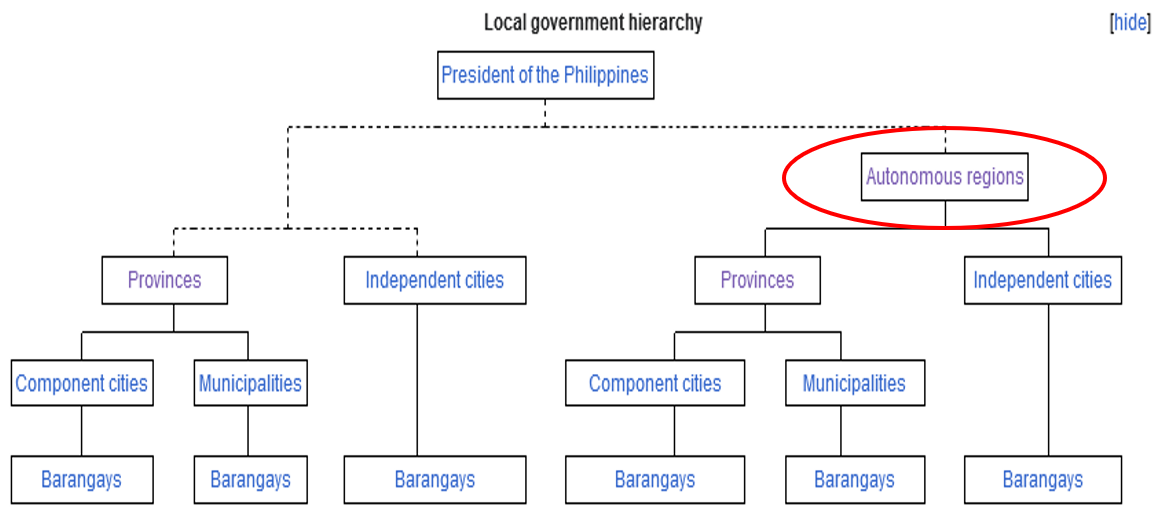
Autonomous Regions
have more powers than other local governments;
Muslim Mindanao (existing)
Cordilleras (planned)
Provinces
Outside the lone autonomous region, the provinces are the highest-level local government.
A province is governed by the governor and a legislature known as the Sangguniang Panlalawigan.
Cities and Municipalities
•Municipal Government in the Philippines is divided into three – independent cities, component cities, and municipalities.
•Several cities across the country are "independent cities" which means that they are not governed by a province, even though like Iloilo City the provincial capitol might be in the city.
•Independent city residents do not vote for nor hold provincial offices.
Barangays
the smallest of the local government units
A barangay's executive is the barangay captain and its legislature is the Sangguniang Barangay, composed of barangay councilors and the SK chairman.
the SK Chairman is the head of Sangguniang Kabataan
further divided into sitios and puroks but those divisions do not have leaders elected in formal elections