Week 2
 Call Kai
 Learn
Learn Practice Test
 Spaced Repetition
 Match
Match Flashcards
 Knowt Play
1/51

There's no tags or description
Looks like no tags are added yet.
Name | Mastery | Learn | Test | Matching | Spaced | Call with Kai |
|---|
No analytics yet
Send a link to your students to track their progress
52 Terms
What does the pre central gyrus do?
sends outgoing voluntary motor messages
What does the post central gyrus do?
receives conscious sensory information from bones, tendons and muscles
damage to the brain stem can result in what?
coma, complete paralysis (locked-in syndrome), cessation of breathing and heart rate regulation, inability to swallow, and severe vertigo
What are the three meninges layers that protect the brain and spinal cord from damage?
dura mater, arachnoid mater, and pia mater (inner)
subarachnoid space between the arachnoid and pia mater is filled with cerebrospinal fluid (CSF).
What is the role of white matter?
is mainly myelinated axons which surround grey matter and facilities fast transmission of signals between different areas of grey matter
What is grey matter?
Primary function of neuron cell bodies, dendrites + unmyelinated axons found in centre, forming a butterfly-like shape
function → processing and interpreting informatiom
if you wanted kick a ball how does the brain organise this:
1) motor cortex: initiates movement and pre central gyrus of frontal lobe imitates voluntary movement
2) sends signals through descending pathways in spinal cord upper motor neruons to lower motor neurons
3) lower motor neurons assigned to the muscles transmit these signals down their myelinated axon to synapse at the muscle fibres assigned to that neuron, the neuron + fibres = motor units
4) all fibres contract together via the sliding filament process shortening the muscle
5) contraction applies force transmitted → that’s attended to the bone, force pulls that bone back to the origin of the muscle
*can only perform movement that is permitted by that particular synovial joint
6) the cerebellum refines movement by coordinating timing, balance + accuracy
7) incoming sensory feedback from muscles + joints allows ongoing adjustments
brain labelled
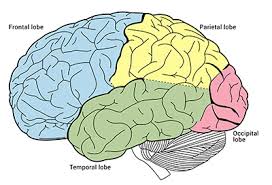
Which structure in the brain is primary responsible for the regulation of voluntary movement
frontal lobe
which part of the brain is primarily responsible for refinement and coordination, balance of movement?
cerebellum
What are the two roles of the somatic nervous system?
1) motor role: receives processed info from the brain and sends instructions from CNS to muscle and glands for a response
2) sensory role: detects stimuli (light + sound) + sends info to CNS
damage to frontal lobe:
weakness to one side of body and inability to plan or problem solve: impaired judgement + different control emotions
damage to parietal lobe:
Right Parietal Lobe: Damages typically lead to difficulty navigating, spatial disorientation, and neglect of the left side of the body.
Left Parietal Lobe: Damages often affect language, calculation, and writing, and can cause difficulty distinguishing left from right.
damage to cerebellum:
a wide, staggering walk (ataxia), clumsy or overshooting movements, slurred speech (dysarthria), involuntary eye movements (nystagmus), and tremors during purposeful actions
damage to brain stem
permanent brain death. If the injury is less severe, it may result in a coma, paralysis, or "locked-in syndrome," where a person is fully conscious but unable to move or speak.
What does the nervous system do?
coordinates and controls the body functions
What is the primary role of the spinal cord?
transmitting signals between brain and body
Which sequences best describes voluntary movement control?
brain plans movement → sends motor signal → muscle contraction
Which division of the nervous system controls voluntary movement?
somatic nervous system
What is a key function of the somatic nervous system?
coordinating and regulating voluntary movement
Which structure transmits commands to skeletal muscle?
motor neurons
Which statement best describes the interaction between systems during voluntary movement?
neural input activates muscle to produce movement
What is a primary factor determined by the musculoskeletal system
force capacity and range of motion
What is a spinal nerve?
a mixed fibres nerve
What does a motor unit consist of:
one motor neuron and all fibres it innervates
What does the term neuromuscular control mean?
the subconscious, trained response of muscles to signals from the nervous system, enabling coordinated movement, balance, and joint stability. It involves two-way communication where the brain directs muscle activation while receiving sensory feedback about body position, crucial for preventing injury and optimizing physical performance
Damage to the frontal lobe would most affect:
weakness to one side of the body, decision making and inability to plan or problem solve
Which term describes awareness of body position and movement?
proprioception
What is the name of the bony landmark and the bone the spinal cord leaves the brain stem to travel down the vertebral column?
forum of the occipital lobe
Why do children repeat movements during crawling and walking and standing?
motor development → developing, faster firing, more motor unit = brain gets smarter bc of repetition and trial/error
Why is neuromuscular training important in athletic skills and motor learning training?
Optimises: motor unit recruitment
Improves: proprioception, strength + power, balance + mobility
Decreases: injury risks
Which components form the foundation of neuromuscular training?
strength, power, balance, coordination and mobility
the nervous system controls voluntary movement by adjusting, organising and coordinating messages via which structures starting in the pre central gyrus
primary motor cortex → upper motor neuron → lower motor units
Neural input from motor cortex provide two main functions what are these functions and what their outcomes
motor unit recruitment = strength
faster firing = power
describe what is different for producing precision movement (fine motor control) compared to gross strength movement, powerful forces
small → precision + control
large → high force + power
Affect of physical decline due to older populations: Neuromuscular coordination
Ageing slows communication between the brain and muscles due to reduced nerve conduction and motor unit function. This leads to slower reaction times, poorer balance, and less coordinated movements, increasing falls risk
Affect of physical decline due to older populations: Reduced bone density
Bone mineral density decreases with age due to reduced bone formation and increased bone resorption. Bones become weaker and more fragile, making fractures more likely if a fall occurs
Affect of physical decline due to older populations: Sarcopenia
Sarcopenia is the age-related loss of muscle mass, strength, and power. Weaker muscles reduce the ability to maintain posture, recover from slips, and perform daily activities safely
Affect of physical decline due to older populations: Reduced proprioception and vestibular function
Ageing reduces the sensitivity of receptors in muscles, joints, and the inner ear. This impairs awareness of body position and balance, making it harder to maintain stability and increasing the likelihood of falls.
Two Differences in Sex Characteristics (Neuromuscular Systems) During and Post Puberty
1. Muscle mass and strength
Males experience greater increases in muscle mass and strength due to higher testosterone levels.
Females generally develop less muscle mass but maintain greater flexibility.
2. Body composition
Males tend to have a higher proportion of lean muscle mass and lower body fat percentage.
Females tend to have a higher body fat percentage and different fat distribution patterns due to oestrogen.
Older Adults: Reduced Neuromuscular Efficiency
What specifically is happening? Name three mechanisms:
Loss of motor units – Fewer motor neurons are available to activate muscle fibres, reducing force production.
Slower nerve conduction velocity – Signals travel more slowly between the brain and muscles, causing delayed reactions.
Muscle fibre atrophy (especially Type II fast-twitch fibres) – Muscle fibres shrink and lose power, reducing strength and the ability to respond quickly to balance disturbances.
Explain how the somatic nervous system and musculoskeletal system work together to produce coordinated movement:
The somatic nervous system and musculoskeletal system work together to produce coordinated movement by allowing the brain and spinal cord to control skeletal muscles.
The brain plans and initiates movement, sending signals through motor neurons in the somatic nervous system.
Motor neurons transmit electrical impulses from the central nervous system to specific skeletal muscles.
When the signal reaches the muscle, it causes muscle fibres to contract.
Contracting muscles pull on bones via tendons, creating movement at joints.
Sensory receptors in muscles, tendons, and joints provide feedback about body position and movement (proprioception) to the nervous system.
The nervous system continuously processes this feedback and adjusts muscle activity, ensuring movements are smooth, accurate, and coordinated.
Example: When reaching for a cup, the somatic nervous system activates the appropriate arm and hand muscles while receiving sensory feedback to adjust force and position, allowing you to grasp the cup accurately
What is the highest control centre for SNS?
cerebal cortex
What is the highest control centre for ANS?
hypothalamus
Postcentral gyrus: somatosensory cortex
receives incoming messages but only designated areas for certain parts of the body
precenteral gyrus: motor cortex
sends outgoing messages, but certain parts of that gyrus serve different parts of the body
Two functions of frontal lobe
motor cortex (direct control of voluntary movements) + decision-making
Two function of parietal lobe:
sensory info processes; environment + body response + orientation ability
Two function of temporal lobe:
auditory (hearing) + speech production + understanding spoken words + memory
Two functions of occipital lobe:
process visual info (visual)
two functions of cerebellum: not a lobe
coordination + balance
What is the mechanism for injury risk for athletes and for older populations, with regards to poor neuromuscular control?
Poor muscular control increases injury risk because muscles are responsible for stabilising joints, controlling movement, absorbing forces, and maintaining balance. When muscular control is impaired, the body becomes less able to protect joints and tissues from excessive stress.
Athletes
In athletes, poor muscular control can lead to:
Reduced joint stability – muscles fail to adequately support joints during high-speed or high-force movements.
Poor movement patterns – incorrect biomechanics during running, jumping, landing, or changing direction increase stress on ligaments, tendons, and cartilage.
Delayed neuromuscular responses – slower activation of stabilising muscles reduces the body's ability to react to sudden changes in position.
Increased risk of acute injuries such as:
Ankle sprains
Knee ligament injuries (e.g., ACL tears)
Shoulder dislocations
Muscle strains
Overuse injuries – repetitive movements performed with poor control can result in tendinopathies, stress fractures, and joint pain.
Mechanism: Poor neuromuscular control causes abnormal joint loading and reduced shock absorption, leading to excessive forces on passive structures such as ligaments and cartilage.
Older Populations
In older adults, poor muscular control is often associated with age-related declines in:
Muscle strength (sarcopenia)
Balance
Coordination
Reaction time
Proprioception (awareness of body position)
This can lead to:
Postural instability and impaired balance.
Difficulty correcting body position after a trip, slip, or external perturbation.
Reduced ability to safely transfer weight during walking and daily activities.
Increased falls risk, which is one of the major causes of injury in older adults.
Higher risk of fractures, particularly of the hip, wrist, and vertebrae.
Mechanism: Decreased neuromuscular control reduces the ability to maintain the body's centre of mass over its base of support, making falls more likely. When falls occur, reduced muscle strength also decreases the ability to protect the body from impact