Unit 4: Energy Generation
 Call Kai
 Learn
Learn Practice Test
 Spaced Repetition
 Match
Match Flashcards
 Knowt Play
1/69

There's no tags or description
Looks like no tags are added yet.
Name | Mastery | Learn | Test | Matching | Spaced | Call with Kai |
|---|
No analytics yet
Send a link to your students to track their progress
70 Terms
Energy production
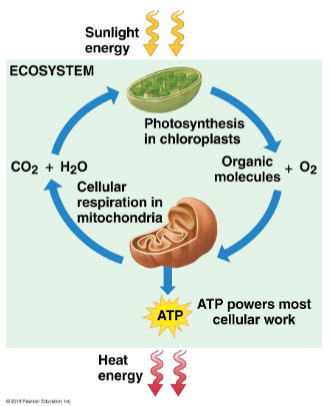
Photosynthesis and cellular respiration work together to provide energy to all living organisms
Exergonic reaction
Reaction that produces or releases energy. For example, chemical energy stored in glucose is released as ATP and heat

How much ATP does your body use?
Life sustaining activities: 75% of your energy
The brain uses 20% of your daily energy
Life sustaining activities use 1300-1800 C per day
Basal metabolic rate (BMR)
Voluntary activities: 25% of your energy
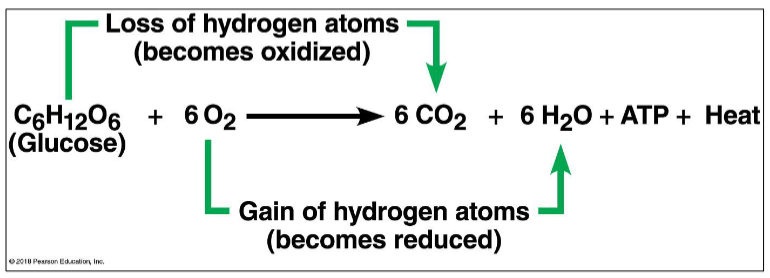
Redox reactions
The transfer of electrons form one reactant to another
Oxidation
The loss of electrons
Reduction
The gain of electrons
Redox Reaction in Cellular Respiration
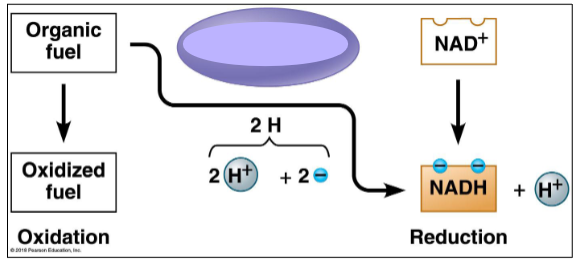
Nicotinamide adenine dinucleotide (NAD+)
A coenzyme made from the vitamin niacin
Shuttles electrons in redox reactions
Accepts electrons to become reduced to NADH
Dehydrogenase
Enzyme that oxidizes the organic fuel molecule
Strips two H atoms from the fuel molecule
Transfers two electrons and one proton to the NAD+ molecule to make NADH, and releases the second proton
Electron Transport Chain (ETC)
NADH delivers the electrons to a series of carrier molecules
Final electron acceptor in cellular respiration is oxygen
Reduces O2 to H2O
The molecules are mostly embedded in the inner mitochondrial membrane
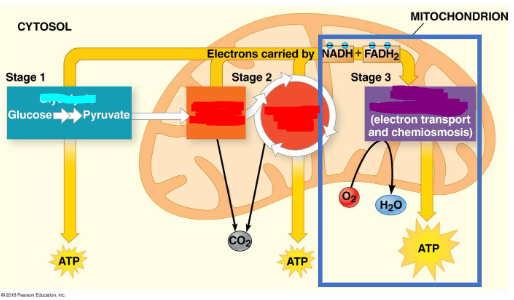
Stages of Cellular Respiration
Each stage is a series of chemical reactions and each stage takes place in a different region of the cell.
Glycolysis
Pyruvate oxidation and the citric acid cycle
Oxidative phosphorylation
Substrate Level Phosphorylation
The process by which ATP is produced in glycolysis and the citric acid cycle. A phosphate group is transferred from the substrate to ADP to form ATP
Stage 1: Glycolysis
Takes place int he cytosol
Breaks glucose into two molecules of pyruvate
9 chemical steps (product of one reaction is reactant for the next, different enzyme each time)
Two molecules of NAD+ are reduced to two molecules of NADH
Net gain of 2 molecules of ATP (2 ATP are used, 4 ATP are produced)
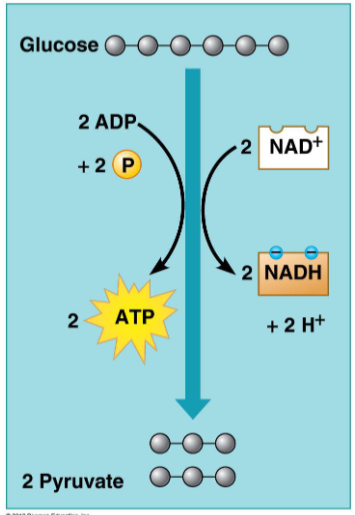
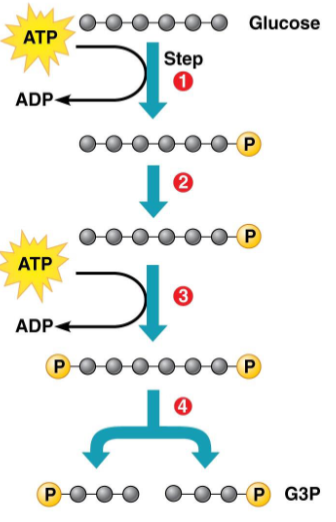
Energy Investment Phase
First part of glycolsis
Consumes energy to energize the glucose molecule in order to split it into two G3P molecules
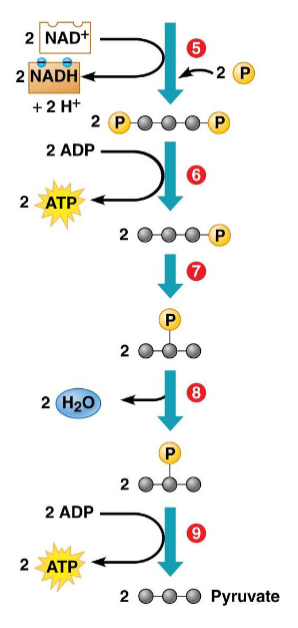
Energy Payoff Phase
Second part of glycolsis
Energy is produced (4 ATP molecules, 2 NADH molecules)
Final product is two molecules of pyruvate
Energy Production of Glycolisis
No O2 used (anaerobic reaction)
2 net ATP and 2 NADH, about 6% of energy a cell can harvest from a glucose molecule
Glycolysis is an Ancient Process
The universal energy harvesting process of life
Because its is so widespread in life, glycolysis likely evolved very early in the history of life
Location of glycolysis in the cell also suggests antiquity
Occurs in the cytosol and does not require membrane-bound organelles
Does not require oxygen
Used long before there was oxygen in the atmosphere
Stage 2: Pyruvate Oxidation and the Citric Acid Cycle
Pyruvate is transported into the mitochondria. Part of this stage uses oxygen so it is aerobic.
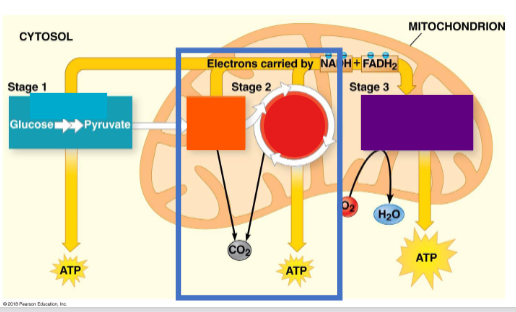
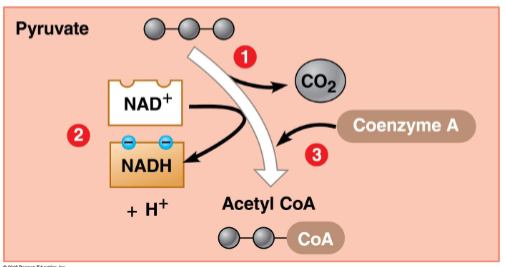
Pyruvate Oxidation
Pyruvate is oxidized to a 2-carbon compound
Carboxyl group is removed from pyruvate and released as C02
The 2 carbon molecule is oxidized to reduce NAD+ to NADH
Coenzyme A (CoA) is added to the two carbon molecule (CoA is derived from vitamin B)
Final products: Acetyle CoA and 2 NADH
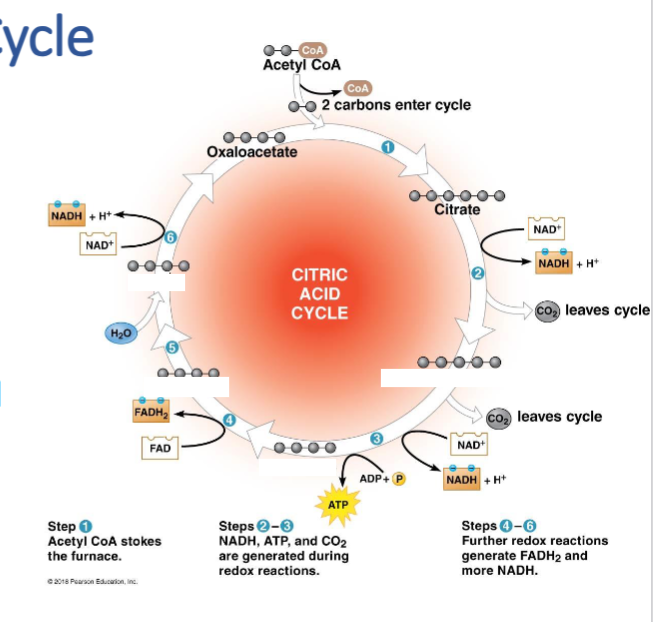
Citric Acid Cycle/Krebs cycle/TCA cycle
Each step is catalyzed by a different molecule in the mitochondrial matrix or the inner mitochondrial membrane
Acetyl CoA is combined with oxaloacetate to make citrate
Redox reactions remove two carbon atoms and releases them as CO2
Oxaloacetate is regenerated
Output per acetyle CoA (double per glucose):
2 CO2
3 NADH
1 FADH
1 ATP
Energy Storage Molecules
A small amount of energy is produced through glycolysis and citric acid cycle
Most of the energy from glucose is stored as NADH and FADH2
High energy electrons must be shuttled through an electron chain
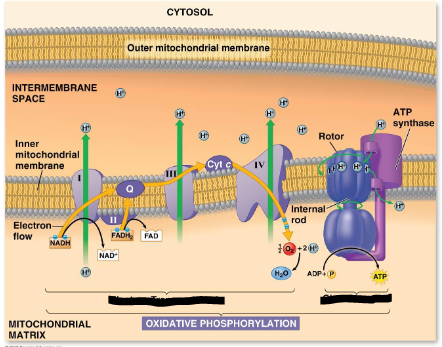
Stage 3: Oxidative Phosphorylation
Energy captured by the NADH and FADH2 molecules is used to phosphorylation ADP to ATP
Takes place in the mitochondria
Two parts: electron transport chain and chemiosmosis
90% of the ATP of cellular respiration is produced
Electron Transport Chain
NADH and FADH2 shuttle electrons to this
H+ ions are pumped across the inner mitochondrial membrane into the intermembrane space
Active transport that results in an H+ concentration gradient that holds lots of potential energy
Terminal electron accepter is O2 which is reduced to H2O
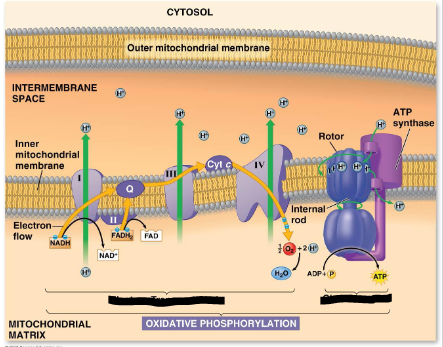
Chemiosmosis
The potential energy of the H+ concentration gradient is used to make ATP
H+ atoms are driven back down to their concentration gradient through the enzyme complex ATP synthase
Phosphorylates ADP to ATP
Fermentation
The process of harvesting energy from organic matter without using oxygen as a terminal electron acceptor.
Does not use oxygen so it is anaerobic respiration
Harvests energy for the cell using glycolysis
Enough energy for your muscles to contract for a short amount of time when starved of oxygen
Many microorganisms use this to supply all their needs
NAD+ Regeneration
Aerobic cellular respiration:
NAD+ is regenerated when NADH passes its electrons through the electron transport chain during oxidative phosphorylation
Anaerobic fermentation:
Oxidative phosphorylation does not take place because there is no oxygen
A different anaerobic path is needed to regenerate NAD+
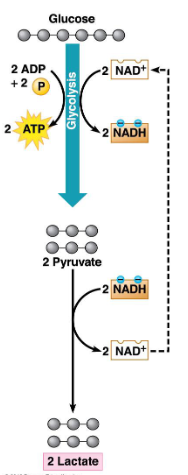
Latic Acid Fermentation
Done by animal muscle cells and some bacteria
Pyruvate is reduced to lactate, allowing 2 NADH to be oxidized to 2 NAD+
Examples:
In muscle cells this occurs when the need for ATP outpaces the delivery of oxygen
Liver cells oxidize lactate back to pyruvate
Bacterial lactic acid fermentation makes cheese and yogurt
Lactic acid bacteria turn soybeans into soy sauce and cabbage into sauerkraut
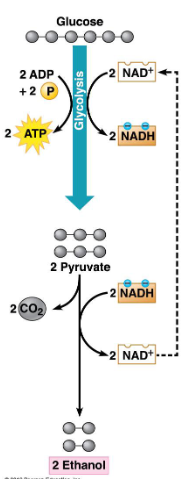
Alcohol Fermentation
Yeasts and some bacteria reduce pyruvate to ethanol and CO2 while oxidizing NADH to NAD+
Examples:
Ethanol used in alcoholic beverages (brewing, winemaking) since CO2 causes the the bubbles
CO2 causes bread dough to rise
Yeasts and respiration
Single celled fungi
Normally use aerobic cellular respiration to process their food
Also able to survive in anaerobic conditions by using alcohol fermentation
Anaerobes
Organisms that can live in anaerobic conditions
Obligate anaerobes
Require anaerobic conditions, are poisoned by oxygen
Facultative anaerobes
Can live in anaerobic or aerobic conditions
Will make ATP by either fermentation or oxidative phosphorylation depending on whether or not O2 is available
The organism always takes the available route that produces the most energy
Photosynthesis
Solar energy is used to convert CO2 and H2O into sugars and O2
Used by plants and some microorganisms
In some prokaryotes photosynthesis is not linked to carbon fixation
Carbon Fixation
Process by which living organisms convert inorganic, atmospheric carbon dioxide CO2 into organic compounds which are reduced to form sugars that can be used for energy and biological growth
Autotrophs
“Self-feeders”. Organisms that make their own food. The ultimate source of organic molecules for almost all life on earth (take in inorganic material and turn into organic)
Photoautotrophs
Autotrophs that use energy from light. Primary producers of the biosphere
Heterotrophs
The consumers of the biosphere
Cannot make their own food
Consume plants or animals, or decompose organic material
Dependant on photoautotrophs for oxygen and for organic fuel to maintain life
Chlorophyll
A light absorbing pigment in the chloroplasts. Causes the green colouring in plants.
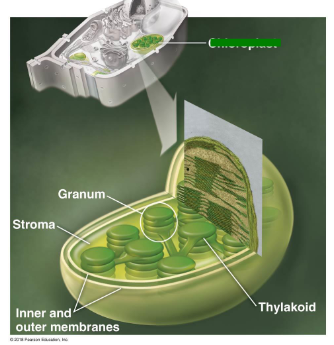
Chloroplasts
Specialized organelles found in plant cells and eukaryotic algae that convert sunlight into chemical energy through photosynthesis. Most concentrated in the leaves.
Leaf Structure
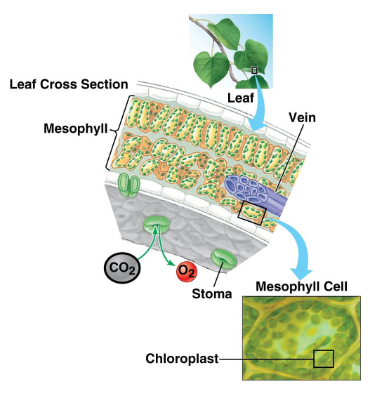
Chloroplasts are concentrated in mesophyll cells. Each mesophyll cell has 30-40 chloroplast
Also contains stomata and veins
Stomata
Pores that allow CO2 to enter the leaf and O2 to exit the leaf
Veins
Deliver water, minerals, sugars to all parts of the plant
Chloroplasts Structure
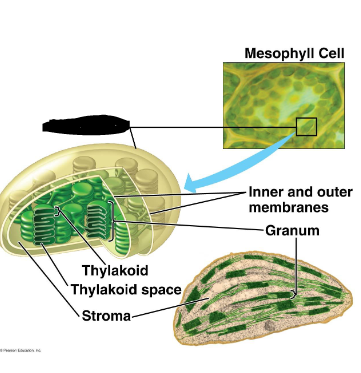
Photosynthetic enzymes and chlorophyll are embedded in the thylakoid membranes
Sugars are manufactured in the stroma
Chlorophyll a
A pigment that absorbs blue-violent and red light. Participates directly in the light reactions of photosynthesis
Chlorophyll b
Absorbs blue and orange light. Transfers energy to chlorophyll a
Carotenoids
Pigments that reflect shades of yellow and orange
More stable than chlorophyll
Broaden the spectrum of colours that can drive photosynthesis
Pass their energy to chlorophyll
Photoprotection
Protection from excessive light energy
Some carotenoids capture and dissipate excessive light energy that would otherwise damage the cells
Light energy can damage chlorophyll or react badly with it to damage other cellular components
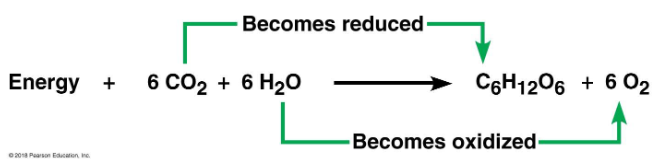
Photosynthesis is a Redox Reaction
The opposite of cellular respiration
Potential energy of the electrons increases as they move from H2O to CO2
Energy from sunlight gives the electrons this energy boost
Stages of Photosynthesis
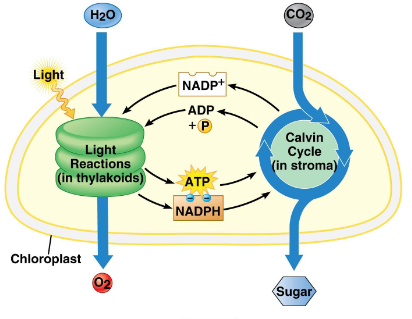
Light reactions:
In the thylakoids
The capture of light energy
Calvin Cycle
In the stroma
Carbon fixation
Stage 1: Light Reactions
Light energy is absorbed by chlorophyll
H2O is split to release O2
Electrons are transferred from H2O to NADP+ to reduce it to NADPH
ATP is produced
Capturing Solar Energy
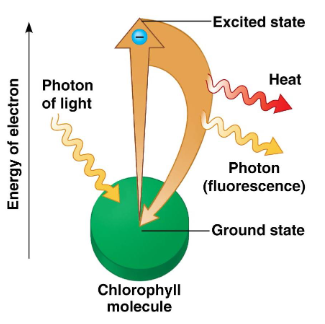
When a pigment molecule absorbs a photon, an electron jumps to an energy level farther from the nucleus
Raised from a stable ground state to an unstable excited state
The excited electron drops back down to its ground state and releases energy in the form of heat and sometimes light (fluorescence)
Photosystems
Two complexes:
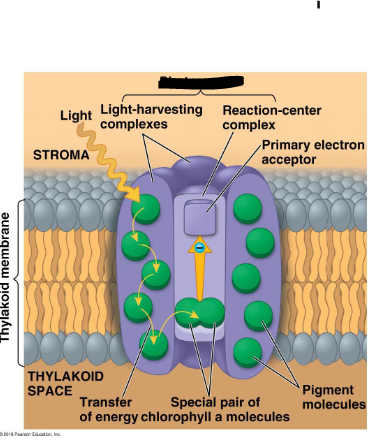
Reaction centre surrounded by light harvesting complexes
When a pigment molecule in the light harvesting complex absorbs a photon the energy is passed from molecule to molecule
The energy will finally be passed to the reaction centre complex
Light-harvesting complex
Pigment molecules bound to proteins
Harvests light from a wide range of different wavelengths
Large numbers of pigment molecules allows for efficient light harvesting
Reaction Centre
A pair of specialized chlorophyll a molecules bound to proteins
Contains the primary electron acceptor
When an electron in the reaction centre chlorophyll molecule is boosted to an excited state it is captured by the primary electron acceptor
Two Photosystems
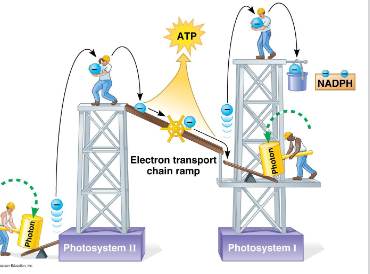
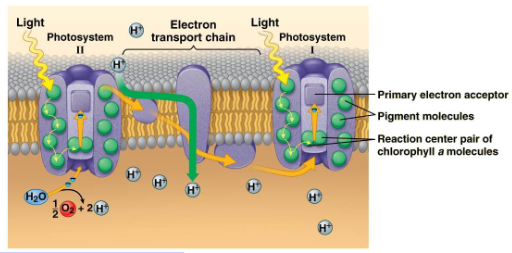
Photosystem II and photosystem I are coupled together by an electron transport chain (ETC)
A photon excites an electron in the photosystem II pigment, the energy is passed to the primary electron acceptor, and moves down an ETC to produce ATP
Another photon excites an electron in photosystem I pigments, the energy is passed to a primary electron acceptor and NADPH is formed
Light Reactions Step 1
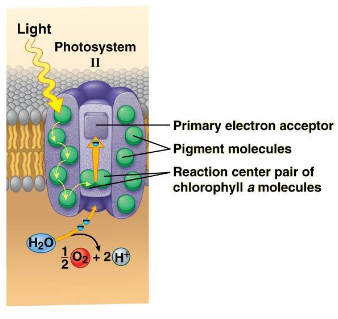
Water is split into one oxygen atom (O), two hydrogen ions (H+) and two electrons
O joins with another O to form O2 which is released from the cell
Electrons are passed to the reaction centre chlorophyll a
Replaces the electrons that was passed from chlorophyll to the primary electron accepter
H+ stays in the thylakoid space to build up a concentration gradient
Light Reactions Step 2
Electrons pass through an ETC
Terminal electron acceptor is the photosystem I reaction centre chlorophyll a to replace the electrons that were passed to the primary electron acceptor
Light Reactions Step 3
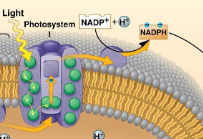
After photosystem I there is another short electron transport chain
Electrons are passed to NADP+ to reduce it to NADPH
Light Reaction Step 4
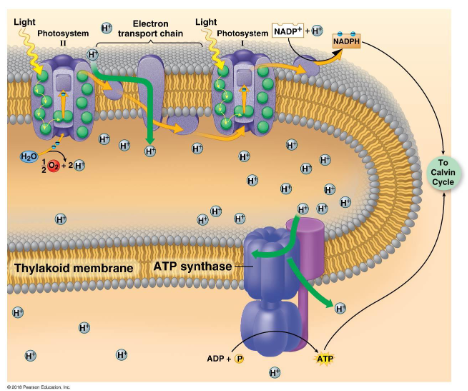
Chemiosmosis produces ATP
H+ gradient formed by the ETC between photosystems and the splitting of water
H+ is pumped through ATP synthase to phosphorylate ADP to ATP
Redox reaction of the Calvin Cycle
Reactants:
CO2 from the air
ATP and NADPH from the light reactions
Products:
Glyceraldehyde-3-phosphate (G3P), used by the cell to make glucose, sucrose, and other organic molecules
Stage 2: Calvin Cycle/Dark reactions/Light-independent reactions
4 main steps
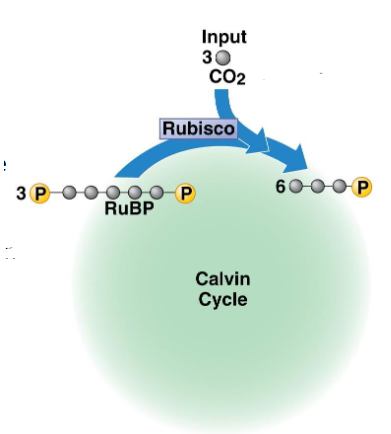
Starting material: 5-carbon sugar called ribulose bisphosphate (RuBP)
The cycle turns three times to generate one molecule of glyceraldhyde-3-phosphate (G3P)
Each turn incorporates one CO2 molecule. Three turns incorporates three C atoms
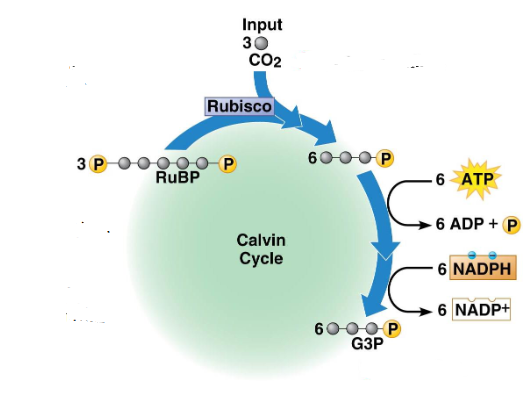
Calvin Cycle Step 1 - Carbon Fixation
CO2 is attached to RuBP
Done using enzyme rubisco
The resulting 6-carbon molecule is unstable so it immediately splits into two 3-carbon molecules
Calvin Cycle Step 2 - Reduction
NADPH and ATP are used to reduce the 3-carbon molecule to G3P
NADPH provides the electrons for reduction
ATP provides energy for the process to take place
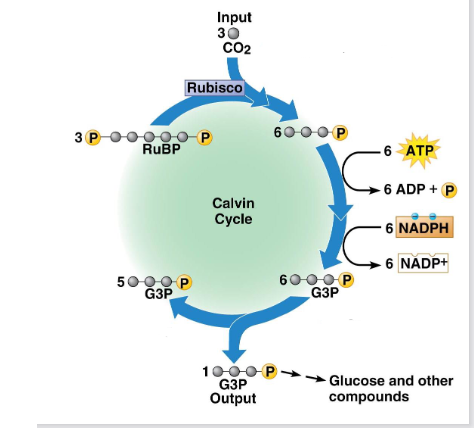
Calvin Cycle Step 3 - Release of G3P
For every 3 CO2 molecules fixed, one G3P molecule is released as a product
Calvin Cycle Step 4 - Regeneration of RuBP
Five GSP molecules are rearranged to make RuBP using energy from ATP
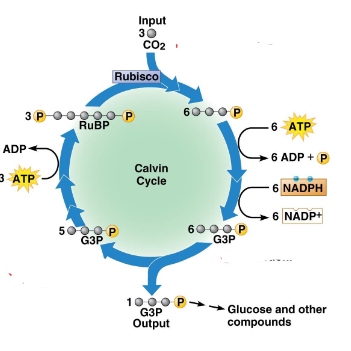
Energy Input of Calvin Cycle
The cycle turns three times
3 CO2 molecules enter the cycle combining with 3 RuBP molecules
Makes 6 G3P molecules (one is released)
5 G3P molecules (15 carbon atoms total) rearrange to make 3 RuBP molecules (15 carbon atoms total)
Synthesis of one G3P molecule
Uses 9 ATP
Uses 6 NADPH
ATP and NADPH were provided by the light reactions
G3P can be used to construct glucose
Energy storage
Cellular respiration releases the energy stored in glucose
C3 Plants
Standard plants that use CO2 directly from the air and use rubisco to add CO2 to RuBP. Includes many important agricultural crops
Problem: Hot, dry weather decreases crop yield.
Plants close their stomata to reduce water loss through evaporation
CO2 cannot enter the leaf, so concentrations decrease
O2 cannot exit the leaf so concentrations increase, resulting in photorespiration
Photorespiration
Reaction that occurs in the light and consumes O2 to release CO2
O2 levels build up in the plant
Rubisco adds O2 to RuBP instead of adding CO2
Rubisco is “sloppy” enzyme
Results in a 2-carbon product instead of G3P
Uses ATP and NADPH without yielding any sugar
C4 Plants
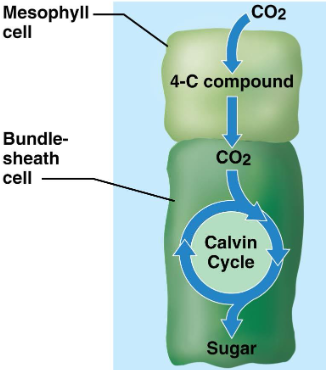
Avoid photorespiration by splitting the mesophyll cell into two cells
New mesophyll cells have an enzyme with a very high affinity for CO2
Fixes CO2 into a 4-carbon intermediate compound, even when its concentration is very low
The 4-carbon molecule shuttles the CO2 to the bundle-sheath cells that perform the Calvin Cycle
Includes sugarcane and corn
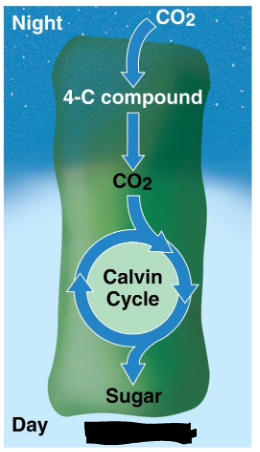
CAM Plants
These plants are adaptive to very dry climates (pineapples, cacti, succulents, etc)
Converse water by only opening its stomata at night
CO2 is fixed into a 4-carbon molecule in the mesophyll cell which stores the carbon at night to be used during the day
During the day that CO2 is released into the cell so that the Calvin Cycle can proceed