3.1 — Reasons for Government Intervention in Markets
 Call Kai
 Learn
Learn Practice Test
 Spaced Repetition
 Match
Match Flashcards
 Knowt Play
1/42

There's no tags or description
Looks like no tags are added yet.
Name | Mastery | Learn | Test | Matching | Spaced | Call with Kai |
|---|
No analytics yet
Send a link to your students to track their progress
43 Terms
Why do governments intervene at all (3 spec points + 4 bullet points)
Government intervenes to:
• Improve allocative efficiency
• Correct external costs/benefits
• Improve equity (fairness)
• Protect consumers

What is market failure
When the free market fails to allocate resources efficiently, leading to a loss of social welfare.
- When the free market does not make the best use of scarce resources
- An inefficient allocation of goods and services in the market
- Occurs when the price mechanism fails to take into account all of the costs and benefits that are necessary to produce or consume a product
What are the main 4 situations in which market failure occurs and needs government intervention
Lack of public goods
2. Underproduction of merit goods
3. Overconsumption of demerit goods
4. Information failure
Key concept link:
What is allocative efficiency
When resources are allocated to produce the goods and services most desired by society, where price equals marginal social cost.
What is a public good + examples
A good that is both non-rival and non-excludable. - consumed collectively
- E.g. police force, national defence, fire protection, street lights, flood control systems etc.
What is non-rivalry
When one person’s consumption of a good does not reduce its availability to others.
What is non-excludability
When it is impossible or very difficult to prevent non-payers from consuming a good.
What is the free rider problem
When individuals benefit from a good without paying for it, reducing incentives for private provision.
Why are public goods under-provided by the free market
Because firms cannot exclude non-payers, cannot charge a price, and therefore there is no opportunity to make a profit.
Why does the free rider problem cause market failure
It leads to under-provision or zero provision of public goods despite social benefit.
- When left to the free market, public goods would not be provided despite the benefits they give to those who consume
How does the government address the non-provision of public goods + one issue with this
By directly providing and funding them through taxation.
- Issue = the opportunity cost as the funding for public goods is competing with other types of government spending (often in countries with a moderate tax rate)
What is a merit good
A good that generates positive externalities and is under-consumed in a free market.
What is an example of a merit good + why
Education, healthcare, vaccinations, or public transport.
- Considered by the government as desirable for economic growth and development
What are positive externalities
External benefits enjoyed by third parties when a good is consumed or produced.
Why are merit goods under-consumed
Because consumers only consider private benefits and ignore external benefits.
information failure on the part of consumers
How does imperfect information affect merit goods
Consumers underestimate long-term benefits, reducing consumption below the socially optimal level.
What is the main problem with the provision of merit goods
When provided by the private sector, the quantity supplied is less than what is required.
- Access is restricted by those who can afford to pay
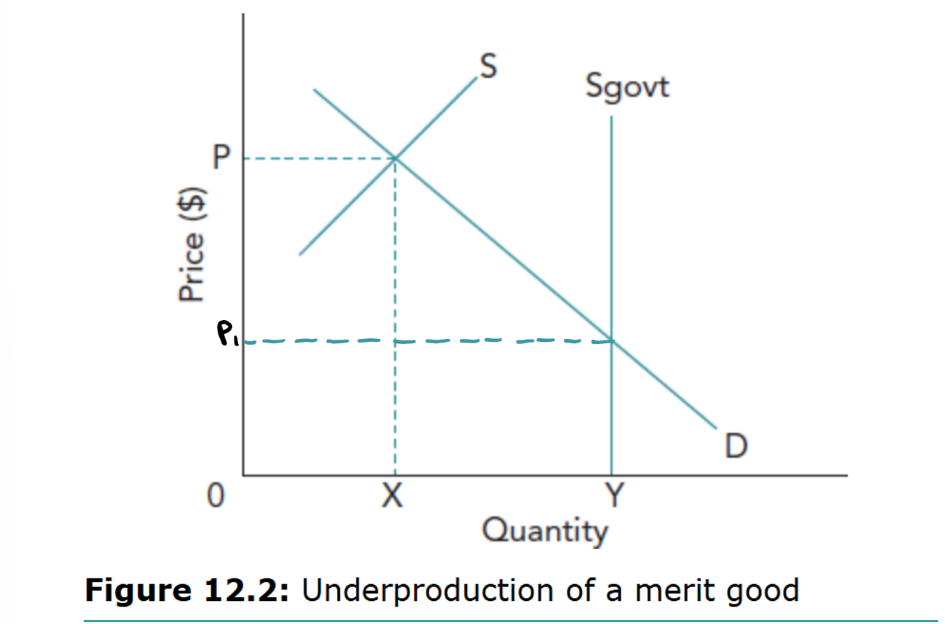
Using a diagram, explain the underproduction of a merit good and how governments fix it (5).
When a merit good is left to the private market, supply occurs at OX, where the private supply curve S meets demand D, giving price P.
- However, the socially desired output is OY, shown by the government’s vertical supply line Sgovt.
- Because OY > OX, the market underproduces the merit good by OY – OX.
- Government can correct this by either producing the full amount OY itself or subsidising/providing the additional quantity (OY – OX) so total output meets society’s needs.
- This lowers the price to P1 where those who were unable to pay can now pay/consume
Why does under-consumption of merit goods cause market failure
Because social benefit exceeds private benefit, leading to allocative inefficiency.
How can the government increase consumption of merit goods (4)
Through subsidies, free provision, compulsory consumption, or information campaigns.
What is a demerit good + easy example
A good that generates negative externalities and is over-consumed in a free market.
- Undesirable for consumers and tend to be overprovided
- E.g. cigarettes and tobacco
What are negative externalities
External costs imposed on third parties when a good is consumed or produced.
Why are demerit goods over-consumed
Consumers underestimate long-term costs and ignore external costs.
- Also invariably lack full and proper information
How does imperfect information affect demerit goods
Consumers are unaware of or underestimate harmful effects.
What role does addiction play in demerit goods consumption
It leads to irrational decision-making and over-consumption.
What is an example of a demerit good (4)
Cigarettes, alcohol, drugs, or gambling.
Why does over-consumption of demerit goods cause market failure
Because social cost exceeds private cost, leading to allocative inefficiency.
How can the government reduce consumption of demerit goods (5)
Through indirect taxes, regulation, age restrictions, bans, or information provision.
Give an example of government intervention to address the overconsumption of demerit goods + why (its effect).
In many countries, regulations banning smoking in public places have been introduced, as well as manufacturers being required to put written warnings and graphic photographs on packaging explaining the dangers of smoking.
- Reason being to protect the health and well-being of the population + promote a more productive workforce + make savings in the healthcare budget (fewer patients with smoking-related complaints)
What is a maximum price
A legal upper limit set by the government on the price of a good or service.
- Sellers of the good cannot sell it legally at any price above the price ceiling
Why might a government impose a maximum price (2)
To make essential goods more affordable and protect consumers (especially those on low incomes).
For a maximum price to be effective must it be set above or below the equilibrium price + why
To be effective the maximum price must be set below the equilibrium price because otherwise it won't lower the price.
What happens if a maximum price is set below equilibrium
Excess demand occurs as quantity demanded exceeds quantity supplied.
What problems can arise from maximum prices (4)
Shortages, black markets, reduced quality, and reduced supply.
What is a minimum price
A legal lower limit below which a price cannot fall.
Why might a government impose a minimum price (2)
To protect producer incomes or discourage consumption.
What happens if a minimum price is set above equilibrium
Excess supply occurs as quantity supplied exceeds quantity demanded.
What problems can arise from minimum prices (4)
Surpluses, waste, government stockpiling, and higher costs.
Explain the reason and effect of implementing maximum prices on housing (rent controls) (3)
- Rent controls keep housing affordable for low‑income families by setting rents below market levels.
- They can also attract key workers to high‑cost areas by reducing accommodation expenses.
- However, while they increase affordability, they may worsen shortages because landlords earn less and may supply fewer rental properties.
Explain the reason and effect of implementing minimum prices in agriculture. (3)
- Governments set minimum prices for key crops (e.g., wheat, rice) to keep prices above equilibrium, stabilising farmers’ incomes despite unpredictable harvests.
- This protects domestic food security by ensuring future supplies.
- But consumers face higher prices, less is traded, and resources may be used inefficiently because production is supported even when demand falls.
Why can price controls lead to government failure
They may distort market signals and reduce allocative efficiency.
What is government failure
When government intervention leads to a worse outcome than leaving the market alone.