5 - Crime, Conflict and spatial disparities
 Call Kai
 Learn
Learn Practice Test
 Spaced Repetition
 Match
Match Flashcards
 Knowt Play
1/16

There's no tags or description
Looks like no tags are added yet.
Name | Mastery | Learn | Test | Matching | Spaced | Call with Kai |
|---|
No analytics yet
Send a link to your students to track their progress
17 Terms
What are the two theory in relation of crime
Expected utility theory - Individuals weigh benefits against costs of crime - Italian bank robberies 2005-07 discouraged criminals with bigger sentences
Prospect theory - Offenders misperceive probabilities - should increase detection rather than sentencing - London riots (2011) harsher sentencing deterred certain crimes but shifted others
Whats the Becker model of crime
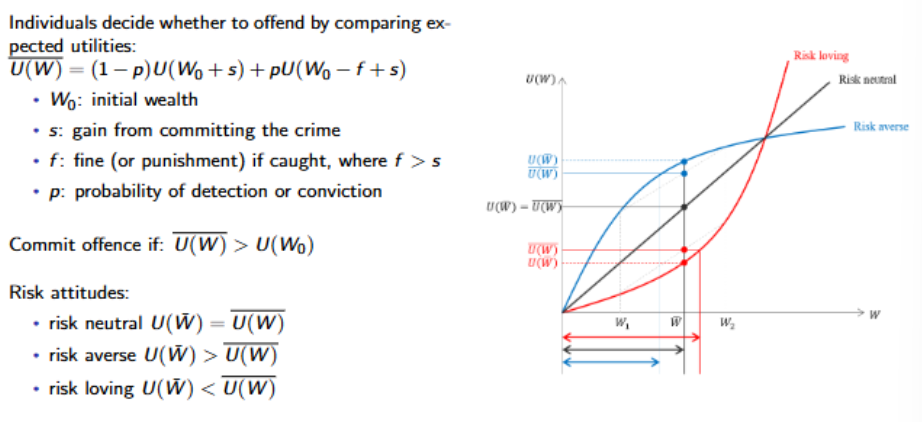
The becker model attempts to explain the rationality of crime by saying expected utility of crime > expected utility of not offending then crime will occur
probability of conviction and severity of conviction determine crime rate
What is the expected utility of the becker model of crime
pU(W1) + (1 − p)U(W2)
• where p is probability of conviction, W1 is wealth after penalty, W2 is wealth without conviction.
Draw a diagram and explain the becker model of crime
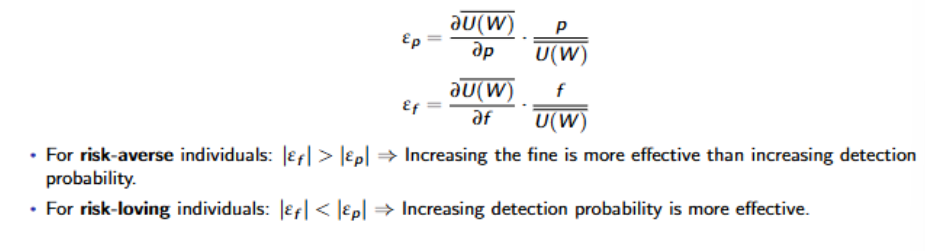
What are the two levers for policy makers and what are the elasticities of offending
Severity of punishment
Detection
How is the prospect theory different to the becker model
Takes into account peoples situation - more desperate more likely to commit crime no matter the punishment
Relative to current income or a reference point
Perceived possibilities - more sensitive to loss
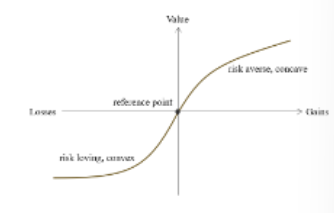
Draw the prospect theory diagram and explain it
Concave for gains - risk averse when things are going to plan
Convex for losses - risk seeking when things are going bad
Steeper for losses than for gains
When below reference point - current income more willing to take risks
Summarise the prospect theory
Offenders more sensitive to detection probability than punishment severity
Certainty matters more than severity
Immediate automatic fines/ punishment matters more than a delayed court outcome for example
Income stability and employment prospects
Explain civil war onset in relation to income
Negatively correlated with income per capita
Opportunity cost lower of joining war as low wage
Weak fiscal and institutions means limited control
Is ethnicity differences cause for civil war
Maybe not but it is a coordination device to unite behind
Polarisation maybe a better explanation - group structure + grievances and opportunity
Main policy approaches to stabilisation
Peace building and state capacity: invest in institutions, policing and fiscal systems to restore governance
Education and jobs - higher opp cost
Security sector reform - policing
Aid conditionality and coordination
How can regional disparities be overcome`
Better transport - allows access to better jobs (Connecting capital and ideas)
What are agglomeration forces
Where workers and firms cluster to share knowledge, suppliers and markets
What are the positive externalities and dispersion forces to do with agglomeration
positive externalities include productivity gains from knowledge spillovers, labour market pooling (Skills matching), shared infrastructure and services
Increasing congestion due to commuting and transport friction costs, rising land and rent costs, lower trade and commute costs shift activity towards more accessible places
Why is spatial disparities a problem
Underutilisation of human capital and infrastructure in lagging areas
Can lead to inequality and discontent
Lagging areas will be trapped in low productivity outcomes
Can be solved by improved transport
Whats an example of this
The big sort - london and south east - high productivity
North Wales and north east lag behind
Due to skilled workers moving to high productivity areas from the lagging areas
What drives spatial sorting
Average ability in north falls if high skill move and low skill remain
No locational penalty - northerners earn same wage as southerners in the south