Biomechanics WK 3- DPT
 Call Kai
 Learn
Learn Practice Test
 Spaced Repetition
 Match
Match Flashcards
 Knowt Play
1/67

There's no tags or description
Looks like no tags are added yet.
Name | Mastery | Learn | Test | Matching | Spaced | Call with Kai |
|---|
No analytics yet
Send a link to your students to track their progress
68 Terms
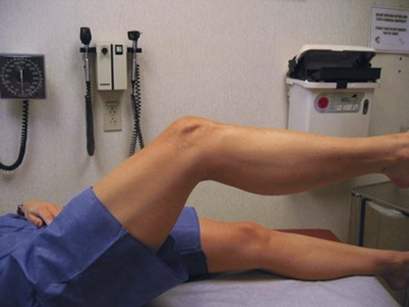
The picture below represents a patient attempting to perform a straight leg raise. This patient has some quadriceps weakness and is unable to maintain the knee in an extended position while performing the straight leg raise. Fully extending the knee through terminal knee extension places large demands on the quadriceps. This inability to maintain the knee in full extension during a straight leg raise is known as:
extensor or quadriceps lag
There are several 2 joint muscles that cross both the hip and the knee joint. Which of the following is NOT a two joint muscle that can move both the hip and the knee:
biceps femoris short head
This 2 joint muscle can flex the hip AND flex the knee:
sartorius
what are medial rotators of the knee:
semimembranosus, sartorius, popliteus
what are the 3 muscles of pes anserine
sartorius, gracilis, semitendinosus
what are functions of the menisci of the knee:
dissipate pressure of the femoral condyles on the tibial plateau
deepen the concavity of the tibial plateaus
improve the congruity between the femoral condyles and the tibial plateau
This part of the meniscus is considered to have the most abundant blood supply and because of that is sometimes referred to as the red-red zone. Tears in this area of the meniscus are often surgically repaired because of the potential for these tears to heal:
outer third
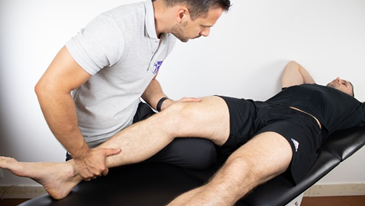
A valgus force at the knee (a force applied to the lateral aspect of the knee and directed medially, abducting the tibia on the femur as pictured below) will most stress which of the following ligaments:
medial or tibial collateral ligament
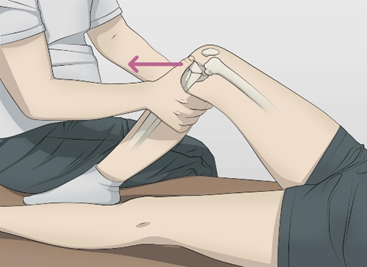
An anterior drawer test (attempting to pull the tibia anteriorly on the femur as pictured below) will most stress which of the following ligaments:
anterior cruciate ligament
The concave-convex rule dictates the pattern of rolling and gliding that occurs at a joint. Which of the following statements best describes the arthrokinematics that occur with OPEN chain knee extension (tibia moving on femur):
tibia rolls and glides anteriorly on the femur
Which of the following statements best describes the arthrokinematics that occur with CLOSED chain knee extension (femur moving on tibia)
femur rolls anteriorly and glides posteriorly
At the end of CLOSED chain knee extension, some rotation occurs to put the knee in the screw home position. Which bone rotates and in which direction to create the screw home position in CLOSED chain knee extension:
femur internally rotates
Unlocking the knee or moving it out of the screw home position is a necessary first step to allow knee flexion to occur. Which muscle is primarily responsible for the rotation that occurs to unlock the knee and to allow knee flexion to take place:
popliteus
The quadriceps angle or Q angle is an angle that measures the lateral pull of the quadriceps muscle. It is the angle between a line connecting the mid patella and the ASIS and a line connecting:
the mid patella to the tibial tuberosity
An increased Q angle does not correlate with patello-femoral pain. However, an increased dynamic Q angle does correlate with patello-femoral pain. During a single leg squat, what would you observe to indicate an increased dynamic Q angle:
the knee would move medially creating an increased angle of knee valgus
In which of the following muscles, would you expect the highest innervation ratio:
gluteus maximus
A muscle will produce the greatest force when it is held at what percentage of its resting length:
110% stretched slightly
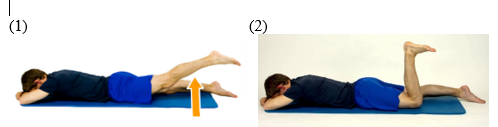
Your patient is lying prone and fully extends his hip (1). He then flexes his knee and tries again to extend his hip but cannot extend his hip as far (2). This lack of hip extension occurs because the hamstrings cannot shorten enough to move the hip through full range with the knee flexed. The hamstrings lack the functional excursion to move all the joints over which they pass through the full range of motion. The hamstrings are experiencing:
active insufficiency
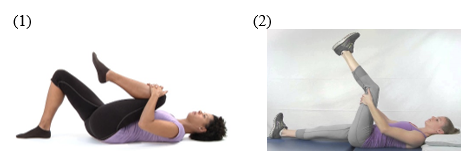
Your patient is lying supine and flexes her knee and hip bringing her knee to her chest (1). She then extends her knee and again tries to flex her hip as far as possible but cannot flex her hip as far (2). In this case, the hamstrings are experiencing:
passive insufficiency
What terms would you use to describe the fiber arrangement of the rectus femoris.
Would it be 1) parallel or oblique and 2) what type of fiber arrangement:
1) oblique, 2) bipennate
2 joint muscle- works at hip and knee
rectus femoris
all vasti only work at what joint
knee
deepest vastus
vastus intermedius
what muscle is an accessory extensor and keeps the capsule out of the way during flex/ext
articularis genu
what are the primary knee extensors
rectus femoris, vastus lateralis, vastus medialis, vastus intermedius
what compartment are the knee extensors a part of
anterior compartment
which vastus tends to atrophy more quickly with disuse or immobilization
vastus medialis
which muscle becomes actively insufficient with hip flexion greater than 90° and knee extension
rectus femoris
secondary knee extensors
articularis genu and TFL
knee extension limited by:
posterior capsule
arcuate and oblique popliteal ligaments
hamstring tightness
tight collateral ligaments
what compartment are the knee extensors
posterior compartment
what muscles are the primary knee flexors
semitendinosus, semimembranosus, biceps femoris (long head)
biceps femoris (short head)
popliteus
flexion limited by:
soft tissue approximation
cruciates
anterior tibial collateral ligament
quadriceps tightness
gluteus maximus is what part of the “delt of the hip”
posterior delt, extends and ER hip
gluteus medius is what part of the “delt of the hip”
middle delt, abduct hip
TFL is what part of the “delt of the hip”
anterior delt, flexion and IR hip
tibia has more rotation in which direction (medial or lateral)
lateral rotation
external rotation limited by:
cruciates
medial capsule including tibial collateral ligament
pes anserine tightness
internal rotation limited by:
cruciates
lateral capsule
biceps femoris tightness
degrees of flexion needed for normal walking
40-60°
what type of joint is the knee
diarthrosis
what type of diarthrosis is the knee
biaxial, condyloid
how many axes and degrees of freedom does the knee have
2
what axes does the knee pass through
flex/ext axis and rotation axis
tibio-femoral joint LPP
25° flexion
tibio-femoral joint CPP
full extension and lateral rotation of the tibia (screw-home)
degrees of flexion in the knee
0-135° full flexion
tibia moves on femur in which chain movement
open chain
femur moves on tibia in which chain movement
closed chain
external and internal rotation of the tibia is what movement
spin
purpose of patella
improve mechanical advantage of quads
dissipates compressive forces exerted by quads
patella glides what direction as the knee extends
superiorly
patella helps most at what degree of flexion
45°
what open chain movement is bad for patello-femoral pain
TKE and SAQ
what closed chain movement reduces pain and uses more quads
TKE
least to greatest patellar loading activities
walking, climbing stairs, descending stairs, squatting
squats are closed chain knee flexion that is ____ for patello-femoral pain
bad
open chain knee flexion lessens the load and should stay in what degrees
90° —> 45°
not TKE!!
Q angle normals for men and women
men: 8-14°
women: 11-20°
larger Q angle will pull patella which way
laterally
is static or dynamic Q angle predictive of patello-femoral problems
dynamic
exercises for patello-femoral pain syndrome
TKE
open chain 90°- 45°
strengthen abduction and ER
what is innervation ratio
how many muscles fibers are in one motor unit
low innervation ratio examples
fine controlled contraction
fingers, eyes
high innervation ratio examples
quads, back, glute max
factors influencing muscle force production
motor unit recruitment
fiber arrangement
cross sectional area
muscle length
speed of muscle contraction
leverage temperature
fatigue
functional excursion
how far a muscle can go after being max elongated