Pre-Health Microbiology Chapter 20
 Call Kai
 Learn
Learn Practice Test
 Spaced Repetition
 Match
Match Flashcards
 Knowt Play
1/19

Earn XP
Description and Tags
Finals
Name | Mastery | Learn | Test | Matching | Spaced | Call with Kai |
|---|
No analytics yet
Send a link to your students to track their progress
20 Terms
What is classification?
Placing organisms in groups of related species, lists of characteristics of known organisms
What is identification?
Matching characteristics of an “unknown” organisms to lists of known organisms, clinical lab identification
Why take the time to identify an infectious agent?
Many bacteria are resistant to certain antibiotics and specific pathogens are associated with disease complications, so tracking the spread can lead to its source and prevention
What are problem-solving algorithms to identify bacteria?
Several tests at once to seep up identification by using step by step procedures and interpret results in a set sequence
What are the steps to problem-solving algorithms?
Isolate, create a pure culture, gram stain, and discover biochemical pathways/properties
What is restriction fragment length polymorphism (RFLP) analysis?
DNA is digested with restriction enzymes then run on a gel to observe the digestive patterns with fluorescent staining or radioactive probe to identify a specific gene or DNA sequence
What is polymerase chain reaction (PCR)?
A lab technique used to amplify a specific segment of DNA exponentially in vitro by performing denaturation, annealing, and elongation
Why is PCR the most widely used molecular method in the clinical lab?
DNA primers can be made for specific pathogens, so multiple sets of DNA primers can identify individual genes from a pathogen for more specific typing; useful for pathogens that are hard/slow to grow
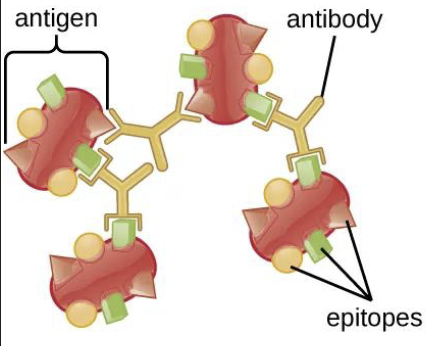
Polyclonal antibodies typically recognize…
Many different epitopes on the same antigen
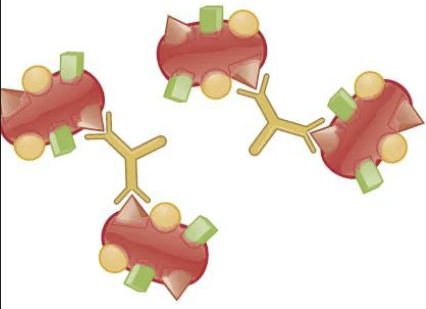
Monoclonal antibodies typically recognize…
One epitope
What is serotyping?
Used to identify and classify microorganisms based on the specific antigens present on their surface
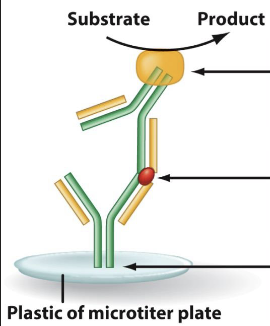
What does ELISA do? (enzyme-linked immunosorbent assay)
Detects antigens in a sample by capturing the conjugated antibody if an antigen is present and will yield a colored product
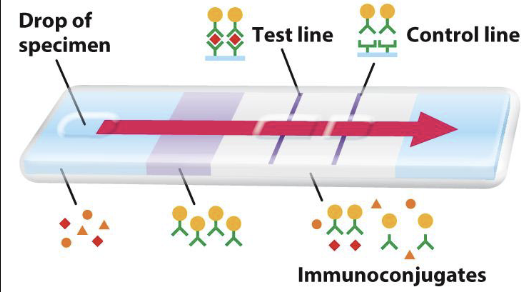
What are point of care lab tests (rapid antigen test)?
Used directly at the site of patient care, the result is obtained quickly in order to make appropriate treatment decisions; involve immunochromatographic assays (ICT)
What makes a good POC lab test?
High specificity and high sensitivity; important to make sure tests are accurate and reliable
What is sensitivity?
How small of a sample a test can detect
What is specificity?
How well a test can distinguish positives and negatives
What is a sample application?
A drop of specimen; if present, it contains C-ps antigen from S. pneumoniae (red diamonds)
What happens when labeled antibodies are binded?
The sample moves along the strip then meets gold-labeled antibodies and this antibodies bind specifically to the pneumococcal antigen —> antigen-antibody complex
What is the test line (detection zone)?
The complex reaches the line, which has fixed antibodies against the same antigen, then the complex gets captured here and gold particles accumulate visible colored lines
What is the control line (validity check)?
Excess labeled antibodies continue to the control line then bind to anti-rabbit IgG antibodies to form a line if working properly